RSNO. Sondergard, Williams: Beethoven, Mahler, Sibelius (Usher Hall: 21 April ’17)

Image result for Sibelius pictures

Jean Sibelius (1865-1957)

“Their playing of Sibelius’s Finlandia was one of the best, if not the best, I have ever heard, live or recorded. “

Editorial Rating: : 4 Stars: Nae Bad

One of the excitements of live music is that you never know quite how it is going to turn out on the night. You think you’ve got it at rehearsal, but performance is something different. Only a very few orchestras turn out a consistently really high standard, time after time.

After two years in Edinburgh I am becoming increasingly impressed by the quality of the local bands, and Friday’s concert contained some excellent playing in a well chosen, thoughtful programme that while relatively well supported was deserving of a larger audience. Clearly the Florida sun has sown benefits. It was a very good concert indeed.

The RSNO’s opening numbers are sometimes a little shaky before they get into their stride. Not so tonight. Their playing of Sibelius’s Finlandia was one of the best, if not the best, I have ever heard, live or recorded. The opening chords of the brass were well rounded and melodic whilst still conveying the angst of the Russian threat to the mother country in this highly nationalistic piece. Not a trace of blaring or vulgarity. The mournful strings provided a similarly well-rounded tone in what was a very well executed opening number, convincing and moving. Applause was loud and long. Deservedly.

It was a very interesting choice to follow with Mahler’s Der Knaben Wunderhorn, a less austere work than Kindertotenlieder, or, for example, Das Klagende Liede.   Five songs were selected from the original 24 settings, covering nature, folklore and soldiers’ tales. Baritone Roderick Williams gave a well-executed performance in which the orchestra again shone, but perhaps a little too brightly. There were issues of balance between soloist and orchestra and one would have preferred the soloist not to have referred to his music.   This notwithstanding, the intriguingly named “St. Anthony of Padua’s Sermon to the Fish” was sung and played beautifully, and was well balanced. Also, “Where the Fair Trumpets Sound” was the star of the set with gentle orchestral backing, melodic singing.

After the interval it was back to Sibelius and The Oceanides. I confess I had not heard this 11 minute miniature before and I loved it. It started with a most unusual but effective piece of string writing that reminded me of sea mists and tides, to be followed by the increasingly effective flute section before building to something stronger involving the whole orchestra evoking the ocean’s sheer vastness and permanence. Commissioned and first performed in America, one critic described the new work (1914) as “the finest evocation of the sea which has ever been produced in music”. Well, there is plenty of competition for that, not least Debussy’s La Mer, but it certainly stands the comparison.

Our evening was brought to a close by Beethoven’s Symphony No 1 in C Major. Critics have often categorised his first two symphonies as Mozartian, with the composer coming of age with the Eroica. I am not so sure. The first few bars’ shifting harmonic sands alone, quite startling in early 19th century Vienna, point to something more revolutionary, and although there is a classical theme overall  – such as can be found in both Mozart and Haydn –  as Tovey said, the symphony has “more of the 19th century Beethoven in its depths than he allows to appear on the surface.” This contention was certainly supported by Thomas Sondergard’s interpretation, which was mature and grounded in what was a hugely enjoyable performance by an orchestra that was clearly loving what it was doing. So did we.

nae bad_blue

Star (blue)Star (blue)Star (blue)Star (blue)

Reviewer: Charles Stokes (Seen 21 April )

Go to the RSNO website

Visit Edinburgh49 at the Usher Hall archive.

A Number (Lyceum: 6 – 15 April ’17)

(L-R) Peter Forbes and Brian Ferguson
Photo: Aly Wight

“If a play can have a cell line, this is it”

Editorial Rating: 4 Stars: Nae Bad

Presented in partnership with the Edinburgh Science Festival

Caryl Churchill’s A Number is 15 years old. It’s still Sci-Fi though, as opposed to science history. Yes, Dolly the sheep, the world’s first cloned mammal born on 5 July 1996, is now referenced as Exhibit Z.2003.40 in the National Museum, but there’s still no comparable human ‘display’. And if ‘it’ does appear – when it appears? – it might well provoke some distress amongst its close relations. So, there’s the scenario.

Bernard 2 (35) finds out that he is one of an unknown number of cloned Bernards. He’s not at all happy about it and his father doesn’t help by saying that he doesn’t know how many ‘things’ are out there either. Dad, for painful reasons, thought he’d signed off for one, not a whole batch. At which point you might idly recall Miller’s All My Sons or, better, Huxley’s Brave New World and the Bokanovsky Process that could, on average, produce 72 embryos from a single egg. However, Dad hasn’t read the book. No chance. Dad is far less interested in informed consent than in what an able lawyer can do for him, for them even, and he has a point …

A Number opened at the Royal Court Theatre in London on 23 September 2002. The public inquiry into unauthorised organ retention at Bristol Royal Infirmary and at Alder Hey hospital, Liverpool, had delivered its final report in January 2001. By early 2003 families of the victims at Alder Hey accepted an out-of-court settlement of £5 million. The Human Tissue Act (Scotland) followed in 2006.

If a play can have a cell line, this is it: 50 minutes of tightly sequenced work by two actors; five exacting scenes between father and son(s) played out within a small bare room beneath a naked bulb. It’s stark and clean, with wallpaper from the DNA Helix collection. There is no warm light until the appearance of the affable Bernard 3, aka Michael Black. Scenes divide suddenly as the ‘family’ multiplies.

As Balvennie in the James Plays Peter Forbes grabbed land and titles with all the appetite of a lesser man on the make. In A Number he’s the father, Salter, and he’s on the defensive in a sympathetic study of the ethically dispossessed. Brian Ferguson plays three differently consituted Bernards: searching, angry, and content. It’s a nimble and impressively disciplined act, even when toppling a chair across the stage.

Smartly directed by Zinnie Harris, this is a brisk and absorbing production of a play that always invites critical admiration. Churchill does not offer any way out of the cloning debate but she certainly moderates it. Next time that you shop for a Little Gem Lettuce you will – (!)cos of this play– examine it a tad more specifically, wondering not ‘How many?’ but ‘Is that me?’

nae bad_blue

Star (blue)Star (blue)Star (blue)Star (blue)

Reviewer: Alan Brown  (Seen 8 April)

Go to A Number at the Lyceum

Visit Edinburgh49 at The Lyceum archive

Girl in the Machine (Traverse: 3 – 22 April ’17)

Rosalind Sydney as Polly.
Photos: Mihaela Bodlovic

“Galvanising”

Editorial Rating: 4 Stars

Time was when wireless simply meant a radio and Mr Chips taught Latin and Greek. Now we’re practically Wi-Fi dependent and it’s definitely ‘Goodbye, Mr Chips’ and ‘Hello’ Citizen Chip. Soon enough you’ll be living beyond 120 and if you’re lucky the worst you’ll suffer physically is an itchy forearm when your chip is updated. Mentally, however, you might get fried.

That’s where Stef Smith’s galvanising new play has us: in the near enough future when ‘the gap is getting smaller between the human and the hardware’. ATMs now ask how you’re feeling and robots are cleaning up on the wards. Owen, a Charge Nurse, might be out of a job soon. The only ‘shit’ left to deal with is what his lawyer wife, Polly, does for a living, for the outside world is going down the pan big time. Stress is a plug-in on her iPad Pro. Polly is not in a happy place, although she does love Owen and he loves her. He’s just brought her a present in a black box to help her feel better, which it does, but she really should have just stayed with the nice hot bath, the scented candles and a glass or two of Merlot.

It’s a container load of a drama, ingeniously designed and neatly packaged. Owen and Polly inhabit a rectangular box, complete with geometric floor covering and modular seating. It’s a neutral, pastel space inside a post-industrial shell. It must have been tempting to put an Amazon Echo (or Samsung Smart TV) centre stage; as it is, Polly is freaked out by a data file eavesdropped from her memory of better days whilst Owen appreciates how ‘our house looks much bigger with no electricity in it’.

This must be the angst of a neo-Millennial generation – and not that of those who worry whether their passports should be blue or burgundy. Polly (Rosalind Sydney) and Owen (Michael Dylan) are in their 30s, see their neighbour as a man ‘whose face looks like a smashed circuit board’, and yet wonder at their growing inability to feel for each other. Polly is digitally hooked, ‘twitches’ for a connection and finally, fatally, makes one. Owen resists the circuitry. That this is a loving relationship in crisis is never in doubt – such is the quality of the performance – but that the destruction of an intelligent woman is caused by a gadget on speed is more of an ask. The script also suffers from some philosophical surges that are best characterised by Polly’s despairing repetition of ‘I can’t stop thinking’.

Michael Dylan as Owen.

The villain of the piece is the arch voice of the Black Box programme. It seduces indiscriminately and without mercy, because it’s a rogue bot. The hero is certainly Orla O’Loughlin whose sympathetic, human, direction moves her two actors every which way along a traverse stage, not least to the killing beat of Kylie’s ‘Can’t Get You Out Of My Head’ (!), and who also holds them together in still exchanges that in less capable hands could sound derivative and forced.

Back in 1934, in Mr Chips’ last days, Black Magic chocolates were a year old. He probably gave Mrs Chipping a box of them and didn’t worry a jot about their tantalising centres. And then came the digital age and a virtual Raspberry Heaven (or Caramel Caress).

Star (blue)Star (blue)Star (blue)Star (blue)

Reviewer: Alan Brown (Seen 5 April)

Go to Girl in the Machine

Visit Edinburgh49 at the Traverse .

Casanova, Northern Ballet (Festival Theatre: 23 – 25 March ’17)

Giuliano Contadini as Casanova.
Photos. Guy Farrow, Northern Ballet.

“Sooo awesome!”

Editorial Rating: 5 Stars: Nae Bad

Casanova is a brand new ballet on its world premier tour, choreographed by Kenneth Tindall in his first major work. This could have gone either way but be reassured: this is a really exciting piece.

The story itself is based upon the life of Giacomo Casanova, taken from Ian Kelly’s biography of Casanova. It starts with Casanova (Giuliano Contadini), a trainee priest, intent upon following his vocation when he meets musicians the Savorgnan Sisters, Nanetta & Marta (Abigail Prudames and Minju Kang). Together the sisters seduce the young priest and take his virginity. Upon discovery, Casanova is cast out of the seminary with only his violin and a book: a forbidden text given to him by Father Balbi (Jeremy Curnier), a renegade priest who, being hunted by Inquisition, offloads the book on to the young man.

What follows is a story of the rise and fall of Casanova, first in his native Venice and afterwards again in Paris after being forced to flee by the Inquisition. Casanova takes himself seriously: he is an intellectual, a mathematician and a social climber. Ultimately though it is a story of talent wasted through dissipation and through that, he loses the women who loved him and whom he loves in turn: Henriette (Hannah Bateman) and Manon Balletti (Ayami Miyata).

In the central role of Casanova, Contadini (almost literally) carries the entire production. This is an incredibly demanding performance, having to show a wide range of emotions, the intellectual acuity, the boredom of unending lust and upmost despair to the brink of self destruction. Contadini is a good choice: the proportions of his Italian frame adds a level of authenticity to the production. The role itself is incredibly physical, one of the toughest I have seen for a male dancer, so it is with little wonder that there was just the slightest sign of fatigue by the end. As Henriette, Bateman’s performance is very moving and, as the nun M.M., Ailen Ramos Betancourt is extremely seductive. The cast delivered their roles wonderfully in a fabulous ensemble performance. Casanova should be sexy and frankly this lot are sex-on-a-stick. Christopher Oram (Costume and Set design) really delivers on this point: creating dance costumes that invoked the 18th. Century while being as revealing as a Berlin cabaret. His set is extremely versatile, which along with the change in lighting (Alastair West) allows the action to be set in the grandeur of Venice, in the glitter of Paris and down in the dungeons of the Inquisition.

The whole production is driven, almost relentlessly, by the score written by Kerry Muzzey. Again the music is modern while being true to the roots of the period. For this writer it brought back memories Michael Nyman’s music for the film The Cook, The Thief, His Wife and Her Lover (1989). The music certainly is cinematic in quality, which is reasonable given this is Muzzey’s background. One audience member was heard to say afterwards “You could have watched that blind. The music!” Tindall is reported as saying that he approached Muzzey to create the music because neither of them have had the experience of creating a major production for ballet before. It shows, but not in a bad way. If one is used more to the Russian style, the choreography perhaps lacks the ostentation and even some of the elegance in comparison. However, the audience is instead offered something a lot more visceral and more approachable. During the interval I met a friend in the audience who had never seen a ballet before. Her eyes were glowing as she said “It is sooo awesome!”

In Casanova, Tindall has created a new ballet which is quickly going to be accepted as a modern classic.


nae bad_blue

Star (blue)Star (blue)Star (blue)Star (blue)Star (blue)

Reviewer:  Martin Veart (Seen 23 March)

Go to Casanova at the Festival Theatre and to Northern Ballet

Visit Edinburgh49’s  Festival Theatre archive.

EUSOG, HMS Pinafore (Assembly Roxy, 21 – 25 March ’17)

Photos. EUSOG.

“Every member of the cast should be pleased with their committed, lively, fun and engaging performance that made for a great night out”

Editorial Rating: 4 Stars: Nae Bad

It is a moot point whether the restraint of trade as practised, for example in the Middle Ages by the City of London Livery Companies, and more recently by some trades union through the closed shop, protects the integrity of the brand through quality control, or acts merely as an effective way of cornering the market, but the arrangement between Arthur Sullivan and W S Gilbert with Richard D’Oyly Carte, whereby the D’Oyly Carte Opera Company held exclusive performance rights to their entire operettic oeuvre for 90 years must be one of the most spectacular coups de theatre in the history of the genre. Of course, it was all about the money, including staging at the Savoy Theatre, and served both parties well.

The D’Oyly Carte licence expired in 1961 and unleashed a torrent of enthusiastic amateur productions while the D’Oyly Carte Company managed to maintain brand leadership amongst the professional shows. The relative ease of the music to play and sing, along with its catchy tunes (alas, poor Arthur Sullivan with his longing to be a serious composer: he actually wrote some quite good serious stuff)) gave the works a new lease of life. In 1962 this writer played the Sergeant of Police in a prep school production of the Pirates of Penzance, other G&S triumphs followed …..

So it would be some surprise to Gilbert and Sullivan that the Edinburgh University Savoy Opera Group would exist at all. However I am sure they would have been delighted, as was I, with the spirited and enthusiastic performance they are currently giving of HMS Pinafore at the Assembly Roxy.

Director Holly Marsden’s interpretation aims to criticise the British class system and to question what it is to be British through setting it in the modern era aboard a cruise ship. As she rightly claims, this mimics Gilbert and Sullivan’s original intentions, for they were ruthless satirists, but had such a light touch that their politically immune audiences considered it merely “poking fun”. Conceptually the production can bring nothing other than the enduring relevance of  “Englishness” and class, but that’s powerful stuff in a Scotland (re)considering independence and/or Brexit.  ‘Class’ may be an Edinburgh thing but it seems pretty resplendent around my way. Yet, and again to the director’s credit and in the spirit of the original, this was not some heavy handed student left wing rant, but a joyous fun filled romp played for laughs which came aplenty.

The orchestra struck up the familiar overture sounding small in number but large in enthusiasm, perhaps rather too like a ship’s orchestra before they settled in, and then the “ship’s company” took us through the opening ensemble “We sail the ocean blue” and we set off on a cruise of musical merriment that lasted the entire evening without a drop. The liveliness of the cast was engaging, honourable mentions going to Angus Bhattacharya’s wonderfully effete and arrogant Sir Joseph Porter, complete – naturally – with pelvic thrust, and to Talya Stenberg’s Buttercup, whose Californian accent was delightfully incongruous before she got under way. The most musical voice on stage that night belonged to Biomedical Sciences student Livi Wollaston, who should seriously consider switching to a degree in Vocal Studies at the Conservatoire.

The mentioning of a few should not disappoint the many who made such an effective contribution to the show.  Every member of the cast, and creative team,  should be pleased with their committed, lively, fun and engaging performance that made for a great night out.

nae bad_blue

Star (blue)Star (blue)Star (blue)Star (blue)

Reviewer: Charles Stokes (Seen 22 March)

Go to EUSOG & HMS Pinafore

Visit Edinburgh49 at the Assembly Roxy archive.

Further than the Furthest Thing (Bedlam, 14 – 18 March’17)

Tiffany Garnham as Mill and Oscar Gilbert as Bill

“… a fascinating and celebrated play “

Editorial Rating: 3 Stars

These days Little Englanders have never had it so good, which of course sticks in the craw. Well, it might, and it should, particularly if you’re from Tristan da Cunha and want to get home. You won’t get far via Google maps – try it: Edinburgh, Scotland, to Edinburgh of the Seven Seas, furthest South Atlantic. Add it up in stages: Edinburgh to Cape Town is 8,900 miles and then from the Cape to the UK’s most remote overseas territory is another 1746; a total of 10646 miles. Zinnie Harris’  fascinating and celebrated play certainly goes the distance and has considerable appeal and for a student company to attempt the same without the scenic resources of the professional theatre is quite some going. This is intrepid work by directors Jess Haygarth and Aggie Dolan.

‘Drips and drips’ begin the first half of Further than the Furthest Thing and then there’s a homecoming. Francis, 20 something, comes back to Tristan and to the girl he left behind. The tiny population lives off its potato ‘Patches’ and from its crayfish catch. Resources are scarce and timber has had to be taken from the church roof to make a coffin. Wistful cello, flute and violin accompany the sound of the waves but this is not Eden. There’s rumbling thunder and something is definitely not right up on the mountain. Bill Lavarello, a village elder, has heard the lake churning, and that is a bad, bad sign. Perhaps God is angry for what the islanders did some twenty years ago; but for now a businessman, who got off the ship with Francis, has a plan for them all. Then nature expels him and everyone else.

Mr Hansen is the unsmiling factory owner who can make eggs disappear. Harry Richards plays him as an Economics major, disciplined, good with manila folders and with a dismal hold on emotional intelligence. Nevertheless, Hansen would seem to offer change and prosperity and he almost does.

Variation-on-Kraftwerk’s Robots opens the second half in Hansen’s UK bottling plant. Young Geographers will know that the characters have left the global south. Sociology freshers will recognise anomie, although This is England it ain’t. Folk are displaced when work is directed from behind desks. Bill is told that he has a ‘good’ job tending pipes in the boiler room and his wife Mill is offered the almighty vision of a fitted kitchen in affordable housing. A younger couple, Francis and Rebecca, determine to return to their ‘Village’, to that other Edinburgh far, far away, but have they missed their ‘time’?

Bill (Oscar Gilbert) and Mill (Tiffany Garnham) are at the play’s centre. Bill has faith (and guilt) whilst Mill is shrewder, more adjusted. “We is from England now”, she says, employing the island dialect that characterises their speech and their shared past. There is a plain innocence to them and to their relationship that young actors can respond to very well. Francis (Rufus Love) is their strapping nephew who, whilst away in South Africa, is horrified and hurt by common, filthy, English usage. He is the conflicted one but it’s probably Rebecca who suffers the most and Anna Swinton acts her heart out in the role.

You may gather that this is a BIG and serious story for a small stage. Go deep, as poor Bill does, and you’re into the Book of Genesis; stay at the shallow end as I did, intrigued by the utter Englishness of folding picnic chairs, and you’ll hear Lennie in Of Mice and Men asking ‘How it’s gonna be .. [&].. tell how it is with us’. And so, uncomfortably, as scene follows scene (reckon on 25 plus) it is all in the telling. Should it sound quite so educative? Earnest speech delivers premonition just as effectively as the horrific promise that Rebecca demands of Bill, and the speech is unrelenting. The drama just gets too wound up, is constantly interrupted by shifting table and chairs, and looked far from easy. It became long and portentous and beyond what an EUTC production, however devoted, should attempt. Only sardonic tea with Mill, Rebecca and Francis provides light relief, that and the happy injunction to ‘Feel like Britons’, even when naked.

Star (blue)Star (blue)Star (blue)

Reviewer: Alan Brown  (Seen 14 March)

Go to EUTC

Visit Edinburgh49 at Bedlam

Hay Fever (Lyceum: 10th March -1st April ’17)

Rosemary Boyle, Susan Wooldridge, Charlie Archer. Photo credit – Mihaela Bodlovic

“Susan Wooldridge is sensational as Judith Bliss”

Editorial Rating: 3 Stars: Nae Bad

The overarching theme in Noel Coward’s Hay Fever is one of contrast: theatre vs real life; keeping up appearances vs showing your true colours. And while capturing a lot of the inherent comedy in such situations, this latest production from the Lyceum Theatre Company and the Citizens Theatre, for me, goes one contrast too far in creating a production of paradox which ends up being somehow less great than the sum of its parts.

Without the traditional curtain opening at the start of the show, Tom Piper’s stark and stripped back set, which exposes a lot of the “backstage” area, is immediately visible. On first impression, it feels cheap and unfinished, leading me to worry I’ve walked into the theatre a week too soon. It does, however, create a rugged bohemian mood, which seems to make a lot more sense as the piece progresses.

When the action begins, much of it early on feels quite forced, with the first scene in particular a mass of very obvious stage directions with vases, cushions and sitting down. Thankfully, Rosemary Boyle as Sorrel allays many of my fears by capturing that much-needed sense of balance between theatricality and reality, with charming facial expressions, tone and timing all making her compelling to watch. In contrast her on-stage brother Simon (Charlie Archer) consistently leans towards being melodramatic, and it’s only in the final scene where his character starts to blend with the rest of his family that he feels like part of the same play as everyone else.

Indeed, this sense of mismatched acting styles also applies to the guests. Pauline Knowles brings a wonderful Jordan Baker coolness to Myra, with a clear journey in mood as she resists the madness around her, while Nathan Ives-Moiba (Sandy) seems quite content to bark his lines at anyone and everyone, with little subtlety or variation throughout.

Considering all of the above, perhaps what jars most about this production is how difficult it is to believe any chemistry or relationship between the family members and their guests. Susan Wooldridge, who is sensational as Judith Bliss in the second half of the piece, with commanding presence and vitality, is perhaps too old and withering to be believed as Sandy’s obsession, while Benny Baxter-Young’s frustrated and frumpy David seems the exact opposite of what Myra and Jackie would endure a trip to this house for. Individually the characters work, but together they don’t.

Hywell Simons and Katie Barnett. Photo credit – Mihaela Bodlovic

In saying that, there are some moments of brilliance. My personal highlights include the hilariously awkward arrival of Jackie and Richard – deftly played by Katie Barnett and Hywel Simons – which captures just how amusing British politeness can be to the outside eye, while Clara (Myra McFadyen) dazzles every time she sets foot on stage, particularly in the unexpected interlude. Even more unexpected (for everyone concerned) in this performance was the breakfast trolley’s stage direction to topple over, which though admirably covered by quick-fire improvisation, perhaps most deftly sums this production up: funny but off-balance.

nae bad_blue

Star (blue)Star (blue)Star (blue)

Reviewer: Steve Griffin (Seen 14 March)

Visit the The Lyceum archive.

THIS REVIEW HAS NOT BEEN SUBEDITED

Benedetti; Oundjian; RSNO (Usher Hall 10 Mar.’17)

Image result for RSNO Images

“I was happy to leave the concert hall with a spring in my step and wish them bon voyage on their long flight to Orlando”

Editorial Rating:  3 Stars

The RSNO are rounding off their glorious 125th Season with a tour of the USA, Florida to be exact. Why Florida? Because classical music’s largest constituency is older people, and Florida is a state where they are legion, both full time residents and the “Snowbirds” who go for the winter. And Florida has more world-class concert halls than any other state in the USA. Five, no less. They played their final concerts in Glasgow on Thursday, and Edinburgh on Friday. There was a real whiff of excitement in the air. The last time they toured the States was 1992, before the fabulous Nicola Benedetti was born.

So Friday night’s audience, loyal to their orchestra and adoring of their favourite soloist, were in no mood to be troubled by the niceties of musical criticism, they were there to have a good time, and they did. Alas, it is the job of the music writer to point out the subtler issues.

The first half of the concert was, on paper, a romantic’s dream, Debussy’s Prelude a l’apres-midi d’un faune, followed by the ultra romantic Bruch violin concerto. This writer anticipated both eagerly. Both disappointed.

Principal flute Katharine Bryan led off the Debussy confidently and competently in what is an extremely exposed solo in a difficult register. The orchestra answered in a well played ten minute exposition of the theme, but only on a fairly superficial level. This work has mystery, shades of eroticism and soul, and we didn’t get this. Indeed, in the entire first half of the concert Peter Oundjian’s baton was there for the score, but too restrained in the exposition.

By all accounts Nicola Benedetti had given a bravura performance of the Brahms’s Violin Concerto in Glasgow the previous evening. Tonight we were all well up for the Bruch, arguably the most romantic violin concerto ever written, if not as great a work as the other three German concerti: by Beethoven, Brahms, & Mendelssohn. While one doesn’t want the soloist – or orchestra – to wear their hearts on their sleeves, there was much more that could have been brought out of the work by the soloist in terms of phrasing, power and sheer bravura of performance. Competently executed and, yes, restrained, we were left feeling puzzled and short changed. The presence of sheet music tucked away on a stand suggested a performer perhaps a little weary before the USA trip, allied with, unusually, no encore. Yet, of course, in the eyes of the RSNO claque she can do no wrong, and was applauded enthusiastically. The orchestra played well.

Live music is a fickle mistress and often provides the unexpected, both disappointing and pleasing. What on earth could the RSNO bring to Beethoven’s Fifth Symphony, and what new is there to write about it?

Well, the RSNO brought a fresh, lively approach to the work from the beginning of the well known opening theme. It was as if they had received a half time pep talk. They made a lively pace throughout, notably the cellos in the andante con moto, along with the cleverest, anticipatory build up to the final Allegro. Clearly a game of two halves, I was happy to leave the concert hall with a spring in my step and wish them bon voyage on their long flight to Orlando


Star (blue)Star (blue)Star (blue)

Reviewer: Charles Stokes (Seen 10 March)

Go the the RSNO

Visit Edinburgh49 at the Usher Hall


Me, As A Penguin (Bedlam, 8- 9 March’17)

Rufus Love as Mark and Sally MacAllister as Liz.
Photos: EUTC

“Sally MacAllister and her bump are terrific”

Editorial Rating:  5 Stars

This is a real Buy Now goodie. There’s cake, Bowie’s Heroes, Hull, aka.UK City of Culture 2017, and top-shelf performance. All, or thereabouts, satisfying and delightful.

Tom Wells’ play is eight years old now but doesn’t have a sell-by date, and certainly not for a student audience. For a start, most (boys) feel guilty about not knowing how to knit and there’s something unquantifiable, way beyond The Complete University Guide, about tasty bites of Battenberg for tea on an old but wonderfully comfortable sofa. Caitlin Allen’s set and costumes are a treat by themselves.

Not that anyone’s at Uni’ in this play, although a few ‘soft’ (ie. valuable) GCSEs like Textiles are shared around. Liz (22-23?) is going to have a baby very, very soon, and can’t wait to be a young mum in ASDA with baby sick in the pocket of her jeans. Mark, dad-to-be and nice bloke, used to work at IKEA where sofas just reproduce. His mate Dave – a ‘complete twat’, in Liz’s honest opinion – is a keeper at Hull’s old aquarium, before it became spectacular as ‘The Deep’. And then there’s Stitch, Liz’s kid brother, a ‘yearning not belonging’ kind of guy who has a sad thing for Dave but who is happier knitting snoods and eating yoghurt. When Me, As A Penguin begins Stitch has come back with a new friend, whom he has stashed behind the shower curtain.

Liz probably shouldn’t be at the heart of the play – that’s more likely to be Stitch’s lovable anguish – but Sally MacAllister and her bump are terrific. It’s comic but tender and never more so than during a fabulous dance routine with Stitch and the later, faster, exit for the maternity unit when Mark tries to pack the hospital bag. Forget birth plan or dressing gown, think more potted plant.

Oliver Beaumont as Stitch and Sally MacAllister as Liz.

Oliver Beaumont is Stitch, gay, gangling and woebegone. He has almost given up on the city. Withernsea and home, 17 miles away, is a kinder place. Forlorn rather than pathetic works for him and results in a near miss with tragedy that sidesteps the absurd. It’s Stitch’s relationship with Dave (Tom Whiston) that’s difficult to realise. The script for the two of them is unforgiving and explicit and especially tough to realise from inside a giant penguin suit.

Tom Wells, the writer, has a degree in English. At a guess, he’s read Cowper’s The Sofa , a hymn to IKEA from 1794, with its immortal opening, I sing the Sofa (!)– that takes aim at the upholstered and the artificial. Me, As A Penguin is in the same virtuous, giving, vein and this production, directed by Matthew Sedman, is really worth seeing.

Star (blue)Star (blue)Star (blue)Star (blue)Star (blue)

Reviewer: Alan Brown (Seen 8 March)

Go to EUTC at the Bedlam Theatre

Visit Edinburgh49 at Bedlam

The Marriage of Figaro (Assembly Roxy: 1st, 3rd and 4th March ’17)

img_1893

I have seen grander productions of The Marriage of Figaro… but not better ones.”

Editorial Rating: : 4 Stars:  Nae Bad

It’s hard not to enjoy Figaro. The tunes are familiar, the plot is a delightful melange of innocent deceit and caprice, and all ends happily. It is true, however, that the subject matter of powerful men demanding sex from young women who are effectively in their thrall has deeply unpleasant contemporary undertones. However the sheer good nature of the plot, the cunning of the women involved in cleverly winding up and trapping the men (aided and abetted by the master of cunning himself, Figaro), allows us to dismiss any politically correct concerns. It’s a lot more female friendly than The Benny Hill Show, and overall is a happy opera that allows us to laugh at the foibles of human nature as we re-attach ourselves to the finer strands of love, forgiveness and commitment. Cosi Fan Tutte it is not.

This production is staged by Edinburgh Studio Opera: a well-established group of University music (and other disciplines) students who team up with musicians starting out on their professional careers, and on the whole is a very successful follow-up to last year’s triumph, Carmen.

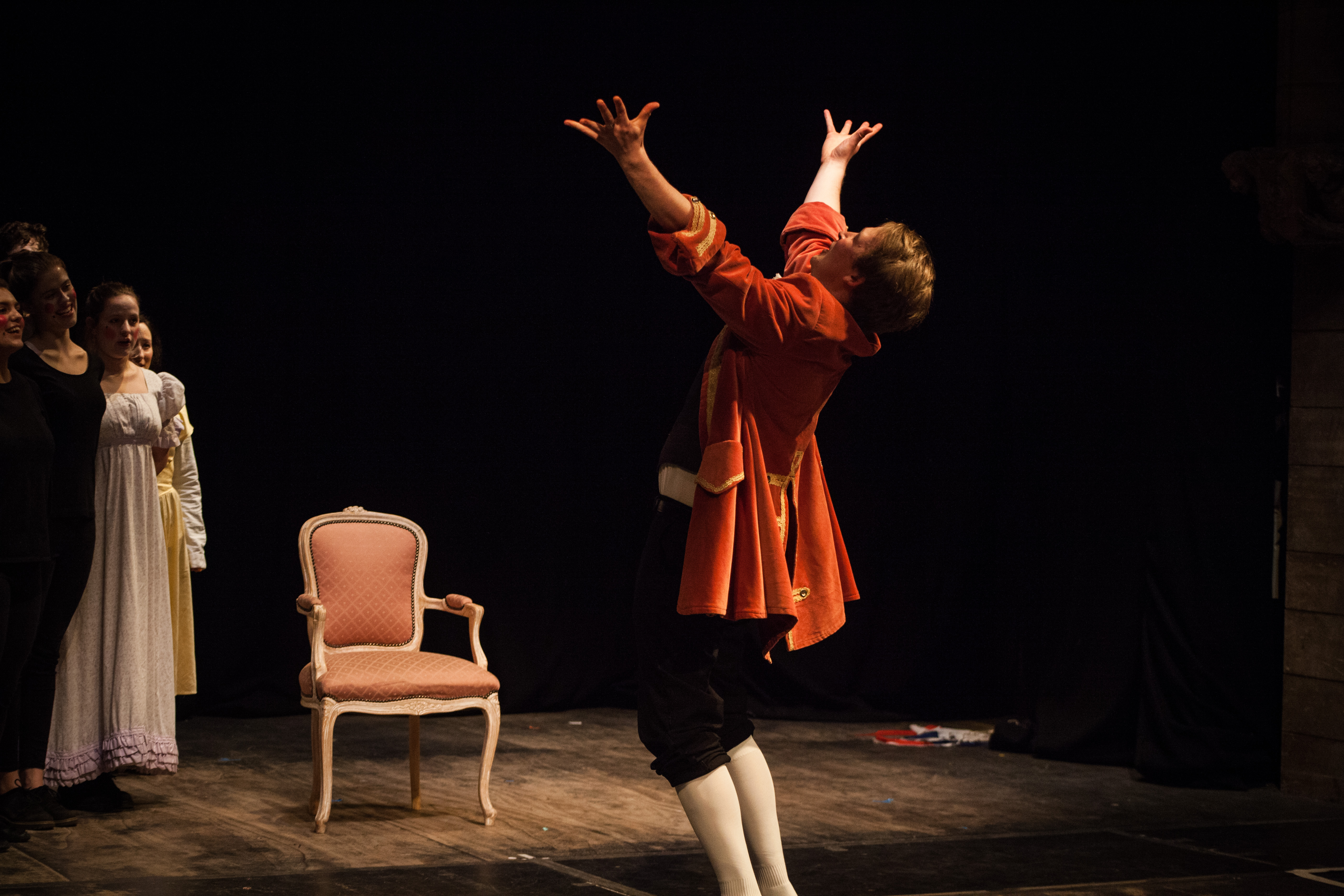
It uses a number of quite clever production devices in its storytelling in order to compensate for its stripped back set (a necessity of student productions!) – just clothes hampers and a door. We are led to believe we are watching an opera audition to start with, with cast getting into their costumes on stage. Quite why the chorus is dressed in black with grotesque make up in the manner of a Greek Chorus such as in Bacchae, is harder to understand, but arguably acts as a reminder that at this moment there are three entities in play; us, the audience; such actors as were robed; and the chorus being aspirant players hoping to get in on some of the action (which ultimately they did).

For me, this device works because the opera starts off with just two people on stage and the full company arrives only later on.  For the guise to return just as the interval and finish approach, as the chorus cast off their (over) garments on stage and wheel them off in laundry baskets is .entertaining but puzzling.  Again, perhaps a reminder that we were watching an audition, but could have been more thoroughly explored to make a clearer through-line. Other charming (if a little bizarre) moments are when the chorus also act as a very animated set of trees in the forest scene, a humorous foil to the shenanigans going on between the Count and Cherubino.

The libretto is sung in English with a commendable clarity that engages from the start. There is some fine solo as well as ensemble singing, with Jessica Conway (Rosina) delivering a couple of demanding arias very close together more than capably, while Jonathan Forbes Kennedy’s Count and Timothy Edmunson’s Figaro bring just the right balance of authority and vulnerability to their parts both vocally and with their acting. But for me, the star of the evening without doubt is Sarah Gilford’s Susanna, who not only sings beautifully, but acts with coquettish smiles, joyful humour and a streak of kind cunning. The Count never had a chance.

The production runs until the 4th March and I strongly recommend it for its inventive, professional approach. Ingenuity and creativity, allied to committed singing, acting and orchestral playing soon make one forget the necessarily stripped production. It is a joy from start to finish, and played for laughs which come aplenty. I have seen grander productions of The Marrage of Figaro, but not, in terms of sheer engagement with the work, better ones.  It feels as if the company really are giving it all they have, perhaps in the absence of more luxurious proscenium arch props, which sprinkles it with an extra layer of magic.


nae bad_blue

Star (blue)Star (blue)Star (blue)Star (blue)

Reviewer: Charles Stokes(Seen 28 February)

Visit the Assembly Roxy  archive.

THIS REVIEW HAS NOT BEEN SUBEDITED