Lyceum Variety Nights (Lyceum: 26th Feb ’17)

“A fab night of quality entertainment”

Editorial Rating: 4 Stars

“This is a night of pure joyful entertainment,” co-host Sian Bevan tells us in her opening gambit. And entertaining it absolutely is, with another excellently curated programme of work from seven fine artists across music, spoken word and theatre.

The Lyceum’s Variety Night, though, is more than about just going to see a selection of snippets of work from talented acts. What makes it extra special is the joy and level of informality of proceedings that sets a tone somewhere in between your regular night at the Lyceum and a slightly drunken party. And there’s a raffle.

Bevan and the programme’s producer Jenny Lindsay, who act as comperes throughout, seem genuinely excited to be there and by the acts they are about to introduce, and they are a very natural pairing. Once again, it’s a shame not to hear more from them by way of warm-up to the main event, but with such a packed a programme it’s understandable why they want to crack straight on with the action, which flows professionally and smoothly from one act to the next.

This night had a very noticeably Scottish feel to it, with Gerda Stevenson and Rachel Sermanni sharing some absolutely gorgeous and ageless poetry and song, while Aidan Moffat and Colin Maguire performed rather more masculine musings on ex-girlfriends and bed, among other things.

It was only Adele Hampton, right at the end of the evening, who perhaps brought that real sense of “variety” to proceedings. Hailing from Washington DC and with a very international flavour, her work stuck out both for its gentle, flowing lyricism, and engaging quality of never really feeling like she was performing, rather just talking to friends. The Creative Martyrs also shone with their cabaret-style double-act with a slight political message – easily the most risqué act in a relatively tame programme.

It’s a little rough around the edges – some of the performers use notes, there’s some coarse language thrown in from time to time, and the low-tech stage-sharing brings a sense of rawness and individuality to this unique show, but all of that makes it infinitely more likeable in my book. Everything about how the night is put together gives a sense of being part of something really special and celebratory, and as a one-off show it’s a real treat to know you’re witnessing something unique, like being part of a secret club.

Perhaps this was a little safer, with slightly less wow-factor than the opening instalment three months ago, but overall it was still another fab night of quality entertainment. I’m already looking forward to the next one.

Star (blue)Star (blue)Star (blue)Star (blue)

Reviewer: Steve Griffin (Seen 26 February)

Visit the The Lyceum archive.

THIS REVIEW HAS NOT BEEN SUBEDITED

The Winter’s Tale (Lyceum:10 February – 4 March ’17)

l-r: Maureen Beattie, Frances Grey and John Michie. Photography: Mihaela Bodlovic

l-r: Maureen Beattie, Frances Grey and John Michie.
Photography: Mihaela Bodlovic

“Go with an expressive meld of The Proclaimer’s evergreen ‘I’m Gonna Be’ and the absolute integrity of Paulina”

Editorial Rating: 5 Stars: Nae Bad

Accept that the Oracle at Delphi is a DNA lab – and why not? – and that no Bohemian sheep shearing feast is complete without See You Jimmy hats – ‘perhaps the most potent symbol of national self mockery in the world’ – and then you create a ‘Winter’s Tale’ to die for. And indeed little Mamillius does die, and the good lord Antigonus does get ripped apart by a bear, but that’s tragicomedy for you: part psychodrama, part romance, and now part ceilidh; all startlingly well realized in this Lyceum production, directed by Max Webster, designed by Fly Davis and with music by Alasdair Macrae.

Delphic maxim, admonition and genetic instruction, the aphorism ‘Know thyself’ would be a three-in-one cure all for Leontes, King of Sicilia. He might have found the motto in his Christmas cracker. Unfortunately, he doesn’t and goes insanely jealous instead: losing his wife, his son, his new born daughter and his best friend in the process. That’s roughly half the play, an hour or so, and then after the (16 year) interval there’s sixty minutes of making jolly good, when that lost daughter finds her Prince, the friends are reconciled and – miraculously – love between husband and wife is restored. Sweet? Nah, not when Jimmy Chisholm’s Autolycus is around, fleecing ordinary folk, pinching their gold, selling dodgy CDs and hawking his ‘delicate burdens of dildoes and fadings’ (that’s Shakespeare, not James Robertson’s proud and vernacular Scots). If it’s continuity you’re after, to oppose Leontes’ psychosis, then go with an expressive meld of The Proclaimer’s evergreen ‘I’m Gonna Be’ and the absolute integrity of Paulina (Maureen Beattie), as audacious in the face of power as you could wish woman to be.

The Winter’s Tale is late Shakespeare so it’s always interesting to see how a thoughtful production brings its mature ‘status’ into play. Rulers, Polixenes (Andy Clark) as well as Leontes, are petty tyrants in this telling. They act beyond reason, expecting loyalty and deserving none. Their women are their subjects. When Hermione (Frances Grey) pleads her innocence she knows that Leontes, husband, judge, and executioner, speaks a ‘language that I understand not; [that] My life stands in the level of your dreams’. In 1611 it was possible, and probably necessary, to admit that Leontes has regained his authority by the final scene; but not in 2017. The deluded male is busted and a near broken John Michie does it very well. It’s the same with position and rank, for who would be liege-men to lords such as these? Prince Florizel’s love for his common shepherdess (tho’ she’s not really!) cannot be doubted and Bohemia looks just the kind of subversive place where young people should grow up.

Jimmy Chisholm as Autolycus.

Jimmy Chisholm as Autolycus.

The binary nature of the piece – Sicilia vs. Bohemia – locks it together. One is urban and a touch swanky with its musicians in a recording booth, expensive and insulated; whilst over in Bohemia, or is it in a field near Auchtermuchty?, Autolycus is on the make and Annie Grace plays her Border pipes on a makeshift platform and it’s all in for a Canadian Barn Dance. Perdita (Fiona Wood), pranked up in her goddess claithes and pink Converses, is made-for-Fife. ‘Too noble for this place’ reckons Polixenes. Prat!

Yes, judgements come fast and sure in this tale. The opening signal is a beautiful arrangement of ‘In the Bleak Mid-Winter’, whose plaintive ‘What can I give him?’ is Hermione’s anguished, unanswerable question. Mamillius is the sacrificial lamb – and bear. Rustics, pre-eminently John Stahl as the Shepherd are as funny, honest and whole hearted as they are gullible and foolish. Autolycus, complete with paper crown around his neck, is the disgraceful Lord of Misrule, whom you shouldn’t care about, just delight in.

What is apparent throughout is clear-cut. Indeed there’s a thematic insistence upon narrative clarity and serious moral direction that other productions can lose sight of. No chance here: not only is the lighting plot instructive, there’s even an ultrasound to pay attention to and, remarkably, an apt reference to the human genome project:

‘Your mother was  most true to wedlock, prince;

For she did print your royal father off,

Conceiving you.’

Invention does not diminish Shakespeare.

nae bad_blue

Star (blue)Star (blue)Star (blue)Star (blue)Star (blue)

Reviewer: Alan Brown (Seen 14 February)

Go to The Winter’s Tale at the Lyceum

Visit Edinburgh49 at The Lyceum archive.

RSNO: Remmereit, Bryan. Vaughan Williams, Martin Suckling, Ravel. (Usher Hall: 3 Feb ’17)

The Lark Ascending

“In Katharine Bryan we heard some of the finest flute playing around today”

Editorial Rating: 4 Stars

The RSNO chose interesting, offbeat fare for their Sir Alexander Gibson Memorial Concert on Friday night, by way of complete contrast to what will be an immensely popular Rachmaninov/Tchaikovsky melange this coming week. Good for them, and I am sure that the great man, who brought so much to the RSNO in his extraordinary twenty-five year tenure and yet died at the relatively young age of 68, would have thoroughly approved.

The first piece was not without controversy: Vaughan Williams’s The Lark Ascending transposed for flute by the RSNO’s Principal Flautist, and soloist on the night, Katharine Bryan. This well known work – indeed, it is number one in Classic FM’s Hall of Fame (make of that what you will) – while for some overexposed, is to me almost sacred. I first heard it as a schoolboy played in a concert in Dorchester Abbey in Oxfordshire by one of my peers, Richard Deakin, who went on to teach music at the Royal Academy and found the Orchestra of St John’s Smith Square. An early summer evening by the Thames with the fading sun streaming through the Abbey’s stained glass windows … and the piece moved onto my spiritual and emotional hard drives for ever.

To transpose it to flute had me and a number of others worried. Yet for me, full of reservation, it was a triumph. The warmth and roundness of the flautist’s timbre brought a new dimension to the work outwith the capacity of the violin. Bryan’s playing was exquisite: her control of her breathing in long passages extraordinary, her phrasing superb, her control and precision utterly convincing. So much so that I shall buy the recording. Now there’s a compliment in this age of streaming and downloads.

Composer Martin Suckling came on next to introduce his world premiere performance of our next piece,  The White Road. Interesting as this prologue was, it later became clear  – as our flautist returned  in a shimmering white dress rather than her earlier red version –  that this was a fill in. No matter, it gave the next quite difficult fifteen minutes some context.

Notwithstanding the composer’s aspirations the work essentially was a back and forth between sharp musical bites from the flute echoed by percussion, with minimal brass, wind and string support and unconvincing body bops by the soloist to accentuate the to and fro with little added value from the microtones. Melody went missing until the end of the work and I found it unremarkable. Fairly typical of the modern genre, I suppose, but it really only came into itself at its close.

Our nerves were soothed by Bryan’s blissful rendering of Massenet’s Thais as an encore, accompanied only by harp. Luscious.

Following the interval we were treated to Daphnis and Chloe Suites No’s 1 and 2. This piece is a conductor’s nightmare in terms of its fluidity and apparent lack of time signature, so it would be timely to point out that the baton was being held on the night by Arild Remmereit standing in for the indisposed Peter Oundijan. A fine job he made of it (and for the rest of the evening, too). You never felt the orchestra were out of control and their disciplined playing impressed. The work opened with a flute solo and lo and behold, there was Katharine Bryan again, now in black dress, back in her familiar principal flute’s chair. The Danse Guerriere at the conclusion of the first suite showed real verve and the Lever de Jour opening Suite No 2 was well realised and convincing. Remmereit got everything he could out of the band in the Danse Generale which ended our evening with a – or rather, several – bangs.

So in conclusion,  this was a concert that entertained with the familiar, challenged with new takes on familiar themes, and also with new material. Sir Alexander would have been proud of his orchestra’s playing and in Katharine Bryan we heard some of the finest flute playing around today.


Star (blue)Star (blue)Star (blue)Star (blue)

Reviewer: Charles Stokes (Seen 3 January)

Go to the RSNO, Scotland’s National Orchestra

Visit Edinburgh49 at the Usher Hall archive.

Lysistrata (Kings: 27 – 28 Jan.’17)

Cait Irvine, centre (Lysistrata) Photo: Greg Macvean

Cait Irvine, centre (Lysistrata)
Photo: Greg Macvean

“5th Century revel disarms ‘Call of Duty’”

Editorial Rating:  3 Stars: Outstanding

This is a tumultuous inaugural production by the Attic Collective. It has that shameless tumescent quality that really would ‘Make Greece Great Again’. Athens/Attica was still big in 411 BC but had been sorely bashed in Sicily and was hurting. Aristophanes’ Lysistrata must have been excruciating, urgent fun back then and it is remarkable that – in the right hands – it can still have the same effect.

As a play it’s less in-your-face than in-your-crotch. Just look at the tall curvy door, upstage centre, and reckon, pretty confidently, that it’s all about Pussy Power. Then there are the phalluses, not one of leather, but several of rubber and latex, and all impressive, but none more so than the Spartan emissary as gauche walking dick. Naturally enough there is supplication to Zeus for relief from priapism.

The men suffer because the women have crossed their legs. Lysistrata leads a women’s revolt that denies sex to husbands (and wives) until the Peloponnesian War ends. They occupy the Treasury – a smart kick in the balls –  and wait for their men to come to their senses, as it were. They are finally brought to it by the body beautiful of Kim Kardashian, aka. Aristophanes’ figure of Reconciliation. Of course, the women are frustrated too and invent desperate, hilarious, excuses to return home.

Conor McLeod (Men's Leader) and Megan Fraser (Statyllis)

Conor McLeod (Men’s Leader) and Megan Fraser (Statyllis)

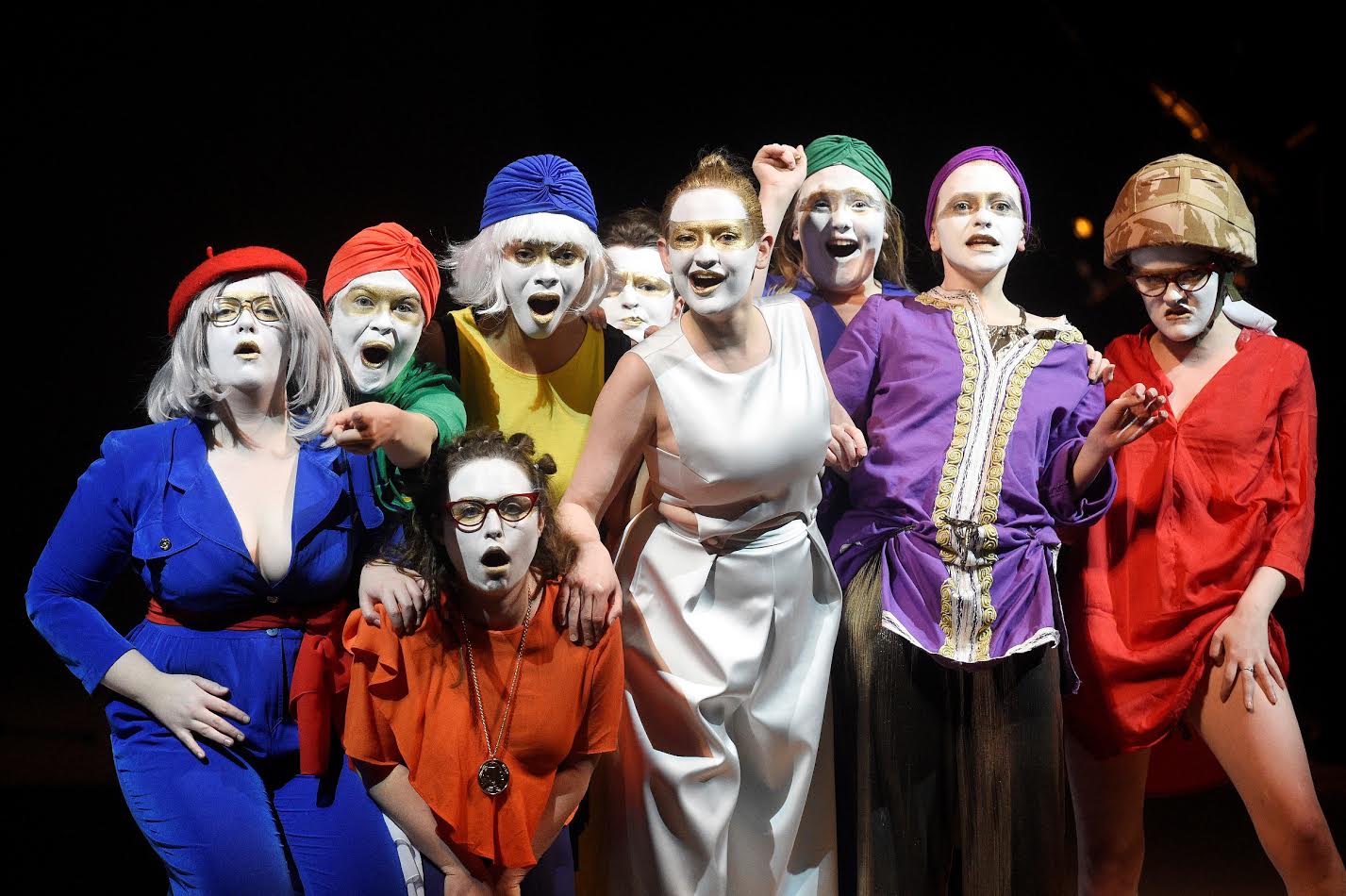
This is when a 5th Century revel disarms ‘Call of Duty’. ‘Tits not Targets’ is the message. It’s summery: the men are in a uniform of white shirts, cropped chinos and canvas slip-ons. Not a spear or bronze helmet in sight. Just helmets from the Urban dictionary. Cinesias (Adam George Butler) has his shades. Their leader (Conor McLeod) is a dapper, convinced and convincing kind of chap. Meanwhile the women are a riot of colour with their white faces and ‘war paint’ and they soak the men with Water Blasters. It’s loud too, especially when Charlie West hits his box drum.

Arguably the on-stage debate is one-sided. Determined Lysistrata (Cait Irvine) and cocky Stratyllis (Megan Fraser) reduce the men to defensive huddles and oddly impotent hakas. Deciding  to dump the split Choruses of the old men and women of Athens does tilt the balance in favour of the youthful and the libidinous (no real loss!) and the sense of the words can go AWOL in dionysiac chant and jabber but there’s no doubting the drive and sense of the piece as a whole. Director Susan Worsfold and Musical Director Garry Cameron succeed in sustaining dramatic form, resolved in celebration, from a plot that is about as carnal and abandoned as it gets.

By the by, a Belgian lady senator called for a sex strike in 2011. It was meant as a provocative joke but it excited the Christian Democratic opposition to remark that “Politicians are not there to strike. On the contrary, politicians are there to arouse the country.” Hear! Hear! (Aristophanes).

outstanding

StarStarStar

Reviewer: Alan Brown (Seen 27  January)

Go to the Attic Collective with edtheatres.com.

The Edinburgh49 archive at the King’s Theatre

Mack the Knife (Bedlam: 25 – 26 Jan.’17)

mack-the-knife

“Lady, ‘the hottest ticket in town’”

Editorial Rating: 3 Stars

There’s a virtual Hall of Fame in this show: Brecht, Weill, Lotte Lenya, to start with; and a few music greats – Ella Fitzgerald, Ray Charles, Sinatra – and then Kevin Spacey as Bobby Darin with the title song. If you want more, there could be Tony Bennett and Lady Gaga’s The Lady is a Tramp and a passing literary reference to Raymond Chandler’s Philip Marlowe.

Nathaniel Brimmer-Beller would channel them all through his play. It’s a clever and applaudable conceit but the interference is too much. Too many signals from too many sources.  A mellow jazz intro’ – nice – leads into Oh, Lady Be Good which given what follows is practically hilarious. ‘Lady’ sings that she’s ‘all alone in this big city’ but for all her lonesomeness she is plainly making out just fine. It helps that the competition in the other clubs is thinning out, alarmingly so in fact, and the police appear clueless.

Detective Foster (Paddy Echlin) likes his work. He’s had lessons in psychological profiling and Jack the Ripper is on his mind rather than Georgia but he’s a poor sap. He has the sharp trench coat and the 50’s trilby but is not the hard-boiled character that he thinks he is. More a marshmallow with a toy gun.  Deacon (Jacob Brown), Lady’s trumpet player, is more on the case and knows a set-up when he sees one but unfortunately his incredulous WTF’s don’t help him. As for Lady, ‘the hottest ticket in town’, Jo Hill enjoys herself. She’s sassy at the mike, sings confidently, and is audacious beyond reckoning.

And here’s the rub. Lady’s luck – call it ‘cool’ if you must – is something else. It turns tension into the comic macabre, not least when she kneecaps herself and stays on her feet. Maybe her aim was off but even a flesh wound must hurt like hell. Then there’s the absolute gift of a police detective who ‘packs heat’ like Clouseau on holiday.

Will Briant on piano and Vebjorn Halvfjierdvik on bass give the piece a tempo and style that if extended – for the Fringe, say – could lift the play into the lighter, skilful register that Brimmer-Beller is reaching for.

Star (blue)Star (blue)Star (blue)

Reviewer: Alan Brown (Seen 25 January)

Go to Bedlam Theatre

Visit Edinburgh49‘s Bedlam archive.

Ten Years of Taylor Swift (The Mash House: 14 Jan ’17)

taylor-swift

“A fun and fantastic showcase”

Editorial Rating: 3 Stars

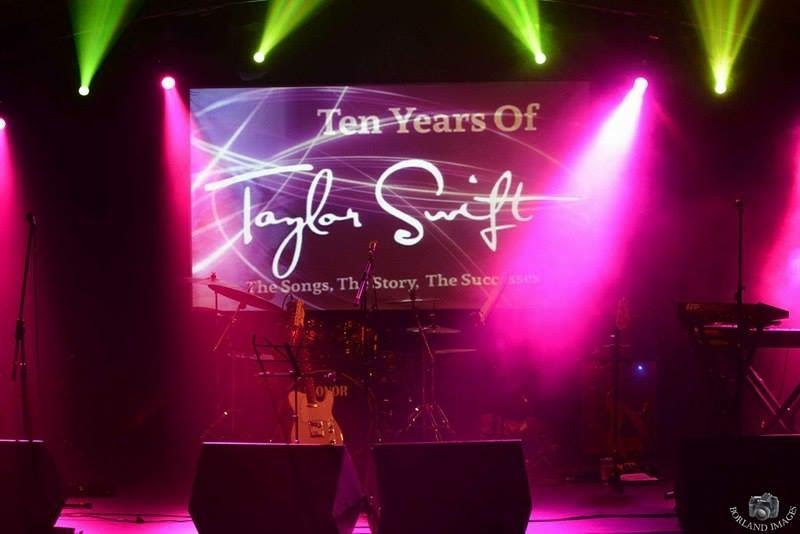
Not being a huge Taylor Swift fan myself I was slightly apprehensive before the show. However, I must admit I was very pleasantly surprised. This gig was set up by 16 year old Lisa Kowalski, who with some help from mum managed to put on an entertaining evening any event organizer would be proud of.  The three hour set – a good length! –  showcased a range of Taylor Swift’s material – from her younger country days to newer pop songs.

Before the show there was an excited buzz around the room and I could immediately tell I was surrounded by some devoted Swifties. There was not much in a way of an introduction before singer Matthew Gibb, together with the backing band, started off the night with his original version of ‘Blank Space’.

Soon it was clear to see that despite their young age these are all very talented singers and musicians including The 45 and Beth Swan. Although the backing band added an extra kick of enthusiasm to the night I was glad that there was an acoustic session in the middle, where you could clearly hear each performer’s voice.

Each act enjoyed great stage presence but there were three performers who really stuck out – Ashleigh Burns, Olivia Dawn Haggerty and Lisa Kowalski herself.

17 year old Ashleigh from Glasgow gave an impressive performance with her versions of ‘Love Story’ and ‘Trouble’. Her strong, soulful voice in combination with a charming presence and confidence on stage made it a great set. Olivia impressed with her beautiful ballad version of ‘All Too Well’ whilst Lisa was not only good at talking to and entertaining the crowd, but vocally she also did well, with a good range and a convincing ‘attack’. Although not pitch perfect at all times these girls have serious energy and potential.

All night everybody’s enthusiasm was so contagious that I couldn’t help bopping along and I even got caught up in the whole sing-along spirit of the night! I can only recommend this particular show if you are a big Taylor Swift fan but I really loved the whole idea behind it – celebrating an artist together with lots of like-minded fans. The whole event was brilliantly organized and you could clearly see the huge effort put in from all parties. It was definitely a fun and fantastic way to showcase young talent from across Scotland.

Star (blue)Star (blue)Star (blue)

Reviewer: Iona Young (Seen 14 January)

Visit the Edinburgh49‘s Other venues archive.

Picnic at Hanging Rock (Lyceum: 13 – 28 January ’17)

hanging-rock-1

“It’s cool, it’s chilling and it shocks”

Editorial Rating: 4 Stars: Nae Bad

Do you approach Hanging Rock expecting to see corsets hanging in mid-air? Well, in which case you will have noted that the excised last chapter of Joan Lindsay’s 1967 book provides this astonishing feature. Either that or you’re wandering in a Dreamtime of your own (adolescent) imagination, set about with eucalyptus trees and hot flushes from Peter Weir’s 1975 screenplay. Now here comes the wake-up call, a dramatic restorative, if you will.  It’s cool, it’s chilling and it shocks.

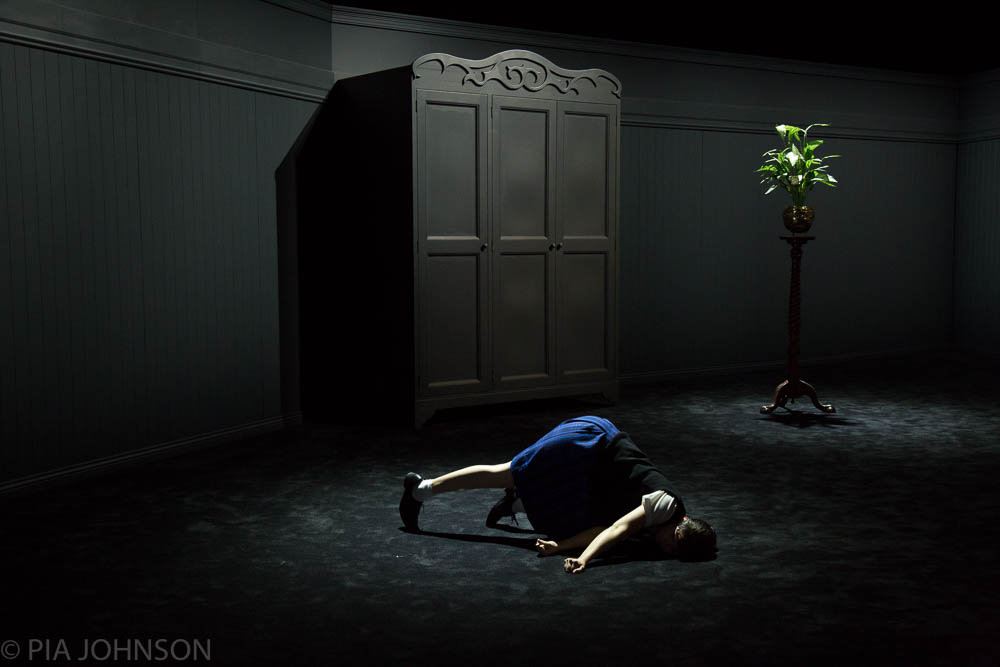
This Picnic at Hanging Rock is a stylish outing, to say the least, from Melbourne’s Malthouse Theatre and Perth’s Black Swan Theatre Company. That’s Perth, Western Australia, and that’s a collaboration over 2170 miles, but who’s counting? This is Tom Wright’s adaptation but as in Lindsay’s story distance is of no consequence and time is suspended, ‘running out and spooling in’, between grey black panelling topped with brushwood. No rock is visible and there is no interval.

There is thunder and a blackout and five schoolgirls suddenly appear, side by side across the stage, in immaculate uniform ready for Speech Day 2017. They tell the story, their shared creepy story, of what happened on St Valentine’s Day, 1900, when a daytrip from Appleyard College went to Hanging Rock and four girls and one teacher disappear. One of them, Irma, is later found, close to death, and with absolutely no memory of what happened. It is, at its opening, a composed and perfectly disciplined account that you realise is the sure and safe way to rationalise the irrational, the unknown and the dangerous. It is a long introduction but necessary, for in this telling you understand that an ancient landmark is an abcess to be swabbed away for the sake of white Australians everywhere and young ladies from proper schools can never be too English. Whatever happened, dear, it’s really too, too bad that it happened in the state of Victoria.

hanging-rock-2

There are parasols to ward off the sun, a grand aspidistra to maintain respectability, and – figuratively – there must be ‘lino, asphalt, and axminster’ to hide the red earth. Mrs Appleyard, founder and Headmistress, remembers Bournemouth but dreams of the  intimate touch of her (?dead) husband. Irma, returns to the school before leaving for a stay in England and is viciously attacked by girls suffocating in their own propriety. Director Matthew Lutton works to challenge perceptions: angling the girls in contorted positions, immobilizing their movements in successive freeze-frame ‘shots’, subjecting the narrative to enigmatic surtitles over frequent blackouts. How else to refresh, even subvert, what has become an almost mythological text, complete with panpipes?

It is actually without humour – an unusual and tense achievement over eighty-five minutes – but the performances of the several characters are still appealingly unaffected and distinct. Amber McMahon cross-dresses as the young Englishman, Michael Fitzhubert, but there’s no caricature here. Elizabeth Nabben is Mrs Appleyard and builds a fragile role to its last despairing moment; Nikki Shiels suffers as Irma, whose fate it is to keep her nightmares under control, whilst Arielle Gray and Harriet Gordon-Anderson are in supporting roles that they make important.

Is an audience bushwhacked by theatrical device and intelligence? I think so, but it is performed with considerable respect for its source and the script is smart, spare and ingenious. Technically it works a treat with outstanding lighting and sound and this is probably one production where the ‘best’ seats, for the best effect, are probably at the front of the Upper Circle and you should definitely read the Director’s and Writer’s programme notes after the show because they’re too helpful. The play’s the thing.

[FYI. Bruce Springsteen and the E Street Band play at Hanging Rock on Saturday 11 February. You simply cannot keep a good place down!]

nae bad_blue

Star (blue)Star (blue)Star (blue)Star (blue)

Reviewer: Alan Brown  (Seen 14 January)

Picnic at Hanging Rock at the Lyceum

Visit Edinburgh49‘s The Lyceum  archive.

Edinburgh Quartet, Beethoven (St Andrew’s and St George’s West: 11 Jan. ’17)

https://i0.wp.com/www.theedinburghreporter.co.uk/wp-content/uploads/2017/01/edinburgh-quartet-poster-january-2017-209x300.png

“The Edinburgh Quartet have some magic dust around them that creates real homogeneity and synergy”

Editorial Rating:  4 Stars

I saw on Facebook that a friend of mine was going to Wednesday’s Edinburgh Quartet Rush Hour Concert, and “ticked’ that I was going too. “They’re playing the Rasumovsky Quartet”, he enthused, virtually. “Which one?”, I replied. “Eh?”, came the rejoinder. For not many people know that there are in fact three, all commissioned by Count Andres Rasumovsky, the Russian Ambassador to Vienna, with the stipulation that they should contain Russian themes. Well actually, the one we heard, the third and arguably the finest, didn’t, but it contained an awful lot of interesting new approaches to the genre.

The Edinburgh Quartet bring a pleasingly creative approach to their programming and tonight we heard from Edinburgh Artist Erik Petrie, who was working alongside them this week at their Residency at the Ocean Terminal and just hours earlier had completed a magnificent, colourful violin scroll canvas which the Quartet proudly displayed. Second violinist Gordon Bragg discussed the intriguing relationship between quartet and artist with Erik before the concert started.

The Edinburgh Quartet have recently adopted a practice of having a theme for their concert series, and the theme for this early part of the New Year is “Revolution”. For certain, the works by Mozart (French Revolution) and Shostakovich (post Russian Revolution and very influenced by Stalin) could be deemed as appropriately covered by this banner, but for Beethoven in 1808 it was stretching a point, other than that the Rasumovsky Quartet, Op.59 No.3, is certainly revolutionary in construction.

The first movement Allegro opens with a series of diminished sevenths punctuated with silences that set off an atmosphere of wonder and mystery, resolving into C major and we are away in more conventional quartet form. Quite a shock for its audience then and quite a surprise today. Comparisons and styles can legitimately be made to `Mozart’s “Dissonance” Quartet.

The Andante con moto employed a lot of pizzicato and if Beethoven was trying to persuade his sponsor that the quartet contained a Russian theme it would be here, with its intimations of folk song.

Come the third movement Allegro we found ourselves listening to a cheerful minuet, yet just as we were beginning to relax and take it easy we barnstormed into the final Presto at breakneck speed. The players did not make one slip in these very demanding passages which they delivered with real verve. One felt the spirit of troubled Beethoven, hounded by deafness and in the process of beginning to admit it to his brothers and close friends. On the early sketch of this movement he had written “Let your deafness be a secret no longer – not even in art.”

Yet again, despite a number of personnel changes, the Edinburgh Quartet have some magic dust around them that creates real homogeneity and synergy, giving the impression they had been playing together for years. We had a relaxed yet assured, inspired performance. The tight, together playing we have become accustomed to, and sheer listen-to pleasure, was joyfully experienced tonight as always.

Star (blue)Star (blue)Star (blue)Star (blue)

Reviewer: Charles Stokes (Seen 11 January)

Go to Edinburgh Quartet‘s homepage

Visit Edinburgh49’s St Andrew’s and St George’s West archive.

RSNO, Prieto and others (Usher Hall: 2 Dec’16)

Image result for verdi

“…this was a strong, conviction performance of a great work with some fine playing and singing”

Editorial Rating:  4 Stars: Nae Bad

“An opera in ecclesiastical robes” (Von Bulow”). “Bulow has blundered. It is a work of genius” (Brahms). But Von Bulow was not necessarily being pejorative. So what if the Verdi Requiem is an opera in ecclesiastical robes? This perennial argument does have some merit in criticism of the work. I see nothing wrong in celebrating a requiem in operatic style, but it is the structure and intervals within the requiem format that get in the way of the flow of the work. It is a series of seven moments, apart from the enjoyably more substantial Dies Irae and Libera Me. To me, its enjoyment is entirely secular. If I want a spiritual or religious high, I turn to Faure, or Mozart or, indeed, Brahms. If I want music to die for (le mot juste?), then it’s Verdi.

Friday night’s wonderful performance by the RSNO, RSNO Chorus and four soloists: soprano Evelina Dobraceva, mezzo-soprano Elizabeth DeShong, tenor Edgaras Montvidas and Bass-Baritone Hanno Muller-Brachmann – under the baton of Carlos Miguel Prieto was at times spoilt by the audience. On the whole I have a lot of time for the RSNO followers, who do not whoop or whistle, do not clap between movements, and allow a respectful interval at the end of a piece before applauding, but on Friday they coughed and they croaked as and when they pleased, spluttering just a few moments into the desperately fragile pianissimo Requiem. Surely they could have held back at least until the forte passages. I relished – in the fortissimo Dies Irae – the thought of drowning them out myself. This may be the price you pay for live music in winter, but perhaps the Usher Hall could print a few useful tips on muting the effect, as they do in the programme notes at the Royal Festival Hall.

Enough of the audience and on to the artists. The 120 strong chorus managed to keep precision and intensity in their pianissimo entrance, and sang throughout with discipline, force and feeling. Sopranos never harsh, well balanced between the four parts and every entry spot on; basses clear, and good mid range from the altos and tenors. They sang the Dies Irae and Libera Me as well as I have ever heard it sung. Bearing in mind the size of their catchment area this pays a real compliment to their talent and training.

The orchestra were also well up to the task and played with feeling and élan. The “stereo” effect of placing two trumpets up in the gods at the back of the hall in reply to the others on the stage in the Tuba Mirum worked very effectively – it doesn’t always – and it was a revelation to hear, again in the Dies Irae, a double fortissimo, that’s four fortes, without any blaring or coarseness.

The casting of the four soloists from America, Lithuania, Germany and Russia, coming together for a couple of gigs in Glasgow and Edinburgh shows what an international world classical music is, and how Scotland is right up there with the best of them in its ability to attract such talent. The work is not easy on the soloists, especially when singing with each other in duet format. Individual soloists sang well with the orchestra but the two sopranos struggled to sound homogenous in the Recodare, Jesu Pie in the Dies Irae but had got more used to each other in the kinder Agnus Dei. One felt bass-baritone Hanno Muller-Brachmman wasn’t entirely comfortable in the Mors Stupebit and Confutatis maledictus in the Dies Irae, but he entranced us later in the Lux Aeterna. Their quartet for the Offerterio worked well, and soprano Evelina Dobraceva thrilled us in the concluding Libera Me where she really nailed it.

Overall this was a strong, conviction performance of a great work with some fine playing and singing with just a few issues of coordination and integration between soloists, which is always a risk with a live performance of a work that really puts them on the spot. There was a respectable pause before enthsiastic applause broke out, showing that the audience’s heart was in the right place, even if their fitful larynxes were not.

nae bad_blue

Star (blue)Star (blue)Star (blue)Star (blue)

Reviewer: Charles Stokes (Seen 2 December)

Go to the Royal Scottish National Orchestra

Visit Edinburgh49‘s Usher Hall archive.

Alice’s Adventures in Wonderland (Lyceum: 26 Nov – 31 Dec.’16)

Photo credit Drew Farrell. (L-R) David Carlyle as Gryphon, David James Kirkwood as cast, Jess Peet as Alice, Gabriel Quigley as Queen of Hearts, John Macaulay as King, Alan Francis as Duchess, & Tori Burgess as cast.

Photo credits: Drew Farrell.
(L-R) David Carlyle as Gryphon, David James Kirkwood as cast, Jess Peet as Alice, Gabriel Quigley as Queen of Hearts, John Macaulay as King, Alan Francis as Duchess, & Tori Burgess as cast.

“This particular and generous invitation to Wonderland should be accepted at once”

Editorial Rating:  4 Stars: Outstanding

When Alice’s Adventures in Wonderland was first published Britain also got its first speed limits for horseless vehicles. The Locomotive Act of 1865 meant no more than 4mph in the countryside and 2mph in towns, together with a red warning flag. No doubt Edinburgh Council is heading that way again, and for good reason, but that does not stop Anthony Neilson’s version of Lewis Carroll’s nonsense classic from being very welcome, fast and surprising.

‘A large rabbit-hole under the hedge’ it has to be, for how else could a very round White Rabbit (WR) go down it? Wowza! It is some exit! Children gasped. And ‘in another moment’ down went Alice after WR, feet first, ‘never once considering how in the world she was to get out again’. No worries – as Alice plummets towards Australia – remember that this is a ten year old on approach to Wonderland.

 The Lyceum is bedecked with small hot air balloons and a fluttering kite. Fairground music plays on and up goes the title in lights, announcing the main attraction as part gaiety theatre, part fond and exuberant dream. It is all, quite naturally, larger than life. Wait until you see the size of the Duchess’s baby. And those arms! Surreal. The Cheshire Puss grins from within the disc of the sun, Alice gets stuck inside WR’s des res and there’s alarming talk of Giant Child infestation. Set a jumbo tea service upon designer Francis O’Connor’s super revolve, press the ‘On’ button and see the glittering tea leaves fly …

(L-R) Jess Peet as Alice, Isobel McArthur as Dormouse, David Carlyle as March Hare, & Tam Dean Burn as the Mad Hatter

(L-R) Jess Peet as Alice, Isobel McArthur as Dormouse, David Carlyle as March Hare, & Tam Dean Burn as the Mad Hatter

It may, at the close, be all Victorian and ‘lingering in the golden gleam’ – and that’s ok, as Carroll admired Tennyson after all (& photographed him) – but in terms of performance and effect the surface quality is lively and attractive. There’s nothing adrift here; no pool of tears either. Instead Alice (Jess Peet) is pretty contemporary: sure-footed and unfazed, arguably more midshipman in the Home Fleet than a dreamy little girl from Oxford, but resolute with crystal diction and a level gaze. Tam Dean Burn plays the Hatter as mad as mad can be without terrifying a young audience and he has maniacal fun with the safety curtain. Mordant humour might well be the preserve of the Welsh and – for me – David Carlyle’s glum Gryphon, marvellously at odds with his colourful plumage, is the co-star of the show. He (and not the Knave) stands accused of stealing the Queen’s tarts – surely a preposterous charge, for who could refuse to follow his courtly lead in the Lobster Quadrille?

As wholesome children’s picture books go The Very Hungry Caterpillar is up there with the best and Eric Carle’s creation, unlike Carroll’s, does not smoke a hookah but then it has long been observed that you ‘Do not look to ‘Alice’s Adventures’ for knowledge in disguise’. Quite what you do look for is your crazy, delighted, business and it might even, with a lot of luck, be the same as a child’s vision. A recipe for mock-turtle soup as pepper spray won’t appeal but otherwise this particular and generous invitation to Wonderland should be accepted at once, not least because no hedgehog was harmed in its production.

outstanding

StarStarStarStar

Reviewer: Alan Brown (Seen 1 December)

Go to Alice’s Adventures in Wonderland at the Lyceum

Visit Edinburgh49’s The Lyceum archive.