Balladynas and Romances (Assembly Roxy: 9 -10 November ’15)

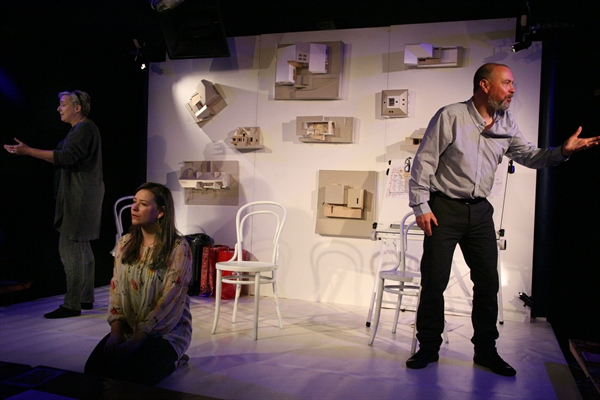
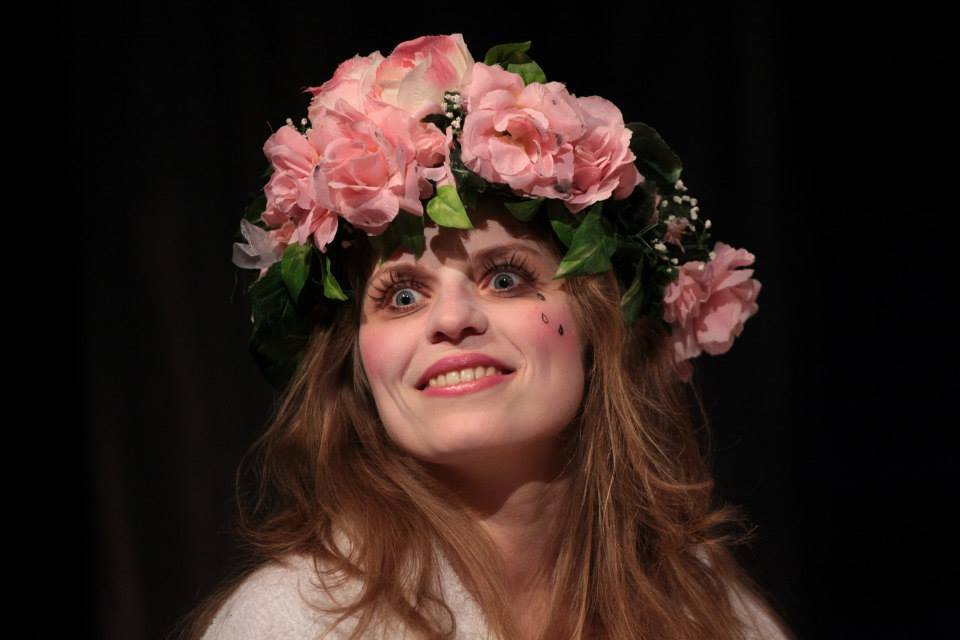
Aphrodite. Photos from Teatr Pinokio, Lodz.

Aphrodite.
Photos from Teatr Pinokio, Lodz.

“The clucking immortality that is forever C-3PO.”

Editorial Rating: 3 Stars  Nae Bad

My namesake, Alan, has had his own school of motoring in Edinburgh since 1979. He also advertises that a Polish instructor is available, Lekcje nauki jazdy w języku polskim. That would have been handy, off-road, for Balladynny i Romanse. But then in these fluent days the President of the European Council and former Prime Minister of Poland is a Donald, so what the hell …

… which brings me to the Roxy where – appropriate for an old church – heaven and hell congregate on earth in director Konrad Dworakowski’s immersive staging of the Ignacy Karpowicz novel. It is long at 135 minutes but is disciplined and expert. Go to the excellent Polish Book Institute for a useful synopsis of the book and be drawn to Karpowicz’s other work, not least ‘Uncool’ (2006); all still waiting for publication in English.

What we get in Balladynas and Romances on stage is, however, eminently translatable as it’s a classic ‘What If …?’  What if the gods drop in while we’re about our ordinary, sometimes tacky lives, in and out of Poundland (the cute Polish equivalent is Biedronka or ‘Ladybird’ ), in and out of each other – warning: puppets perform sex acts – and what if Athena, Aphrodite, Jesus, and the rest, are a bit cheap and maybe past their sell-by date? The answers are not hard to come by, as the gods are very visible and like talking about themselves, but it is tricky to see if Olga, Janek, Artur and Kama notice that their tawdry domesticity is being messed with. ‘A remote god [may] be a redundant one’ but it has long been our Fate – aka. the Occasional Narrator – not to realize that Eros or Lucifer happens to be in the front room.
Balladyny2

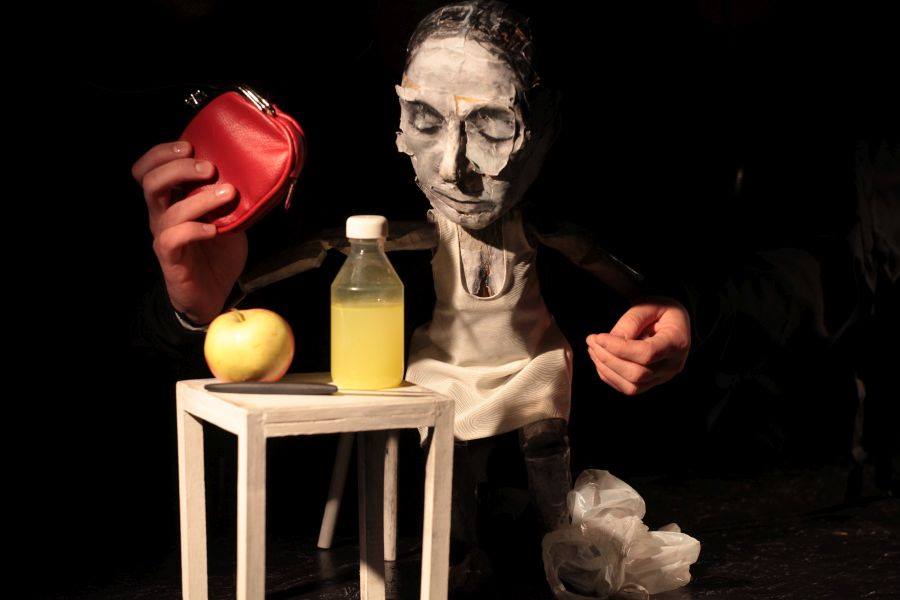
The little mortals are puppets and the gods are dressed in primary black and white, in bathrobes and shades for example. It provides for effective contrast(s), not least when Nike, god of Victory, tenderly cradles the tiny body of a bomb blast victim. Olga, Catholic, fifty something and living alone, undresses and takes a bath and her credulous faith is somehow all the more touching for being manipulated into being. It is the showy gods, though, who demand attention, dwelling as they do on their genealogy – which is a nightmare for Gender theorists – and selfish loves. Eros and Lucifer stand apart, interestingly, each musing on their lot; whilst Osiris’ slender shrouded form and huge eyes recalled the clucking immortality that is forever C-3PO.

Smart lighting and electronic music often snapped the piece back from self-indulgent space and without those puppets the drama would have died, which may well have been the point.

I missed Poland. Eros ruefully mentioned his adopted country at the end of the first half and there were, I’m sure, far more references available than I understood. I googled one Erika Steinbach when I got home and grasped why Old Nick, from Lodz, is a fan. Clearly Balladyna is important but her literary profile receded as, languorous yet scheming, she acted out her bridging role as demi-god fixer and apologist for the ills of the world. At one point, in marvellous conversation with an opinionated Chinese Fortune Cookie, she convinced me that Pinocchio Theatre really know what they are about.

Director: Konrad Dworakowski
Set designer: Marika Wojciechowska
Music: Piotr Klimek
Choreographer: Jacek Owczarek
Lighting director: Bary

Cast: Hanna Matusiak, Ewa Wróblewska, Żaneta Małkowska, Małgorzata Krawczenko, Mariusz Olbiński, Łukasz Bzura, Łukasz Batko, Natalia Wieciech, Anna Makowska.

nae bad_blue

Star (blue)Star (blue)Star (blue)

Reviewer: Alan Brown (Seen 9 November)

Go to ‘Balladynas and Romances’ at the Polish Cultural Institute & to Pinocchio Theatre, Lodz.

Visit the Assembly Roxy archive.

♫ Royal Scottish National Orchestra (Usher Hall: 6 Nov ’15)

“the playing was of the highest calibre…….”

Photo: RSNO.

Photo: RSNO.

 4 Stars:  Nae Bad

“If music be the food of love, play on…”  Yes, that’s from “Twelfth Night”, for love was the leitmotif of Friday evening’s RSNO concert at the Usher Hall, but the principal vehicle was that most famous love story of all, of Juliet and her Romeo.

While many others, from Gounod to Leonard Bernstein, have told this tale in musical form, there is no doubt that within the classical arena it is Tchaikovsky and Prokofiev who hold sway and these two were the chosen representatives for this part of the evening’s programme.

The concert opened with Tchaikovsky’s Romeo and Juliet Overture-Fantasy.  Tchaikovsky abandoned plans for an opera, never mind a ballet, and yet this 20 minute work is like a short, single movement symphony.  Not telling the story as such, it portrays its three main elements: the solemnity and compassion  of the Friar, the passion of the young lovers, and the festering hostility between the Montagues and Capulets.

RSNO Music Director Peter Oundjian chose to interpret this magnificent work conservatively and thereby avoided the emotion and thrills one might expect from, say, a Russian orchestra. As a consequence one found oneself wanting more, particularly from the all important flutes.  There were issues of balance among woodwind and brass, and a generally slow tempo.  Perhaps, inevitably, the band was settling in.

In between the Tchaikovsky and Prokofiev came the brilliantly chosen Khachaturian Piano Concerto.  The concerto, written some eighty years ago, was an ambitious attempt to blend Caucasian folk music influences within a bravura Liszt style masterwork. It arguably doesn’t quite bring it off, but is high on excitement, melody and romance, and is more akin to Prokofiev than the oft compared Tchaikovsky.  A clever piece of transitional programming.

It was with a sense of joy (and a bit of relief) that here, as for the rest of the evening, the RSNO gave of their very best.  The playing was taut, together, focussed.  Brass and woodwind complementing each other perfectly, a warm bass clarinet providing rich undertones for the clear and bright strings.

Soloist Xiayin Wang gave an exciting, bravura and thoroughly comprehensive interpretation in her high octane premiere performance of the work.  After the wake up call of the Allegro ma non troppo e maestoso we were soothed by the tender and melodic Andante con anima before the joyful resolution of the familiar third movement, appropriately designated as Allegro brilliante.  Orchestral accompaniment was punctuated by two extensive solo interludes, if not quite cadenzas, which the soloist disposed of magnificently. As a result I got more from work than ever before, and now consider it as far more than just Prokofiev-lite, and had the privilege of telling the soloist so as she charmingly and modestly mingled with us in the interval, sipping from a bottle of mineral water and shimmering in her gown.

Following the interval we were treated to a suite of 20 excerpts from Prokofiev’s ballet Romeo and Juliet that included some of its most romantic, accessible passages, until thirty minutes in, the bleak, searing awfulness of Tybalt’s Death hit us right between the eyes. Again, perhaps a little more restrained than a Russian orchestra might portray it, nonetheless, the RSNO’s playing was of the highest calibre: rich, flowing cadences, a silvery sheen on the strings, well balanced, richly toned woodwind and brass, and in the background the tuba and timpani sounding like a death knell.

Taken as a whole this was a cleverly programmed and highly effective concert that showed the RSNO’s playing, when into its stride, as being of the very finest.  Kicking off with the Tchaikovsky demands a leap of faith and perhaps a little less caution.  Nonetheless we had a glorious, generously programmed evening. There was a real lift to my walk home across the Meadows.

nae bad_blue

Star (blue)Star (blue)Star (blue)Star (blue)

Reviewer: Charles Stokes (Seen 6 November)

Go to RSNO here

Visit the Usher Hall archive.

Thingummy Bob (Traverse: 29 – 31 October ’15)

Karen Sutherland and John Edgar. Photo: Douglas Jones & Emma Quinn.

Karen Sutherland and John Edgar.
Photo: Douglas Jones & Emma Quinn.

“Go Bob, go!”

Editorial Rating: 4 Stars: Nae Bad

A Lung Ha Theatre Company production in association with Luminate, Scotland’s creative ageing festival.

Go looking for ‘Thingummy’ in a dictionary and you’ll find ‘Thing + a meaningless suffix, colloquial [since] 1751′. Well, there is nothing sketchy, meaningless or dated about this prize piece from writer Linda McLean and Lung Ha Theatre. It is plain, touching, and enjoyable; which is totally unsurprising when you learn that its title song is The Young Ones by Cliff Richard and The Shadows, 1962 (and counting). It is a bit mean of me to draw your attention to line 6, ‘For we won’t be the young ones very long’, but that’s the inescapable bit.

Bob (John Edgar) is in a wheelchair in a care home and is on a mission to rescue his LP records and what he can of his memory. He knows that he likes caramel wafers and is none too keen on pill popping. He loves his wife Audrey very much and wants to get back to their house but he cannot find his keys. He is determined, resourceful and witty and when he says “I do so mean it”, he does.

Binox (Karen Sutherland) has the job of keeping her eyes on Bob. She is the speaking voice of the care home’s security system and – binoculars trained – she would follow him wherever he goes. Charge Nurse (Kenneth Ainslie) and auxiliary Cap (Mark Howie) do their caring best and his niece Gemma (Emma McCaffrey) is always reassuring and kind but Bob can be hard to keep track of. The police get in on the act too. Bob’s other niece, Lesley (Karen Sutherland again), sends warm letters and postcards but she’s in Sydney, Aus. so really it’s down to his neighbour, Mrs Johnson (Kenneth Ainslie once more), to put the kettle on for when Bob makes it home.

It’s a fun pursuit that is made all the more engaging by the breadth and space of the set design by Karen Tennent. M C Escher squares and a revolving centre piece might suggest a board game – with rapping moves –  but the projection of photographs from Bob’s family album adds a whole new dimension. Personal really. Music by Philip Pinsky provides a catchy accompaniment, complete with scratches from those treasured 33s.

At one point, when Bob is trying to reach Audrey, Gemma says ‘”This is too sad”. It is and it isn’t, which is the appeal of ‘Thingummy Bob’. McLean’s script is clever, switching from the short and conversational – especially Cap’s serial “Aye’s” – to the longer, more considered and reflective sequencing of Binox and Lesley. Certainly the issues of aging and dementia are well in place but it is Bob’s story and Edgar’s performance that hold the stage as he wheels around it.

Artistic director Maria Oller and Movement Director Janis Claxton find great, sympathetic, cheer from this closing couplet of ‘The Young Ones’, ‘And some day when the years have flown / Darling, this will teach the young ones of our own’. Go Bob, go!

nae bad_blue

Star (blue)Star (blue)Star (blue)Star (blue)

Reviewer: Alan Brown (Seen 30 October)

Go to Lung Ha Theatre Company and Luminate

Visit the Traverse archive.

Tipping the Velvet (The Lyceum, 28 Oct – 14 Nov ’15)

“An imaginative attempt at what could have been quite a bland adaptation”

Editorial Rating: 2 Stars

From the quills of established writer Sarah Waters and high-flying playwright Laura Wade, my expectations were certainly high on entering the auditorium for this new interpretation of the award winning novel. And with a very amusing opening skit and a dazzling number from Laura Rogers as Kitty, it certainly got off to a fine start.

However, while the amount of creativity on show – from daring aerial sequences, to lush period costumes and a Victorian Music Hall arrangement of a song famously featured on a Diet Coke advert – was impressive, unfortunately, this production’s lack of cohesion and staccato structure made it nigh-on infuriating for me to sit through.

In saying that, the show wasn’t without its laugh out loud moments – a landlady dressed in exactly the same design of fabric as the wallpaper in her house and lines such as “You exquisite little tart” certainly caused a few chuckles. However, the comedic aspects were pushed to their limits with a section involving animal carcasses being used as puppets in a song, and a certain “adult” section depicting Nancy’s experience as a prostitute. Definitely not recommended for the easily offended.

Sally Messiah is certainly charismatic as Nancy, Amanda Hadingue is very likeable as Annie (among other characters she plays), and Ru Hamilton delivers a delightful turn as gender-bending Alice. However, for me the most credit in this production should go to the stage hands, whose alarmingly efficient scene changes left me in a state of amazement on numerous occasions.

Much of Lizzie Clapham’s design was visually impressive, but use of space could definitely have been improved: at times the central characters would appear very lost towards the back of a somewhat empty stage, hindering the sense of intimacy they were trying to create. In a production with so many scenes, locations and jarring cuts between them all, a much more fluid approach to location and action would have been more engaging.

There were various musical numbers interspersed throughout the piece, almost all of which were interpretations of modern songs. In some instances, these worked well as a way to bring relevance to today’s audience, but in the second act when Nancy is desperate for a place to live, she belts out a line from one power ballad after another, with farcical impact. Rather than being able to relate to her struggle, she is instead alienated, and it becomes difficult to then reconnect with her in the following scene. This is part of what frustrated me the most about this production: at times we were allowed in to develop a bond with the characters, while in certain sections it was impossible to do so.

The constant bouncing between styles, coupled with the distinct over use of the compere/narrator/MC character, who incessantly dove on stage with needless interruptions between every scene, made this production feel like it was having some sort of pubescent identity crisis between Brechtian fable, cabaret variety show, and an episode of Jeremy Kyle. I could have handled any of those interpretations individually but all in one show was just too much.

In some ways I’m glad this production took some risks to create an imaginative attempt at what could have been quite a bland adaptation. It’s just a shame that so many different styles, techniques and devices were used in the process.


Star (blue)Star (blue)

Reviewer: Steve Griffin (Seen 29 October)

Visit the The Lyceum archive.

THIS REVIEW HAS NOT BEEN SUBEDITED

Hidden (The Lyceum: 20-24 October ’15)

“Gives chills and thrills aplenty”

Editorial Rating: 3 Stars: Nae Bad

Hidden really is a treat for anyone who’s ever wanted to explore what goes on everywhere else in a theatre that audiences don’t normally get to see. Marry that with tales from the history of the building and a Victorian horror story and you have quite an intriguing evening’s entertainment. However, while the idea and overall style and feel of the piece were terrific, there was no clear narrative or sense of progression between each section, leaving me feeling a bit cheated as to specific details and stories.

Individual sections were generally great at creating an overall mood, setting a scene (the dressing rooms in particular stood out), or presenting a static idea, and the piece was littered with numerous magical moments  – terrified faces and screams, isolated “scenelets” and monologues. Yet we learned very little about who these characters were, why there were there, and how they related to anything else that was going on.

While for most of the performance, the audience is directed where to go next by theatre ushers, in one section in the scenery dock, three of the young performers (Xanthe Mitchell, Ellis Imrie and Anna Millar) more than capably moved us around to follow the action. Staying true to their characters and without speaking, they created a compelling and haunting theatrical moment, demonstrating commanding professionalism and presence beyond their years. Moving into the area beneath the stage, Gregor Weir delivered a very charismatic and spooky monologue about being trapped, making clever use of the space by hiding in between and rattling racks of stored stage lights.

Indeed this whole section (directed by Lyceum Artistic Director Mark Thompson), which allowed the audience to fill the space as they wanted and explore the action from the perspective they chose, gave the piece a very immersive and personal feel. It’s a shame that this sense of individual discovery was not carried through more parts of the performance, particularly the section on the stage, where instead we were asked to simply stand in a line to one side and observe.

In saying that, the section in the stairwell leading up to “the Gods” (very emotively delivered by Emma Simpson and Tegan Wright) was a great way to follow the action, and break-up the sense of travelling from one part to the next by making the travelling itself part of the performance. Similarly, walking behind the bar in the stalls, past three caged performers shrieking to be let out, also helped make the “journey” more interesting to experience.

While it wouldn’t have been right to have delivered this piece in tour guide style, I feel that making more effort to communicate some of the background to each section would have been really beneficial. I felt it also lacked a little bit of diversity in terms of mood – it was almost all a chilling ghost story, when some happier or funnier moments of the theatre’s history would have added another layer of depth to the performance.

Given that this performance was devised and delivered by young people, in collaboration with four different directors, one must give them due credit for their achievement – this is a very ambitious project that gives chills and thrills aplenty, and is a worthy education and exploration into just how exciting theatre can be. For me it just lacked that bit of cohesion to make it really special.

nae bad_blue

Star (blue)Star (blue)Star (blue)

Reviewer: Steve Griffin (Seen 20 October)

Visit the The Lyceum archive.

THIS REVIEW HAS NOT BEEN SUBEDITED

Descent (Traverse: 20 – 24 October ’15)

Photo: Leslie Black

Photo: Leslie Black

” … doolally moments get longer and longer”

Editorial Rating: 4 Stars: Nae Bad

The fourth in this autumn’s ‘A Play, a Pie, and a Pint’; presented in association with Luminate, Scotland’s creative ageing festival.

Do you play ‘Trivial Pursuit’? Remember the rules? Where do those wee scoring wedges go, the ones that make up the ‘pie’? When did England win the World Cup? Rob is certain he knows the answers but he doesn’t, not at all.

You might go down with a bad cold, but Rob is going down with dementia and he’s probably only in his mid-fifties. That’s ‘Younger Onset Dementia’ then.

Linda Duncan McLaughlin’s play is not comfortable and it is definitely not trivial. It takes 60 minutes of stage time for Rob to go from running his own architectural practice to forgetting how to sit in a chair. His wife, Cathy, does more than her best to care for him but their daughter, Nicola, can see that there comes a point when Dad is too far gone and that Mum cannot continue the struggle to keep him at home, not least for the sake of her own health.

That Rob is an architect is a cruel touch. He has always found pleasure, even beauty, in design and function but here is laid low, kaboshed, by a condition that reduces his brain to formless mush. While he grows frantic because he cannot find his pen we see display models carefully arranged on the wall and neat plans on his drawing board. Rob knuckles his forehead in frustration as his doolally moments get longer and longer but there’s nothing feeble-minded about Barrie Hunter’s performance.

“Everything’s slipping”, says Cathy, and a clock tick-tocks away in the dark scene intervals. Wendy Seager’s calm presence is all the more disquieting in this exacting role. Cathy holds on to Rob as long as she can, which puts her at considerable risk, but their home grows silent, then empty, and finally there is nothing left, just an absence. Nicola (Fiona MacNeil) has, as she puts it, ‘to kick the walls down’.

It is a steep descent, narrowing all the while. McLaughlin and director Allie Butler steady it with a retrospective structure, instances of shared speech and some explicit commentary. The audience, selfishly, is  especially alert when the signs-to-look-out-for are tested at home. Rob, bless him, is appalled – and scared.

NHS Lothian is ‘Making Edinburgh dementia friendly’ at the moment. Look out for a leaflet in the libraries asking whether you are ‘Worried about your memory or someone else’s?’ If you’re not, Descent will make you think again.

nae bad_blue

Star (blue)Star (blue)Star (blue)Star (blue)

Reviewer: Alan Brown(Seen 20 October)

Go to Descent at the Traverse here

Visit the Traverse archive.

♫ The Edinburgh Quartet (St Andrew’s and St George’s West: 14 Oct.’15)

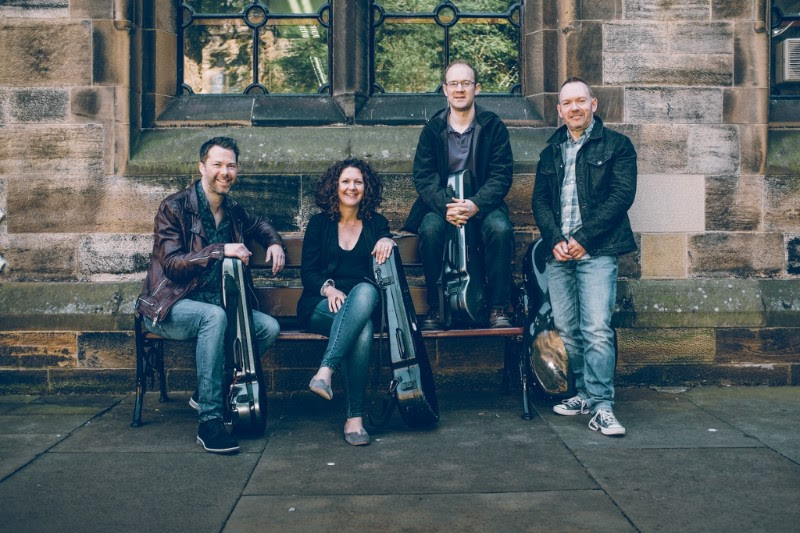
The Edinburgh Quartet. Photo: EQ.

“Intimacy and Excellence”

Editorial Rating:  5 Stars

The Edinburgh Quartet premiered its 2015/2016 Season with not so much a concert as a cleverly curated musical event.

The theme of The Edinburgh Quartet’s first trimester is “Intimate Voices”.  First Violin Tristan Gurney introduced the evening by explaining that they wanted a theme that reflected the medium’s capacity for intimate expression, and that there were many composers who chose to write for it because of this intimacy at the very core of the musical experience.  They exploited this brilliantly with their choice of opening work, Janacek’s String Quartet No. 2, Intimate Letters.

Janacek’s work is rewarding but challenging, and to plunge headlong into this incredibly varied, complex and intense oeuvre at a rush hour 5.30pm concert after a hard day at the office would have been a lot to ask of even the most ardent fan.  So they didn’t.  They led us in gently, and it made for an informed, involved and thoroughly inclusive musical evening of delight and difference.

The band kicked off with a beautifully together, easy on the ear interpretation of a waltz by Janacek’s contemporary Dvorak, and you immediately had the confidence that here was a quartet at ease with themselves, their music and their audience. We relaxed. Then Tristan got us into Janacek with his pleasing Romance for Violin ( accompanied on piano by the versatile second violin Gordon Bragg).  In a bright move that greatly helped us all in the appreciation of the music that was to follow, Edinburgh Makar/Poet Laureate Ron Butlin introduced us to Janacek’s 11 year long,  passionate, barely requited and entirely platonic romance with Kamila Stosslova, and read extracts from his love letters, whose poignancy enhanced the accessibility of the music and put it in context.

And what music it was! A beautifully woven tapestry of multifarious musical styles reflecting the panoply of emotions this extraordinary love affair engendered: bold unison openings, contrasting with passages so quiet that they were barely audible; rich melodic lines; frantic near dissonance; folk song; all greater than the sum of its parts in a way reminiscent of Beethoven’s late quartets. All in, a four movement work of less than half an hour’s duration for just four instruments!

And last, but of course not least, the playing.  Sure, the string quartet is intimate, but it is also a quite disproportionately expressive genre.  The Edinburgh Quartet is a well honed team, delivering demanding notation, phrasing and bowing, including pizzicato and sul ponticello, with not only great capability but real understanding, anticipating and following each other and never absorbed in their own playing at the expense of the group. Yet still with first class individual flair.  Fiona Winning’s viola richly developing and sustaining the theme of Kamila from early on, with Mark Bailey’s cello in confident support and finally getting his moment of glory in the last movement.  The violins, leading, supporting, ducking and diving throughout this rich, multi faceted and immensely enjoyable work.  An artistic and audible treat.

Star (blue)Star (blue)Star (blue)Star (blue)Star (blue)

Reviewer: Charles Stokes (Seen 14 October)

Go to Edinburgh Quartet here.

Visit the Other archive.

Who’s Afraid of Virginia Woolf? (Bedlam: 13 – 17 October ’15)

zmNi2cSofHsDbaIu5q-ZCYi3vqRNwW5e63TtyzVN5zI,f1EKqPn7WaRX-pS8CIy4irpbv6ccB19vfHCH_eUY46U,D3UV8nQ7mgS7WOJ6yu2AIVkv_JjciZjbTs92rIMErL8,vNbY3VPQeN9NnOf0OBZQ5XYk4-h5o47OPKJJfiCgOVE

Henry Conklin as George and Caroline Elms as Martha.

“Courageous and spirited performance”

Editorial Rating: 4 Stars: Outstanding

There are drinks before a party and there are drinks after a party. The LADbible, a new source for Edinburgh49, lists ‘17 Things That Always Happen During Pre-Drinks’; but what about Post-Drinks? The lads should go back to George and Martha’s place and learn how Mom and Dad get down at two in the morning on a Saturday night. And then some. Don’t play these party games at home, boys and girls.

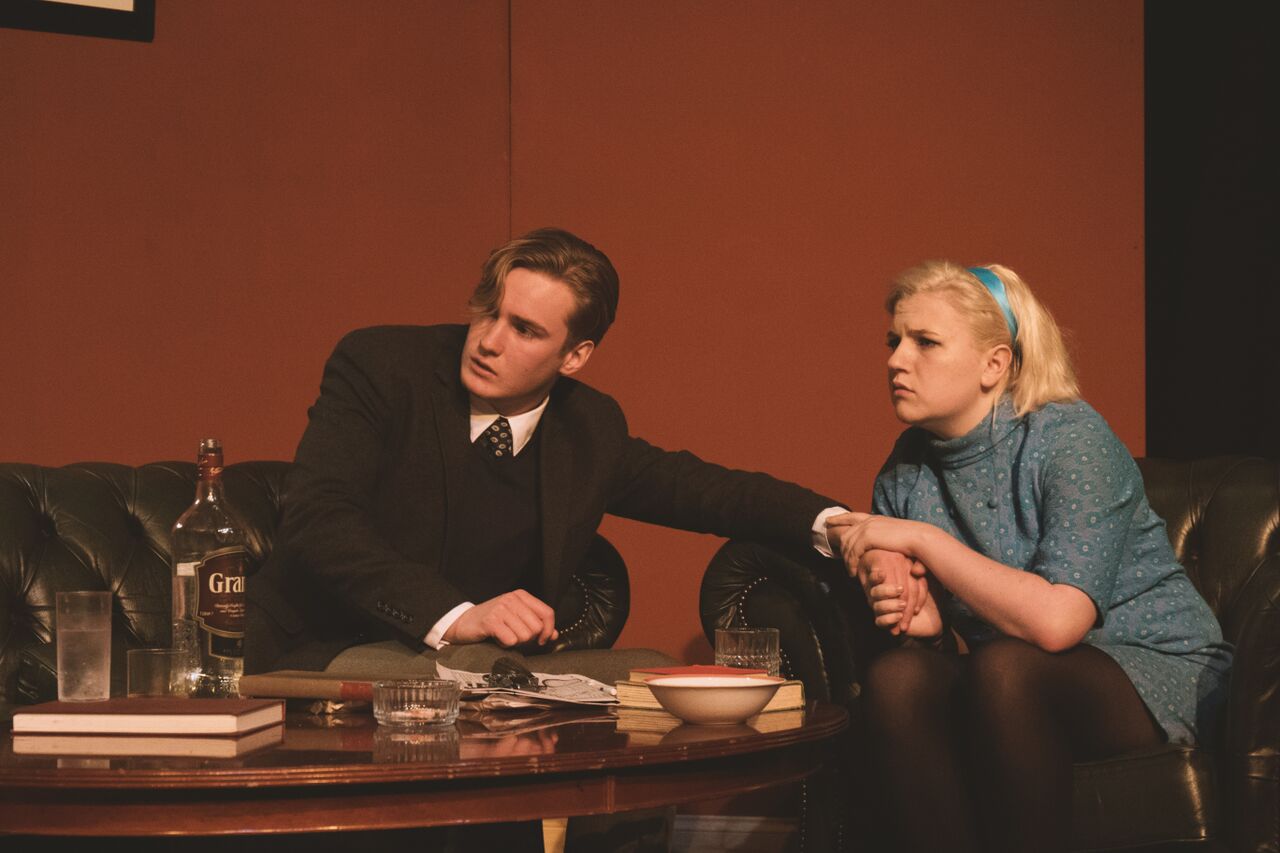
Edward Albee’s 1962 play is a lacerating shocker of a marriage on the rocks. Martha is 52, is really high-maintenance and has a nice line in mixing ice-cubes and tears. George is 46 and – to quote his wife – doesn’t “do anything; you never mix. You just sit around and talk”, which explains the two chesterfield sofas on stage but under-estimates by a long, long shot George’s mocking and mordant words. Total war is not declared until halfway through the second act but the skirmishing is unrelenting and bloody. When they are not ripping into each other they practice on their late night guests, Nick (30) and Honey (26), whom they have just met.

We’re in a small university town in New England where George hasn’t made professor in the History faculty, despite marrying the college President’s daughter, and Nick – fresh in from Kansas, blond and bright – has just joined the Biology Department.

It’s like Albee is swirling his first couple in a highball glass (and note the cheeky correspondence between George and Martha Washington …). Actors Henry Conklin and Caroline Elms give a performance of such fortified intensity that you wonder how they’ll recover. Conklin is the measured, oiled one, his level delivery only once or twice spilling into fury. Elms is more intemperate, emotionally more profligate, but still vulnerable. Albee would have her past her prime, which is tricky at the undergraduate stage, but then George is supposed to be thin and going grey. Neither performer worries about that and they give each other such a goddam kicking that not for one second did I doubt the wasted nature of their twenty-three years of marriage. Tender proof positive is provided by their exhausted, mutual dependence at the end.

Stephen MacLeod as Nick and Jodie Mitchell as Honey.

Macleod Stephen as Nick and Jodie Mitchell as Honey.

George calls Nick and Honey ‘children’ and they are: not so much innocent as defenceless. Jodie Mitchell plays Honey as – frankly – clueless and squiffy and there’s an honesty to it that is very appealing.  Macleod Stephen has the harder part, trying to stand against George, to withstand Martha (he flops) and manage several whisky sodas. Nick’s sudden understanding of the acute sadness that slashes through the whole action is important but was almost blindsided.

Director Pedro Leandro should be delighted with courageous and spirited performance. It is a long play but the tension held and what might have turned mannered and flat did not. The sofas, stage left, could have been more in the centre and I did miss Martha banging against the door chimes (my bad, I reckon) which needs to be seen to make sense of George’s ruthless masterplan to wipe her out.

Simon and Garfunkel’s The Dangling Conversation opens up the second act and is a pitch perfect choice. Remember the line, “Is the theatre really dead?” Well, it ain’t.

outstanding

StarStarStarStar

Reviewer: Alan Brown  (Seen 13 October)

Go to EUTC here

Visit the Bedlam archive.

Lord of the Flies (Festival Theatre: 13 – 17 October ’15)

Set design: Jon Bausor Photo: Regent's Park Theatre.

Set design: Jon Bausor
Photo: Regent’s Park Theatre.

“Big, bold and gutsy”

Editorial Rating: 3 Stars: Nae Bad

For me, with the May general election in mind, this is a timely production of Lord of the Flies: a charismatic, commanding and fear-mongering leader on one side; a righteous and idealistic leader who is unable to win mass support on the other; and one guy in the middle who doesn’t fit into either camp and who is killed off. I wonder if William Golding knew back then how important and relevant his book would still be 61 years after its publication. And that’s without postulating that Michael Gove might make a ‘good’ Beast. This Regent’s Park Theatre production certainly doesn’t shy away from the issues – it’s big, bold and gutsy, but in my opinion, tries too hard to make its point.

I must start with Jon Bausor’s design – the first thing you see on entering the auditorium. It’s visually spectacular, with the focal point being a very believable carcass of a crashed aeroplane to one side, strewn with suitcases. On the other a sizable ramp leads up and off, and everything is surrounded by trees and hanging branches in Naturalistic style. Yet while stunning, I felt the set ended up being too much of a dominating presence, causing unnecessary overlaps with different scenes occurring concurrently (and confusingly) in the same part of the stage. I would have preferred a more mapped-out use of the space to clearly define the different locations in the story and help distinguish the separateness inherent in the characters.

One of this production’s strengths was the energy and dynamism with which the warrior-like sections were portrayed. With frantic movement, chanting, and a commanding performance from Freddie Watkins as ringleader Jack, these moments were terrifying and powerful, and an effective glimpse into what a group of boys might turn into without effective parenting. Indeed, this interpretation puts Jack’s character front and centre (rather than Ralph’s), giving more focus to the brutality of the boys’ behaviour throughout.

However, some of the effectiveness of the “savagery” was lost given a distinct lack of contrasting moments of quietness and subtlety. I found the whole thing too unnecessarily shouty: Piggy and Ralph would communicate in raised and pained voices when alone. Commands were all aggressive, and fright seemed to always be expressed very loudly. Even the Officer shouted all of his lines, reducing his status to that of the children, when his presence could have been communicated far more effectively through physicality and control.

Anthony Roberts as Piggy.

Anthony Roberts as Piggy.

In saying that, there were occasions where the dynamic changed to great effect: early in the second act when Ralph and Piggy discuss how to get Piggy’s glasses back is a rare glimpse of depth and subtlety in performance style, allowing the audience to connect with these two as different from the others. It’s a shame this technique wasn’t used more in the first half of the production. Anthony Roberts gave a valiant performance as Piggy, and I would have liked to have seen more of him.

The sound and lighting were both excellent in supporting the action and setting the scene, and the occasional music added to the ambience without being overpowering. The evolution, down the way, in costume and makeup to underline each character’s descent into savagery was clever and effective. That all went to show that clearly a lot of thought and creative energy has been put into this production, but for me a couple of big flaws hold it back from being remarkable.

nae bad_blue

Star (blue)Star (blue)Star (blue)

Reviewer: Steve Griffin (Seen 13 October)

Go to ‘Lord of the Flies’ at the Festival Theatre

Visit the Festival Theatre archive.

The Seagull (Bedlam: 7 – 8 October ’15)

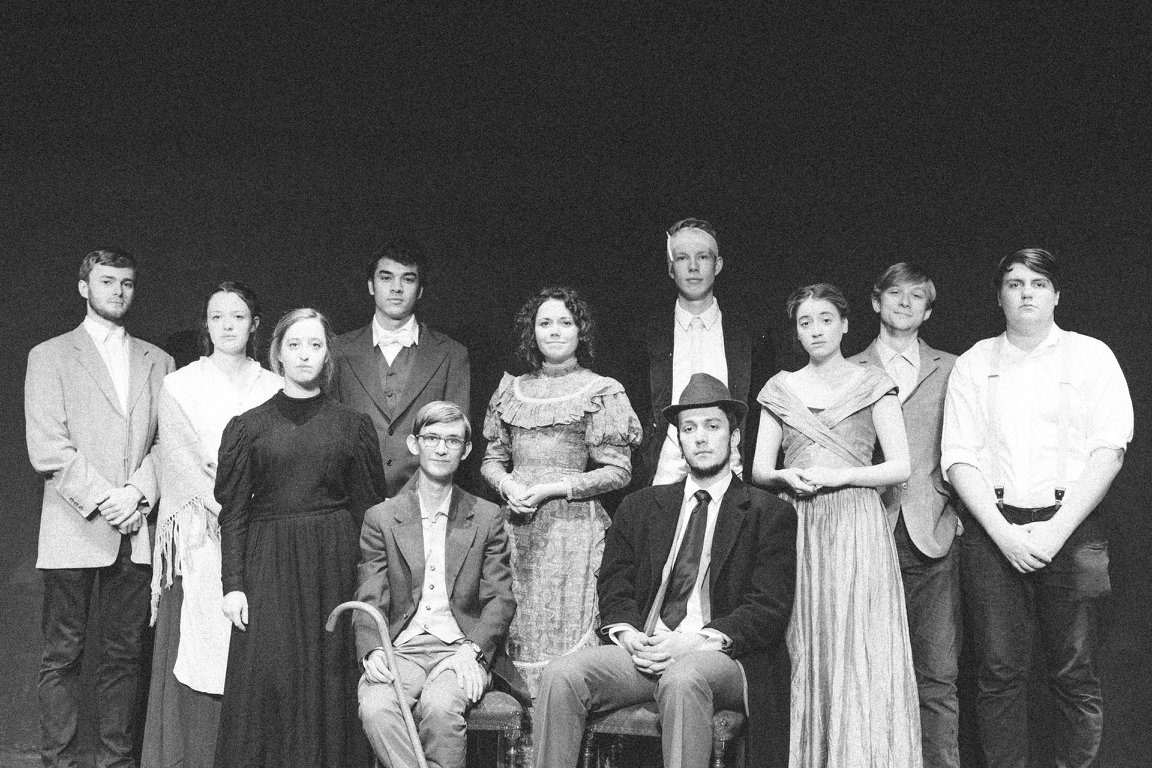
The cast. Photo: EUTC Facebook page.

The cast.
Photo: EUTC Facebook page.

“Enlivening”

Editorial Rating: 4 Stars Nae Bad

At a guess, the Scottish Seabird Centre in North Berwick is not a must-go destination for students. Well, maybe directors Holly Marsden and Kathryn Salmond are the happy exception for their production of The Seagull gets as up close and personal as the centre’s webcams. And, critically, it does so unencumbered by tradition. No sentimental guano here.

Don’t get me wrong. This Seagull does the business: it’s intelligent, funny and sad – but it is also grounded and plain. Nina’s lofty ‘I am a seagull … No, that’s not it’ is lost on the wind (or cut) and her fraught state at the end of the play is all the more effective for being low-key.

Leave the real emoting to Konstantin (Douglas Clark), who does a fine, anguished job of it – just as he did as Alan Strang in Equus in March. It is not so much an uptight, stressy, performance as an upright one: earnest, principled, and lonely. Kostia stands apart as young and intense, a little weird, which goes down well with an EUTC audience. Chekhov is suitably amended. Where, back then, Kostia left university in his 3rd year ‘owing to circumstances’; now he did politics at uni. and got nowhere.

A seagull is still the emblem of the Moscow Arts Theatre and it is appealing to see how the play is up to date. There’s embattled youth with dreams and no prospects; parent(s) brittle with glee and anxiety and a professional class whose diplomas are looking tired and whose pensions are meagre. Town and country are miles apart and there is the constant engagement with what pays and what doesn’t. There’s even bingo and the fortunate winner who takes all, including the girl.

For Kostia, theatre just exists as nice vistas in abstracted space, which is a cheerless and absent place to be. It is more enlivening, by far, to stay in the company of others. There’s uncle Sorin, played with bleak glee by William Hughes; doctor Dorn, a gently sardonic Finlay McAfee; and the famous literary cad Trigorin, whom a soulful Jonathan Ip rescues from the censure that he probably deserves. However, it’s the women who really people the stage: Arkadina, Kostia’s impossible, self-absorbed mother, is strongly played by Elske Waite; Nina, lovely and brave, is a beautifully articulate Katya Morrison; and an unerring Sally Pendleton is the trapped but resolute Masha. I thought all three performers offered a junior master class in diction.

Of especial note in a solid, more than pleasing production was the spare quality of the costume and stage set. For once the doors opened and shut without shaking the ‘walls’ and a single fireplace, a table and a few chairs proved just enough.

We’re told that this is the first time that The Seagull has been put on at Bedlam. I’d be happy to see it or its relations fly back soon. Three Sisters, anyone?

nae bad_blue

Star (blue)Star (blue)Star (blue)Star (blue)

Reviewer: Alan Brown  (Seen 8 October)

Go to Bedlam Theatre and the Edinburgh University Theatre Company here.

Visit the Bedlam archive.