The Crucible (The Lyceum 18 Feb – 19 March ’16)

https://i.guim.co.uk/img/media/250f6b044fc785f891c930dbd8326ddbf5d7351e/125_403_5364_3222/master/5364.jpg?w=620&q=85&auto=format&sharp=10&s=83ea0e1bac8ee60cbbf8c5a0a8815ec7

“Just as bleak and brilliant as Miller’s tragedy demands”

Editorial Rating:  4 Stars Nae Bad

Nothing says “a good night” like unchecked hysteria, unopened hearts and unnecessary hangings. That’s why I’m always excited to see a production of Arthur Miller’s “The Crucible”, and even moreso in the beautiful Lyceum theatre. But does Mark Thomson’s staging of Miller’s work deserve a standing ovation or a slipknot? The star rating above may be a small clue as to which is true: this was a beautiful, if flawed, production of a well beloved American classic.

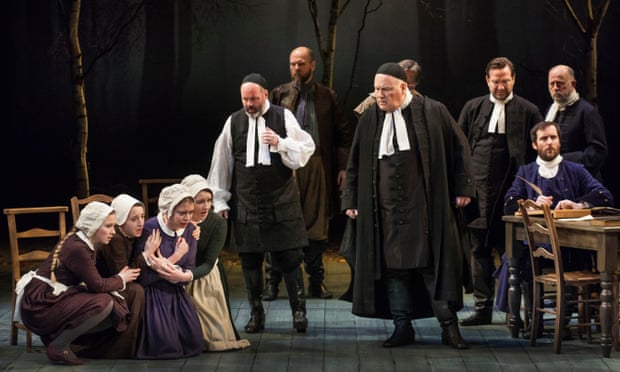
Set in the year 1692, ‘The Crucible’ follows the path of destruction wreaked by mass hysteria, lust and shame in the town of Salem, Massachusetts. As rumours of witchcraft fly and secret affairs are uncovered, what begins as a simple dance in the woods becomes a matter of law, life and death. Lighthearted stuff.

As you might imagine, Miller’s classic demands atmosphere. From the outset, it’s clear that Thomson has a knack for choosing set designers. It’s not often I open with talk about the furniture, but I was extremely impressed with the quiet ingenuity of Crucible’s set. From the authentic, rustic comfort of the Proctor house to the cold rigidity of the courthouse, each setting hit all the marks in terms of visuals. But even further, it wasn’t just pretty – the use of space was downright clever. Each little quadrant of the stage was self-contained enough to render smaller scenes intimate, and yet interconnected enough to make group sections seem cavernously intimidating. And the use of trees for scenery and blocking lent what felt like meters of depth to a finite stage. For set alone, this show ticked all the boxes.

But luckily, the set isn’t all I’ve got to write happily about. As can be expected from the Lyceum, the acting talent on display is considerable – my personal MVP goes to David Beames as the most entertaining and human interpretation of Giles Corey I’ve seen yet. If I could pay him to narrate my life, you’d bet he’d never go hungry.

But aside from pure entertainment value, I was most impressed by Richard Conlon as Reverend John Hale. When I first read The Crucible, I disliked Hale. I thought he was two-dimensional and boring – but none of these problems so much as touch Conlon. No other portrayal of the character has been as compelling or realistic as his, and I’ve similarly never felt for Hale as much as I did in this production. The emotional depth, the body language, the subtle vocal tics; they all come together almost flawlessly. Fan-bloody-tastic.

Similarly, Philip Cairns shines as John Proctor, applying a great amount of force and raw emotion to the character’s more intense scenes. He moves from tenderness to scepticism to fury as if it were easy as breathing – though this is no doubt benefited from acting opposite the likes of Irene Allan as Elizabeth Proctor. The part of Elizabeth is by no means easy: showing an audience the culmination of years of insecurity and indecision without overacting is like slacklining drunk; that’s what I was so pleased to see how powerful the character was in Allan’s hands. Her final scene and famous closing lines gave me chills.

That same strength runs through the rest of the cast. Meghan Tyler as Abigail Williams is wonderfully duplicitous, mixing sensuousness with devious brutality in the same breath. The Putnams (Douglas Russell and Isabella Jarrett) are as abrasive as the narrative demands, and Greg Powrie’s Reverend Parris is pathetic is the best way possible. Even the young company capture the panic and vulnerability of young girls in the hard frontier of the American East.

So, with such a talented cast and clever design crew, why isn’t this a five star show? Predictably, there are always a few flies in the soup.

As a general note, whilst the accent work at play generally good, it was prone to slippage. Often, the cadence showed more sense than the characters by fleeing from Massachusetts to upstate New York – and, on occasion, Cairns’ Bostonian drawl threatened to slide into a strange mix of Henry Kissinger and Arnold Schwarzenegger. Whilst it won’t bother the average Brit theatregoer, those more familiar with the voices of the new world may find it slightly grating.

Furthermore, I had a huge problem with the sound design. Whilst at times it was a dramatically advantageous decision, at others (especially in the courtroom scenes) it was, at best, a distraction and at worst it utterly broke the tension and dramatic pacing of the scene. I found myself consciously wondering why on earth a scene of screaming hysterics and implied cold-blooded murder for the sake of sex was accompanied by a pleasant violin trill in a major key. In any other show this might not be such a large issue, but in one which is so dependent on atmosphere and audience absorption, it gets amplified.

And it’s in the hysteria that we find my biggest complaint with the production. Whilst certain scenes were certainly not lacking in gravitas, the play’s overall arc of tension was patchy. Some sections jump from being devoid of dread to bursting with it – instead of a steadily escalating fever pitch, it jumps from extreme to extreme.

Unfortunately, this also wasn’t helped by the fact that it felt strangely static at points, as if all the fear had been sucked out of the room. There’s a difference between strained silence and dull quiet, and sometimes this production seemed to confuse them.

Do I think these flaws ruined The Crucible? Far from it. Mark Thomson’s formidable cast rides out the few choppy waves this show presented, and Miller’s famous talent for dialogue is hardly diminished. There are definitely more strengths to this production than weaknesses, and the audience chatter at both the interval and end attest to that fact.

If you get the chance, definitely give The Crucible a look. It’s a production that never fails to entertain whether you’re a Miller virgin or a die-hard fan. Though perhaps a little clunky in the seams, the overall fabric of the show is just as bleak and brilliant as it Miller’s tragedy demands. You might not see Sarah Good with the devil, but you’ll definitely see a strong production.

nae bad_blue

Star (blue)Star (blue)Star (blue)Star (blue)

Reviewer: Jacob Close (Seen 20 February)

Visit the The Lyceum archive.

THIS REVIEW HAS NOT BEEN SUBEDITED

Guys & Dolls (Church Hill Theatre, 9-13 Feb. ’16)

Adam Makepeace as Nicely Nicely Johnson

Adam Makepeace as Nicely Nicely Johnson

“A feel-good romp of a show”

Editorial Rating: 4 Stars: Nae Bad

Guys & Dolls has a special place in my heart, as it was my first footlights show at university some ten years ago. I remember the hours I spent rehearsing the gruelling dance sequences and complex harmonies, so I was amazed at how well this cast of Edinburgh University students delivered on both counts. The scene in Havana was perhaps a bit ambitious choreographically and could have contained more progression and showpiece moments, but overall the chorus numbers were performed with great vim and pizazz.

The stars of show also delivered with aplomb. Ellie Millar as Sgt Sarah Brown had a voice that danced with the purity and clarity worthy of a leading lady, and her rendition of If I Were a Bell struck a fine balance between comedy and stunning vocal range. Oliver Barker oozed with masculinity and presence as Sky Masterson, while Tom Whiston brought a likeable naivety to Nathan Detroit. Mae Hearons was a delight as Miss Adelaide, and really came into her own in act two with a string of dazzling songs.

While the vocals across the board during the first half of the production were a little shaky (I’ll put it down to nerves in front of a packed house early in the run), the second half was littered with many a five-star moment, including Adelaide’s moving second lament, a Sinatra-esque Luck Be a Lady, and the precise and energetic Crapshooters Ballet. However, for me, the vocal performance of the night was by Adam Makepeace as Nicely Nicely Johnson, who delivered a rousing and extremely capable rendition of the tricky Sit Down You’re Rockin’ the Boat. A special mention also to Tilly Bartholomew as Arvide Abernathy, who was charming and note perfect in More I Cannot Wish You, and displayed great tenderness and well-placed comedy throughout the performance.

This show aimed to take the original musical back to its roots in the 1930s, and some nice touches in Grace Dickson’s choreography – particularly in Take Back Your Mink – felt very reminiscent of that golden era. Director Lucy Evans also cast some females in traditionally male roles as a nod to some of the period’s female gangsters, and, while a brave choice, I felt Evans could have gone one step further in allowing these characters to explore their femininity and interact with the male characters as women, rather than women pretending to be men. Still, Lila Pitcher was commanding as Chicago big-shot Big Jule in an interesting gender twist.

Yet for all the great work by the performers and band (who never faltered under Steven Segaud’s masterful musical direction), I was a little disappointed in the production values of the set and costumes. These elements were quite basic, and with a bit more attention could have added much more “wow factor” and style to be sympathetic to the show’s overall creative aims and chosen time period.

All-in-all, a feel-good romp of a show. Don’t gamble – buy a ticket.

nae bad_blue

Star (blue)Star (blue)Star (blue)Star (blue)

Reviewer: Steve Griffin (Seen 10 February)

Go to the Edinburgh University Footlights

Visit the Church Hill Theatre  archive.

The James Plays (Festival Theatre: 3 – 13 Feb.’16)

Steven Miller (James I) Photo Tommy Ga-Ken Wan

Steven Miller (James I) Photo Tommy Ga-Ken Wan

“‘On you go then, son. On you go. You can do it’.”

Editorial Rating: 4 Stars: Nae Bad

‘Poisoned dresses are something out of children’s stories … if you want to kill her. Put a knife in her’, which would explain, right enough, why there is a whopping great sword on the boards. Still, The James Plays do imply – with a nod and a wink and a catchy dance step – that the Scots are one wicked antidote to the English. They also, with stirring ease, bring on guid strong women. Admire (or not) the toxic fortitude and murderous determinations of James I, II, and III but applaud Queens Joan, Mary and Margaret and give thanks for Annabella, Meg and Phemy.

There is no shortage of bloodletting in Rona Munro’s gutsy trilogy of how to keep head and crown together – in fact the ginormous sword runs with the red stuff – but actually the property of the piece is the kist in the bedroom. That’s ‘proper furniture’ [that chest], with a hundred uses’. You can hide a boy king in it for a start – and ‘drop it out of the window and brain any bastard climbing up the castle’. Munro’s writing is like that: hands-on, unhesitating and constructive.

Best, if you can, to see the plays in order – that’s from 1420 to 1488; and although they’re too inventive and complete to be Horrible Histories they do, in their savage and entertaining scenes, come pretty close: in James I, for instance, when Walter Stewart nails horseshoes to the hands and feet of one of his tenants, old Ada, for scolding him; or in James II when the young king peeks out of his kist to see his mother about to have sex with her ‘protector’ John Stewart. Too many Stewarts? Well, there’s always a Douglas on the make and by the time of the bi-sexual James III, there’s his lover, architect Cochrane, and fine wine and madrigals before all else, especially trying to rule Scotland.

Laurie Sansom’s convinced direction and Jon Bausor’s set design, with drawbridge, allow a febrile exchange between private and public space. The royal four-poster is closely guarded and/or spied upon, take your pick, and the king swings his sword on its canopy. When Parliament assembles it is alongside an audience on stage. The throne is up there too, occasionally occupied, but the space also doubles as a tower room where Isabella Stewart is held captive and spins out her prophetic misery.

Blythe Duff (Isabella Stewart) in James I_& II Photo Tommy Ga-Ken Wan

Blythe Duff (Isabella Stewart) in James I & II Photo Tommy Ga-Ken Wan

That’s Blythe Duff as Isabella and as Annabella in James III and it is, again, a terrific performance. She reprises the roles from the original 2014 production with the same astringent glee and love. She’s there at the very end, dressing the new king with clothes and jewels and with an absolute definition of understatement: ‘On you go then, son. On you go. You can do it’.

And, yes, these dramatised chronicles do at times go on … and on. The squabbling lords might get to you, as they certainly did to James III, or it might just be that the set-piece addresses to the Three (male) Estates are too PC, too YES-NO referendum freighted for your taste, or that you find staged medieval football awkward, but then there’s the wheel of fortune to turn and it’s a mighty one to get going and even harder to brake. These are, after all, history plays and since when were they short and sweet?

Matthew Pidgeon (King James III) in James III_ Photo Tommy Ga-Ken Wan

Matthew Pidgeon (King James III) in James III
Photo Tommy Ga-Ken Wan

Go into the National Museum of Scotland, as I did in-between plays. You’ll find wolves on level 1, ‘Beginnings’, and they certainly belong in the nightmare sequences of James II, but search further and there ain’t too much in the Kingdom of the Scots: one small panel for each of ‘our’ Jamies and arrowheads from the walls of Threave Castle. More fun certainly, more knowledge possibly, is to be had watching Peter Forbes as gross, droll, Balvenie stacking up the Douglas lands; or see Dani Heron as Phemy, 15, assault a guard who’s presuming to search the queen’s rooms. Ballsy! And then there are the sovereign roles: Steven Miller as James I, the poet king, keyed up, commanding in the thick of it but who would have given everything to pen ‘Love, love me do’ in his time; rangy Andrew Rothney as James II, damaged and vulnerable, but who has that majesty thing ; and Matthew Pidgeon as James III, truth seeker, rascal man, outrageous king in black patent winklepickers , only matched by his virtuous Danish queen, Margaret, played by Swedish actress Malin Crepin, naturally.

I saw The James Plays in 2014, when I had been reviewing Fringe shows, and was disconcerted by the numbers on stage and by the sheer size of the venture. In review terms it was a stand-off. Now, second time around, I’d call it all audacious and vivid. Showstoppers with attitude.

nae bad_blue

Star (blue)Star (blue)Star (blue)Star (blue)

Reviewer: Alan Brown (Seen 6 February)

Go to The James Plays at the Festival Theatre and to the National Theatre of Scotland

Visit Edinburgh49’s Festival Theatre archive.

The Pillowman (Bedlam Theatre 2 – 6 Feb. ’16)

Scott Meenan as Katurian. Photo: Mollie Hodkinson

 “This show  will wring the life out of you, in the best way possible.”

Editorial Rating: 4 Stars Outstanding

Pillowman is to dark comedy what heroin is to vapor rub. Martin McDonagh’s tale of bloody flesh and fairytales is dark, dirty and sometimes barefacedly brutal – and in the hands of director Emily Aboud, often stingingly clever as well.

Set in a faceless concrete prison, ‘Pillowman’ tells the story of writer Katurian questioned about gory child murders strongly resembling the short stories he writes. Throw in a heaping helping of torture, a pinch of weirdly psychotic police banter and as much moral relativism as you can stomach, and you’ve got a play which (despite quite a few good laughs) stays tensely uncomfortable the entire way through. Make no mistakes: this show  will wring the life out of you, in the best way possible.

But a script without a director doesn’t get too far, and with Emily Aboud returning to the stage after her barnstorming production of Equus, there’s never any doubt it’s in safe hands. Apart from some strangely static blocking at the beginning, her overall vision for the production strikes gold: McDonagh’s work feels just as grittily surreal as it should.

And on the note of surreality, the set for this production is a gem- it’s not often I’ve seen twists dependent entirely on clever set design, let alone done so with such skill. There were some design choices, though, which seemed less prudent than others: a series of videos projected onto the stage wall would have had twice the impact if performed live. Whilst the presentation detracted nothing, it was slightly disappointing to think of its potential. And to sound designer Alex Greenwald, I’ll say only this: The low ambient drone? Fantastically slithery.

Luckily, the propitious problem of wasted potential is brilliantly absent from the cast. Theatre veteran Scott Meenan captures the quiet intensity of Katurian excellently. Subtle yet passionate is a hard duality to pull off, so it was a joy to see it done so well. And even more so when combined with Douglas Clark as Michal: the burden of the fool in black comedy is a heavy one, but Clark makes the part feel as natural as breathing.

Hot off the heels of EUSOG’s Addams Family, Esmee Cook expertly runs the emotional gamut as wonderfully sadistic second-in-command Ariel – but the indisputable star of the police parade is Paddy Echlin as Detective Tupolski. Sardonic and hilariously removed from normal logic, Echlin dominated the stage whenever his annoyingly wrong tie came flapping through the set doors.

The supporting cast were noticeably solid, especially in terms of physical theatre – Sian Davies in particular has a peculiar knack for playing tragically adorable kids.

With such energy and dynamism throughout, however, it was a disappointment to see the production fall into the trap of lengthy and jarring set changes. For a piece which, in every other aspect, set up a wonderfully naturalistic and believable surreality of tone, these seemed like a strange choice. They were luckily few and far between, but are still a bit like stopping a delicious meal to eat a couple of handfuls of packing peanuts.

Overall, I was impressed by Pillowman. It has creative and well-crafted direction and maintains the kind of thick atmosphere most other shows could only dream of (although, making the Bedlam Theatre feel like a freezing cell requires little help). Combine with stellar acting and a well-chosen crew, and you’ve got a production that’ll knock your socks off  –  and then probably strangle you with them, but still.


outstanding

StarStarStarStar

Reviewer: Jacob Close (Seen 3 February)

Go to Pillowman at Bedlam here.

Visit Edinburgh49’s Bedlam archive.

The Table (Traverse, 3rd Feb ’16) part of the Manipulate visual theatre festival

Edinburgh, UK. 17/08/2011. Fringe First winners, Blind Summit, present "The Table", starring Moses, the Bunraku table puppet, who is ably assisted into being by Mark Down, Nick Barnes and Sean Garratt. Photo credit: Jane Hobson

“One of the most wonderful performances I have ever witnessed”

Editorial Rating: 5 Stars: Outstanding

One table, one puppet, three men, no strings. And one of the most wonderful performances I have ever witnessed.

While it might seem quite basic, this spectacular puppet show (which could also be classified as stand-up comedy – more on that later) is a tour-de-force in keeping theatre simple yet incredibly effective. Within seconds, the carefully constructed cardboard face and cloth body became an intriguing old man whose every word and movement held me completely captive. And for a show an hour long, that’s no mean feat for something with no pulse.

The puppet began by introducing us to his table – his home – pointing out the garden, his vegetable patch, and where it might be extended to grow more carrots. All the while, he kept us entertained with witticisms most comedians would be proud of, and a dash of audience interaction to keep us all on our toes. And it’s all delivered so naturally, I was completely transported into the world of the table.

Yet while the slow and sometimes inappropriate ponderings of a confused old man were a delight in themselves, the crux of the performance lay in its original purpose – to retell the story of Moses’ saving of the Israelites and his eventual death on the mountainside. In this guise we see him humble, we see him angry and we see him defeated. We see him battle against the elements and lie down to sleep (which is far more difficult for a puppet than it may be assumed). And when he finally leaves the table, I genuinely felt lost and upset to say goodbye. Perhaps this says something about my childish tendencies, but the sell-out crowd of all ages seemed just as moved as I was.

The hands and voice behind this masterpiece – Nick Barnes, Mark Down and Sean Garratt – lovingly move every centimetre of the puppet with precision in care, and always in sync, down to their own breathing. What was particularly enjoyable about their roles were the playful and apparently improvised moments of the show, where the performers joked with and challenged each other to keep up with the pace. At one stage the poor puppet’s hand fell off, probably by accident, but this was covered and managed very well, even if the performers found themselves creasing up with infectious laughter.

About two minutes in I was hooked and thought this show has the potential to launch itself into my top ten favourite things I’ve ever seen on stage, and by the end it had firmly secured its place. Simply masterful.

outstanding

StarStarStarStarStar

Reviewer: Steve Griffin (Seen 3 February)

Go to The Table at Manipulate and Blind Summit

VisitVisit Edinburgh49’s  Traverse archive.

Macbeth: Without Words (Traverse, 2nd Feb ’16) – part of the Manipulate visual theatre festival

Sandra Franco photo. Ludens Ensemble

Sandra Franco photo.
Ludens Ensemble

“A compelling, highly intelligent and creative retelling of the famous story”

Editorial Rating: 4 Stars: Outstanding

Macbeth: Without Words is one of those shows you see from time to time where you can’t quite decide if you love or hate it. It’s gutsy, original, and a full-on hour long assault of the senses that I couldn’t take my eyes off.

The piece starts with one actor, in a corset and clown make-up, leaping around the stage acrobatically before picking up a microphone and making a range of strange noises. Those with a more traditional perspective on Shakespearian theatre might baulk at the very interpretative style, which I’ll admit took some getting used to, but what unfolded was a compelling, highly intelligent and creative retelling of the famous story.

It is a very physical performance, as it needs to be to convey the monstrous action. There is no spoken dialogue. The dexterity of performers was sensational, as the cast of three managed to create almost every character from the play – all identifiable through their physicality and token elements of props and costume. Stand out moments included the initial stabbing of the king silhouetted through a plastic sheet, and Lady Macbeth appearing through that same plastic sheet towards the end, in all her ghostly presence.

Although without speech, it was not without noise; and many of the sounds were created by the performers live – either vocalised into microphones or using various banging, rubbing and scraping of props and instruments. The layering and looping of these created fantastic tension and atmosphere, with a real sense of baleful magic and connection between the performers and the action. Given how powerful this technique was, especially at the beginning where a complex soundscape was created very simply, it was a shame that for some scenes the company relied on pre-recorded sound, leaving me feeling a little bit cheated. At one point a recording of bagpipes was played, and I felt the company – in Edinburgh of all places – missed a trick.

It was also disappointing that for a show pertaining to be “without words”, that short excerpts from the script were occasionally projected onto a screen to clarify the action on stage. I admit that the task to portray every nuance of Shakepeare’s work without any words at all is nigh-on impossible, but in some scenes it was done so well – the incantations of the witches, the murders, the washing of the hands, the breaking of the news – all performed using physicality, silhouette and props,  that it was such a shame that the company “copped out” in those rare moments. It seemed that with a little bit more work or development the company will have created a piece truly “without words” and fit for any European Capital of Culture.

This could have been one of those mind-blowing, life-changing performances that I’ll never forget, but unfortunately, those few flaws held it back somewhat. Still, ‘tis far from a sorry sight and overall the battle was far more won than lost.

outstanding

StarStarStarStar

Reviewer: Steve Griffin (Seen 2 February)

Go to Macbeth: Without Words at Manipulate

Visit Edinburgh49’s Traverse archive

LoopsEnd (Traverse, 2nd Feb ’16)

LoopsEnd

“A visual feast”

Editorial Rating: 3 Stars: Outstanding

I have seen many spectacular aerial displays over the years, from companies all over the world,  and with their latest work, LoopsEnd, Edinburgh and LA based Paper Doll Militia is definitely right up there with the best of them in terms of risk, precision and wow-factor. However, while technically the gymnastics were great, I was a bit disappointed by the overall cohesion of the work.

A performance in two parts, the first half, Ashes, was inspired by the tearing down of an industrial estate where the group used to rehearse. The main visual element of the piece was two long ropes hanging from the rigging, twisted and weighted down with bags of powder. Even watching the ropes untwist and retwist in the empty space was graceful and compelling, and when combined with George Tarbuck’s stunning lighting design and the trademark tricks and treats of a seasoned aerial company, this piece was, at times, nothing short of a visual feast.

Throughout the performance, white powder was used in various ways to represent the “ashes” – one performer literally had a pile on his shoulders in the opening sequence, while the closing image was of the two bags attached to the hanging ropes slowly emptying as the ropes swung in the space. These individual instances were very powerful visually, but it was difficult to see the link between these, and any sort of narrative or progression within the piece. Indeed, many of the “theatrical” devices seemed under-developed and incomplete: there were too many moments of clichéd wide-eyed wonder and writhing around in angst, and at one point one performer walked back and forward many times, overtly undecided about whether to touch the rope. Such basic and overused devices unfortunately offset the splendorous vision of the other sections.

In the second piece, Unhinged XY, projection was also used, which in some ways added another dimension to the visual smorgasbaord, but in others gave a seemingly unnecessary layer of complexity and confusion to the action – again, it often wasn’t clear how the costumes, music, acrobatics, projections and design all married up.

The aerial silk work in this piece, and the use of wind and fabric combined to make some stunning visuals and standout moments. When one performer walked up a hanging piece of silk, weighted at the bottom by another, while competing with gusts around her, I was awestruck by the strength and artistry on show.

It was a bit of a shame that both pieces relied quite so heavily on overpowering recorded sound and music. While at some points it was great in setting and supporting the overall tone of each section, its constant use meant the work was unable to establish a mood for itself, so I would have preferred a more selective and sensitive approach to the aural aspects of the performance.

Overall, there’s no denying the talent and visual creativity that have earned Paper Doll Militia their excellent reputation. However, LoopsEnd left me somewhat hanging in mid-air, rather than applauding with my feet flat on the ground.

outstanding

StarStarStar

Reviewer: Steve Griffin (Seen 2 February)

Go to Paper Doll Militia

Visit Edinburgh49‘s  Traverse archive.


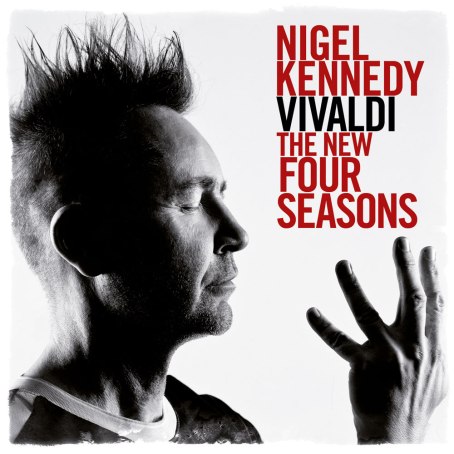
Nigel Kennedy: The New Four Seasons + Nigel Kennedy Dedications (Usher Hall: 27 Jan. ’16)


Editorial Rating: 5 Stars:  Outstanding

“Superlative musicianship … beautiful music from about two inches of steel E string  “

“Have you got anything by Nigel Kennedy?”  the enthusiastic lady said to the bemused shop assistant in the HMV Record Store, Oxford Street, some thirty years ago.  Mostly people asked for music by title or by composer, and when  by artist only those of a more traditional, established genre.  Here was a new phenomenon: the classical musician as rockstar.  Since then, more have come.  But Kennedy was the trailblazer.

It has been greatly to Kennedy’s credit that his unconventional dress sense and stage demeanour (fist bumps, shouts, foot stamping et al) has not got in the way of his superlative musicianship.  Yes, he has succeeded in making classical music more attainable, but not by getting into crossover or dumbing down.  Notwithstanding the informal approach, he has always taken his music intensely seriously.  Comparisons may be odious, but Joshua Bell played the Usher Hall a couple of weeks ago.  Both players are at the top of their game.  But I know who nailed it. 

Wednesday’s programme was a music critic’s nightmare.  None of the works (apart from the original ‘Four Seasons’)  is in the public domain (for once, Grove failed to come to the rescue) and the programme notes contained nothing about the music, just biographies of the band, a largely Polish contingent of exceptional ability.  I was on my own.

Never fear, Nigel introduced the pieces and in every one you could see where he was coming from.  First off was an Amuse bouche of a Bach partita that threw the theme back and forth between violin and cello, exquisitely played with a real bond between the star and talented acolyte Peter Adams.

There then followed four of Kennedy’s own compositions.  Dia Jarka, dedicated to contemporary guitarist/composer Jarek Smetana –  and as far as we can tell, no relation to Bedrich – had the guitars and double bass laying down a raga style line, with nuances of the Beatles’ Maharishi phase.   Stephane Grappelli was a folk/jazz fusion as one might expect, but not in the “swing” Grappelli style; more intense. Kennedy’s relationship with Grappelli, was, of course, similarly deep, from when he first disobeyed the orders of his over strict teachers at the Juilliard to go on stage to play jazz with the old man at Carnegie Hall, with brandy having been taken to steady the nerves as he risked expulsion.  One is reminded of Nureyev in his early days rebelling against the Kirov. Different political system; similar didactic musical approach.

For Isaac Stern came next with a beautiful interpolation of violin and viola, followed by a tribute to American bluegrass composer/violinist Mark O’Connor with the unusual but effective combination of violin, bowed double bass and guitar.

After some playful fooling around deceiving the audience they were going to hear more, Kennedy made the audience friendly announcement “Ladies and gentleman it is my sad duty to stop playing and let you go to the bar”.  So we did.

The second half was Kennedy’s signature piece, The Four Seasons, but in his own arrangement for strings, two guitars and piano.  It worked. Antonio Vivaldi would not be so much as turning in his grave as wanting to get out of it so that he could join the party.  There followed some forty five minutes of “extras” – one would hardly call them encores because they were generously offered without the audience asking, and a near three hour set was concluded with a sublime rendition of the Londonderry Air, taking it right up into the highest register (could it have been eleventh position?) and Kennedy still getting beautiful music from about two inches of steel E string.  I was reminded, perhaps not too strangely, how the Rolling Stones played way over time at Wembley in 1990 having had to finish early the previous evening.  Oh, Danny Boy, we were sorry to see him go, but, boy, had we had our money’s worth!

outstanding

StarStarStarStarStar

Reviewer: Charles Stokes (Seen 27 January)

Visit the Usher Hall

The Weir (Lyceum: 15 Jan – 6 Feb. ’16)

l to r. Lucianne McEvoy, Darragh Kelly, Brian Gleeson, Frank McCuster, Gary Lydon. Photo. Drew Farrell

l to r. Lucianne McEvoy, Darragh Kelly, Brian Gleeson, Frank McCuster, Gary Lydon.
Photos. Drew Farrell

“You will not want to let these characters go home”

Editorial Rating:  4 Stars: Outstanding

For an Irish play set in an out of the way bar, The Weir is pretty sobering. That it is also witty, articulate, and beset by place, loss and sprites is less of a surprise. Writer Conor McPherson has serious form by now when it comes to the dregs of self at the bottom of a glass,  or more cheerfully, to the poetry in the head of a creamy pint of Guinness.

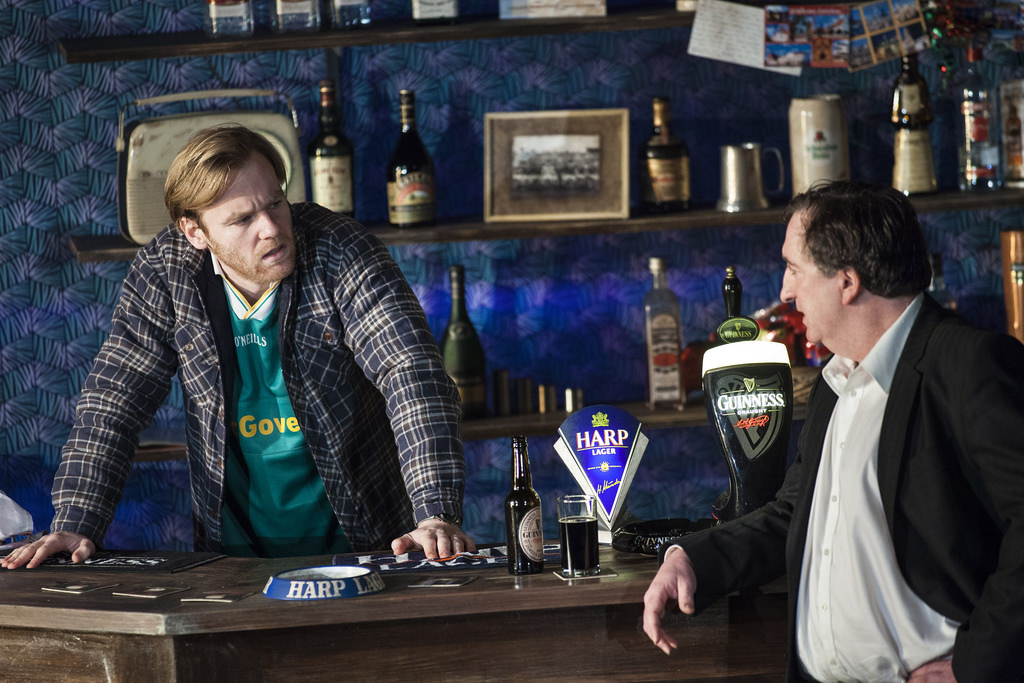
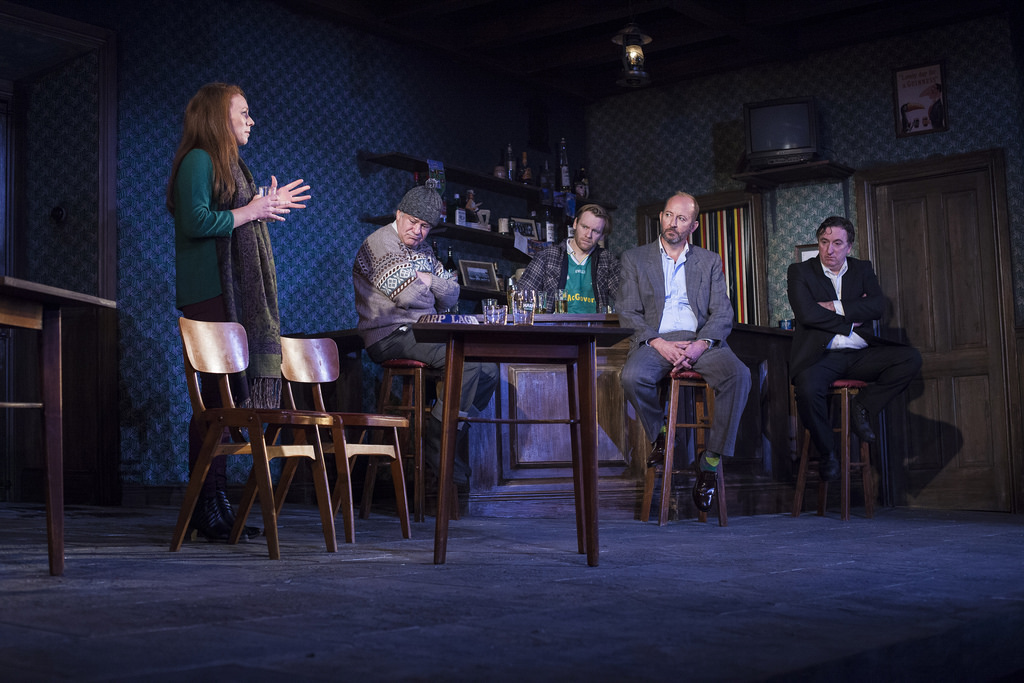
Except that the Guinness in Brendan’s bar is ‘off’ because the fecking tap is broken. Jack has to help himself to a bottle (it’s that kind of village pub); Finbar’s ok because he’s become a tad more sophisticated and drinks Harp Lager; Jim, gentle soul, is happy with small chasers; Brendan is pleased to keep them company; and Valerie, well, she’s down from Dublin and might stay a while. She has a white wine – awkward – poured in a straight glass. There is no smoking ban yet and Designer Francis O’Connor has the craic curling across a wide, low beamed, space with the telegraph poles leaning drunkenly outside. There is a television above the bar but it’s a careful, appealing touch when Jack reaches up to switch off the rugby – it might have been gaelic football. The reception was bad anyway.

Nothing interferes with the story telling and there is no interval. First, Jack with his faerie road and spooky knocks at the door; then Finbar, with a terrifying old woman on the stairs; then Jim’s unwitting shocker in the graveyard that summons Valerie’s nightmare; and finally, cleverly, at the fireside, it’s back to Jack as he mournfully recalls his lost chance at love and marriage. Each tale is far too enthralling, too involving and heartfelt, to be contained as a monologue. The silence after Valerie’s story is literally stunning. Director Amanda Gaughan lets it down evocatively, rendering the men helpless in their sympathy.

McPherson’s achievement is to write bar stool conversation that is as moreish as good peanuts, wholesome against the odds. And the Irish cast are very, very good at helping themselves: Gary Lydon as Jack, sturdy, crumpled; Darragh Kelly as Jim, fond, credulous; Brian Gleeson (yes, son of ….) as Brendan, open, obliging; Lucianne McEvoy as Valerie, injured, self-possessed. And Frank McCusker as Finbar, whose equable, decent, tones stay short of the self-satisfied.

Brian Gleeson, Brendan, and Gary Lydon as Jack. Harp Lager and Draught Guinness as themselves.

Brian Gleeson, Brendan, and Gary Lydon as Jack.
Harp Lager and Draught Guinness as themselves.

‘The Weir’ was written in 1997, enjoyed immediate success and has attracted lyrical approval thereafter. Personally, I’ll play safe and just recognise how companionable a piece it is. You will not want to let these characters go home in the rain*. Single men, who know each other well, have gathered hospitably, stood each other a drink (or two), and have talked idly. However, there is the one woman amongst them and it’s Valerie who’s channeling the hard stuff.

(*Too tempting, sorry, not to cross -reference to Seamus Heaney’s Casualty from a darker period whose subject is the ‘Dawn-sniffing revenant’ plodding home from the pub in midnight rain.)


outstanding

StarStarStarStar

Reviewer: Alan Brown (Seen 19 January)

Go to The Weir

Visit the The Lyceum  archive.
The Academy of Saint Martin In The Fields (Usher Hall: 10 January 2016)

Image: ASMF org.

Image: ASMF org.

“The quality of the playing was at a consistently high standard throughout.”

Editorial Rating:  4 Stars:  Nae Bad

A cold wet sleety January afternoon did not deter the hardy Edinburgh cognoscenti from gathering eagerly and loudly in the foyer of the Usher Hall on Sunday.  The Hall’s Twitter feed had advised  the 250 or so who had arranged to pick up their tickets from the box office to come early because of demand.  To begin with this certainly stopped the ticket queue from standing in the rain, and one got the impression the queue wouldn’t have minded anyway, but by 2.45pm the line was well out of the doors.

The draw was, of course, The Academy of Saint Martin In The Fields, perhaps the finest chamber orchestra in the world, now undergoing a new lease of life under the directorship of player/conductor Joshua Bell, subway busker and near megastar. Bell was certainly a brilliant catch for this magnificent band after Sir Neville Marriner’s retirement four years ago.

The other huge name on the bill was cellist Steven Isserlis, again, world class in stature.  The combined group are on a UK and European Tour, and it was Edinburgh’s turn to hear the magic.

The programme selection was both esoteric and matinee attractive.  The concert was relatively short, at a total of less than an hour and a half’s playing time, but nobody left feeling they had been short changed.  In art, as perhaps in matters of the heart, it is not so much the duration, but the intensity of the experience that provides the enduring memory.

The programme began with a snippet by Dvorak, “Silent Woods”, originally  “Waldesruhe”, a piece for piano for four hands, later transcribed for cello, and ultimately for cello and orchestra, which was the version we heard. Quiet, gentle, soothing, with flavours, understandably, of Smetana’s Ma Vlast, one wondered whether this lullaby-like jewel, played with such beguiling ease, would send the postprandial audience to sleep.

If it did (and the enthusiastic applause suggested otherwise) the blast of Beethoven’s Eighth Symphony would have them wide awake in no time.  This is not a great symphony, and apart from the lively Allegro vivace con brio, which the orchestra delivered in cracking form, the remaining three movements (a comment on the composition, not the playing), save for a spirited final Allegro vivace, plodded along a little.

After the interval we were treated to the second movement from Schumann’s posthumously published violin concerto,  along with a tiny but fascinating codetta written by Benjamin Britten.  Ten minutes of understated, beautiful playing, with Bell the absolute master of his art.

The concert ended with the “must have” item, the Brahms Double Concerto for Violin, Cello and Orchestra. What followed was secure, utterly capable ensemble playing with the two soloists interweaving with each other as warp and weft.  There was none of the stodginess you sometimes get in Brahm’s full on orchestration with the band moving nimbly through the familiar passages in support of the soloists.

Overall, not only did this concert have eminent soloists and an interesting programme, the quality of the playing was at a consistently high standard throughout.  At the time of their foundation 55 years ago, Sir Neville Marriner promised that the Academy would never go on stage unless thoroughly rehearsed.  True today as it was then, what we got was  not so much a concert as a performance, in the truest and fullest sense of the word.

nae bad_blue

Star (blue)Star (blue)Star (blue)Star (blue)

Reviewer: Charles Stokes (Seen 10 January)

Go to the Academy of St Martin’s in the Field.

Visit the Usher Hall and archive.