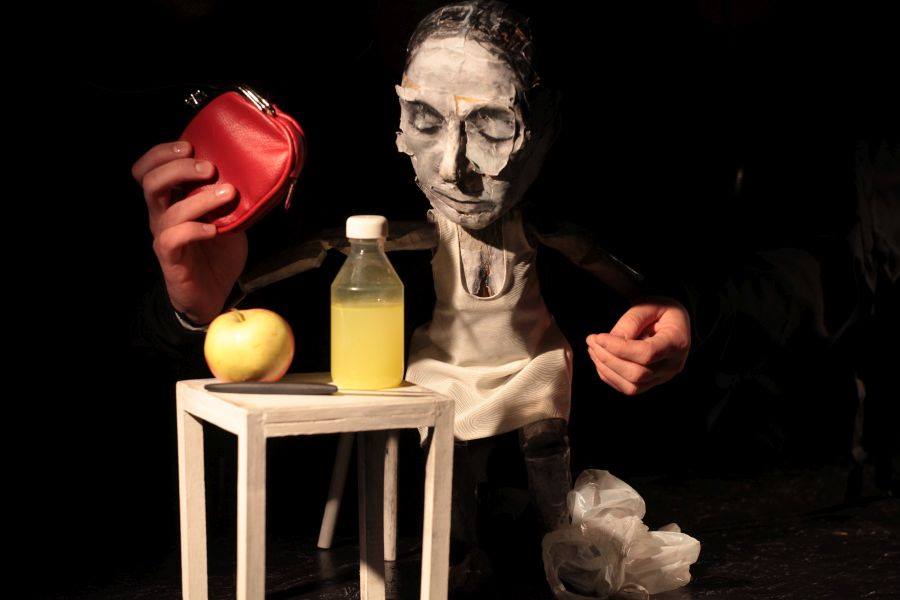
Tracks of the Winter Bear (Traverse: 9- 24 December ’15)

Traverse Theatre

Traverse Theatre

“Cool and works a treat”

Editorial Rating: 4 Stars: Nae Bad

Now here’s a frosty cracker of a show in two acts: Act 1 written by Stephen Greenhorn and directed by Zinnie Harris; Act 2, written by Rona Munro and directed by Orla O’Loughlin. Each Act tells a different story with different characters but pull them apart and – with a muffled bang – you get a Christmas message and a novelty polar bear torch. There’s a ginormous bear as well, but that would explode the cracker idea way beyond belief.

As last year, with The Devil Masters, we’re close to home but it’s the sanctimonious New Town no more; no, it’s Craigmillar, Abbeyhill, and on the beach at Portobello. Act 1 opens up high, probably on the Crags, looking ‘down there’ on Edinburgh. Act 2, for the most part, is up a hillside but closes on a tenement stair. It is most definitely winter in both acts. You can almost hear the soft snow crunch beneath the boots – and it stays white n’ even – and there are bare trees suspended from the sky. Kai Fischer (Designer) and Simon Wilkinson (Lighting) make it blue and cold and pretty empty. But there’s keen writing, much humour, a lot of tenderness and a finely attuned soundscape from David Paul Jones. And the audience is close-in on both sides of a narrow traverse stage, behind scrim gauze, which is cool and works a treat.
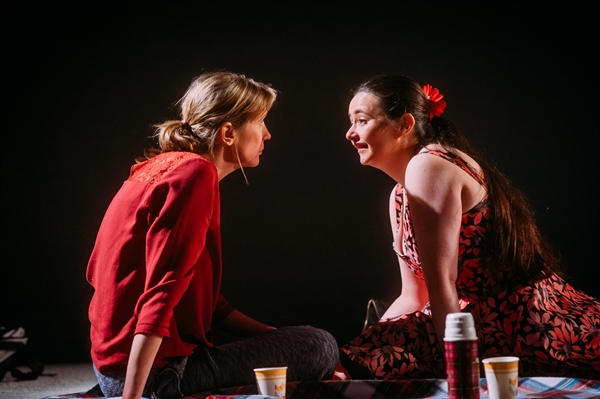
Deborah Arnott and Karen Bartke Photos: Mihaela Bodlovic

Deborah Arnott and Karen Bartke
Photos: Mihaela Bodlovic

Act 1, Greenhorn’s work, is the love story of Shula (Deborah Arnott) and Avril (Karen Bartke). Shula went away after exams and came back to find Avril married to Craig, which both women find hard to take. ‘How to cope?’ falls somewhere between nostalgia and vodka, which makes it a slightly unsteady mix of the sad and the satisfying. The story is told in retrospective snatches of memory and loss. Arnott does forsaken and hurt very well; whilst Bartke has the gentler, healing role. Watch out too for the graveside wit of Mairi (Kathryn Howden) as she tends the memory of her Donald.

Act 2, Munro’s piece, is funnier, more outrageous. Jackie (Kathryn Howden again) has had enough of being Mrs Claus in a tacky Winter Wonderland but along comes her one big ‘wee adventure’ involving a killer polar bear with a bloodcurdling roar and a fantastic nose for shortbread. As Jackie mentioned Snowball cocktails, I thought Advocaat, and then of Dutch author Hans de Beer’s lovely Little Polar Bear stories; and indeed Munro’s bear (a magnificently swaddled Caroline Deyga) is a kind creature, once she has digested and expressed the men in her life, but I still wouldn’t bring susceptible children to this show.

Kathryn Howden and Caroline Deyga

Kathryn Howden and Caroline Deyga

‘Look at you!’ calls out a delighted Jackie as she passes under the Bridges. She is, naturally, on the back of a polar bear and having a whale of a time. No doubt the water is freezing but I still found the Tracks of the Winter Bear to be peculiarly heart-warming, which is always good at this time of year.

 

nae bad_blue

Star (blue)Star (blue)Star (blue)Star (blue)

Reviewer: Alan Brown (Seen 9 December)

Go to Tracks of the Winter Bear

Visit the Traverse archive
Snow White and the Seven Dwarfs (King’s Theatre: 28 Nov. ’15 – 17 Jan. ’16)

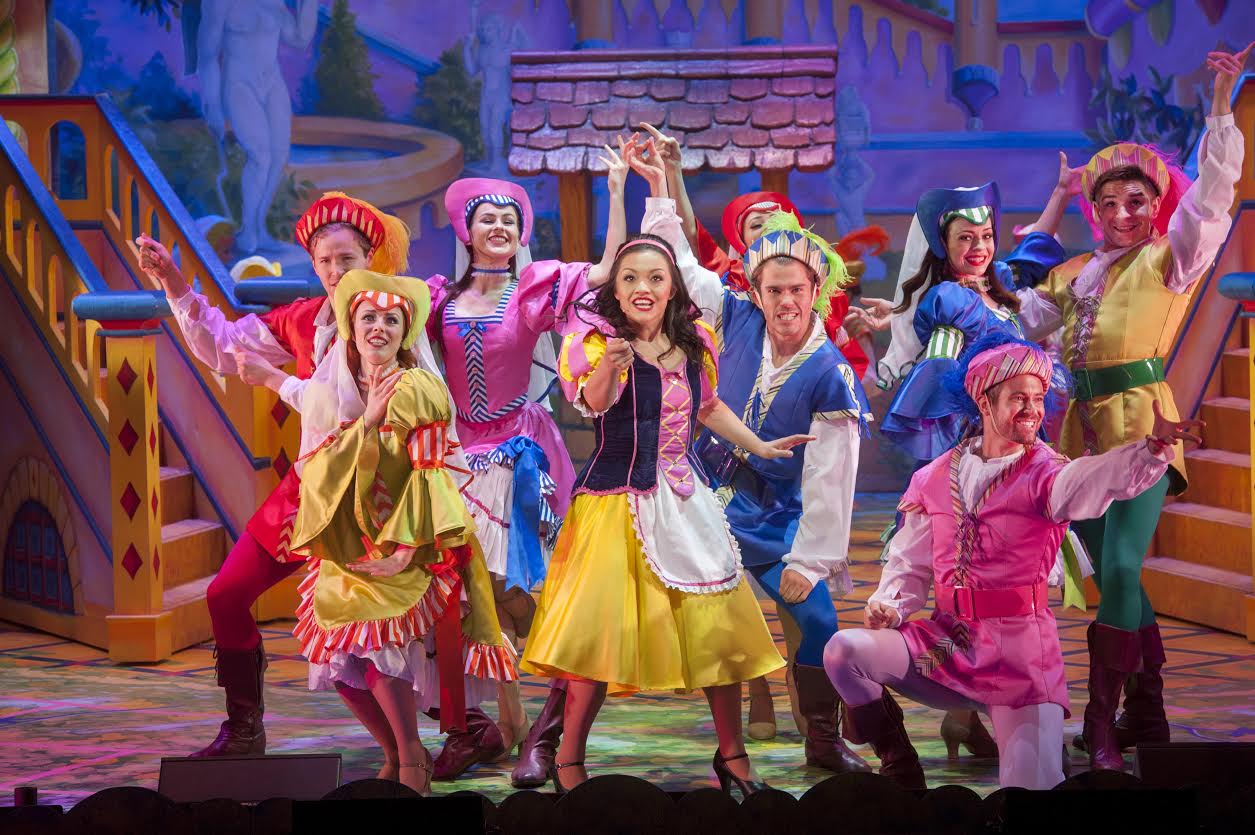
Frances Mayli McCann as Snow White with Ensemble. Photos by Douglas Robertson

Frances Mayli McCann as Snow White with Ensemble.
Photos by Douglas Robertson

“Packed with laughs for audiences of all ages”

Editorial Rating: 4 Stars: Outstanding

I’ll admit, ever since the age of about 9, panto has never been very near the top of the list of my favourite art forms. And it’s true that I do tend to like my theatre a bit more high-brow. In saying that, this panto all but shattered my age-old preconceptions by being very, very funny, and at the same time embodying surprisingly high production values.

Where to start, but with Edinburgh’s pantomime royalty – Grant Stott, Allan Stewart and Andy Gray. Their on-stage chemistry is just as visible as they say it is, with lots of friendly jibes and presence that oozed confidence and star quality. The banter between them was great, and their improvisation and cover-up skills were spot-on. Stewart in particular impressed as Nurse May, with a dazzling array of seamless costume changes and a likeability that almost made the stage feel instantly more alive whenever he was on it.

Andy Gray, Allan Stewart and Grant Stott.

Andy Gray, Grant Stott and Allan Stewart.

Both Greg Barrowman as Prince Hamish and Frances Mayli McCann as Snow White also impressed with powerful singing voices, and their personalities perfectly balanced out those of their more esteemed cast members. But for me it was the dwarfs who stole the show, in particular the scene where they were riding an array of animals, and I was disappointed these characters were not used more often. The troupe showed fantastic energy and comic timing, and brought the ridiculous hilarity already on display to new heights every time they made an entrance (or exit!).

The script wasn’t so much littered as smothered with witty one-liners, topical references, football jokes, and a healthy sprinkling of good old-fashioned farce. Indeed, this show certainly has a bit of everything for the little’uns and their respective elders: there’s flying, dinosaurs, pyrotechnics, colourful costumes and a touch of audience interaction. I defy anyone not to giggle at at least one element of this offering.

The musical numbers were all delivered with aplomb, with dance sequences many grades above the step-ball-change choreography I was expecting. Song selection (mainly covers of popular songs) often seemed shoehorned in for the spectacle, but then again, one doesn’t go to panto for that. Still, the music was upbeat, in tune and full of fun.

I can forgive that the structure was a bit all over the place, that some of the scenes between the fab three bordered very closely on self-indulgent, and the almost never-ending rendition of a well-known Christmas song towards the end. It’s a show packed with laughs for audiences of all ages, and brings a lot of sparkle to brighten even the hardest of hearts. Oh yes it does!

outstanding

StarStarStarStar

Reviewer: Steve Griffin (Seen 8 December)

Go to Snow White and the Seven Dwarfs.

Visit the King’s Theatre archive.

The Lion, the Witch and the Wardrobe (Lyceum: 28 Nov.’15 – 3 Jan.’16)

l.tor: Charlotte Miranda Smith as Susan, Ben Onwukwe as Aslan, and Claire-Marie Sneddon as Lucy. Photos. Royal Lyceum Theatre.

l.tor: Charlotte Miranda Smith as Susan, Ben Onwukwe as Aslan, and Claire-Marie Sneddon as Lucy.
Photos. Royal Lyceum Theatre.

“Fantastical adventure and heart”

Editorial Rating: 4 Stars: Outstanding

Allegory or not, “It’s [still] a magic wardrobe. There’s a wood inside it, and it’s snowing, and there’s a faun and a witch and it’s called Narnia. Come and see.”

And enchanting it certainly is. This 2009 adaptation follows the adventures of four WWII evacuees as they travel through the wardrobe and discover the mysterious, wintry world of Narnia, encountering everything from witches to talking lions, to Father Christmas. C S Lewis’ wondrous story is expertly captured on the Lyceum stage by director Andrew Panton, and is an absolute triumph of a Christmas show.

The one thing that is immediately evident is how polished a production this is. Each scene change is almost like an smooth apparition; as if in some transitory dream, the audience move from one moment to the next without really knowing how they got there, and it’s wonderful. As the oak-panelled set opens out to reveal Narnia for the first time, one cannot help but gasp – with the younger audience – at the intricate display on stage: snow falls and coats the floor in a sparkling white blanket; tall icy trees seem to go on forever and that iconic lamp post glows in the shadows, waiting patiently for Mr Tumnus to appear. The impressive set is further complimented by sumptuous costume design, particularly in that of the animals. Mr and Mrs Beaver and Aslan the Lion are brought to life not only through their physicality but also through that wardrobe, but literally this time.

Stunning set and faithful costume aside, it is the strength of the cast that bring the real magic to this production. Special commendation must go to James Rottger, Charlotte Miranda Smith, Christian Ortega and Claire-Marie Sneddon, playing children Peter, Susan, Edmond and Lucy, respectively. As an audience member, there is often an underlying fear when watching adult actors in child roles as, if poorly performed, it can often remove you from the story. Yet this troupe executes their performances with such a warm and honest vulnerability that it is impossible not to be drawn into their adventure.

This childlike wondering proves all the more effective through the addition of song to the narrative. While some numbers do feel unnecessary, they do give the show another dimension of fantastical adventure and heart. After defeating the Witch, and the cast start singing the words, “You can’t know, but you can believe”, the spellworking in the theatre is almost palpable, and it is hard to suppress the urge to wave back at Aslan and the faun as they bid their farewell to their audience.

As stage magic goes, cutting the mustard might be up there as tricky; and evil White Witch (Pauline Knowles) has trouble living the part that is forever Tilda Swinton’s. A chilling performance works for her at times but it is often ambushed by pantomime warmth and is limited by the reach and power of the virtuous characters.

However, this is holy Advent time and this is a lovely production of a miraculous story that will delight the expectations of the children and grown-ups who come to see it.


outstanding

StarStarStarStar

Reviewer: Rachel Cram (Seen 4 December)

Go to The Lion, the Witch and the Wardrobe at the Lyceum.

Visit the The Lyceum archive.

‘The Great Train Race’ (Interchange, Galashiels: 29 Nov. ’15)

Ellie Zeegen and Simon Donaldson Photo: Firebrand Theatre

Ellie Zeegen and Simon Donaldson
Photo: Firebrand Theatre

“You might want to take sides and cheer your engine along”

Editorial Rating: 4 Stars: Outstanding

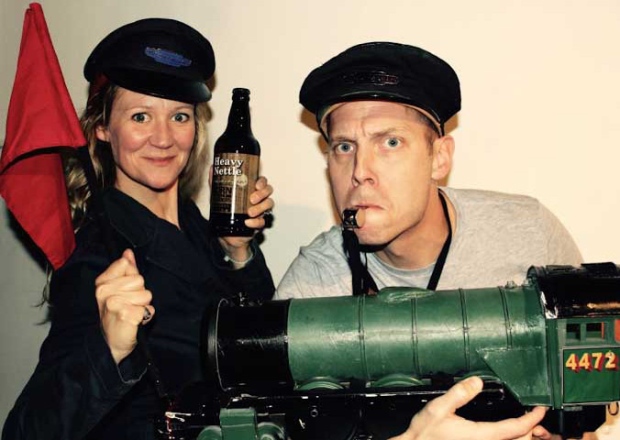
Where better to stage this play of trains than in a bus and railway station? And so to the impressive Galashiels Interchange, which may have a Borders postcode, but whose track once more runs straight to Edinburgh and onto the ED49 platform. The permanent way is back – ‘Hurrah!’ – and the winding A7 is properly historic.

Redoubled ‘Hurrahs!’ too for the return of Robert Dawson Scott’s 2013 flag waving, whistle tooting, tale of men and locomotives (and a gender bending signal box). It is the summer of 1895 and two railroad companies – the North British and the Caledonian – are competing to run the fastest overnight service between London and Aberdeen. They take different routes – up the east and west coasts respectively – but the two eventually converge at Kinnaber Junction, 38 miles from the finish, which is where the signal box comes in – big time. And, just to add to the headlong fun, there are no speedometers in the cabs.

This is main-line ‘Play, Pie and a Pint’: three actors and 45-50 minutes long, which happily enough is almost the journey time between Gala’ and Waverley on the Borders Railway. Could The Great Train Race be performed on a moving train? Maybe director Richard Baron entertained the idea and brought it to the (Fat) Controllers of ScotRail. Well, we do get a Sir Topham Hatt character of sorts, and the piece is staged in the rectangular ‘round’. Not exactly in a carriage but the action goes from side to side, round n’ round, with the passengers occasionally buffeted by the wind from a passing train. Never mind, you might be on a ‘Grouse Express’ and the shooting parties have lobster in their hampers. You might want to take sides and cheer your engine along or – more likely – just sit forward and enjoy a show performed at speed and with great, engaging, spirit.

It is easy to distinguish the actors. When they are not sporting beards or holding balloons or dumping ‘hot’ coals in your lap, livery is all. Ali Watt is decent Norrie, railway clerk of the North British. He has the uniform, English accent, and manners of a man who believes in the rulebook and in fair competition. Dumping timetables and ‘dropping’ stations is simply not on. On the other footplate, in overalls, is Cammie (Simon Donaldson, educ. Earlston High School), a fitter in the engine sheds whose speech runs more along the lines of “Yer dancer”, which to describe a 2-4-0 ‘Hardwicke’ locomotive is going some. In-between the two and indicatively Doric, stands Kinnaber (Ellie Zeegen), whose friendly and eager narrative is the coupling rod.

It is a chuffing good story, merrily told, and with such invention and detail that the Borders Railway might wish that they were passenger numbers. Oh, sorry, there are tales of overcrowding already; which is scarcely Firebrand Theatre’s fault.

outstanding

StarStarStarStar

Reviewer: Alan Brown (Seen 29 November)

Go to Firebrand Theatre


‘To Breathe’ (Summerhall: 24 – 28 Nov ’15)

To Breathe 1


Photography: Andrew Perry. Back line, l to r: Erin Whalley, Tiffany Soirat, Anna Elisabeth Thomsen. Front line, l to r, Adela Briansó, Lewis McDonald, Maddie Flint.

“Inventive and intriguing”

Editorial Rating: 3 Stars: Nae Bad

It’s not often you see student theatre groups perform original work with such a strong dance element, especially pieces on complex themes with so much thought behind them. They generally take hours upon hours to devise and rehearse, so one must give Theatre Paradok kudos for even getting to the startline of this show, and for packing Summerhall’s Demonstration Room to the rafters with an eager audience on a Thursday night.

Given the premise of To Breathe as a physical exploration of body and breath, to me it was a somewhat strange choice to develop it with a cast of performers with limited dance experience and training. The lack of finesse and technique on display in the more choreographed elements unfortunately detracted from what could have been a very powerful and moving (no pun intended) performance, and this was the lasting impression I took with me – a great concept, but perhaps slightly overreached.

As a theatrical spectacle, it was certainly very accomplished: it contained a lot of light and shade, tension and calm, with a good sense of progression and drive, and the performers’ ability to create changing moods seamlessly was very impressive. Early on the piece was very playful, and the performers raised several laughs in their innocent self-discovery, before moving onto more emotive storytelling. Rachel Stollery’s design really complemented the action, as did the subtle use of music, and with a healthy mix of ensemble and solo sections, structurally this show ticks all the boxes.

What the troupe may not have shown in dance technique or grace, they more than made up for in emotional intensity, concentration and sheer gumption. There was a great energy and spirit to the performance, with the whole company throwing themselves into it wholeheartedly. Maddie Flint in particular was utterly watchable throughout, with a very engaging and expressive face.


To Breathe 2

Lewis MacDonald and Tiffany Soirat

While choreographically it was a fairly safe piece (albeit with a few too many cliched motifs for my liking), there were moments of dramatic risk that were inventive and intriguing. In one of the duets (performed by Lewis McDonald and Tiffany Soirat) the dancers fought and tussled to cover each other in paint, in a sequence that was both passionate and very well controlled. There were some great lifts on show, and this section oozed with sexual chemistry. Later on, the dancers experimented with different movements with their hands in a pile of mud, which again showed great creativity, yet it was difficult to see the connection between this and the rest of the performance.

Overall, the heart and soul of this performance were absolutely in the right place – but I would have liked to have seen more focus on the dance elements to make it more complete.

nae bad_blue

Star (blue)Star (blue)Star (blue)

Reviewer: Steve Griffin (Seen 26 November)

Go to Theatre Paradok

Visit the Summerhall archive.

The Addams Family (Pleasance: 17 – 21 Nov ’15)

Photos: Oliver Buchanan

Photos: Oliver Buchanan

“Funny to the point of tears…”

Editorial Rating: 4 Stars Nae Bad

I hate The Addams Family theme song. It’s not that I think it’s bad, I think it’s too good. It’s every bit as iconic as it is catchy. No matter who you are or what you do, as soon as you hear that da da dadum *click click*, you’ll be reduced to a finger-snapping, grinning mess. Driving a car? Doesn’t matter. Operating heavy machinery? Tough luck nerd. You’re on a one way bus trip to Addams-town and there’s only one song playing on the radio.

And just as epochal is the tune’s creepy, kooky subject matter. The cemetery-dirt stained shoes of the Addams family are impossibly large ones to fill, and although EUSOG’s ambitious production fell an inch or two short of six feet under, it’s a performance so bouncy and entertaining that you’d hardly even notice.

It’s crisis in the Addams household: Wednesday (Ashleigh More) is growing up fast, and even worse, she’s fallen in love with a guy so normal he makes white bread look like a Harley Davidson. Now, his parents are coming to town, and the family needs to be on their best behaviour. It goes just about as well as it sounds like it might. It’s hardly a daring new direction in terms of plot cliché, but there are fine seeds growing in this well-trod ground.

From the outset, it’s very clear that this is a talented cast. Scott Meenan’s Gomez is an utter joy to watch, and an even greater one to listen to. His comic timing and twitchy crispness of movement enhanced an already impressively funny repertoire of gags. But even more impressive was his emotional range: it’s easy to tickle a funnybone, but less so to pull a heartstring.

And whilst Melani Carrie’s Morticia often lacked the steely, sultry smugness which forms the character’s backbone, it’s hard not to be blown away by her voice – not to mention her knack for latin footwork. She was very much the smoky family matriarch, but when next to Meenan, she seemed oddly muted. However, this never affected the performance to the point of becoming a significant problem, and all feelings of flatness were limited to the spoken portions of the show. When Carrie opens her mouth, it’s like being hit by a verbal sledgehammer.

Though perhaps more nuanced than the footwork was More’s Wednesday Addams. Although usually presented as a monotone proto-goth, I was pleasantly surprised by More’s characterization. She perfectly embodies the sense of being pulled in two directions, and manages to do so in such an entertaining and genuine way that it never falls into the usual trap of feeling hackneyed or trope-ish. This was an excellent performance in every sense – especially the oddly sweet chemistry between her and masochistic brother Pugsley (Holly Marsden).

Championing the side of “normalcy” is the impressive Nitai Levi; having traded his moody rocker persona a-la Rent for  wonderfully dorky fianceé Lucas, he provided a great foil for More’s Wednesday, delicately dancing the line between nerdily sincere and annoying. And it seems like the talent runs in the family: Mother Alice (Esmee Cook) and Father Mal (Patrick Wilmott) inject ever more laughter into what is already a show bursting at the seams.

Addams Family 2

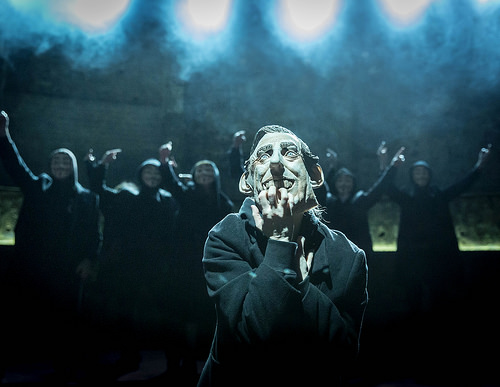
But if stealing a show was a jailable offence, Campbell Keith would be going away for a very long time. Acting as the show’s narrator, Keith’s Uncle Fester dominated the stage every time his weirdly pale head popped out of the wings. It’s hard to make a man who looks like Humpty Dumpty’s goth cousin charismatic, but I’ll be damned if he didn’t succeed.

But all the talent in the world, unfortunately, can’t control a tech setup. Whilst the swell of voices (especially thanks to the ghostly chorus of Ancestors) managed to rise above the band, the microphones were simply too quiet. I lost most of the lyrics in the first half, and the problem still persisted through some numbers in the second act.  And the lights, whilst vibrant and interesting, sometimes felt oddly out of sync with the action on stage. In isolation, either of these issues may not matter. But eventually, grains of sand do become a heap.

And although the chorus should be applauded for their brilliance in terms of both movement and vocal work, the choreography sometimes felt cluttered. There were times I was genuinely afraid an overenthusiastic kick might KO the cellist. Having fewer objects and people on stage may have helped this production breathe easy.

However, I’m loathe to admit the above for a number of reasons. The first being that it would be a crying shame to lose any of the strong chorus, and the masterful musical section – the former never faltering even in the show’s faster and more energetic sections. And secondly, changing the stage would mean altering the breathtakingly Burton-esque set dreamed up by Lu Kocaurek. I’d feel more comfortable pushing over a henge.

Although blighted by a few blips, this was a show more than worthy of its pedigree. Funny to the point of tears and touching to very much the same end, EUSOG’s Addams Family is just as creepy and kooky as that damned theme song promises. Check this one out while you can: Kate Pasola and Rebecca Simmonds have conjured up a brilliant show indeed.

nae bad_blue

Star (blue)Star (blue)Star (blue)Star (blue)

Reviewer: Jacob Close (Seen 17 November).

Go to EUSOG for The Addams Family & cast list.

Visit the  Pleasance archive.

King Charles III (Festival Theatre: 16 – 21 Nov ’15)

Photographs from the West End Production of 'Charles III' by Johan Persson

Photographs by Johan Persson from the West End Production of ‘King Charles III’

“The best of Shakespeare, bang up to date”

Editorial Rating: 4 Stars: Outstanding

Given how topical this production is, I still can’t quite get my head around why someone hasn’t thought of doing a play like this before. Yes, it’s daring and bound to spark discussion on either side of the Royalist debate, but perhaps that’s what makes it utterly ingenious.

Mike Bartlett’s script really is the star of the show – conceiving an idea both dangerous and compelling, that’s also utterly believable. That’s a mean enough feat for many a playwright, but then consider it is also written in Shakespearean style blank verse (with nods to more of his works than I could keep track of), bang up to date, witty, funny and gripping to the very last stage direction.

It’s cleverly structured to allow for scenes and opinions to unfold between all characters, and pacey enough to keep the action flowing, without ever cheating the audience of any details. I would have preferred more ensemble scenes to break up the endless soliloquies and duologues (again, very Will’), while a more contrasting sense of status between the Royals and others would have gone some way to create even more tension.

The style of the performance took some getting used to early on: interpretations of well-known people seemed over-theatricalised, while showing a distinct lack of respect to each other and occasion. This made it hard to engage with immediately, as I was expecting a subtler and more faithful approach to character. For this reason, for me it was the “made-up” characters of Mr Stevens (Giles Taylor) and Jess (Lucy Phelps) who rang most true, and achieved the optimum balance between the theatrical style of the script and connection with the audience.

Charles III 2

In saying that, the very beauty and intelligence of this piece is the subtle level of detachment from presenting something real and expected, to an exploration of imagination and possibility. Once this performance was in full swing, and I could appreciate the characters as part of an intriguing story (as opposed to what I would expect to see in real life), I was all but blown away by its power and craft. Ben Righton’s William was bang on the money in terms of character development throughout, progressing from stable wallflower to dominant leader, while the descent of Charles (Robert Powell) into public ridicule was nothing short of masterful.

If the King could grant me one wish, it would be to fast forward 100 years, when the population know comparatively little of our current royal family, and see how well it is received then. My money would be on it being viewed in the same way we lap up the best of Shakespeare today.

outstanding

StarStarStarStar

Reviewer: Steve Griffin (Seen 16 November)

Go to King Charles III at the Festival Theatre

Visit the Festival Theatre archive.

Hector (Traverse: 11 -12 Nov’15. Touring.)

Images: Peter Dibdin & Paul Davies.

Images: Peter Dibdin & Paul Davies.

“Distinct, succinct, and valuable”

Editorial Rating:  4 Stars: Nae Bad

Take two names of the same man, move him from Dingwall to Colombo, via Kandahar, Omdurman, and Bloemfontein, and you have an extraordinary life. It should be a history in an imperial sense – proud and impressive, monumentally worthy of respect – and in Scotland it surely is; but add sleazy allegations, the New York Herald, and a hotel bedroom in Paris and it’s all demeaned.

Born Eachann Gilleasbaig MacDhòmhnaill in Mulbuie on the Black Isle, Major General Sir Hector Archibald MacDonald shot himself in the head in the Hotel Regina on 25 March 1903. He was 50 years old. This distinct, succinct, and valuable play by David Gooderson, directed by Kate Nelson, would show how, in all likelihood, this came about.

There is a parade ground moment of wounding significance, there is a battle-field manoeuvre of astonishing derring-do, but actually it’s all set up in the mincing and treacherous line, ‘None of us would be called a fairy’, viciously twisted from ‘Three Little Maids from School Are We’. ‘Fighting Mac’, the crofter’s son from Ross-shire, had no defence against tittle-tattle and class prejudice. His face may have been on cigarette cards but the Governor’s wife cares only for (English) officers who can waltz.

https://i0.wp.com/www.tvbomb.co.uk/wp/wp-content/uploads/2015/10/Hector-1.jpg

Look at Hector MacDonald, courtesy of ebay, and see Steven Duffy – broad, ramrod straight, level gaze – but without sword, sash and medals. Actually, keeping uniform to plain khaki and the odd puttee is quietly effective, as is the Highland lilt to Hector’s voice. Fancy jackets, drawled vowels, a certain moneyed ease and a torpid morality are the property of the colonial administrators and the plantation owners. Valentine Hanson is especially conspicuous as the scheming Hugh Phipps and an excellent Kevin Lenon is the chaplain, possessed of a conscience certainly, but with not quite enough of it to do any good. The Governor (Stevie Hannon) and his frightful Lady (Gowan Calder) would curl their upper lips in disdain if they knew that Hector’s London home is in middle-class Dulwich. And Hector has another, much more precious secret that comes as a smart surprise early in the second half.

Ali MacLaurin’s serviceable set is out of a military transport: an unfussy assembly of crates, a desert-blown tarp across the back, boarding steps, and a larger, rectangular box that doubles as wardrobe and coffin. (Listen up for the time of Hector’s funeral. It’s both sad and scandalous.) There is a tantalising snatch of the pipes and drums, just possibly of  ‘The Black Bear’, but the fuller, evocative sound is of strathspey and reel and of gaelic song, beautifully gathered at the close.

My one gripe is with Lord Roberts, supposedly Hector’s army mentor and ally. He bellows a final order that in fact does for Hector. I would have thought it would have been a kinder encounter along the lines of, “Now see here, Archie, this wretched business has to be faced down ….” However, what do I know? David Gooderson has had to work on what is known of MacDonald’s last years when it is clear that relevant letters and papers were ‘lost’ or destroyed. Fortunately, Raj Ghatak, who plays Roberts, also has the much more sympathetic part of the local bank manager, Vikram.

Poppy Day,  introduced in 1919, came too late for Hector MacDonald, but for him (and for the Gordon Highlanders) here are the concluding sentences to the Government Commission’s report on his death:
‘…. We find that the late Sir Hector MacDonald has been cruelly assassinated by vile and slanderous tongues … we cannot but deplore the sad circumstances of the case that have fallen so disastrously on one whom we have found innocent of any crime attributed to him.’

nae bad_blue

Star (blue)Star (blue)Star (blue)Star (blue)

Reviewer: Alan Brown (Seen 11 November)

Go to ‘Hector’ at Ed Littlewood Productions.

Visit the Traverse archive.

Balladynas and Romances (Assembly Roxy: 9 -10 November ’15)

Aphrodite. Photos from Teatr Pinokio, Lodz.

Aphrodite.
Photos from Teatr Pinokio, Lodz.

“The clucking immortality that is forever C-3PO.”

Editorial Rating: 3 Stars  Nae Bad

My namesake, Alan, has had his own school of motoring in Edinburgh since 1979. He also advertises that a Polish instructor is available, Lekcje nauki jazdy w języku polskim. That would have been handy, off-road, for Balladynny i Romanse. But then in these fluent days the President of the European Council and former Prime Minister of Poland is a Donald, so what the hell …

… which brings me to the Roxy where – appropriate for an old church – heaven and hell congregate on earth in director Konrad Dworakowski’s immersive staging of the Ignacy Karpowicz novel. It is long at 135 minutes but is disciplined and expert. Go to the excellent Polish Book Institute for a useful synopsis of the book and be drawn to Karpowicz’s other work, not least ‘Uncool’ (2006); all still waiting for publication in English.

What we get in Balladynas and Romances on stage is, however, eminently translatable as it’s a classic ‘What If …?’  What if the gods drop in while we’re about our ordinary, sometimes tacky lives, in and out of Poundland (the cute Polish equivalent is Biedronka or ‘Ladybird’ ), in and out of each other – warning: puppets perform sex acts – and what if Athena, Aphrodite, Jesus, and the rest, are a bit cheap and maybe past their sell-by date? The answers are not hard to come by, as the gods are very visible and like talking about themselves, but it is tricky to see if Olga, Janek, Artur and Kama notice that their tawdry domesticity is being messed with. ‘A remote god [may] be a redundant one’ but it has long been our Fate – aka. the Occasional Narrator – not to realize that Eros or Lucifer happens to be in the front room.

Balladyny2

The little mortals are puppets and the gods are dressed in primary black and white, in bathrobes and shades for example. It provides for effective contrast(s), not least when Nike, god of Victory, tenderly cradles the tiny body of a bomb blast victim. Olga, Catholic, fifty something and living alone, undresses and takes a bath and her credulous faith is somehow all the more touching for being manipulated into being. It is the showy gods, though, who demand attention, dwelling as they do on their genealogy – which is a nightmare for Gender theorists – and selfish loves. Eros and Lucifer stand apart, interestingly, each musing on their lot; whilst Osiris’ slender shrouded form and huge eyes recalled the clucking immortality that is forever C-3PO.

Smart lighting and electronic music often snapped the piece back from self-indulgent space and without those puppets the drama would have died, which may well have been the point.

I missed Poland. Eros ruefully mentioned his adopted country at the end of the first half and there were, I’m sure, far more references available than I understood. I googled one Erika Steinbach when I got home and grasped why Old Nick, from Lodz, is a fan. Clearly Balladyna is important but her literary profile receded as, languorous yet scheming, she acted out her bridging role as demi-god fixer and apologist for the ills of the world. At one point, in marvellous conversation with an opinionated Chinese Fortune Cookie, she convinced me that Pinocchio Theatre really know what they are about.

Director: Konrad Dworakowski
Set designer: Marika Wojciechowska
Music: Piotr Klimek
Choreographer: Jacek Owczarek
Lighting director: Bary

Cast: Hanna Matusiak, Ewa Wróblewska, Żaneta Małkowska, Małgorzata Krawczenko, Mariusz Olbiński, Łukasz Bzura, Łukasz Batko, Natalia Wieciech, Anna Makowska.

nae bad_blue

Star (blue)Star (blue)Star (blue)

Reviewer: Alan Brown (Seen 9 November)

Go to ‘Balladynas and Romances’ at the Polish Cultural Institute & to Pinocchio Theatre, Lodz.

Visit the Assembly Roxy archive.

♫ Royal Scottish National Orchestra (Usher Hall: 6 Nov ’15)

“the playing was of the highest calibre…….”

Photo: RSNO.

Photo: RSNO.

 4 Stars:  Nae Bad

“If music be the food of love, play on…”  Yes, that’s from “Twelfth Night”, for love was the leitmotif of Friday evening’s RSNO concert at the Usher Hall, but the principal vehicle was that most famous love story of all, of Juliet and her Romeo.

While many others, from Gounod to Leonard Bernstein, have told this tale in musical form, there is no doubt that within the classical arena it is Tchaikovsky and Prokofiev who hold sway and these two were the chosen representatives for this part of the evening’s programme.

The concert opened with Tchaikovsky’s Romeo and Juliet Overture-Fantasy.  Tchaikovsky abandoned plans for an opera, never mind a ballet, and yet this 20 minute work is like a short, single movement symphony.  Not telling the story as such, it portrays its three main elements: the solemnity and compassion  of the Friar, the passion of the young lovers, and the festering hostility between the Montagues and Capulets.

RSNO Music Director Peter Oundjian chose to interpret this magnificent work conservatively and thereby avoided the emotion and thrills one might expect from, say, a Russian orchestra. As a consequence one found oneself wanting more, particularly from the all important flutes.  There were issues of balance among woodwind and brass, and a generally slow tempo.  Perhaps, inevitably, the band was settling in.

In between the Tchaikovsky and Prokofiev came the brilliantly chosen Khachaturian Piano Concerto.  The concerto, written some eighty years ago, was an ambitious attempt to blend Caucasian folk music influences within a bravura Liszt style masterwork. It arguably doesn’t quite bring it off, but is high on excitement, melody and romance, and is more akin to Prokofiev than the oft compared Tchaikovsky.  A clever piece of transitional programming.

It was with a sense of joy (and a bit of relief) that here, as for the rest of the evening, the RSNO gave of their very best.  The playing was taut, together, focussed.  Brass and woodwind complementing each other perfectly, a warm bass clarinet providing rich undertones for the clear and bright strings.

Soloist Xiayin Wang gave an exciting, bravura and thoroughly comprehensive interpretation in her high octane premiere performance of the work.  After the wake up call of the Allegro ma non troppo e maestoso we were soothed by the tender and melodic Andante con anima before the joyful resolution of the familiar third movement, appropriately designated as Allegro brilliante.  Orchestral accompaniment was punctuated by two extensive solo interludes, if not quite cadenzas, which the soloist disposed of magnificently. As a result I got more from work than ever before, and now consider it as far more than just Prokofiev-lite, and had the privilege of telling the soloist so as she charmingly and modestly mingled with us in the interval, sipping from a bottle of mineral water and shimmering in her gown.

Following the interval we were treated to a suite of 20 excerpts from Prokofiev’s ballet Romeo and Juliet that included some of its most romantic, accessible passages, until thirty minutes in, the bleak, searing awfulness of Tybalt’s Death hit us right between the eyes. Again, perhaps a little more restrained than a Russian orchestra might portray it, nonetheless, the RSNO’s playing was of the highest calibre: rich, flowing cadences, a silvery sheen on the strings, well balanced, richly toned woodwind and brass, and in the background the tuba and timpani sounding like a death knell.

Taken as a whole this was a cleverly programmed and highly effective concert that showed the RSNO’s playing, when into its stride, as being of the very finest.  Kicking off with the Tchaikovsky demands a leap of faith and perhaps a little less caution.  Nonetheless we had a glorious, generously programmed evening. There was a real lift to my walk home across the Meadows.

nae bad_blue

Star (blue)Star (blue)Star (blue)Star (blue)

Reviewer: Charles Stokes (Seen 6 November)

Go to RSNO here

Visit the Usher Hall archive.