The Crucible (The Lyceum 18 Feb – 19 March ’16)

https://i.guim.co.uk/img/media/250f6b044fc785f891c930dbd8326ddbf5d7351e/125_403_5364_3222/master/5364.jpg?w=620&q=85&auto=format&sharp=10&s=83ea0e1bac8ee60cbbf8c5a0a8815ec7

“Just as bleak and brilliant as Miller’s tragedy demands”

Editorial Rating:  4 Stars Nae Bad

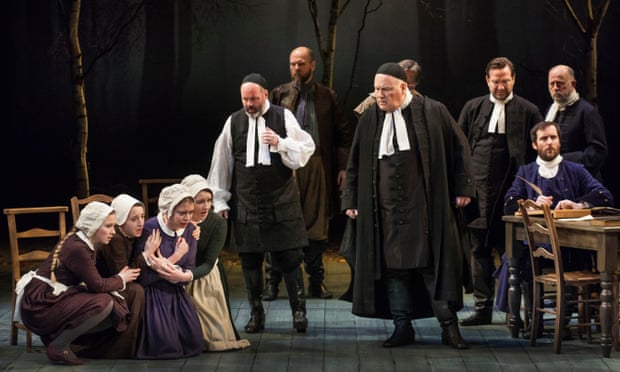
Nothing says “a good night” like unchecked hysteria, unopened hearts and unnecessary hangings. That’s why I’m always excited to see a production of Arthur Miller’s “The Crucible”, and even moreso in the beautiful Lyceum theatre. But does Mark Thomson’s staging of Miller’s work deserve a standing ovation or a slipknot? The star rating above may be a small clue as to which is true: this was a beautiful, if flawed, production of a well beloved American classic.

Set in the year 1692, ‘The Crucible’ follows the path of destruction wreaked by mass hysteria, lust and shame in the town of Salem, Massachusetts. As rumours of witchcraft fly and secret affairs are uncovered, what begins as a simple dance in the woods becomes a matter of law, life and death. Lighthearted stuff.

As you might imagine, Miller’s classic demands atmosphere. From the outset, it’s clear that Thomson has a knack for choosing set designers. It’s not often I open with talk about the furniture, but I was extremely impressed with the quiet ingenuity of Crucible’s set. From the authentic, rustic comfort of the Proctor house to the cold rigidity of the courthouse, each setting hit all the marks in terms of visuals. But even further, it wasn’t just pretty – the use of space was downright clever. Each little quadrant of the stage was self-contained enough to render smaller scenes intimate, and yet interconnected enough to make group sections seem cavernously intimidating. And the use of trees for scenery and blocking lent what felt like meters of depth to a finite stage. For set alone, this show ticked all the boxes.

But luckily, the set isn’t all I’ve got to write happily about. As can be expected from the Lyceum, the acting talent on display is considerable – my personal MVP goes to David Beames as the most entertaining and human interpretation of Giles Corey I’ve seen yet. If I could pay him to narrate my life, you’d bet he’d never go hungry.

But aside from pure entertainment value, I was most impressed by Richard Conlon as Reverend John Hale. When I first read The Crucible, I disliked Hale. I thought he was two-dimensional and boring – but none of these problems so much as touch Conlon. No other portrayal of the character has been as compelling or realistic as his, and I’ve similarly never felt for Hale as much as I did in this production. The emotional depth, the body language, the subtle vocal tics; they all come together almost flawlessly. Fan-bloody-tastic.

Similarly, Philip Cairns shines as John Proctor, applying a great amount of force and raw emotion to the character’s more intense scenes. He moves from tenderness to scepticism to fury as if it were easy as breathing – though this is no doubt benefited from acting opposite the likes of Irene Allan as Elizabeth Proctor. The part of Elizabeth is by no means easy: showing an audience the culmination of years of insecurity and indecision without overacting is like slacklining drunk; that’s what I was so pleased to see how powerful the character was in Allan’s hands. Her final scene and famous closing lines gave me chills.

That same strength runs through the rest of the cast. Meghan Tyler as Abigail Williams is wonderfully duplicitous, mixing sensuousness with devious brutality in the same breath. The Putnams (Douglas Russell and Isabella Jarrett) are as abrasive as the narrative demands, and Greg Powrie’s Reverend Parris is pathetic is the best way possible. Even the young company capture the panic and vulnerability of young girls in the hard frontier of the American East.

So, with such a talented cast and clever design crew, why isn’t this a five star show? Predictably, there are always a few flies in the soup.

As a general note, whilst the accent work at play generally good, it was prone to slippage. Often, the cadence showed more sense than the characters by fleeing from Massachusetts to upstate New York – and, on occasion, Cairns’ Bostonian drawl threatened to slide into a strange mix of Henry Kissinger and Arnold Schwarzenegger. Whilst it won’t bother the average Brit theatregoer, those more familiar with the voices of the new world may find it slightly grating.

Furthermore, I had a huge problem with the sound design. Whilst at times it was a dramatically advantageous decision, at others (especially in the courtroom scenes) it was, at best, a distraction and at worst it utterly broke the tension and dramatic pacing of the scene. I found myself consciously wondering why on earth a scene of screaming hysterics and implied cold-blooded murder for the sake of sex was accompanied by a pleasant violin trill in a major key. In any other show this might not be such a large issue, but in one which is so dependent on atmosphere and audience absorption, it gets amplified.

And it’s in the hysteria that we find my biggest complaint with the production. Whilst certain scenes were certainly not lacking in gravitas, the play’s overall arc of tension was patchy. Some sections jump from being devoid of dread to bursting with it – instead of a steadily escalating fever pitch, it jumps from extreme to extreme.

Unfortunately, this also wasn’t helped by the fact that it felt strangely static at points, as if all the fear had been sucked out of the room. There’s a difference between strained silence and dull quiet, and sometimes this production seemed to confuse them.

Do I think these flaws ruined The Crucible? Far from it. Mark Thomson’s formidable cast rides out the few choppy waves this show presented, and Miller’s famous talent for dialogue is hardly diminished. There are definitely more strengths to this production than weaknesses, and the audience chatter at both the interval and end attest to that fact.

If you get the chance, definitely give The Crucible a look. It’s a production that never fails to entertain whether you’re a Miller virgin or a die-hard fan. Though perhaps a little clunky in the seams, the overall fabric of the show is just as bleak and brilliant as it Miller’s tragedy demands. You might not see Sarah Good with the devil, but you’ll definitely see a strong production.

nae bad_blue

Star (blue)Star (blue)Star (blue)Star (blue)

Reviewer: Jacob Close (Seen 20 February)

Visit the The Lyceum archive.
THIS REVIEW HAS NOT BEEN SUBEDITED

The Weir (Lyceum: 15 Jan – 6 Feb. ’16)

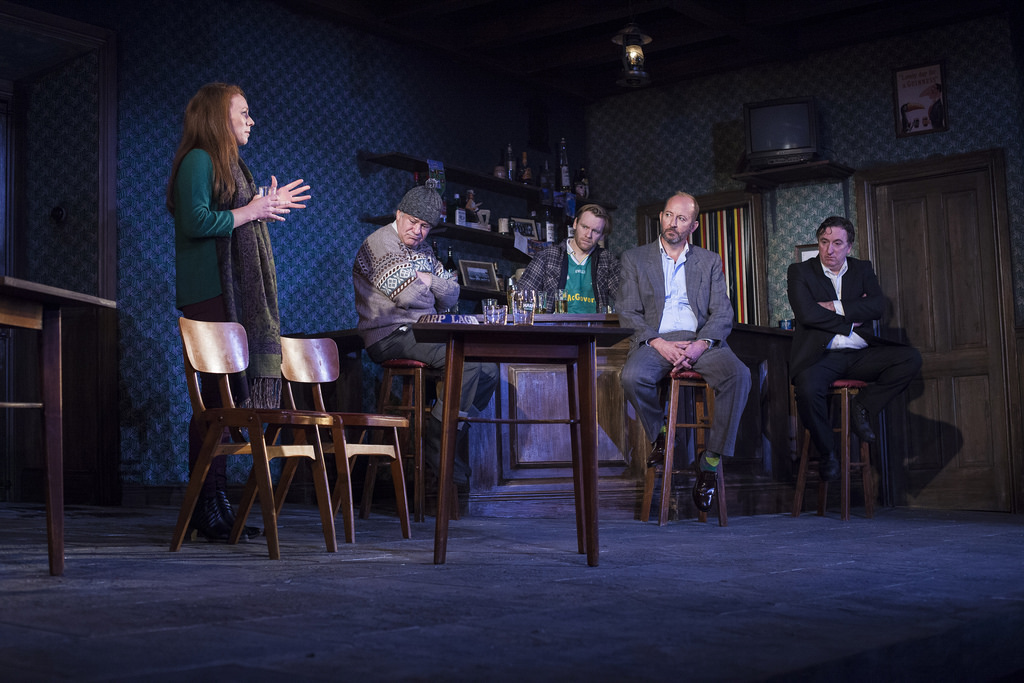
l to r. Lucianne McEvoy, Darragh Kelly, Brian Gleeson, Frank McCuster, Gary Lydon. Photo. Drew Farrell

l to r. Lucianne McEvoy, Darragh Kelly, Brian Gleeson, Frank McCuster, Gary Lydon.
Photos. Drew Farrell

“You will not want to let these characters go home”

Editorial Rating:  4 Stars: Outstanding

For an Irish play set in an out of the way bar, The Weir is pretty sobering. That it is also witty, articulate, and beset by place, loss and sprites is less of a surprise. Writer Conor McPherson has serious form by now when it comes to the dregs of self at the bottom of a glass,  or more cheerfully, to the poetry in the head of a creamy pint of Guinness.

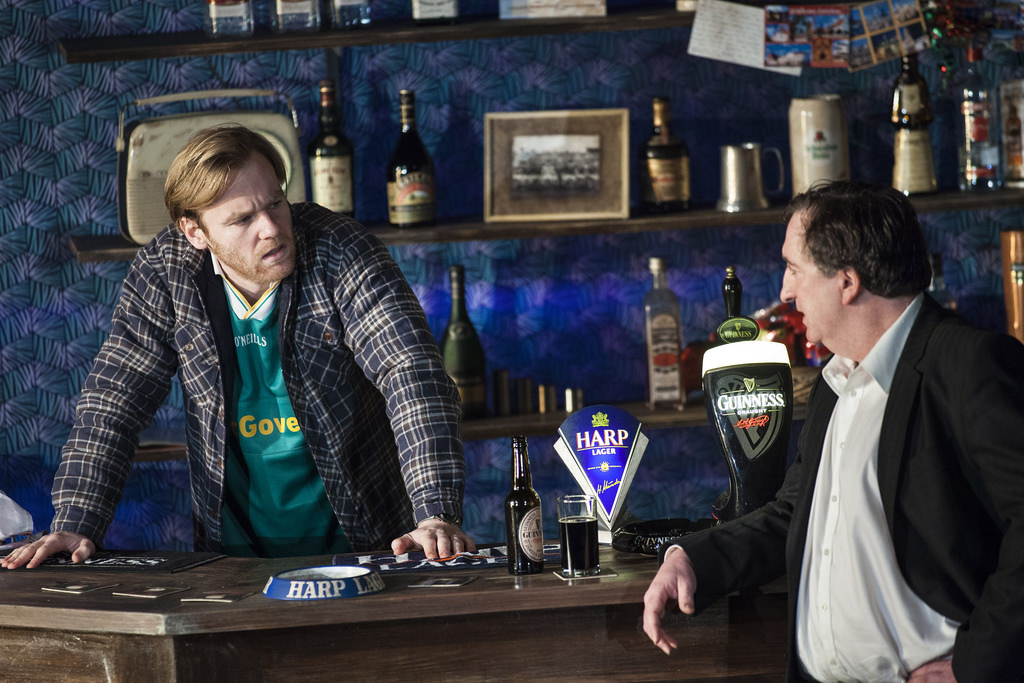
Except that the Guinness in Brendan’s bar is ‘off’ because the fecking tap is broken. Jack has to help himself to a bottle (it’s that kind of village pub); Finbar’s ok because he’s become a tad more sophisticated and drinks Harp Lager; Jim, gentle soul, is happy with small chasers; Brendan is pleased to keep them company; and Valerie, well, she’s down from Dublin and might stay a while. She has a white wine – awkward – poured in a straight glass. There is no smoking ban yet and Designer Francis O’Connor has the craic curling across a wide, low beamed, space with the telegraph poles leaning drunkenly outside. There is a television above the bar but it’s a careful, appealing touch when Jack reaches up to switch off the rugby – it might have been gaelic football. The reception was bad anyway.

Nothing interferes with the story telling and there is no interval. First, Jack with his faerie road and spooky knocks at the door; then Finbar, with a terrifying old woman on the stairs; then Jim’s unwitting shocker in the graveyard that summons Valerie’s nightmare; and finally, cleverly, at the fireside, it’s back to Jack as he mournfully recalls his lost chance at love and marriage. Each tale is far too enthralling, too involving and heartfelt, to be contained as a monologue. The silence after Valerie’s story is literally stunning. Director Amanda Gaughan lets it down evocatively, rendering the men helpless in their sympathy.

McPherson’s achievement is to write bar stool conversation that is as moreish as good peanuts, wholesome against the odds. And the Irish cast are very, very good at helping themselves: Gary Lydon as Jack, sturdy, crumpled; Darragh Kelly as Jim, fond, credulous; Brian Gleeson (yes, son of ….) as Brendan, open, obliging; Lucianne McEvoy as Valerie, injured, self-possessed. And Frank McCusker as Finbar, whose equable, decent, tones stay short of the self-satisfied.

Brian Gleeson, Brendan, and Gary Lydon as Jack. Harp Lager and Draught Guinness as themselves.

Brian Gleeson, Brendan, and Gary Lydon as Jack.
Harp Lager and Draught Guinness as themselves.

‘The Weir’ was written in 1997, enjoyed immediate success and has attracted lyrical approval thereafter. Personally, I’ll play safe and just recognise how companionable a piece it is. You will not want to let these characters go home in the rain*. Single men, who know each other well, have gathered hospitably, stood each other a drink (or two), and have talked idly. However, there is the one woman amongst them and it’s Valerie who’s channeling the hard stuff.

(*Too tempting, sorry, not to cross -reference to Seamus Heaney’s Casualty from a darker period whose subject is the ‘Dawn-sniffing revenant’ plodding home from the pub in midnight rain.)


outstanding

StarStarStarStar

Reviewer: Alan Brown (Seen 19 January)

Go to The Weir

Visit the The Lyceum  archive.

The Lion, the Witch and the Wardrobe (Lyceum: 28 Nov.’15 – 3 Jan.’16)

l.tor: Charlotte Miranda Smith as Susan, Ben Onwukwe as Aslan, and Claire-Marie Sneddon as Lucy. Photos. Royal Lyceum Theatre.

l.tor: Charlotte Miranda Smith as Susan, Ben Onwukwe as Aslan, and Claire-Marie Sneddon as Lucy.
Photos. Royal Lyceum Theatre.

“Fantastical adventure and heart”

Editorial Rating: 4 Stars: Outstanding

Allegory or not, “It’s [still] a magic wardrobe. There’s a wood inside it, and it’s snowing, and there’s a faun and a witch and it’s called Narnia. Come and see.”

And enchanting it certainly is. This 2009 adaptation follows the adventures of four WWII evacuees as they travel through the wardrobe and discover the mysterious, wintry world of Narnia, encountering everything from witches to talking lions, to Father Christmas. C S Lewis’ wondrous story is expertly captured on the Lyceum stage by director Andrew Panton, and is an absolute triumph of a Christmas show.

The one thing that is immediately evident is how polished a production this is. Each scene change is almost like an smooth apparition; as if in some transitory dream, the audience move from one moment to the next without really knowing how they got there, and it’s wonderful. As the oak-panelled set opens out to reveal Narnia for the first time, one cannot help but gasp – with the younger audience – at the intricate display on stage: snow falls and coats the floor in a sparkling white blanket; tall icy trees seem to go on forever and that iconic lamp post glows in the shadows, waiting patiently for Mr Tumnus to appear. The impressive set is further complimented by sumptuous costume design, particularly in that of the animals. Mr and Mrs Beaver and Aslan the Lion are brought to life not only through their physicality but also through that wardrobe, but literally this time.

Stunning set and faithful costume aside, it is the strength of the cast that bring the real magic to this production. Special commendation must go to James Rottger, Charlotte Miranda Smith, Christian Ortega and Claire-Marie Sneddon, playing children Peter, Susan, Edmond and Lucy, respectively. As an audience member, there is often an underlying fear when watching adult actors in child roles as, if poorly performed, it can often remove you from the story. Yet this troupe executes their performances with such a warm and honest vulnerability that it is impossible not to be drawn into their adventure.

This childlike wondering proves all the more effective through the addition of song to the narrative. While some numbers do feel unnecessary, they do give the show another dimension of fantastical adventure and heart. After defeating the Witch, and the cast start singing the words, “You can’t know, but you can believe”, the spellworking in the theatre is almost palpable, and it is hard to suppress the urge to wave back at Aslan and the faun as they bid their farewell to their audience.

As stage magic goes, cutting the mustard might be up there as tricky; and evil White Witch (Pauline Knowles) has trouble living the part that is forever Tilda Swinton’s. A chilling performance works for her at times but it is often ambushed by pantomime warmth and is limited by the reach and power of the virtuous characters.

However, this is holy Advent time and this is a lovely production of a miraculous story that will delight the expectations of the children and grown-ups who come to see it.


outstanding

StarStarStarStar

Reviewer: Rachel Cram (Seen 4 December)

Go to The Lion, the Witch and the Wardrobe at the Lyceum.

Visit the The Lyceum archive.

Tipping the Velvet (The Lyceum, 28 Oct – 14 Nov ’15)

“An imaginative attempt at what could have been quite a bland adaptation”

Editorial Rating: 2 Stars

From the quills of established writer Sarah Waters and high-flying playwright Laura Wade, my expectations were certainly high on entering the auditorium for this new interpretation of the award winning novel. And with a very amusing opening skit and a dazzling number from Laura Rogers as Kitty, it certainly got off to a fine start.

However, while the amount of creativity on show – from daring aerial sequences, to lush period costumes and a Victorian Music Hall arrangement of a song famously featured on a Diet Coke advert – was impressive, unfortunately, this production’s lack of cohesion and staccato structure made it nigh-on infuriating for me to sit through.

In saying that, the show wasn’t without its laugh out loud moments – a landlady dressed in exactly the same design of fabric as the wallpaper in her house and lines such as “You exquisite little tart” certainly caused a few chuckles. However, the comedic aspects were pushed to their limits with a section involving animal carcasses being used as puppets in a song, and a certain “adult” section depicting Nancy’s experience as a prostitute. Definitely not recommended for the easily offended.

Sally Messiah is certainly charismatic as Nancy, Amanda Hadingue is very likeable as Annie (among other characters she plays), and Ru Hamilton delivers a delightful turn as gender-bending Alice. However, for me the most credit in this production should go to the stage hands, whose alarmingly efficient scene changes left me in a state of amazement on numerous occasions.

Much of Lizzie Clapham’s design was visually impressive, but use of space could definitely have been improved: at times the central characters would appear very lost towards the back of a somewhat empty stage, hindering the sense of intimacy they were trying to create. In a production with so many scenes, locations and jarring cuts between them all, a much more fluid approach to location and action would have been more engaging.

There were various musical numbers interspersed throughout the piece, almost all of which were interpretations of modern songs. In some instances, these worked well as a way to bring relevance to today’s audience, but in the second act when Nancy is desperate for a place to live, she belts out a line from one power ballad after another, with farcical impact. Rather than being able to relate to her struggle, she is instead alienated, and it becomes difficult to then reconnect with her in the following scene. This is part of what frustrated me the most about this production: at times we were allowed in to develop a bond with the characters, while in certain sections it was impossible to do so.

The constant bouncing between styles, coupled with the distinct over use of the compere/narrator/MC character, who incessantly dove on stage with needless interruptions between every scene, made this production feel like it was having some sort of pubescent identity crisis between Brechtian fable, cabaret variety show, and an episode of Jeremy Kyle. I could have handled any of those interpretations individually but all in one show was just too much.

In some ways I’m glad this production took some risks to create an imaginative attempt at what could have been quite a bland adaptation. It’s just a shame that so many different styles, techniques and devices were used in the process.


Star (blue)Star (blue)

Reviewer: Steve Griffin (Seen 29 October)

Visit the The Lyceum archive.
THIS REVIEW HAS NOT BEEN SUBEDITED

Hidden (The Lyceum: 20-24 October ’15)

“Gives chills and thrills aplenty”

Editorial Rating: 3 Stars: Nae Bad

Hidden really is a treat for anyone who’s ever wanted to explore what goes on everywhere else in a theatre that audiences don’t normally get to see. Marry that with tales from the history of the building and a Victorian horror story and you have quite an intriguing evening’s entertainment. However, while the idea and overall style and feel of the piece were terrific, there was no clear narrative or sense of progression between each section, leaving me feeling a bit cheated as to specific details and stories.

Individual sections were generally great at creating an overall mood, setting a scene (the dressing rooms in particular stood out), or presenting a static idea, and the piece was littered with numerous magical moments  – terrified faces and screams, isolated “scenelets” and monologues. Yet we learned very little about who these characters were, why there were there, and how they related to anything else that was going on.

While for most of the performance, the audience is directed where to go next by theatre ushers, in one section in the scenery dock, three of the young performers (Xanthe Mitchell, Ellis Imrie and Anna Millar) more than capably moved us around to follow the action. Staying true to their characters and without speaking, they created a compelling and haunting theatrical moment, demonstrating commanding professionalism and presence beyond their years. Moving into the area beneath the stage, Gregor Weir delivered a very charismatic and spooky monologue about being trapped, making clever use of the space by hiding in between and rattling racks of stored stage lights.

Indeed this whole section (directed by Lyceum Artistic Director Mark Thompson), which allowed the audience to fill the space as they wanted and explore the action from the perspective they chose, gave the piece a very immersive and personal feel. It’s a shame that this sense of individual discovery was not carried through more parts of the performance, particularly the section on the stage, where instead we were asked to simply stand in a line to one side and observe.

In saying that, the section in the stairwell leading up to “the Gods” (very emotively delivered by Emma Simpson and Tegan Wright) was a great way to follow the action, and break-up the sense of travelling from one part to the next by making the travelling itself part of the performance. Similarly, walking behind the bar in the stalls, past three caged performers shrieking to be let out, also helped make the “journey” more interesting to experience.

While it wouldn’t have been right to have delivered this piece in tour guide style, I feel that making more effort to communicate some of the background to each section would have been really beneficial. I felt it also lacked a little bit of diversity in terms of mood – it was almost all a chilling ghost story, when some happier or funnier moments of the theatre’s history would have added another layer of depth to the performance.

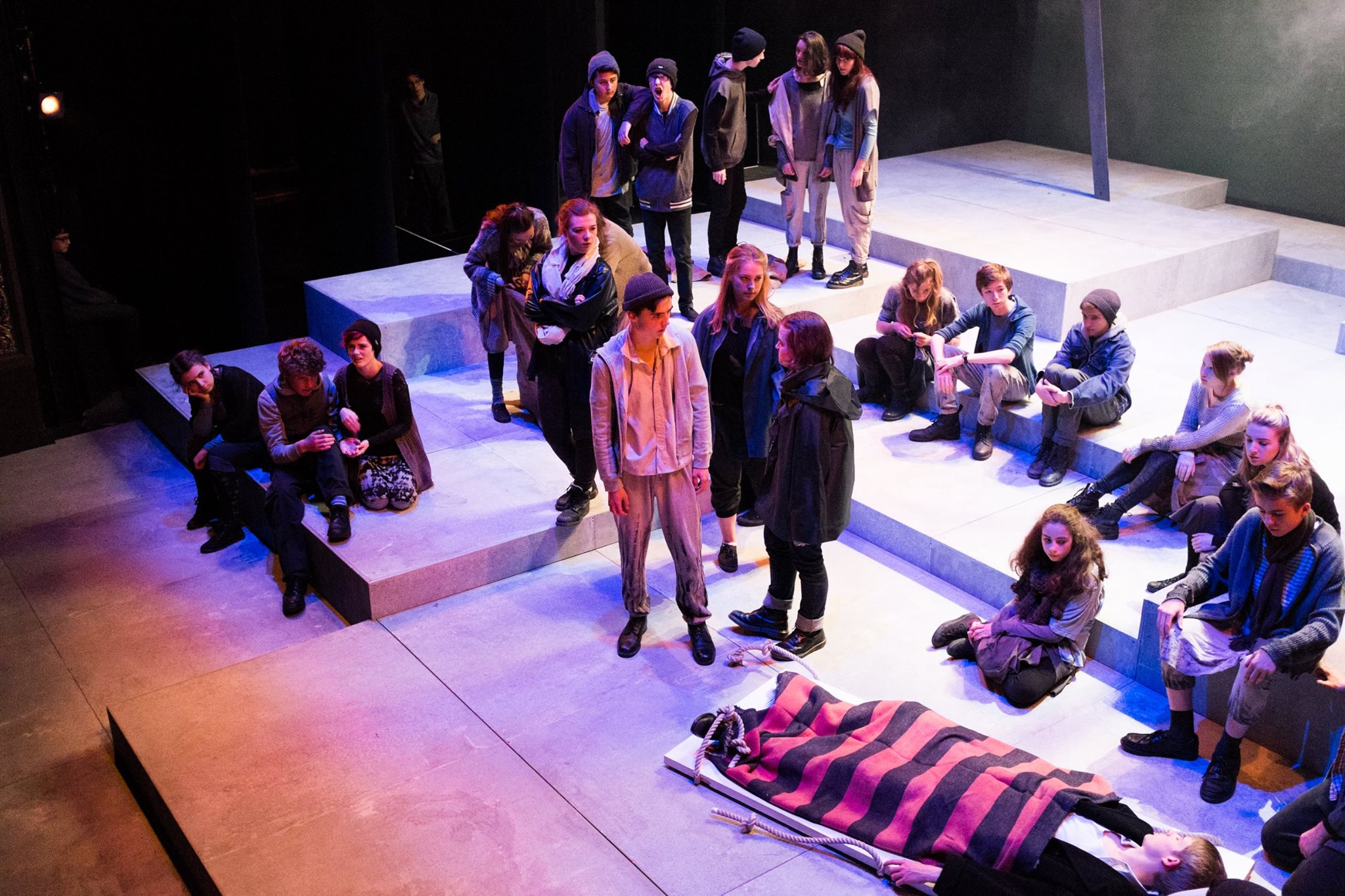
Given that this performance was devised and delivered by young people, in collaboration with four different directors, one must give them due credit for their achievement – this is a very ambitious project that gives chills and thrills aplenty, and is a worthy education and exploration into just how exciting theatre can be. For me it just lacked that bit of cohesion to make it really special.

nae bad_blue

Star (blue)Star (blue)Star (blue)

Reviewer: Steve Griffin (Seen 20 October)

Visit the The Lyceum archive.

THIS REVIEW HAS NOT BEEN SUBEDITED

Waiting for Godot (Lyceum: 18 September – 10 October ’15)

Bill Paterson and Bian Cox as Estragon and Vladimir. Photos by Alan McCredie.

Bill Paterson and Bian Cox as Estragon and Vladimir.
Photos by Alan McCredie.

“Magic and compassionate”

Editorial Rating: 5 Stars  Outstanding

A production dedicated to the memory of Kenny Ireland (1945 – 2014), artistic director of the Royal Lyceum Theatre Company from 1992 to 2003.

It’s celebratory. 50 years of the Lyceum Theatre Company and 50 years, thereabouts, that Vladimir and Estragon reckon that they’ve been together. It’s always nice to be definite about those two, as over the years they’ve acquired a reputation for being as equivocal and as moot as Monsieur Godet, Godot, or Godin, himself. Well, not any more, for this indelible production of Samuel Beckett’s famous play nails them as surely as any I’ve seen – and that includes the Ian McKellan and Patrick Stewart show of 2009. I’m in complete agreement with Gogo (Estragon) when he says ‘They all change. Only we can’t’.

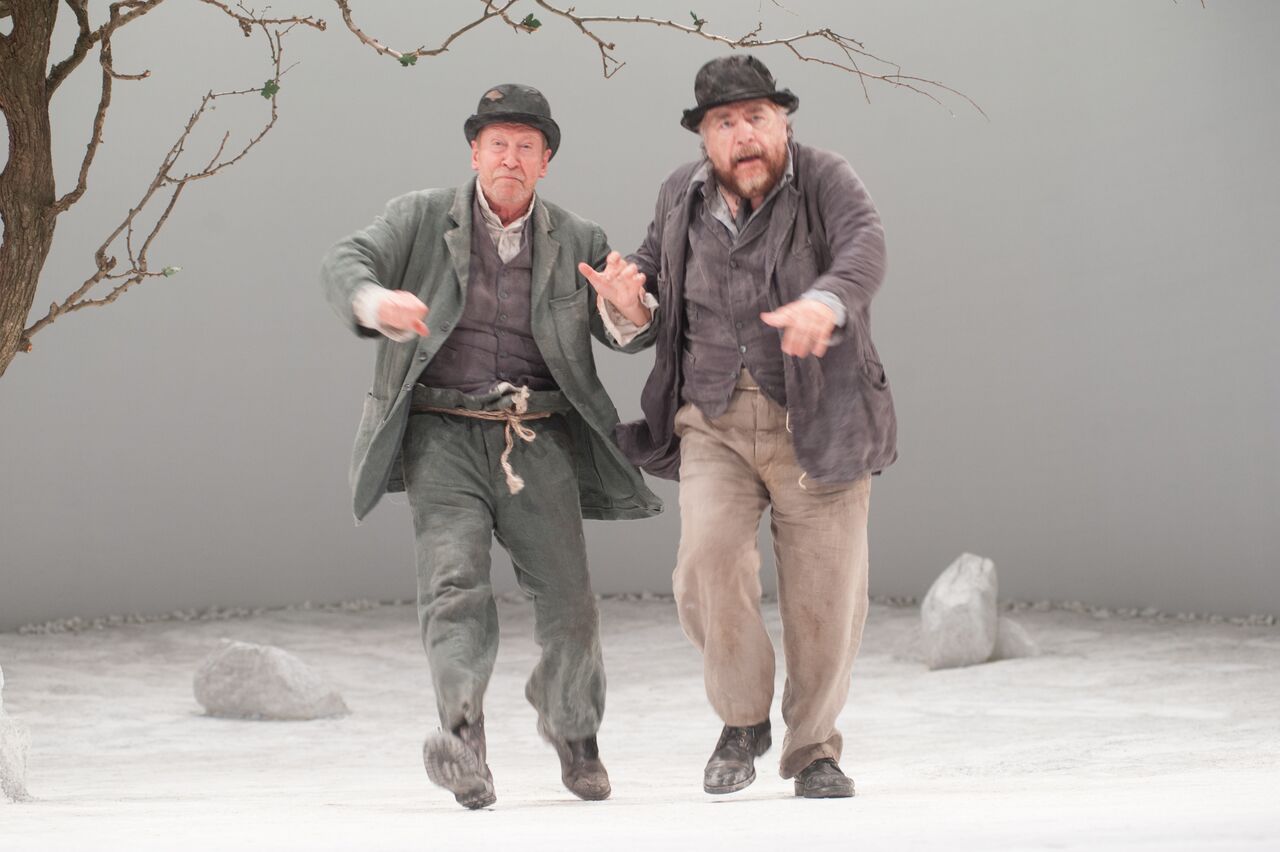
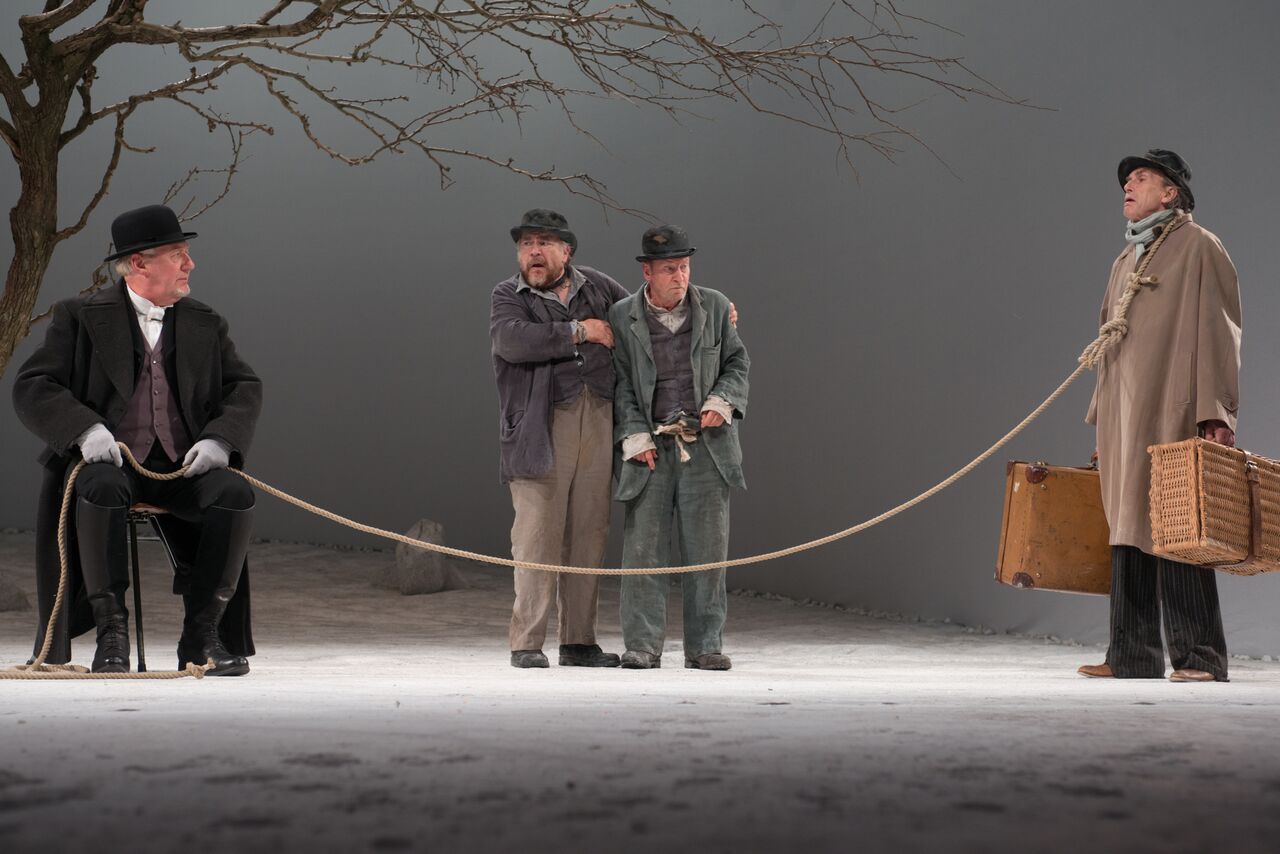
It is probably Didi’s pee stained trousers that did it. For a play that elsewhere is often taken as an exhibition piece for metaphor, where the grave digger puts on the forceps, etc., here a weak bladder in a sixty-two year old man is a weak bladder and that’s that. Gogo’s boots stink, his feet are putrid, and every time that he is reminded that they’re waiting for Godot he stiffens in a gut churning, stomach cramped response. It is unsurprising then that the here and now – the blasted tree on the bleached cold set, the vicious kicks to the hapless Lucky – is ‘kackon country’.

And there’s the marvel: one shitty situation made bearable by kindness and affection, because that is what the magic, compassionate, pairing of Brian Cox and Bill Paterson achieves. Cox plays Vladimir as philosopher clown, constrained to smile rather than laugh. Paterson as Estragon has the pallor to match his delivery. It would be deadpan were it not so forlorn. And it would, of course, be a Laurel and Hardy tribute act were it not for the existential, timeless, pitch and spin of the dialogue. There’s that moment, early in Act 1, when Vladimir is telling the story of the two thieves crucified alongside Christ and Estragon is seriously unimpressed by the ‘Saviour’ word. Didi just wants his story listened to and Cox makes light of his exasperation with a gentle, relaxed ‘Come on, Gogo, return the ball, can’t you, once in a way?’ The half crouch and the outstretched hands look to be off the rugby field to me, which is neat (and topical). Funny too how easily Beckett’s language adapts to Scottish performance for there’s a near constant exchange between blethering and ‘discourse’ that is practically endearing and is certainly comic.

This is not bleak end-gamed Beckett. Take Estragon’s sudden ‘Que voulez-vous?’ that arrests another of their little riffs. That could be a surly or desperate, ‘What do you want?’, but actually it’s much more generous and appealing than that. ‘What do you know [of me]?’ is what Mark Thomson, as director, answers and so two preposterous, hopeless down-and-outs from somewhere wasted and foreign, acquire an extraordinary humanity that fetches warm-hearted laughter from their audience. They might have finished themselves off years ago ‘hand in hand off the top of the Eiffel Tower’ but too late for that now. Instead, we hear of Gogo and Didi picking grapes in Burgundy and Didi rescuing his friend from a suicidal dive into the Rhone.

John Bett as Pozzo (l) and Benny Young as Lucky (r)

John Bett as Pozzo (l) and Benny Young as Lucky (r)

So the blaring inhumanity of the nihilist Pozzo (John Bett) towards Lucky (Benny Young) is made all the more pronounced. These two are truly displaced, dispossessed, and bound. The rope between them just gets shorter as they become increasingly helpless and incoherent. As they collapse, Estragon’s spirits rise and he is almost cheerful. Paterson has that wonderful line: ‘We’ll go to the Pyrenees .. I’ve always wanted to wander in the Pyrenees’.

Yes, it is a question of make-believe and tone but this Godot stands in the light at the mouth of the tunnel and turns its back on the darkness beyond. I found it really illuminating.

(And, ‘cos it’s good and relevant, go to the BBC’s Today programme on http://www.bbc.co.uk/programmes/p031g8l1 to hear a magisterial Michael Billington explain why Waiting for Godot is not in his list of ‘101 Greatest Plays’. Actor Lisa Dwan will have none of it.)


outstanding

StarStarStarStarStar

Reviewer: Alan Brown  (Seen 22 September)

Go to Waiting for Godot at the Lyceum here.

Visit the The Lyceum archive.
‘The Children’ and ‘Mancub’ (Lyceum: 17 July ’15)

Mancub & The Children

“Evolutionary studies”

Editorial Rating: 3 Stars

A Lyceum Youth Theatre double bill.

It must be heroic happenstance that Mancub opened on the Lyceum stage on the same day, July 17, that Ant-Man came to a (film) theatre near you. The little guy wins out and gets out, but it’s tough going. As for The Children, performed by the senior class after the interval, it is kind of the same story but a whole lot nastier. The despairing cry is, “We’re not animals”. The shame is that no-one told the adults.

Mancub

Mancub is Douglas Maxwell’s 2005 adaptation of John Levert’s book Flight of the Cassowary. Paul is in S4. On the good days school is an adolescent aviary; on the bad days, it’s a jungle with teachers in their lairs. A diagram of the human eye is up there on the board in Biology class but Paul only sees foxy Karen (Emma Gribbon) and gulps with nerves. That’s the goldfish in him. He gets a red card in a cup game for roaring at the referee. That’s the grizzly bear in him. He makes friends with the neighbour’s dog (cute and canny Max Hampson) and they chat together. His younger brother, Wee Luke, hates Kipling’s Jungle Book but loves the Disney version. Their Mum and Dad don’t have the imagination to enjoy either.

Xana Mawick, Director, does well to put a cast of 26 on stage all the time and to keep the many episodes distinct. There’s a camera for bonus close-ups and five narrators do a good, clear voiced, job of introducing and accompanying the action. Alexander Levi is Paul, shy but plucky, and able to survive becoming the road kill of insensitive grown-ups; although Tom Borley as football coach, Susskind, is a likeable chump. Best friend Jerry, ably played by Carson Ritchie, is the smart dude with the knockout comeback lines.

The representation and/or mention of those other species, teachers, parents, gran, and – awkwardly, Neds – is a little sketchy, even foolish, but that’s evolutionary studies for you.

The Children tech

There is nothing ill-defined about Edward Bond’s The Children (2000). It is determinedly and definitely in your face – and there’s a brick to hand. When a mother’s instruction, fuelled by fags and booze, is to burn down a house it is no surprise that blood splatters to an acoustic treatment of The Offspring’s The Kids Aren’t Alright.

P

Daughter Jo, in a firm and touching performance by Caitlin Mitchard, does what she is told and is abandoned to a bleak, murderous, environment that offers no features, no direction, no way out (although Fraserburgh is on the map!). Her several – too many? – friends don’t make it. When, at the close, we’re in a harbour with a lighthouse the quiet relief is unlooked for and rather welcome.

There are two adult roles – principally Mum (Jenny Barron) and then the male Stranger shows up. Christie O’Carroll as director must have thought about playing the Stranger himself. Certainly Bond wanted that effect: the dreadful weight and mistaken, if not extinct, certainty of the adult up against the weaker, unscripted promise of the young – and at times it told.

All credit to LYT for holiday performances of a special kind.

Star (blue)Star (blue)Star (blue)

Reviewer: Alan Brown (Seen 17 July)

Go to LYT here.

Visit the  The Lyceum  archive.
‘The Driver’s Seat’ (Lyceum: 13 -27 June ’15)

Driver's Seat

“Prime Muriel Spark”

Editorial Rating: 4 Stars Nae Bad

Never mind the 4th wall, how about knocking down the back wall? Break out upstage centre from the Lyceum and you’ll be into Saltire Court on Castle Terrace. You know you’re in one of Edinburgh’s superior premises when the tenants include global accountants Deloittes and KPMG. A neat, if accidental, location then for a play whose principal character has had enough of audit, who hammers her stapler into her desk, has hysterics and takes a holiday but with absolutely no intention of coming back to the office.

Bye-bye patronizing suits, hello lemon yellow, orange, purple and blue V stripes. It’s 1970 (kind of), when you could buy novelty knives at the airside shops before boarding at Gate 14. Stressed out Lise is all decked out for the fervid south – could be Naples, might be Palermo – and with one type of man very definitely in mind.

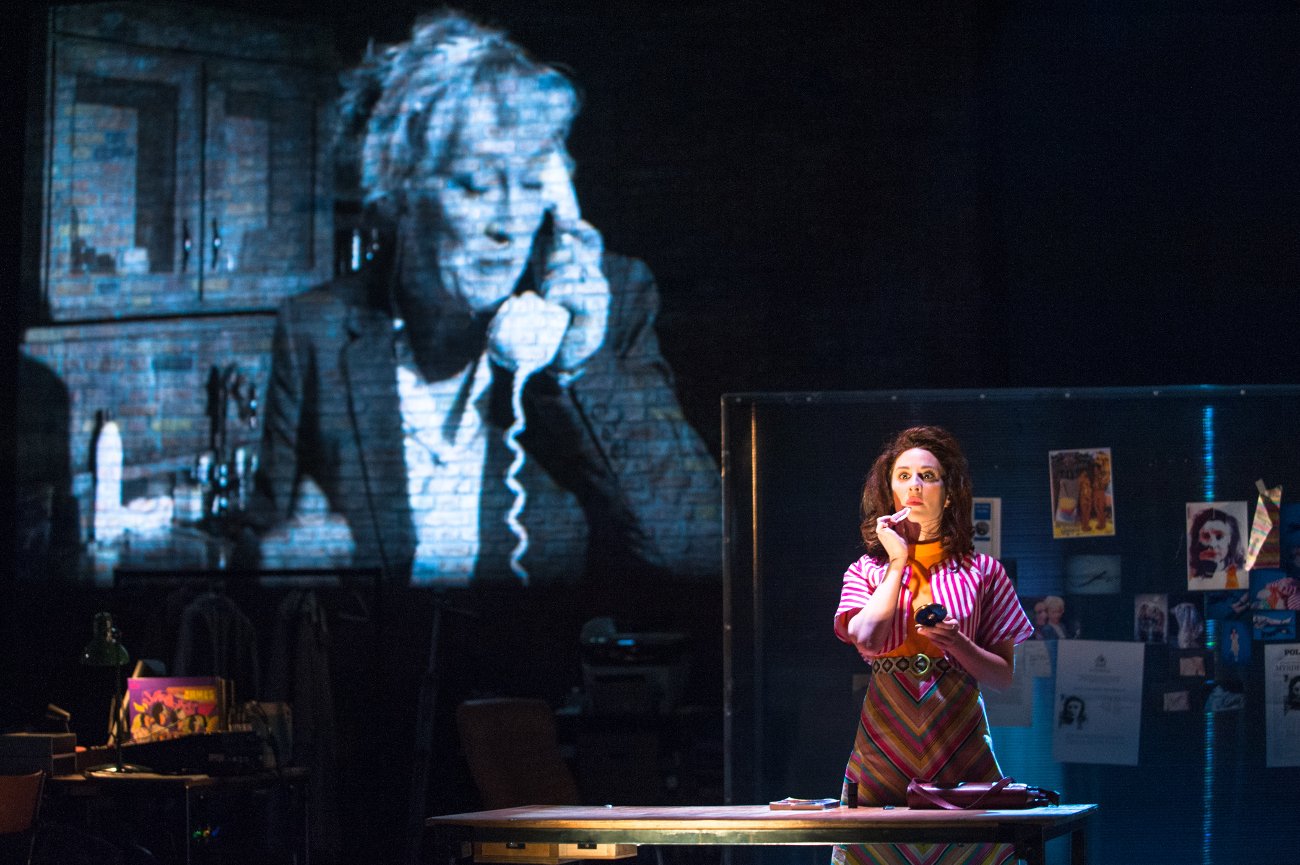
This is prime Muriel Spark territory. She had been living in Italy since 1967 and the shocker that is The Driver’s Seat was published three years later. Here we have it adapted – call it exposed – and directed by Laurie Sansom in a one act, ninety minute, cross-over between garish psychodrama and police procedural. It is articulated, televisual theatre; think anglepoise lamp on accountant’s desk and mess with the springs.

Gabriel Quigley (on screen) and Morven Christie. Photos: Tommy Ga-Ken Wan

Gabriel Quigley (on screen) and Morven Christie.
Photos: Tommy Ga-Ken Wan

Centre stage is the incident ‘room’. As the investigation into ‘What-Happened-to-Lise?’ is conducted, so information, photographs, etc. go up onto a transparent wipe board. You see ‘VICTIM’ in marker pen. That’s retrospective action for you, sorted, marginally distracting, smart; very unlike the downstage action, where ‘What-Is-Happening-to-Lise’ is compulsive, jumpy, and unstable.

Lise herself (in an impressively tight performance by Morven Christie) is vulnerable because she is alone and out there, fixated, conflicted. At home in her bedsit, trying to sleep, she suffers – hands over ears – the moans of her neighbours having sex. Thirty-four years old in the book, she masquerades as the lady abroad: at one point a ‘widow and an intellectual from Iowa, New Jersey’ (sic) – supposedly fluent in four languages but plainly lost when it comes to real Italian. And it is real, via potent supporting roles from Ivan Castiglione and Andrea Vopetti.

There are no hands to the big clock in the incident room, which does point to alienation theory, but up come the sound cues and they appear, chronicling Lise’s known movements from hotel lobby to department store . There’s live mapping of her taxi on the large upstage screens while handheld TV cams relay fraught close-ups. You would think that little is hidden on such a tech-savvy set but as to why Lise acts the way she does there’s not much to go on, which is probably the existential point. Are we watching an object/abject study in self-destruction or an introverted and skittering operetta, complete with CS gas? Composer and sound designer Philip Pinsky uses mild jazz in ironic counterpoint to the spiky and alarming story. Did he, I wonder, smile at the desperate lyrics of the Sniff ‘n’ The Tears’ hit single Driver’s Seat (1979), where  “She had another way of looking at life”?  Accept stunned recall of Elizabeth Taylor & Ian Bannen in film-of-the-book Identikit of 1974 and you can see that Spark’s work is heading straight for Thelma and Louise some twenty years down the road, except that Lise has no buddy to go over the edge with.

Take that original, startling writing of 1970 – you’ll want to read it – and lay bare its mucky gender issues. The result, from creatives and excellent cast, is hard sprung. You won’t enjoy its forlorn subject, unrelieved by some crazy Italian driving in outsize shades, but it is acute work.

A National Theatre of Scotland production.

nae bad_blue

Star (blue)Star (blue)Star (blue)Star (blue)

Reviewer: Alan Brown (Seen 18 June)

Go to The Driver’s Seat and the National Theatre of Scotland here.

Visit the The Lyceum archive.
‘The Venetian Twins’ (Lyceum: 24 April – 16 May ’15)

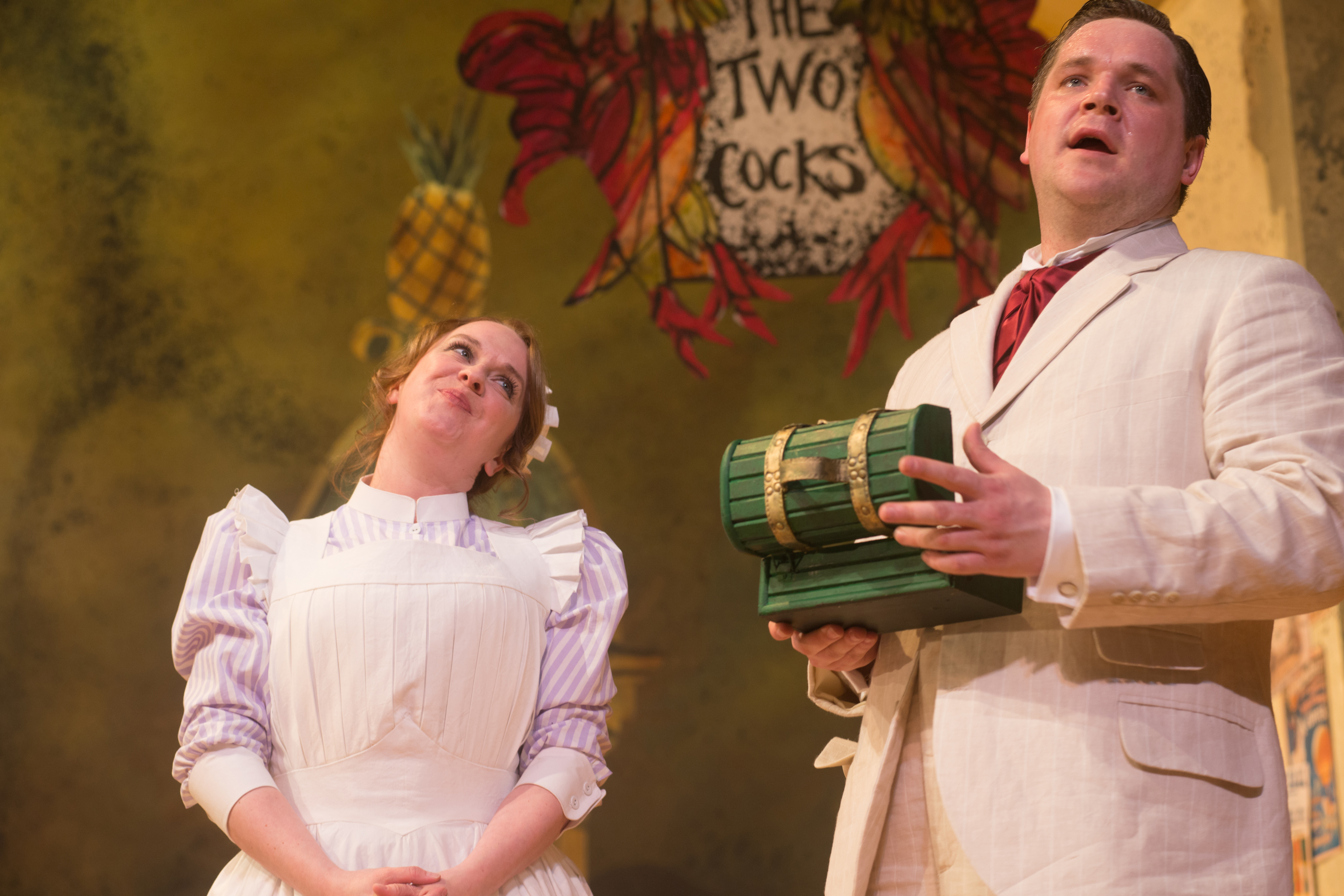
Angela Darcy as Columbina and Grant O'Rourke as Tonino. Photos by Alan McCredie

Angela Darcy as Columbina and Grant O’Rourke as Tonino.
Photos by Alan McCredie

“Helpless merriment awaits”

Editorial Rating: 4 Stars

The fun that there is to be had with twins, eh? And with the long-legged long lost sister who, naturally, is being wooed by one of the brothers, but which one? There’s a consultation on offer with Dr Freud but, nah, he stays in Vienna and it’s much more jolly here in a sun dappled piazza in rosy Verona.

Wednesday was a shocking day in Lothian and so all the more reason to enjoy one of Signor Goldoni’s cloudless comedies. It’s funny what a master drammaturgo can do with disinheritance, murder, suicide and a lovesick ginger loon in lime green.

That’s Carlo Goldoni of a Servant of Two Masters (1743) and many, many more of that ilk. Its near relation has to be I Due Gemelli Veneziani (1750), respectfully translated, because our Edinburgh is the city of La Favorita, ‘the authentic Italian experience’. And just like those jaunty yellow 500s that we see around and about so adaptor/director Tony Cownie delivers big time – in FIAT speak – ‘an emotional mixture of vintage flavours, where everything is colourful, joyful and [almost] authentic’, plus a high speed rally of Scots accents and banter. It’s also now around 1905, Italian railways are steaming in but a bag of gold and a box of jewels will still buy you a bride in an astonishing frock.

‘This place is mental, eh?, declares Twin 1, provincial Zanetto, who is a mild and endearing sort. He’s come to town from the sheep folds and pig pens of Bergamo to marry Rosaura, whom he’s never met, but who has been kept under house arrest for her (rich) Intended. Poor Rosaura! Home tuition didn’t help much and she suffers from acute malapropism, make-up dependency, and the lust of Pancrazio, the priest, who is a top graduate of the Tartuffe school of rank hypocrisy. Twin 2, is dauntless and debonair Tonino, whose tireless belief in the beauty that is Venice and in his no less beauteous self, probably led to his conflicted fiancée, Beatrice (PhD), running away to Verona where she meets …. Zanetto. Signore e signori, it’s the face-off show! Meanwhile, opposite Rosaura’s just has to be the inn of the Two Cocks where more helpless merriment awaits behind the bar.

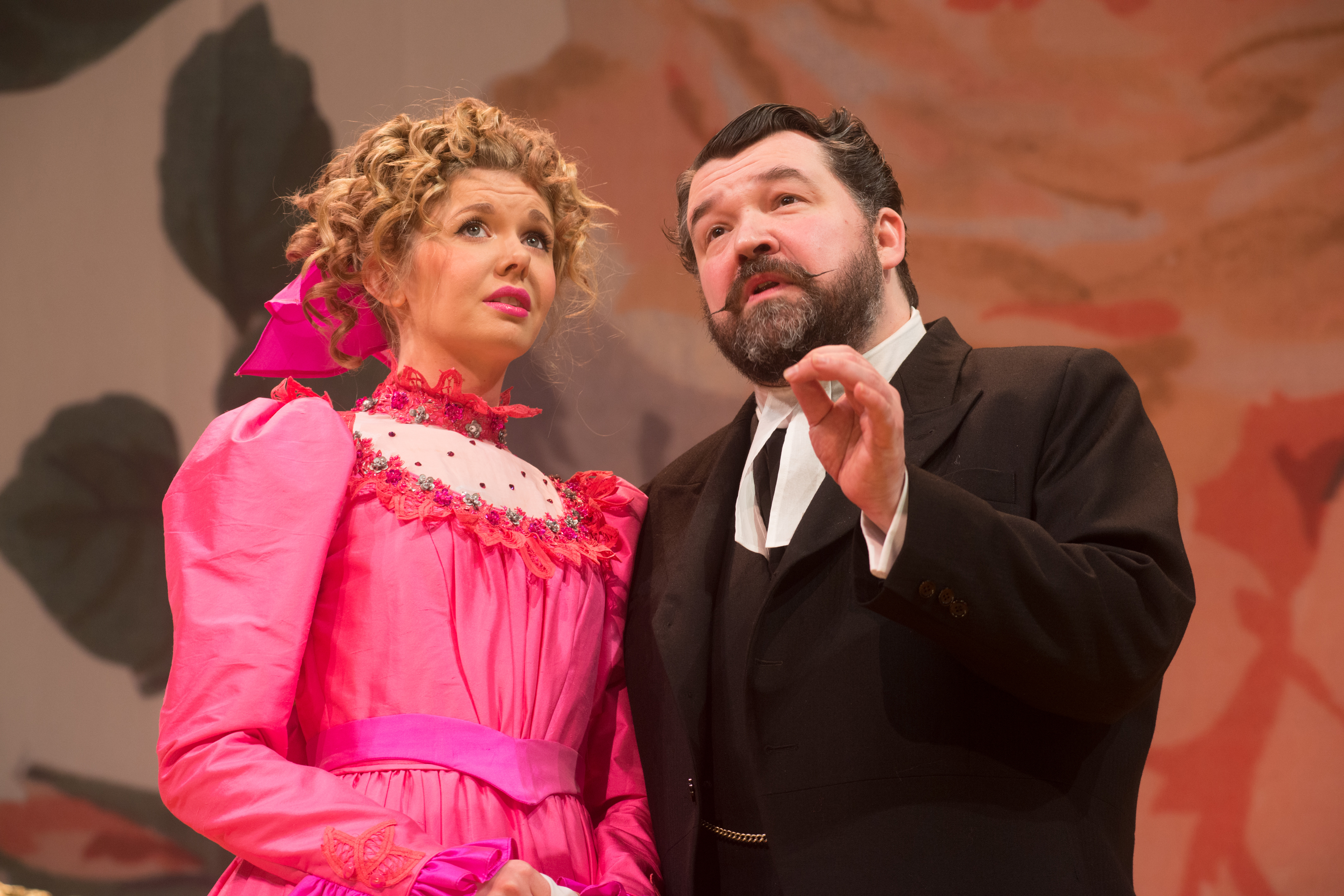
Dani Heron as Rosaura and Steve McNicoll as Pancrazio

Dani Heron as Rosaura and Steve McNicoll as Pancrazio

Twins 1 and 2 are – or is – Grant O’Rourke. It is a treat of a ‘double’ performance where panache meets dead-pan humour and survives. Dani Heron serves up Rosaura as a pink sweetie and the whole piece, actually, is offered con brio: from the bright accordion music to the swashing sword play and pink cravat of posh boy Lelio (James Anthony Pearson). Kern Falconer’s turn as barmaid Mammy Flozzie is a shameless hoot whilst Steve McNicoll as the villainous Pancrazio exists seconds away from pantomime hisses.

The audience knows just about what to expect at every madcap moment because the characters delight in telling them – especially Angela Darcy’s fly Columbina; but there are a couple of slaps in the face, as a reminder that Goldoni’s laughs can and perhaps should at times own a keener edge. You won’t miss them, though, but you might feel for good ole’ Zanetto as I did.

Star (blue)Star (blue)Star (blue)Star (blue)

Reviewer: Alan Brown (Seen 5 May)

Go to ‘The Venetian Twins’ here

Visit the The Lyceum archive.

‘The Caucasian Chalk Circle’ (Lyceum: 18 Feb. – 14 March ’15)

Grusha :Amy Manson Photo: Alan McCredie

Grusha :Amy Manson
Photo: Alan McCredie

“Compelling”

4 Stars: Outstanding

‘Standing between doorway and gateway, she heard
Or thought she heard …’

Listen up, “I’ve looked into the pockets of the rich and that is [considered] bad language.” Here is a contemporary, full-on production of Bertolt Brecht’s great and humane play; its profane political resonances not so much hanging in the air as gusting out of the wind machine. As it goes, these days and then, HSBC (Swiss arm) could be up there on the gallows with the town judge, the Chief Tax Collector and the rest. At a grim stretch, you’ve seen what’s happening in the eastern Ukraine, well, here we go again.

We’re talking piastres of indeterminate (Ottoman?) origin rather than of pound, franc or euro but who cares provided you’ve got a shedload? And that’s the economics of the piece: “Those who had no share in the fortunes of the mighty / Often have a share in their misfortunes.” Out of confusion, collapse, coup and revolution come the have-nots-have-all stories of brave Grusha and of His Worship the excellent, the most scurrilous Azdak. Theirs, in amongst the rifles, rape and the noose, is the unlikely, virtuous, lyrically unco traffic of our stage.

The Caucasian Chalk Circle is a play with songs and director Mark Thomson realises how entertaining it should and can be, in or out of the shadow of Soviet tractors. Sarah Swire, as the Singer-Narrator, is not Brecht’s ‘sturdy man of simple manners’ but a punchy and versatile performer whose style and presence guides and informs rather than commands. Cast members double as musicians and Composer/Musical Director Claire McKenzie creates a strong and urgent soundscape: the city falls to a fearsome clockwork beat; Grusha is held in a ghastly tango by her brute of a husband. There is dancing, quite rightly, at the close.

The Singer: Sarah Swire Azdak: Christopher Fairbank Photo: Alan McCredie

The Singer: Sarah Swire
Azdak: Christopher Fairbank
Photo: Alan McCredie

The Singer sings of once upon a time, for the legend of the circle of chalk is based upon an old Chinese play. At its centre Brecht places Grusha, the kitchen maid, who saves the Governor’s child and runs for the mountains. These are not kind times. Papa’s head ends up on a lance and soldiers are hunting them down. Grusha’s flight is perilous, not least when she’s crossing a 2000 foot drop on a half rotten bridge. This is terrifically staged, as befits the moment when ‘Grushna Vachnadze decided to be the child’s mother’. Thomson realizes that this play works when an audience is exposed to why people behave the way they do. Azdak’s decision not to hand over the fugitive Grand Duke makes sense when you are gripped by his arch reasoning. Trial by chalk circle is palpably, deliberately, grotesque but it’s a dramatic triumph.

Christopher Fairbank is a stomping success as Azdak. More the truculent Ariel than any burdened mage, he is the rogue Time Lord with an impish spirit who obliges and provokes in the blink of an eye. Amy Manson gives an unwavering performance as the steadfast Grusha and harvests all the sympathy that the audience as collective can supply. Nasty, uncomfortable menace comes from the Sergeant, frighteningly well played by Deborah Arnott whilst Shirley Darroch as fat Prince Kazbeki is a cigar chomping nightmare, only marginally offset by her blaring trombone.

Kazbeki: Shirley Darroch Photo: Alan McCredie

Kazbeki: Shirley Darroch
Photo: Alan McCredie

Alistair Beaton’s translation matches the lucidity of his programme notes on translating Brecht but is not helped when the accents travel far and wide: from the Thames estuary to the Welsh valleys, to Birmingham, to the North East, and to Scots, high and low. Strained rather than epic, I thought. And light features like smooth, RP-ridden lawyers, Barbour-clad farmers, mobiles, and a Lidl bag signify too much, too unnecessarily. You can speak uber German, I’m told, but all the same posh English for the ‘upper’ class is becoming too easy a target to mean much.

Still, “All pleasures have to be rationed” says the Girl Tractor Driver. Actually, not so in this eager and compelling production.


outstanding

StarStarStarStar

Reviewer: Alan Brown (Seen 21 February)

Visit The Caucasian Chalk Circle at the Lyceum here.

Visit the Assembly Roxy Bedlam Church Hill Theatre Festival Theatre King’s Theatre Other Pleasance, Potterrow & Teviot Summerhall The Lyceum The Stand Traverse archive.

THIS REVIEW HAS NOT BEEN SUBEDITED