Jess Carrivick: Attention Seeker (WIP) at Venue 236 until 24th AUG (not 11th or 18th)

“…a must-see for anyone who loves comedy; it would also serve as a masterclass for those who hope to bring a one-hander show to the Fringe.”

Editorial Rating: 5 Stars (Outstanding)

Regular readers of this site will know that I’ve got a bit of a thing about solo shows this year. They’ve been one of the mainstays of the Fringe for decades (especially one-woman shows) and are becoming a genre all of their own. The quality of such shows can be highly variable, but this one is the best I’ve seen this summer by a country mile.

Jess Carrivick is a self-confessed “almost” ex-child TV star nepo baby and in this show she tells the story of her life. In a whirlwind of character vignettes, multiple costume changes, bits, skits, and sketches, she whisks us on an absurdist journey which showreels her first ten years that peaked with BBC TV sitcom stardom in the noughties. Apart from one genuinely tearful episode this is a laugh-a-minute romp, see-sawing between hilarious observations on the mundanity of post-fame life and peeks behind the barbed wire curtain of celebrity telly.

As both performer and writer (2021 BAFTA Rockcliffe shortlist), Carrivick pulls off a tour de force in the small black-box Mint Studio, part of the Greenside @ George Street venue. An experienced improv and sketch comedienne, she’s one of those confident and engaging performers it’s impossible not to like. In several silent routines, she has the audience in stitches of laughter with her range of facial expressions and stares that speak a thousand words. A brilliant caricaturist, she evokes a number of showbiz and “civilian” stereotypes with mercilessly effective style and aplomb; regularly complemented by her own deprecating self-criticism. In some gently merciful and non-embarrassing audience participation, she effectively gives a little stage skill coaching to those punters keen to join in the fun. A skilled performer to her fingertips, Carrivick even manages to entertain whilst getting changed behind her costume rail.

At 45 minutes, this is an ideal piece of quickfire entertainment to squeeze in between other shows as you sample the delights of George Street. It’s a must-see for anyone who loves comedy; it would also serve as a masterclass for those who hope to bring a solo show to the Fringe.


ALL our recent coverage? Click here!

‘Edgar Allan Poe: The Murders in the Rue Morgue’ (Venue 53, until AUG 26th)

“…a slick performance in which his character exudes the gravitas required of a predecessor to Sherlock Holmes, often giving light relief with heavily-accented asides that veer towards the comic buffoonery of Inspector Clouseau.”

Editorial Rating: 3 Stars (Nae Bad)

Often described as the first modern detective story, Edgar Allan Poe’s 1841 classic overlaps with the horror genre as the mystery at its heart unfolds. This is a welcome stage adaptation of the tale that introduced the world to the French sleuth Auguste Dupin.

Actors Darren Haywood and James Nicholas present us with a straightforward two-hander in a black box setup with minimal scenery. Haywood as Dupin delivers a slick performance in which his character exudes the gravitas required of a predecessor to Sherlock Holmes, often giving light relief with heavily-accented asides that veer towards the comic buffoonery of Inspector Clouseau. For such a dark tale, there were often moments when the audience chuckled at episodes of quickfire banter onstage. One such particularly engaging passage portrayed a police officer interviewing a succession of witnesses to the eponymous murders. In a cross-channel double act of gallic repartee, Nicholas played the investigating gendarme, while the elastic-faced Haywood adopted a lively comic sequence of caricatures of low-life Parisians.

Nonetheless, I’m afraid I struggle to give this production and its cast the four-star review that parts of it deserve. Overall the play depended rather too heavily on narration and exposition, such as the reading aloud of an explanatory newspaper article. Stage adaptations of literary works can be very engrossing, but to avoid the feel of a radio play this show needs a little more physicality, business with props and costumes, and more imaginative use of the set, however basic it may be. Leaving the denouement to narration backed by sound effects rather emphasises the audio character of this production.

The performance I saw was the first of a month-long run, which I hope will give the cast the opportunity to work up a little more visual action into what is a potentially gripping drama.
That said, both cast members are appearing in other shows at the Fringe this year, including an adaptation of a Conan Doyle story featuring Dupin’s immortal literary successor: Sherlock Holmes, in The Speckled Band. Coming down at well under an hour, this show is suited to those who like their entertainment traditional and on the literary side. So get your coats on and go see this. Come for the classic detective tale that fired the starting gun for a whole genre. Stay for the gallic repartee. Leave to investigate clues in the Fringe brochure that will lead you to discover The Speckled Band!


ALL our recent coverage? Click here!

‘Casting the Runes’ (Venue 33, until AUG 27th)

“We quickly left the outside daylight behind for a haunting and foreboding vibe whose icy fingers crept into every corner of the auditorium from the outset..”

Editorial Rating: 5 Stars (Outstanding)

Fans of the classic ghost stories of M R James will be familiar with the TV adaptations that grace our screens each Christmas. Now, here in Edinburgh, on a deceptively sunny lunchtime, the chilling horror of one of his best tales is vividly brought to life in close-up.

The Box Tale Soup theatre company faithfully reflect the master storyteller’s art in lifting his chilling tale off the page and onto the stage. We quickly left the outside daylight behind for a haunting and foreboding vibe whose icy fingers crept into every corner of the auditorium from the outset. The story itself is classic James: the safe, scholarly world of academe gradually subverted by the creeping menace of some much older, darker force that belongs between the pages of dusty medieval tomes rather than modern textbooks.

A cast of two are aided by some skilful use of puppetry for minor characters, including the decidedly creepy Mr Karswell. Noel Byrne, who looks suitably like Peter Cushing’s worrisome young brother, plays Professor Dunning, an academic with an interest in the occult. With the help of a new acquaintance, he explores a number of mysterious messages and a weird picture that seems to have a life of its own. Antonia Christophers, who plays the acquaintance, does a nice line in quivering fear and wide-eyed terror, as well as operating and voicing the often unsettling mannequins. A simple set is put to effective use, evoking a suitably Edwardian gothic vibe, with door handles that seem to turn themselves, creaking hinges, and a swirling mist worthy of any Hammer horror. No spoilers here, but there was a sudden lighting reveal that made the two ladies behind me audibly squeak as they jumped in their seats. A coup de theatre, that – you seldom get those sitting in your armchair at home.

The sense of fear so skilfully manipulated by James and the cast of this play echoes similar feelings evoked by Samuel Taylor Coleridge in his poem The Rime of the Ancient Mariner, some telling lines from which are quoted at one point:

“Like one, that on a lonesome road
Doth walk in fear and dread,
And, having once turned round walks on
And never turns his head;
Because he knows, a frightful fiend
Doth close behind him tread…”

I know I was not the only one in today’s audience who felt the tingling anticipation of a disembodied tap on the shoulder at certain points during the show.

Situated in a venue that’s part of the popular and lively Pleasance Courtyard complex, the haunting quality of this show is emphasised all the more as you emerge at the end into the contrasting, unfamiliar daylight. Though, this being Edinburgh, the leaden skies were throwing down a moribund shower of rain in ironic tribute. So get your coats on and go see this! Come to see a tale by a master storyteller. Stay for the creepy puppets and creaky hinges. Leave safe in the knowledge that no ghosts will follow you home in the daylight as you head off for lunch.


ALL our recent coverage? Click here!

‘My Father’s Nose’ (Front Room at Assembly Rooms, Venue 20 until AUG 27th)

“…one of those shows which encapsulates what Fringe theatre is all about: a two-hander with a minimal set, which is the springboard for an engaging and eminently watchable hour of lively, tragicomic drama.”

Editorial Rating: 4 Stars (Nae Bad )

This, I feel, is one of those shows which encapsulates what Fringe theatre is all about: a two-hander with a minimal set, which is the springboard for an engaging and eminently watchable hour of lively, tragicomic drama. Douglas Walker plays a recently bereaved man on a park bench, visibly struggling to cope with the loss of his father. With the help of a sympathetic passer-by, the joy and pain of his relationship with the lost parent is re-enacted in a whirlwind of wacky humour, song, and dance. The passer-by is played with much panache by Caitlin Campbell. Both actors are alumni of Bristol Improv Theatre and are appearing in other shows on the Fringe this year.   

In flashbacks, we see a lifetime of the joy and agony of father-and-child relationships, from fun-filled early years to teenage angst. The habits and foibles of loved ones that are the essence of memory form the basis of many set pieces in the show. An early audience favourite was a song from a childish perspective of Dad being a “Cupboardy Man”. Perhaps the most unlikely is a lively song and dance routine about Dad’s seeming obsession with his tax returns. This is the only show in Edinburgh in which you’re likely to hear a joyous two-part harmony ironically singing the praises of HMRC – who are “surprisingly helpful on the phone”, it seems. Performed with gusto as Walker and Campbell trip the light fantastic like Fred and Ginger, it brings an entirely new dimension to Higher-Rate Tax Relief and Allowable Expenses.

Along the way, Walker and Campbell explore the sometimes odd ways that we try to cling to memories of the departed. As the show’s title suggests, Douglas is obsessed with the image of his father’s nose. The dangers of such infatuations are wittily illustrated by the story of an Elizabethan widow who carried the severed head of her executed husband around with her for 30 years. Caitlin, who has “a certificate in psychiatric First Aid” tries to help things along with small episodes of street therapy: is love all we need? A personal favourite was her hilariously pedantic critique of John Lennon’s lyrics to the Beatles hit “All You Need is Love”. I’ll never hear that song again without realising it’s a sequence of tautological platitudes loosely based around Maslow’s Hierarchy of Needs. (Was it ever anything else?) Another memorable digression concerns the sales statistics for rhubarb crumble in Schleswig-Holstein, which may raise a reminiscent smile among those of a certain age.

This is a little gem of a show that deserves an audience for its run in the middle of George Street right up to the end of the month. So whether you’re a civil servant or a Beatles fan, get your coats on and go see it! Come for the lively song and dance humour. Stay for the quirky insights into how we remember those we love. Leave with the thought that never again will completing a tax return seem quite so daunting.   


ALL our recent coverage? Click here!

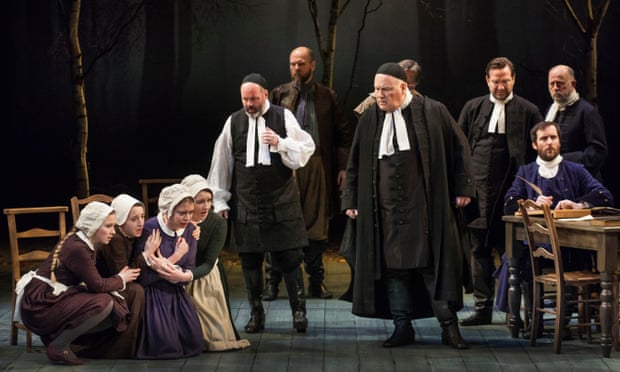
The Crucible (The Lyceum 18 Feb – 19 March ’16)

https://i.guim.co.uk/img/media/250f6b044fc785f891c930dbd8326ddbf5d7351e/125_403_5364_3222/master/5364.jpg?w=620&q=85&auto=format&sharp=10&s=83ea0e1bac8ee60cbbf8c5a0a8815ec7

“Just as bleak and brilliant as Miller’s tragedy demands”

Editorial Rating:  4 Stars Nae Bad

Nothing says “a good night” like unchecked hysteria, unopened hearts and unnecessary hangings. That’s why I’m always excited to see a production of Arthur Miller’s “The Crucible”, and even moreso in the beautiful Lyceum theatre. But does Mark Thomson’s staging of Miller’s work deserve a standing ovation or a slipknot? The star rating above may be a small clue as to which is true: this was a beautiful, if flawed, production of a well beloved American classic.

Set in the year 1692, ‘The Crucible’ follows the path of destruction wreaked by mass hysteria, lust and shame in the town of Salem, Massachusetts. As rumours of witchcraft fly and secret affairs are uncovered, what begins as a simple dance in the woods becomes a matter of law, life and death. Lighthearted stuff.

As you might imagine, Miller’s classic demands atmosphere. From the outset, it’s clear that Thomson has a knack for choosing set designers. It’s not often I open with talk about the furniture, but I was extremely impressed with the quiet ingenuity of Crucible’s set. From the authentic, rustic comfort of the Proctor house to the cold rigidity of the courthouse, each setting hit all the marks in terms of visuals. But even further, it wasn’t just pretty – the use of space was downright clever. Each little quadrant of the stage was self-contained enough to render smaller scenes intimate, and yet interconnected enough to make group sections seem cavernously intimidating. And the use of trees for scenery and blocking lent what felt like meters of depth to a finite stage. For set alone, this show ticked all the boxes.

But luckily, the set isn’t all I’ve got to write happily about. As can be expected from the Lyceum, the acting talent on display is considerable – my personal MVP goes to David Beames as the most entertaining and human interpretation of Giles Corey I’ve seen yet. If I could pay him to narrate my life, you’d bet he’d never go hungry.

But aside from pure entertainment value, I was most impressed by Richard Conlon as Reverend John Hale. When I first read The Crucible, I disliked Hale. I thought he was two-dimensional and boring – but none of these problems so much as touch Conlon. No other portrayal of the character has been as compelling or realistic as his, and I’ve similarly never felt for Hale as much as I did in this production. The emotional depth, the body language, the subtle vocal tics; they all come together almost flawlessly. Fan-bloody-tastic.

Similarly, Philip Cairns shines as John Proctor, applying a great amount of force and raw emotion to the character’s more intense scenes. He moves from tenderness to scepticism to fury as if it were easy as breathing – though this is no doubt benefited from acting opposite the likes of Irene Allan as Elizabeth Proctor. The part of Elizabeth is by no means easy: showing an audience the culmination of years of insecurity and indecision without overacting is like slacklining drunk; that’s what I was so pleased to see how powerful the character was in Allan’s hands. Her final scene and famous closing lines gave me chills.

That same strength runs through the rest of the cast. Meghan Tyler as Abigail Williams is wonderfully duplicitous, mixing sensuousness with devious brutality in the same breath. The Putnams (Douglas Russell and Isabella Jarrett) are as abrasive as the narrative demands, and Greg Powrie’s Reverend Parris is pathetic is the best way possible. Even the young company capture the panic and vulnerability of young girls in the hard frontier of the American East.

So, with such a talented cast and clever design crew, why isn’t this a five star show? Predictably, there are always a few flies in the soup.

As a general note, whilst the accent work at play generally good, it was prone to slippage. Often, the cadence showed more sense than the characters by fleeing from Massachusetts to upstate New York – and, on occasion, Cairns’ Bostonian drawl threatened to slide into a strange mix of Henry Kissinger and Arnold Schwarzenegger. Whilst it won’t bother the average Brit theatregoer, those more familiar with the voices of the new world may find it slightly grating.

Furthermore, I had a huge problem with the sound design. Whilst at times it was a dramatically advantageous decision, at others (especially in the courtroom scenes) it was, at best, a distraction and at worst it utterly broke the tension and dramatic pacing of the scene. I found myself consciously wondering why on earth a scene of screaming hysterics and implied cold-blooded murder for the sake of sex was accompanied by a pleasant violin trill in a major key. In any other show this might not be such a large issue, but in one which is so dependent on atmosphere and audience absorption, it gets amplified.

And it’s in the hysteria that we find my biggest complaint with the production. Whilst certain scenes were certainly not lacking in gravitas, the play’s overall arc of tension was patchy. Some sections jump from being devoid of dread to bursting with it – instead of a steadily escalating fever pitch, it jumps from extreme to extreme.

Unfortunately, this also wasn’t helped by the fact that it felt strangely static at points, as if all the fear had been sucked out of the room. There’s a difference between strained silence and dull quiet, and sometimes this production seemed to confuse them.

Do I think these flaws ruined The Crucible? Far from it. Mark Thomson’s formidable cast rides out the few choppy waves this show presented, and Miller’s famous talent for dialogue is hardly diminished. There are definitely more strengths to this production than weaknesses, and the audience chatter at both the interval and end attest to that fact.

If you get the chance, definitely give The Crucible a look. It’s a production that never fails to entertain whether you’re a Miller virgin or a die-hard fan. Though perhaps a little clunky in the seams, the overall fabric of the show is just as bleak and brilliant as it Miller’s tragedy demands. You might not see Sarah Good with the devil, but you’ll definitely see a strong production.

nae bad_blue

Star (blue)Star (blue)Star (blue)Star (blue)

Reviewer: Jacob Close (Seen 20 February)

Visit the The Lyceum archive.

THIS REVIEW HAS NOT BEEN SUBEDITED

My Name Is… (Summerhall, 13 – 30 Aug: 19:25 : 1hr 20mins)

“Striking, thought-provoking and immensely entertaining”

Editorial Rating:  5 Stars Outstanding

Plays based around well-known news stories are always a thorny matter. Based on the headline story from 2006, “My Name is…” tells of a family torn apart, and the struggles of identity which come from broken marriages. It would have been very easy for this play to take sides, especially given the venue, but what results is one of the most nuanced, balanced plays I’ve ever seen. “My Name Is…” considers the problems of split cultural identity and family dissonance with such multi-angled consideration that it wouldn’t look out of place in an academic study. This is a show which is as compelling as it is thought provoking, and one of the few which left me feeling humbled after it had ended.

Telling a story from two distinct perspectives, “My Name Is…” tackles the problems both with the skewing of information by the media and the apparent schism between secular European and Islamic standards of living – and, as easy as it could have been to the contrary, giving both an equal share of good and bad. This is a measured, well thought out production – one which mimics reality far better than the news reports upon which is is based. Sudha Bhuchar has created a script which simultaneously pulls no punches and leaves no stone unturned, telling an already intriguing story from every angle possible.

But the show would have been nothing without its extremely talented trio of actors. Ahmed, Bartke and MacDonald should all be commended for their performances, which reflected such realism and subtlety that I often forgot I was watching a play at all. Their emotions, their physicality, their delivery – all of it was so raw, and laid claim to such substance, that they not only acted the part, they became the part. These are undeniably talented performers, and they should all be proud of what they accomplished on the small Summerhall stage.

Combined with a cleverly put-together set, minimal-yet-effective lighting and a script which weaves multiple dialogues together like a verbal dance, “My Name Is…” was one of the most striking, thought-provoking and immensely entertaining shows I’ve seen at Fringe yet. This is one of those rare productions I wish everyone could see: one which approaches polarising subjects with sensitivity, nuance and tact, whilst retaining a thrilling degree of entertainment.

Absolutely bloody excellent.

outstanding

StarStarStarStarStar

Reviewer: Jacob Close (Seen 13 August)

Visit the Summerhall  archive.

THIS REVIEW HAS NOT BEEN SUBEDITED

Leper + Chip (Assembly Roxy, 6-31 Aug : 15.00 : 50mins)

“Simple story-telling at its absolute finest”

Editorial Rating: 4 Stars: Outstanding

Sometimes the best thing to do with a play is to keep it utterly, utterly simple. Leper + Chip did just that with astonishing effectiveness.

As the audience enters, the two actors are alone on stage, pacing, as if gearing up for a fight. When the house lights dim, what follows is a high octane, turbo-charged, non-stop pummelling of drama, from two fine young actors.

The play follows 24 hours in the life of two young people from different sides of Dublin. They meet by chance at a party and their two social groups end up in a full-on brawl. The next day is a mad-dash tale of pursuit and rivalry as Leper and Chip try to come to terms with the previous evening’s actions.

It is structured as two interweaving monologues, enabling us to see both sides of the story from the night of their meeting. Each frank account goes on to introduce other friends and acquaintances, who, from just a few lines, seem as real as the actors on stage. As the story unfolds, we’re taken through feelings of pride, guilt, anger and desperation, all against a backdrop of the grittier side of Dublin.

The actors are alone on stage the whole time, with no set, props or complex effects to aid the story telling. The piece is driven completely by the energy and expression of Leper (played by Conall Keating) and Chip (Amilia Clarke Stewart), whose chemistry and personalities complement each other perfectly.

Leper is a real “lad” who thinks nothing of downing countless shots and hitting on older women for fun, while Chip is a feisty wee girl with a distinctly challenging home life. Both characters are incredibly likeable despite their many imperfections: their honesty and heart-on-your-sleeve attitude, which drive some of the more tragic consequences, make them true anti-heroes.

It really is a pacey piece that’s full of drama, and I was on the edge of my seat throughout. The quality of the writing (and directing) was such that the play didn’t seem like it was written at all – indeed, the words fell out of the actors mouths so easily that it really felt like it was a true, if at times a little far-fetched, story. It has clearly been very well rehearsed and never once felt staged or unnatural.

Although at times just a little rough around the edges, these were two heroic performances – full of energy, conviction and real sensitivity to every aspect of the individual characters. Simple story-telling at its absolute finest.

outstanding

StarStarStarStar

Reviewer: Steve Griffin  (Seen 8 August)

Visit the Assembly Roxy archive.

THIS REVIEW HAS NOT BEEN SUBEDITED