+3 Review: Pss Pss (Assembly Roxy: 4-29 Aug: 16.00: 1hr 5mins)

“Utterly charming”

Editorial Rating: 4 Stars

There aren’t many times that I wish I could construct a review purely out of facial expressions and hand gestures, but for this piece whose only words are the occasional utter of “Pss Pss”, it seems only fitting. It’s part clown, part mime, part acrobatic display and almost completely beguiling.

The performance is quite a slow burner to start with, with a short sequence where the two performers comically fight over possession of an apple – which wouldn’t look out of place in a Punch and Judy show on Blackpool beach – but when the music starts the fun really gets going and a real treat of a show unfolds.

Pss Pss dances along that very fine line between slapstick and gymnastic artistry, with glimpses of physical prowess and control that would put most performers to shame. Throw in the fact that they are also very funny and play musical instruments and you have a very impressive show.

Yet while physically impressive (by the end of the performance I truly believed there was no end to the performers’ talents), structurally it was a little lacking, with odd teases of narrative and motif, but little to drive it along from section to section, giving quite a stilted flow. I would have liked to have seen more plot and character development from beginning to end rather than a series of seemingly unconnected skits.

For all the skill and composure on display, perhaps it’s somewhat telling that the loudest and most consistent laughs in this performance were from the five or so primary-aged children in front of me. Although not specifically billed as a children’s show (indeed, their online listing says otherwise), some of the stunts seemed slightly more tailored to the younger audience, so I would definitely recommend it as a family show. Not that it isn’t enjoyable for audiences of all ages, but those with open minds and who are at least young at heart will appreciate it the most.

If there were an award for best facial expressions, Pss Pss would certainly be my early favourite – the range and timing throughout were enough to set most of us giggling at some point. The overall style and feel of the piece is utterly charming, even if substance-wise it occasionally lacks a little depth.

Beware, there is a small amount of audience interaction…

Star (blue)Star (blue)Star (blue)Star (blue)

Reviewer: Steve Griffin (Seen 4 August)

Visit the Assembly Roxy archive.

THIS REVIEW HAS NOT BEEN SUBEDITED

+3 Review: Adele is Younger Than Us (C Nova: 4-29 Aug: 14.30: 1hr)

“A real gem of a show”

Editorial Rating: 4 Stars

I can’t believe it’s already that time of year again where I dust off my quill for Fringe season. Time seems to be moving incredibly fast and before the madness of the month commences I find myself taking stock of just how far I’ve come since my first Fringe experience 10 years ago. It’s somewhat fitting then that my first review of the year is for Adele is Younger Than Us – a frank and funny assessment of one’s life’s achievements in comparison to those of a global superstar. And while, in so doing, it would be easy to wallow, have existential crises or bury one’s head in the sand, Sally O’Leary and Rhiannon Neads take a light-hearted musical look back at their journey to (almost) thirty.

Opening number “How do you write a love song?” isn’t the most original of subjects, and early on I was worried that this show would end up being one big cliché of every “unlucky in love” story ever told. But there’s more than enough personality and punch in the song to maintain interest, and a likeability and professionalism about the partnership that command respect.

Indeed, likeability and laughability are perhaps the words I would use most emphatically in describing the qualities of this show. The script is full of witticisms and puns (my particular favourite: describing the notion of being romantically unavailable as “Taken – like the daughter of Liam Neeson”), while the delivery and comic timing from both performers left me giggling on numerous occasions.

The framing and structure of the show, using Adele’s life and works to compare their own lives to works really well, and helps bring a sense of originality to proceedings. It allows the O’Leary and Neads – by all accounts two normal girls – to trace their own lives in comparison with Adele’s, giving the audience the chance to join them on their journey through adolescence into adulthood. It’s personal and revealing, but also reassuring that actually, we’re all in the same boat.

While there is some variation in mood and genre of the musical numbers, I would have liked to have seen a bit more risk taken creatively here. The attempted rap was a nice try but perhaps a little undercooked, or just a pastiche of itself – I’m not sure.

Overall, it’s a slick, polished and accomplished performance delivered with verve. A real surprising gem of a show.

Star (blue)Star (blue)Star (blue)Star (blue)

Reviewer: Steve Griffin (Seen 4 August)

THIS REVIEW HAS NOT BEEN SUBEDITED

49 + 3 shows to see at the Edinburgh Festival Fringe 2016

With just three weeks to go until this year’s Edinburgh Festival Fringe officially kicks off, we thought it high time that the +3 team share their 49+3 top picks for shows to see in 2016.

As the official Fringe programme once again contains over 3,000 listings, it’s been a challenge for us to compile our (fairly) short list, but the team of myself, Alan Brown and Jacob Close have used all our experience and guile to highlight those which we think really are worth a watch.

And just like last year, we haven’t been bribed, cajoled, threatened or in any other way influenced in making our selection, we’ve each made up our minds independently on what we’re looking forward to. Here they are, alphabetised by genre.

Theatre:
2044
A Streetcar Named Desire
Albatross
Bully Boy
Care Takers
Criminology 303
Daniel
Escape from the Planet of the Day that Time Forgot
The Gin Chronicles: A Scottish Adventure
Leaf by Niggle
Life According to Saki
The Marked
Mungo Park: Travels in the Interior of Africa
Nuclear Family
Of Wardrobes and Rings
Queen Lear
Please Excuse My Dear Aunt Sally
The Silence at the Song’s End
The Six-Sided Man
Still Here
Teatro Delusio
Three Jumpers
The View from Castle Rock by Alice Munro
Villain
William Shakespeare’s Long Lost First Play (abridged)

Spoken Word:
The Harry and Chris Show
Robert Adam: Architect of Enlightenment

Cabaret & Variety:
Hot Brown Honey
Roulston and Young: Songs for Lovers (And Other Idiots)
Triple Entendre: Love, Life and Other Stuff
Tony Roberts – Card Magic

Comedy:
1 Woman, a Dwarf Planet and 2 Cox: Samantha Baines
I Don’t Believe It! An Evening With Victor Meldrew
Katy Brand: I was a Teenage Christian
Mixed Doubles: Fundraiser
Paul Merton’s Impro Chums
Tiff Stevenson – Seven

Musical & Opera:
[title of show]
Crapapella
No Horizon
Paper Hearts the Musical

Dance, Physcial Theatre & Circus:
Are We Stronger Than Winston?
Elixir
Escape
Linger
Lost in Complete
Ockham’s Razor: Tipping Point
The Rooster and Partial Memory

Children’s Shows:
Molly Whuppie

+3 extra special shows:
Ronnie & Jonny: Friends Disunited – Griffin and Muddiman’s debut show, published by our friends at 49 Knights, and featuring a very familiar face…

Don’t Panic! It’s Challenge Anneka – a frank and funny exploration of the taboo topic of anxiety, supporting the fantastic #itaffectsme campaign.

One Day Moko – a moving portrait of homelessness in New Zealand, which I think will have particular resonance in Edinburgh.

And that’s it. If there are any other shows you think should be brought to our attention please get in touch with us at plus3@edinburgh49.com.

1984 (Festival: 31 March – 2 April ’16)

Tobias Batley and Martha Leebolt as Winston and Julia in 1984. Photo Emma Kauldhar.

Tobias Batley and Martha Leebolt as Winston and Julia in 1984. Photo Emma Kauldhar.

“A spine-tingling masterpiece”

Editorial Rating: 5 Stars: Outstanding

To this day, Northern Ballet’s The Great Gatsby is the most beautiful thing I have ever seen on a stage, so I was excited and intrigued to see what the company would do with another classic novel, albeit a completely different genre and tone. What they’ve created is another spine-tingling masterpiece.

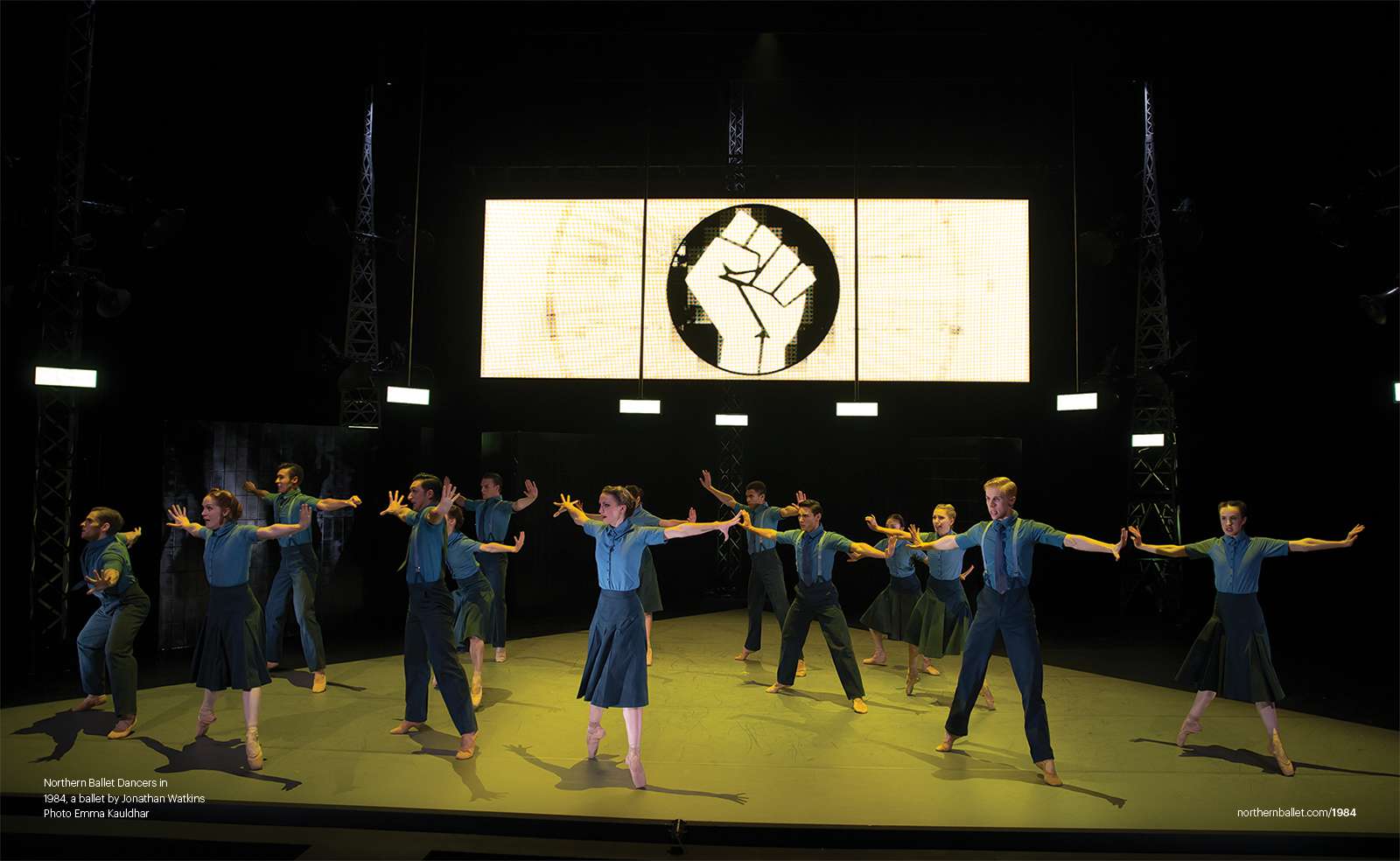
Jonathan Watkins’ choreography is created with all the intricacy and intelligence necessary to portray the complex ideas and changing moods within Orwell’s book. The workers’ unison sections are very crisp and powerful, with many recurring motifs of straight lines and triangles, both in individual movements and formation, which cleverly reflect the “all seeing eye”. Canon variations are used throughout for interest, which work very well to create production line style sequences, again very relevant to the era. In contrast, the Proles’ movements are easily identified through curves, contact improvisation and individuality of style. The lovers’ duet captures all the breath-taking beauty one might expect from a traditional ballet, while the fight scene towards the end is both graceful and gutting, as we see Winston fall and give in to the higher power.

Alex Baronowski’s score is full of accented beats and staccato rhythms which perfectly translate to the repeated motifs of the workers under the control of Big Brother, while the more romantic elements are brought out with strings and flowing, rousing melodies. Much like experimental music of the time, the orchestra uses an assortment of non-traditional instruments to create clashing tinny sounds and altogether this results in an authentic, haunting and sympathetic accompaniment to the action on stage.

Northern Ballet dancers in 1984. Photo Emma Kauldhar.

Northern Ballet dancers in 1984. Photo Emma Kauldhar.

While the relationship between music and movement are clearly intertwined, the design of this production seems equally balanced with the other elements. Chris Davey’s lighting is stark and structural, creating yet more triangles and straight lines for the dancers to follow and stay within, and Simon Daw’s set of moving walls and simple blank spaces adds to the feeling of isolation and hopelessness. Use of colour is also very powerful, from the traditional blue of the workers uniforms, to the bright yellow of hate to the oranges and browns of the Proles, this is clearly a production that pays high regard to many details, making it a joy to watch.

As can be expected in such an interpretation, not every nuance of the book is covered on stage, and sacrifices have to be made to adapt the work for this new form. It’s a shame that some sections aren’t made more of – the final quarter in particular seems a little rushed – but overall the piece strikes a fine balance between narrative progression and beauty of form. For those unfamiliar with the story this production may be somewhat difficult to follow, but even then, the artistry on display is of such high quality that it almost doesn’t matter.

outstanding

StarStarStarStarStar

Reviewer: Steve Griffin (Seen 1 April)

Go to Northern Ballet’s  1984

Visit the Festival Theatre archive.

Uncanny Valley (Summerhall: 29 – 31 March) – part of Edinburgh International Science Festival

Photo:.Borderline Theatre

Photo:.Borderline Theatre

“Educational and entertaining, well-worth taking the kids to”

Editorial Rating: 3 Stars: Nae Bad

As a child I was never particularly into science. At school the lessons were boring and didn’t challenge me to think creatively or engage with it in real life situations. Uncanny Valley, however, does both, placing today’s children at the heart of a situation we may well find ourselves in 30 years’ time.

Essentially it’s a show about humans and robots, and the difference between the two. With the world becoming ever more robotic, the subject matter is engaging for audiences of all ages and I certainly learned a thing or two about artificial intelligence and the Turing Test during the performance. While I imagine 9-year-old me might have struggled with some of the concepts and sitting still through some of the longer “lesson” parts, many of the younger audience members seemed to grasp it fairly well and engage in the interactive elements.

As a children’s piece, one can forgive a certain amount of ridiculousness and be able to suspend disbelief to still be able to enjoy the action. Credit goes to the actors for keeping the performance engaging, with boundless energy creating big, bold characters that are instantly relatable. Kirsty Stuart in particular shines as the cut-throat Mayor who’ll stop at nothing to eliminate robots in her town.

I would have liked closer attention paid to the narrative to keep it seamless all the way through: there were quite a few unexplained jumps in time and location in the story, and I never quite believed Ada’s relationship with her adopted parents. In saying that, some of the theatrical elements are very well done: the Turing Test at the end of the show is funny and gripping; the open moral discussion about whether to swerve a car off road and kill a group of chickens to save yourself is very thought-provoking, and I was even able to feel emotional connection with the robot characters of OKAY and SARA, which adds a really nice dimension.

The beginning is a little confusing – I feel that Rob Drummond as facilitator perhaps tries too hard to convey a lot of factual information early on and doesn’t seem as comfortable in parts of audience interaction as I would expect from an experienced TIE professional. These are only small moments throughout the piece though, as on the whole it’s quite slick and professional.

Overall, Uncanny Valley is educational and entertaining, and well-worth taking the kids to, as long as you’re ready for a bit of thinking! Theatrically it is a bit rough around the edges but still full of heart.

nae bad_blue

Star (blue)Star (blue)Star (blue)

Reviewer: Steve Griffin (Seen 31 March)

Visit the Summerhall archive.

Endgame (Bedlam: 22-26 March ’16)

Thomas Noble as Hamm

Thomas Noble as Hamm

“The best student production I’ve seen in quite some time”

Editorial Rating: 4 Stars: Outstanding

One certainly cannot fault the courage of the students at Edinburgh University this year for taking on so many challenging productions, and to even attempt Beckett – whose works so often have age and world-weariness as themes – is admirable. I was lucky enough to spend an entire term studying Beckett at university, under the tutorship of a renowned expert on his works, but even then I worried that my final performance would be a tragic, naïve offering compared to what had gone before.

Beckett certainly isn’t for everyone, and Endgame is a one-act play with a running time of close to 90 minutes that has very little narrative development or real “action”. What is most satisfying about this production is the group’s sensitivity to Beckett’s text. The great man is notoriously particular about how his work should be performed, and Edinburgh University Theatre Company don’t try any tricks or fancy interpretations to make it new or innovative, but instead use subtlety to let the text speak for itself. Finlay McAfee’s masterful direction teases out various interesting repetitions in the dialogue and hints at some of the political undertones, but never makes bold statements or suggestions.

In saying that, this production also doesn’t take itself too seriously – it’s littered with comedic moments, just as Beckett intended, and is a very well-rounded and watchable show. Sarah Brown’s set is simple yet effective, using black and white as a nod to the “game” element, while all other creative elements are in sync to present a cohesive and professional mise-en-scene.

Thomas Noble as Hamm is the centrepiece of the actors – always on stage, centre stage, he commands attention with charisma and gusto. His moments of anger when flinging props aside are powerful, while he shows great contrast in more intimate conversations with Clov. In turn Clov (Michael Hajiantonis) is excellent as the down-trodden servant, whose development in confidence towards the end, extreme physicality and impressive Irish accent all contribute to a commendable performance.

Jennifer Jones is compelling to watch as Nag, with fantastic control over the small movements and expressions she makes inside the bin. Her physicality is exquisite, and her delivery of the tailor story is achingly on point. Antonia Weir is equally captivating and convincing as long-suffering wife Nell.

To me the only thing lacking from this production is a deeper sense of age and timelessness. The action all seemed a little too fresh and perhaps a touch too “performed” for it to be believable as a snapshot of continual drudgery. In saying that, I’d much rather a slight tip in this direction to keep it energetic and engaging rather than veering down the road of self-indulgent dawdling. In all other respects this show is hard to fault, it’s certainly the best student production I’ve seen in quite some time.

outstanding

StarStarStarStar

Reviewer: Steve Griffin (Seen 23 March)

Go to Endgame at Bedlam Theatre

Visit Edinburgh49‘s Bedlam archive.

A Play, A Pie and A Pint – Billy (The Days of Howling) (Traverse: 22 – 26 March, ’16)

“A dark, eye-opening fable of flawed humans and why they do what they do”

Editorial Rating: 5 Stars

On the surface, this could so easily be “Mumsnet: the play”: a tale of a mother passing judgement on the parents of another child that attends the same nursery as her daughter, juxtaposed with an admin worker whose main priorities are arranging for a pinboard to be put up in her office and responding to radio phone-in competitions. But scrape away that layer of shallow prejudice and what lies beneath is a dark, eye-opening fable of flawed humans and why they do what they do.

The play is written almost exclusively as three intertwining monologues, allowing us to understand multiple viewpoints, with rare yet powerful instances of dialogue when the characters’ paths cross. Director Rosie Kellagher shrewdly opts for simple staging throughout, with each character in their own part of the stage, and keeps the action slick, resulting in an engaging performance I couldn’t take my eyes off.

The writing in this piece is very clever, and quite understandably of award-winning quality, in how it teases and develops action throughout. Early on we are led to be on the side of Alice’s Mum in her mission to ensure a child is properly looked after, while Billy’s Dad comes across as the kind of lout we all love to hate. The tensions are clear, but as the action unwinds and we learn more about who’s who and what has led them to where they are, perspectives slowly change, and at the play’s chilling denouement I was left unsure as to who I should feel most sorry for and whether they really had it coming.

Rosalind Sydney displays great depth, power and fragility as the do-goody Alice’s Mum, from her cutting judgements to her exquisite intonation as a heard-it-all-before call centre operative. It’s hard to believe that Anthony Strachan is anything other than the foul-mouthed, donut-eating, wrestling fanatic Billy’s Dad given the integrity of his performance, while Hilary Lyon is a master of deadpan comedy as the Admin Lady. The acting is controlled, consistent and utterly believable from all three.

In saying that, there were a couple of moments when the action didn’t quite ring true and seemed a little far-fetched (an anecdote of spending 20 hours waiting in A&E being one example), while the weight of action seemed to leave one character a little redundant for the second half of this performance. However, on the great scale of things, these are very minor idiosyncrasies to what is on the whole a compelling production.

For a show that’s this energetic, chopping and changing between three stories with such rapidity, you do have to be on your toes to keep up, but it’s absolutely worth it. Get in there quick.

Star (blue)Star (blue)Star (blue)Star (blue)Star (blue)

Reviewer: Steve Griffin (Seen 22 March)

Visit the Traverse archive.

THIS REVIEW HAS NOT BEEN SUBEDITED

Legally Blonde: The Musical (King’s: 16 – 19 March, ’16)

“Catchy songs, big dance numbers and laughs a-plenty”

Editorial Rating: 4 Stars: Nae Bad

For those who know the film, the premise of the musical is almost exactly identical – blonde bombshell and fashionista Elle Woods from Malibu, California is determined to bag her man, so she buries her head in books and chases him to Harvard law school in the hope of impressing him. The accompanying score is very poppy and upbeat, and while not to my personal taste, even the sternest of faces can’t help but bop along with some of the numbers.

On the whole, local troupe the Bohemians Lyrics Opera Company handle this big production very well – with some impressive dance routines and real powerhouse vocals throughout. The mind boggles at some of the quick changes performed, especially those done on stage, so credit where credit’s due for the risk and professionalism to carry those off. At times, particularly in Whipped into Shape, the performance felt a little flat and a stretch too far for this amateur group – perhaps a bit of shakiness on opening night or not quite having the musical tempos nailed – but otherwise it’s very well rehearsed and full of personality.

Lydia Carrington gives it her all as leading legal lady Elle Woods, and shines with fantastic energy and likeability. Her spirit never falters throughout – impressive considering she is barely ever off stage – and she shows great range and versatility to reflect the changing mood in each scene. However, it’s Lyndsey McGhee as Paulette who raises the biggest cheer of the night with the very moving Ireland (watch out for that towards the end of Act 1). Her voice is deep, rich and she delivers a knockout performance. It’s a shame we don’t get to see more of her throughout the show.

While the leads very much hold their own throughout the performance, for me it is some of the cameo roles that make this production really enjoyable: Ross Stewart is eminently watchable as UPS guy Kyle, while Sam Eastop and Andrew Knox make a great comic pairing in Gay or European. And of course, there are dogs. Scene-stealing dogs. You have been warned…

Yes it’s cheesy, yes it’s American, and yes at times it’s a bit ridiculous, but it’s also a show full of catchy songs, big dance numbers and laughs a-plenty (my favourite line being “I see dead people” in relation to the rather bizarre inclusion of a Greek chorus). If you like the sound of all that then you’ll love this production.

nae bad_blue

Star (blue)Star (blue)Star (blue)Star (blue)

Reviewer: Steve Griffin (Seen 16 March)

Visit the King’s Theatre archive.

THIS REVIEW HAS NOT BEEN SUBEDITED

A Play, A Pie and A Pint – Some Other Stars (Traverse: 15 – 19 March, ’16)

“Gripping until the very end”

Editorial Rating: 4 Stars

There was a real buzz at this, the opening performance of the first in the new season of A Play, A Pie and A Pint at the Traverse Theatre, as audience members of all ages filled the studio – an indicator of the wide appeal the programme has. Opening the batting order is Some Other Stars, which depicts honestly, beautifully and painfully, the journey travelled by a loving couple when one of them, for whatever reason, ends up in a coma.

Performed as two interweaving monologues, Clare Duffy’s script deftly covers a plethora of feelings and thoughts from both sides, from confusion and pain in the early days, through hope, helplessness, boredom and betrayal. The play begins in darkness, with a sizeable monologue from Ian (Martin McCormick) describing what’s going on in his head while in a vegetative state. The discomfort of the darkness and simplicity and repetition of his words work to set a deep and personal tone, drawing us into the obvious conflict of his physical incapability of communicating with his wife, Cath (Kristin Murray).

Once the action gets going it’s quite a pacy affair that is full of dramatic contrasts in perspective that interweave, each seamlessly making way for the next without ever getting bogged down on one idea. Cath’s opening speech is delivered very fast, which on one hand jars against the sensitive, human element of the production, while on the other very ably and stylishly communicates a headful of thoughts that aren’t able to form themselves into cohesive sentences before the next comes along. Perhaps a little too “theatrical” for me, but powerful all the same.

Both McCormick and Murray are very believable in their respective roles, with a command of emotion and tension that makes this play gripping until the very end. While not wholly believable in terms of chemistry as a couple, their energy, pace and variety of emotional intensity are evenly balanced, and that missing spark almost works in their favour in sections where the breakdown in their relationship becomes more apparent.

Yet while the acting is on whole very powerful, I wasn’t convinced by Jonathan Scott’s design which seemed too “artsy” against the very sensitive performance. The use of a hospital bed with a body constructed of plastic bottles and other flotsam certainly represented Ian’s apparent lifelessness, but to me detracted from the integrity of the emotion on display, especially when it was being interacted with. Some of the other design elements also seemed redundant – the table and dolls downstage and the gazebo-like structure didn’t add anything to the production, and I feel that a more stripped back approach, relying on the actors to do the work with their physicality would have aided to the rawness and fragility of the piece. There were moments of this towards the end of the production, where Cath, in desperation straddles her husband in his wheelchair in the hope to get him to feel, which were very moving and required no special effects. It’s a shame this technique was not used more often.

Overall, this is a simple yet moving exploration of a situation none of us ever hopes to be on either side of, presented with real human honesty. Compelling.

Star (blue)Star (blue)Star (blue)Star (blue)

Reviewer: Steve Griffin (Seen 15 March)

Visit the Traverse archive.

THIS REVIEW HAS NOT BEEN SUBEDITED

Julius Caesar (Augustine United Church 1 – 5 March ’16)

Antony (Tom Birch), Caesar (Adam Butler) and Calpurnia (Heather Daniel)

“The kind of unbridled creativity I often only see in student productions”

Editorial Rating: 3 Stars

Reimagining Shakespeare’s classic tale in the modern day world of professional football may seem like lunacy to some, but with themes like loyalty, pride in one’s city, questions over physical fitness and a bit of back-stabbing, the parallels between ancient Rome and football today aren’t as dissimilar as might be first assumed – it certainly piqued my interest. However, as can happen in football, I think there was perhaps too much theorising behind this production, which didn’t quite convert to success on the pitch.

Much like when reading a Hilary Mantel novel, I worry when I find myself constantly having to flick back to the character list to be reminded who everyone is and what side they’re on. And with this interpretation assigning each character a footballing role (for one or more teams) as well, it’s certainly not the easiest to follow for someone unfamiliar with the play.

Adam Butler as Caesar is every inch the star player in this outing, commanding attention and respect from all around him, and it is easy to build rapport with him as the fans’ favourite. He is confident, charismatic and handles Shakespeare’s text very well. Charlie Angelo is also enjoyable and convincing as Casca, bringing an air of comedy into what is otherwise quite an intense evening’s entertainment.

Various women are cast in male roles in this production, the most interesting of these being Alice Markey as Decius, who holds her own with strength and precision. However, in arguably the most important scene of the play, where Calpurnia convinces Caesar not to go out, only for Decius to then persuade him otherwise, I would have really liked to have seen the female Decius use a more sexual approach to her argument, heightening the tension in the scene which unfortunately seemed rather rushed.

Indeed, missed opportunities seemed the name of the game throughout, with many great ideas going unfulfilled or veering off-target. With almost all characters being football players, it is surprising how much standing around there is in group scenes, whereas seeing some football in action and the interactions that come naturally within that could add more depth and integrity to the performance. Given the interpretation of this piece I was also disappointed the fight scenes are not reimagined as football matches between the rival factions, and that stabbing is so faithfully used as the murder method of choice. With interesting references to performance-enhancing and other kinds of drugs throughout, maybe “dagger” could have had a whole new meaning?

However, what I particularly enjoyed about this production was the inventiveness of the projected films throughout, showing characters as models, celebrities and footballers on the pitch. These sections work very well to give background and depth to the characters, and to cover any edits from the original script. Additionally, when all characters are on stage reacting to Antony’s speech after Caesar’s death the atmosphere is very powerful and sustained, while the fight scenes show great energy and control. The use of hoodies instead of cloaks, paparazzi and mobile phones were all nice modern touches showing the kind of unbridled creativity I often only see in student productions.

Overall, I admire the headstrong strategy and imagination of the squad in this play, but for me the formation didn’t allow it to achieve a resounding victory.

Star (blue)Star (blue)Star (blue)

Reviewer: Steve Griffin (Seen 2 March)

Visit the Other archive.

THIS REVIEW HAS NOT BEEN SUBEDITED