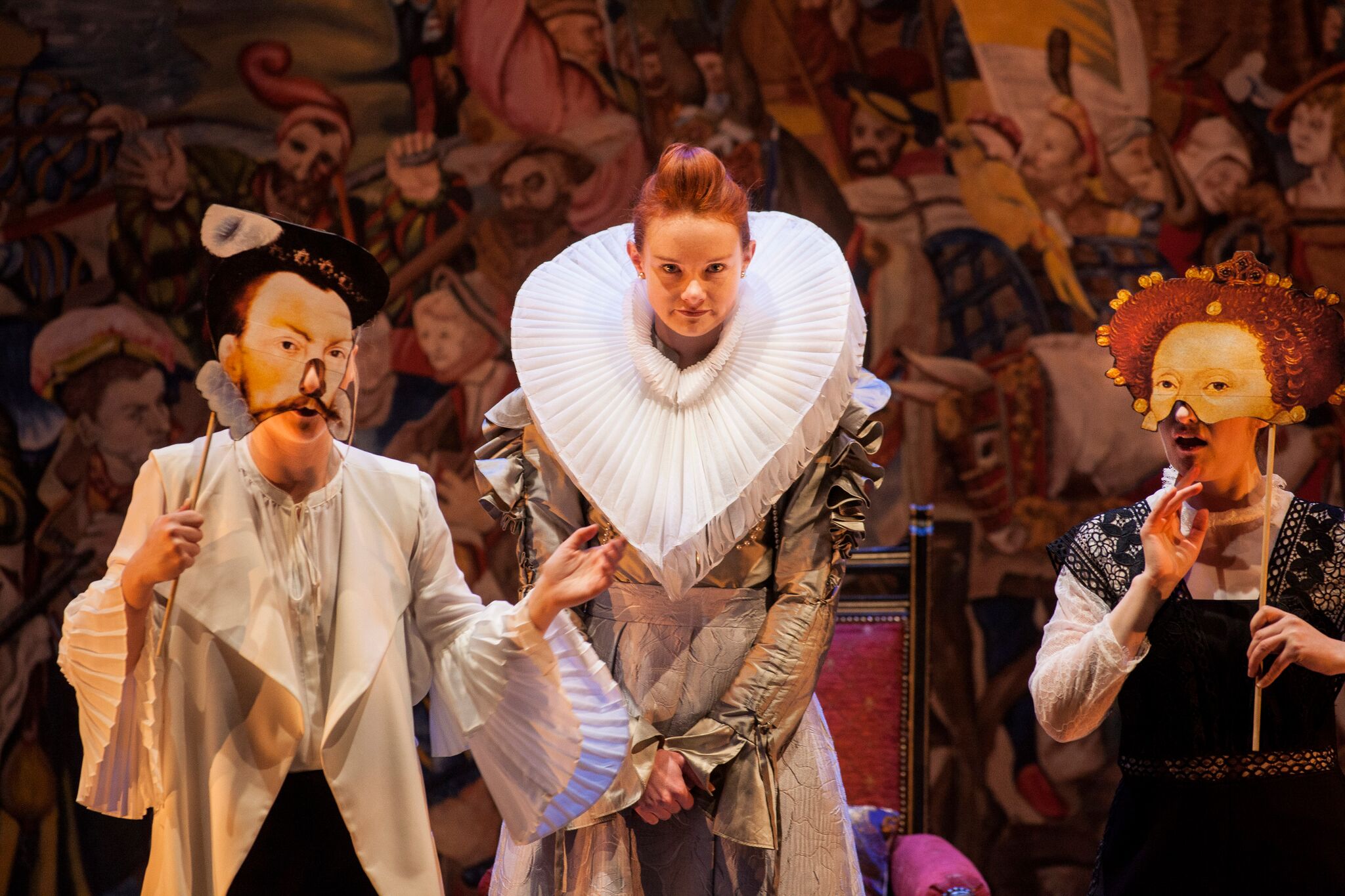
Hedda Gabler (Festival Theatre: 17-21 October ’17)

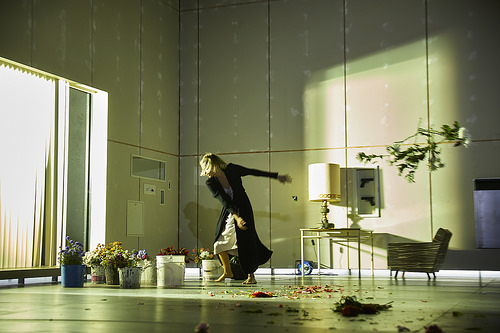
Photo. National Theatre, London

“Glistens with sparkling elements”

Editorial Rating: 3 Stars

I wonder if there is a word, other than bewilderment, for the reaction to a writer who receives praise despite mediocre work. This is what Patrick Marber’s writing stokes inside me. His re-writing of Henrik Ibsen’s Hedda Gabler is by far the most lamentable element of this National Theatre production, which sometimes glistens with sparkling elements, but includes far too many misjudgments at the head-in-hands level .

To name a few: Leonard Cohen’s lovely yet done-to-death “Hallelujah” plays over a somber transition. Pale blue lights shine intermittently on the assembled actors, for no apparent reason. Physicality is dishearteningly overplayed at times, making the performers appear more like wet marionettes than characters telling a story. And yet, Marber’s script outdoes them all.

The play concerns itself with a day and a night in the apartment of academic wet blanket Tesman and the eponymous Hedda, his new, unfulfilled wife. Friends and former lovers of theirs come and go to moan and wail about their various woes, from dead-end marriages to unrequited love to jealousy over academic rivals’ successes. There are intriguing elements to these episodic entrances and exits, most compellingly when Tesman’s semi-rival Lovborg lays out his plan for his next work. This is what most frustrates about this show: there are so many glimmers of intriguing theatre, many stemming from Ivo Van Hove’s smart (yet here unexceptional) direction, but they are all but snuffed out by Marber’s tone-deaf phrasing and (I hazard) self-importance.

Hedda, a groundbreaking and fresh character in 1891, is nowadays much less extraordinary. She is the daughter of a prestigious general, and a young woman with many suitors, yet lacks any real goals or interests in life. This “poverty of spirit” as the play decides to call it, leads her to seek out increasingly sadistic means of exerting some kind of power over something, whether it be tearing up flowers or firing her father’s pistols at unsuspecting guests, and eventually much worse. This kind of bourgeois-fetishizing story creates just the sort of middle-of-the-road tension and intrigue that should be right up Marber’s alley. Is Tesman going to get his professorship? Is Hedda fulfilled? What is that maid doing there? Yet Marber seems to think he doesn’t need to convince an audience to care about these central questions of the script. So he fails to.

Much like in his magnum opus, Closer, Marber’s word choices can prove unfortunate and even unpleasant. The storyline is treated with such carelessness that it is unclear whether it is satirizing its own pomposity or reveling in it. It looks like Ibsen’s text has suffered a form of quantitative easing and the original is struggling to get back into shape. Certain big monologues (that strain the runtime for no apparent reason) are answered by brief ironic retort: when one character loses the precious, handwritten single draft of his upcoming masterpiece, he waxes poetic for no less than five minutes about his loss — to which another character quietly quips: “It’s just a book.” Somehow, this self-awareness gets squashed and replaced with showiness and shiny things.

There are many shiny things. The set is the unfurnished apartment owned by Hedda and Tesman and is immaculately underdressed. Hedda’s costume is a shiny nightgown. The lights gleaming out of an impressive side window are shiny, as is the display Hedda creates as she plays with the blinds out of increasingly aggressive boredom. The two handguns on show in their upstage glass case  are shiny, and even shinier when they are — spoiler alert — fired at certain characters. But shiny objects do not tell good stories by themselves. We seem to have a production that thinks having a smooth set and glossy production values can make up for a certain percentage of the narrative. They cannot. Some more work on character dynamics and relationships and a little less time stapling roses to walls would have helped quite a lot.

That being said, there is still much to be appreciated in the production. For their stamina alone, the actors deserve some credit. Wading through these lines with such patience must have been hard. Lead actress Lizzy Watts gives Hedda some delightfully cruel ticks, from turning her back on anyone she finds unworthy, to consciously tormenting her guests with their worst vices. Her dynamic with Richard Pyros, playing Lovborg, was the most electric to watch, especially as she toys with his teetotalism in the most vicious way. Adam Best as corrupt judge Brack is the most bombastic onstage presence by far, and his was a refreshing performance. Annabel Bates is good at looking sad, that’s for sure. Abhin Galeya waves his hands around far too much, but otherwise is a solid Tesman — though the character seemed meant to be much more pathetic than the relatively proud man Galeya has created. Christine Kavanagh is a charming red herring at the beginning, as her Aunt Juliana character deftly introduces the audience to the show, then disappears — which is a shame, as Kavanagh’s energy was possibly the best-measured. Madlena Nedeva is a solemn and well-crafted presence as Berte, the maid, yet her character is so untapped that she quite literally becomes more a piece of furniture than a participant.

Overall, an underwhelming and overwritten production of an important play. It is surprising and disappointing that others have eaten it up nonetheless.

Star (blue)Star (blue)Star (blue)

Reviewer: Nathaniel Brimmer-Beller  (Seen 17 October)

Go to Hedda Gabler at the Festival Theatre

Go to Edinburgh49‘s Festival Theatre archive.
 

Pleading (Traverse: 3 – 7 October ’17)

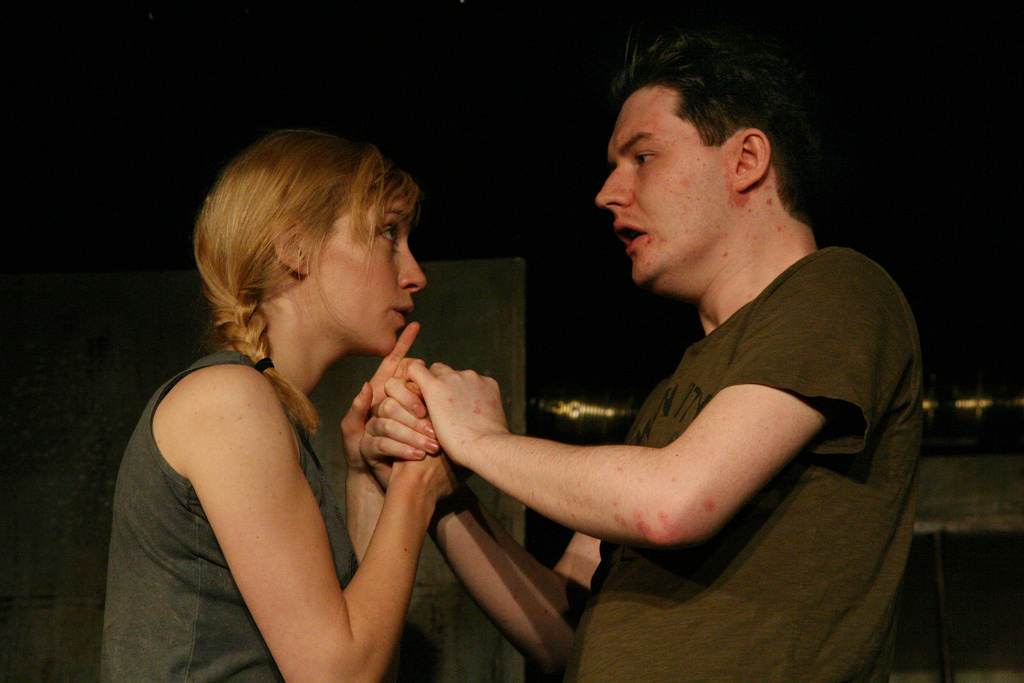
Kim Allan and Daniel Cameron
Photo: Oran Mor

““Everything is negotiable””

Editorial Rating: 3 Stars

Pleading is the first up of five plays in this season’s ‘A Play, A Pie and A Pint’. This is a spiky three-hander by Rob Drummond, surely a playwright on a roll; and there is something of a wrestling bout to its twists and holds. Heard as a radio drama on BBC4 in January, Pleading comes to the stage – but call it a mat – with a narrative thwack.

Michael (19) and Freya, his girl next door /one-time sweetheart, have been banged up in a foreign jail for three weeks now. They are brought together to talk to their assigned lawyer, Amelia Singh. Where exactly they are  is not given but they do face the death penalty for attempting to smuggle Class 1 drugs. That fate – and their flight itinerary: Singapore > Perth > Brisbane > prison – would suggest Malaysia or Thailand. No worries (really?), for Freya’s dad is a QC and in that part of the world “We’re not foreign, we’re British.” Er …? Cue Boris Johnson and the Road to Mandalay?

If ever a defence lawyer was gobsmacked and keeps talking, then it’s the calm and collected Amelia (Nicole Cooper). How to convince her jumpy clients to plead guilty and serve a prison sentence? Maybe then Daddy can come and flap his silk. “Everything is negotiable”, declares Amelia, but it helps if you keep your story straight and consistent. So, over 50 minutes, Freya and Michael ‘negotiate’ the possibilities of how heroin ended up in her backpack. It is conceivable that the truth is told at the end but who can tell? It’s always salutary to be reminded of our talent for lying.

It is an unsparing and sweaty tussle that is ably performed. Freya (Kim Allan) is more in control but her account is the more wayward. Michael (Daniel Cameron) is more fragile, even desperate. At the close they are hanging onto each other for support and the law is somewhere else entirely.

Director David Ian Neville has a good play for voices to work with. Movement is conspicuous and time parcelled out by Amelia’s visits to the remarkably quiet prison. There is credible tension and there is sympathy and anxiety but as a drama I felt it wanted more fear and a lawyer on the ropes.

Star (blue)Star (blue)Star (blue)

Reviewer: Alan Brown (Seen 3 October)

Go to Pleading at the Traverse

Visit Edinburgh49 at the Traverse archive.

Columns (theSpace on the Mile: 14-26th Aug: 10.55: 60 mins)

“A really joyous production”

Editorial Rating: 3 Stars: Nae Bad

If there were an award for theatre company I most want to be friends with, The Wax House (formed by Laura Day and Alexander Hartley) would win it hands-down. Their smiles, personalities and passion for what they do is infectious, and that’s what’s most resounding about this performance of new work Columns. It feels more like you’ve popped round to a mate’s house for fun story time than a converted hotel function room on the Royal Mile, and the atmosphere of the piece really does transport you to a happy place.

The story follows two main characters: Sophie (Day), a personal trainer with an estranged mother and rather volatile relationship with her father; and Joe (Hartley), a pot-plant enthusiast whose parents upped and disappeared without a word almost two years ago. At its heart is a theme of reconciliation and helping others come to terms with loss.

The mainstay of the story is Sophie’s quest to help Joe deal with his parents’ unexplained disappearance, and the questionable moral choices (such as impersonating his mother in a voicemail message) she makes along the way in so doing. It’s a simple and effective approach to create tension and drive the piece along, as we do follow her thought process and qualms at each step, though it’s a shame how easily it all turns out in the end: some of the journey and struggle is cut short, cheating the audience of a full feeling of satisfaction.

Indeed, what is rather frustrating about Columns overall is the number of loose ends and glossings over of facts that are rather central to the story: proof of a certain phone call, and Sophie’s motivation to undertake her first piece of exploration being key examples. Yet what is there is performed with such warmth and vivre that these flaws are almost forgotten by the end.

The company make clever use of carboard boxes as their set and props throughout, each painted with different patterns and images on each side, and which are then variously arranged to create different scenes. This action adds to the playful, happy nature of the piece, as do the audio interludes accompanying each scene change, seemingly capturing unplanned snippets of Day and Hartley in discussion about the show.

The performance I saw was a relaxed one, adapted specifically to suit those who find the traditional theatre environment too formal to sit still and quiet in for an hour. Day and Hartley certainly make the space welcoming and friendly one to be in, encouraging us all to be ourselves and respond however we felt comfortable to. I’d never been to a relaxed performance before, but would absolutely recommend it for those who might face barriers to access theatre normally.

Overall this is a really joyous production, but needs more work on the script and details of the story to take it to the next level.

nae bad_blue

Star (blue)Star (blue)Star (blue)

Reviewer: Steve Griffin (Seen 24 August)

THIS REVIEW HAS NOT BEEN SUBEDITED

Fragile Man (theSpace on the Mile: 10-26th Aug: 11.50: 50mins)

“The structure and story are a stroke of genius”

Editorial Rating: 3 Stars: Nae Bad

Suicide is a topic that’s difficult to talk about on all fronts. It is the biggest killer of men in the UK under the age of 50, and this alarming trend doesn’t appear to be fading away any time soon. It’s refreshing, then, that some shows at the Fringe this year approach the issue in a sensitive, accessible way, and Fragile Man is one of them.

Set on a remote hilltop at dusk we meet two men, one apparently on the verge of committing suicide and one who steps in just in time to save him. It seems like a fairly predictable set-up, yet what unfolds is an attempt at reconciling a frank discussion into the hard-hitting issue of male suicide with a thrilling dramatic play. The two sound like they shouldn’t work together, but they almost do. Almost.

While several elements of David Martin’s script are quite clunky and cliched, the overall structure and story Fragile Man follows are a stroke of genius, cleverly peeling away at the layers of the two characters to reveal a gripping and thought-provoking heart. Only in the last few minutes does it all “click” into place, and with some polishing in the sticky areas, the writing could be the basis of a really intelligent piece of theatre.

As an emotive and challenging two-man show, with a hefty amount of multi-roling, it’s a big ask from actors David Martin and Richard Miltiadis to sustain the tension for a whole hour. They make a commendable effort and absolutely give it their all, but at times both seem a bit out of their depth with the magnitude of the piece, often resorting to overly emotional responses and exchanges, when at times a more withdrawn and subtle approach would help create more contrast and power. Though for new company performing a debut piece, I should perhaps cut a little slack.

When it comes to Jacqs Graham’s direction, the physical nature and more stylised elements of the performance, while creative, sometimes feel disingenuous, not aided by the quite choppy scenes and dominating set the actors variously crawl in and out of during the transitions. For me, a simpler approach to both the direction and design would be more effective to maintain a consistent and honest feel throughout. In saying that, some of the cutaways from the main story – including the confession scene and direct address in the lecture – do work very well, flowing seamlessly and maintaining the integrity of the set-up, and it’s a shame the whole piece isn’t performed at this level.

This is an important and interesting play, which, if not quite worth shouting about, should, like the subject it addresses, at least be talked about far and wide.

nae bad_blue

Star (blue)Star (blue)Star (blue)

Reviewer: Steve Griffin (Seen 22 August)

THIS REVIEW HAS NOT BEEN SUBEDITED

Sister Act (theSpace @ Surgeon’s Hall: 14-20 Aug: 16.10: 1hr 45mins)

“Energetic, harmonic and full of the gospel spirit this whole show embodies”

Editorial Rating: 3 Stars

In my experience, condensed versions of musicals generally go one of two ways: they either trim the fat from the full version and present a slick and sizzling highlights reel (as in EUSOG’s Spring Awakening last year), or they come across as a slightly misshapen patchwork quilt of musical moments. Unfortunately, Edinburgh University Footlights’ production of Sister Act falls into the latter camp. However, some of its musical moments are really rather magical.

We all know the story of the show: aspiring and audacious nightclub singer Deloris Van Cartier has to hide away with a group of nuns for her own protection, and in so doing transforms their choir into a team of sensational songstresses. Sarah Couper certainly gives it her all as Deloris, with hugely likeable sass and personality, which is more than capably offset by Tayla Steinberg’s harsh but witty Mother Superior.

It’s Alice Hoult as the timid Sister Mary Robert who vocally steals the show though, with a flawless rendition of the rousing The Life I Never Led. A masterclass in control, it’s a shame some of the other numbers lack the overall quality and power of this one: it really stands out as something special.

Yet when this production hits the sweet spot, it really does soar. The Raise Your Voice scene in particular is energetic, harmonic and full of the gospel spirit this whole show embodies. Caili Crow’s choreography is stylish, intricate and very deftly delivered, and for a few minutes here and there the performance really sparkles.

The main strength of this production overall is comedic characterisation, and director Ansley Clark has done a great job in bringing the best out of each individual throughout the performance. Nicola Frier is a revelation as the excitable Sister Mary Patrick, delivering laughs aplenty with every utterance; Adam Makepeace is a wonderfully dorky TJ; and Mhairi Goodwin brings a whole new level of vibrancy to Sister Mary Lazarus that I didn’t think was possible.

This production is quite hit and miss though, making it difficult to stay fully engaged with it throughout. While I won’t go into details of the technical issues which unfortunately blighted this production, other factors such as the (at times) awkward staging, the very choppy nature of lots of different quick scenes, and lack of palpable tension in the big moments all detract from what has the potential to be a really outstanding show. It all feels a little rushed and a bit too rough around the edges.

This a very commendable effort from the cast and company, but perhaps slightly too ambitious too pull off.

Star (blue)Star (blue)Star (blue)

Reviewer: Steve Griffin (Seen 15 August)

THIS REVIEW HAS NOT BEEN SUBEDITED

Louise Reay: Hard Mode (The Stand Four: 3-27 Aug: 17.55: 60mins)

“A unique and insightful project perfect for Fringe audiences”

Editorial Rating: 3 Stars: Nae Bad

This is a very clever show. Through a healthy mixture of character work, pre-recorded videos, impressive knowledge of modern Chinese society, and truly human moments, Louise Reay has crafted a unique and insightful project perfect for Fringe audiences. Some fine tuning of the details and the flow of the show would be useful to make its 60 minutes shine brighter, but overall Hard Mode is a worthy offering.

The show’s title derives from the idea that in modern China, life is lived as if in ‘hard mode.’ Reay takes care to share a genuine taste of what that kind of life means, from tampering intrusively with audience members to stationing masked cronies around the room to watch and possibly punish the viewers at all times. She uses clever techniques like distributing identical napkins for all audience members to wear (to recall authoritarian homogeneity), and leading the room in hive-mind chants in between musings on what having a free society means now and what losing it could mean later. The masked guards do stay unsettlingly in character the whole time, even banishing non-compliant individuals who dare to remove the napkin to the ‘jail,’ which is the corner of the room. Though some of the points on surveillance are presented somewhat simplistically, the dark sense of forced enjoyment is done well. This show, to its credit given its subject matter, is effectively unpleasant.

Reay bases this societal reenactment on her lived experiences in China, thankfully. A few lines and jokes would seem like sweeping (and potentially offensive) generalisations if she hadn’t proven her extensive knowledge of Chinese culture, from the language to the media to the in-jokes. On the comedy end, the highlights of the show are her stagings of a possible future where the Chinese government has bought and hawkishly runs the BBC. Her David Attenborough-centered skits are hilarious, and her all-Chinese rendition of ‘Far-EastEnders’ is impressive for her sheer capability with the language, as a native English speaker.

On the dramatic side, and yes, there is a somewhat unexpected dramatic side, Reay mixes in her own real life in ways that teeter on the edge of too much. Without giving anything away, the sense of ‘hard mode’ in a societal sense is re-purposed in a personal sense, which at times is truly affecting, and at others feels like retreading and backtracking on points that have already been made.

Reay’s use of an actor to portray Chinese artist and social activist Ai Weiwei in a pre-recorded video conversation Reay apparently had with him feels strikingly off-kilter with the rest of the piece, and not only because it is never truly verified that Weiwei actually said any of the statements in the video. The actor’s timing is jarring, the delivery is confusing and flat, and points are muddled and indistinguishable — under what is admittedly fabulously intricate facial hair. For me, these filmed asides are revisited too often, and though most of Reay’s recurring jokes are quite funny and/or poignant (special nod to the unforgettable Loneliest Newsreader in the World), the Weiwei scenes feel poorly executed.

Overall, if you are looking for a bizarre yet poignant hour at the Fringe, and happen to be in the relatively far away lands that house the Stand Four, Louise Reay’s Hard Mode might be for you. Just be sure to set your expectations to Weird Mode.

nae bad_blue

Star (blue)Star (blue)Star (blue)

Reviewer: Nathaniel Brimmer-Beller

THIS REVIEW HAS NOT BEEN SUBEDITED

Auditions (Sweet Grassmarket: 3-13 Aug: 3.30: 65 mins)

“Fun and upbeat”

Editorial Rating: 3 Stars

An interesting concept for a musical, Auditions presents a series of vignettes from those who have been doing the rounds for a long time, sharing their highs, lows and learnings after years in “the business”. While many musicals seem to feature – and be aimed at – younger and lither casts, it’s nice to hear the voice of experience or a change, especially when there’s something there we can all learn.

The content covers everything you would expect of such a show, with a range of stories from type-casting, competition, nervousness, over-confidence, and sexually predatory producers, and each one, while brief, is a pleasant insight to the side of being a performer that’s not often put on stage.

My main problem with this show though is how bland it is, which perhaps suitably fits the theme: being about the almosts, maybes, and not-quite-good-enoughs. The songs are nice, with a consistent pop/musical theatre feel and tried-and tested structure and chord progressions, though there’s nothing musically or lyrically to make them stand out: I felt like I had heard each one a hundred times before. There’s a very touching moment late on covering a sensitive subject which brings some much-needed variation to the overall mood, but it’s almost too little too late to save the show from mediocrity.

The same can be said of the cast. Each of the four members have good voices – they capably hold their own – but don’t expect to be blown away by any powerhouse vocals. Perhaps the lack of radio mics means they are forced to keep something back to protect themselves, but for seasoned pros I was still expecting a bit more wow-factor.

While there is generally a good mix of songs in terms of subject matter, they are full of lyrical clichés and heard-it-all-before melodies. I lost track of how many references there were to skies of blue or the importance of staying true to oneself. Indeed, much of the staging and choreography is also very dated, with raised hands and dropped heads being very common features. Again, perhaps a hark back to yesteryear for how things used to be, but more originality and creativity would help make this show feel like something special.

However, what this show lacks in originality it makes up for in positivity: the numbers on the whole are fun and upbeat, with plenty of toe-tapping to be done. It’s a harmless hour of fun, which could make a very pleasant retreat from some of the more challenging work out there this August.

Star (blue)Star (blue)Star (blue)

Reviewer: Steve Griffin (Seen 9 August)

THIS REVIEW HAS NOT BEEN SUBEDITED

War in America (Former Royal High School/King’s Theatre: 24-27 May ’17)

Connor McLeod as Mr Slype. Photo by Greg Macvean

“Some fine performances from the young cast”

Editorial Rating: 3 Stars

War in America’s revival in the build-up to the current UK General Election is very apt – and almost feels as if it is written especially for this moment, though it is now over 20 years old. The narrative sees the rise of a female political leader (known only as “She”), who hides behind a variety of lies, disguises and games in order to get to the top. Meanwhile, in a pleasingly Orwellian set-up, our little man Mr Slype (a rather spineless MP) is bullied by rival parties to vote for a law he neither wants nor doesn’t want, and some rather underhand tactics see him inadvertently give his vote to She, handing her the reins of the country. What happens after gets a little confusing.

Given the setup and opening few scenes where the main characters and topics are introduced, the first fifteen minutes of this production really makes it feel like a cutting-edge, gripping political drama – not too dissimilar from Mike Bartlett’s King Charles III, which I reviewed last year. Jo Clifford’s dialogue is cutting, intelligent and witty, Susan Worsfold’s direction is slick, and there’s palpable tension between rival factions to keep us on our toes. The production loses its way somewhat in the second half, however, and tries to cram in too much with too many characters and melodramatic revelations, that it becomes more of a slog to sit through.

That being said, there are some fine performances from the young cast, most notably Andrew Cameron as the cunningly-named and deftly acted Mr Fox, who is very charismatic and convincing and throughout. Scenes with him and his assistant Alfred (Mark O’Neill) were among the most compelling of the performance, and I could easily picture them on a bigger stage receiving great acclaim. Connor McLeod is also strong as Mr Slype, with great variation in swagger and guilt from scene to scene.

It is, however in the more dramatic scenes where the tension and integrity of the piece slips. She’s relationship with her estranged daughter fails to ring true throughout the piece – distinctly missing the deep emotional connection needed to be convincing, and its climactic resolution is very sloppy compared to the polish evident in other areas. Indeed, many aspects of the show like this come across as rather rushed, when a more considered approach would be more powerful. While in general it’s a gutsy effort from the young cast (and great for them to be getting involved with works on important subjects like this), I think in some cases it would have been beneficial to have some more experienced actors to give the brutal narrative the necessary punch it needs.

And the “too controversial” content, which led the show’s initial production being cancelled 20 years ago? For me that must have been a lot of fuss over very little, as the more overt elements were perfectly pitched within the overall mood of the piece, never seeming gratuitous or unnecessary. Indeed, the scenes with sexual content were handled and incorporated very well, and while spawning a few titters, were powerful insights and metaphors into the darker side of politics. If anything, I think these elements could be pushed further.

Overall this is a show with fantastic potential, and with some more development could be very special indeed.

Star (blue)Star (blue)Star (blue)

Reviewer: Steve Griffin (Seen 26 May)

Visit the King’s Theatre archive.

Glory on Earth (Lyceum: 20 May – 10 June ’17)

(L-R) Christina Gordon, Rona Morison, Kirsty Eila McIntyre
Photos: Drew Farrell

“Evocative, imaginative drama”

Editorial Rating: 3 Stars: Outstanding

You’re 18 and you don’t know the 2nd Psalm. Well, that’s you written off. You do know a good few dance moves but that doesn’t cut it. Your stock is worthless, you’re ignorant; best go home little girl.

Ah, but where’s home? And who are you calling cheap?

Ans: Mary Stuart, born Linlithgow, brought up in France from the age of 5; Queen of Scots and actually in Scotland from 1561 to 1568, forced to abdicate, kept ‘safe’ under house arrest in England for 19 years and then beheaded, aged 44, in February 1587. Mother, via the union of the crowns, of James VI and I.

So much for dates and titles – but that’s not to dismiss their grip, far from it – it’s just that Linda McLean’s new play creates evocative, imaginative drama from the baleful encounters of the young, attractive queen with the almighty John Knox. He’s there from the off, in front of the curtain, in clerical black and giving new definition to the reproving stare. God’s word, you understand very, very quickly, is “non-negotiable”.

At least Mary has the support of her ‘Marys’, six of them in this telling, who attend her, dance freakpop with her (… really liked that!), and review her suitors in a modern, OMG/ “Awkward”, kind of way. There’s a disciplined choric role in there too, in whispers, gesture, and half lines, as well as the harmonious choral interludes, mostly in French. In other, opposed, parts the Marys are privy councillors and reformers. Queen Mary’s life is here, opened and closed by the executioner’s block, but the tawdry and the sensational (& the melodramatic) are absent: no Darnley, no Rizzio, no Bothwell – just her searching and bold question to Knox, “Do you see a bad person, Sir?”

(L-R) Jamie Sives, Shannon Swan, Christie Gowans, Hannah Jarrett-Scott, Christina Gordon, Fiona Wood, Kirsty McIntyre, & Rona Morison

James Sives, as Knox, is too cool to rise to the question. And he’s damnably clever, in or out of his pulpit in St Giles. Hear Sives and hear the preacher’s ‘History of the Reformation’, righteous and utterly fearless. He walks on stage and kills the dancing stone dead. An unexpected and rather wishful soundtrack of France’s finest minstrels: Piaf, Francoise Hardy, Christine and the Queens (sic), cannot stand. However, Brel’s ‘La chanson des vieux amants’ probably does touch him, as he grieves for the loss of his first wife, but then Brel was Belgian.

Rona Morison, as Mary, has the sympathetic part, the level gaze (female) and the appealing voice. More principled and upright than pliant or weak, and so much younger, this Mary is an important addition to the historical strumpet/martyr and – should you browse Netflix – an invaluable corrective to the endless episodes of CBS’s  ‘Reign’.

David Greig directs with a clear eye on what mattered then and should still matter now. Knox won and Mary failed. The austere and the severe are there in the steel blue lighting and the greys of an uncluttered set and in Knox’s strict delivery. Where there’s a wide and colourful tapestry, there’s dancing and short-lived levity. Elizabeth I, speaking through a mask, is both laughable and ominous and maybe the scheming Scottish nobility could have used the same distancing device. The disrobing of the queen at the end has its own proper and tragic significance.

‘Be wise now therefore, O ye kings: be instructed, ye judges of the earth.
Serve the LORD with fear, and rejoice with trembling.’    From Psalm 2.

You won’t fall to your knees but Glory on Earth will make you give thanks for new writing and live theatre.
.

outstanding

StarStarStar

Reviewer: Alan Brown  (Seen 23 May)

Glory on Earth is at the Lyceum

Visit Edinburgh49 at The Lyceum

Edinburgh Quartet (Queen’s Hall: 27 March’17)

Painting by Erik Petrie

“The band’s playing being bolder and more committed as they got into their stride”

Editorial Rating:  3 Stars

The life of a professional musician has always been tricky, whether you were Mozart churning out prodigious quantities of glorious music against impossible deadlines and demanding creditors, Shostakovich keeping Stalin and his apparatchiks at bay, or even today as a rank and file player with the necessity often to freelance and keep several irons in the fire, both for the benefit of professional development and regular employment.

All these aspects were present at Monday’s Queen’s Hall recital by the Edinburgh Quartet. First, the line up. The first violin desk has been filled by a variety of (very talented) artists since Tristan Gurney left for London last year and was tonight filled by Zoe Beyers. Second violin Gordon Bragg also plays for the RSNO and is currently touring with them in Florida, his place being taken on the night by Tom Hankey. Catherine Marwood ably took the viola desk on behalf of Fiona Winning, leaving only Mark Bailey on cello as part of the regular band. I am afraid, notwithstanding good individual playing, it showed – a bit. Talented individuals do not necessarily an ensemble make.

The evening started with Mozart’s String Quartet in D Major K575. Composed towards the end of his life and published posthumously it is an enjoyable work that allows each member of the band to show off their individual talents, a wise choice here in that their experience of playing together is limited. It made for an easy to get into start to the evening, with Catherine Marwood’s viola to the fore supported by Mark Bailey’s Cello.

There followed Shostakovich’s String Quartet No 1 in C major. A short (fourteen minute) romantic work, yet of some intensity but also tunefulness, it surprised and pleased the audience as not coming as too much of a shock after the Mozart; the band’s playing being bolder and more committed as they got into their stride.

The evening concluded with Beethoven’s String Quartet in C major No 3 ‘Rasumovsky’ one of three so named after its sponsor, the Russian Ambassador to Vienna. Again, the work offers plenty of scope for the individual players to respond to, as well as some good ensemble playing as the Quartet were by now fully warmed up. There was real verve in the opening movement, particularly in the Allegro vivace, smooth togetherness in the Andante con moto quasi allegretto supported by well despatched cello pizzicato and really good ensemble playing in the Menuetto. The work was brought to a close with a high sprirted, high speed Allegro molto.

The concert was part of the Edinburgh Quartet’s season branded ‘EQ:Revolution’ and as before an artist from a different genre offered a complementary interpretation. In this instance it was Erik Petrie who went on stage, as he has done at others, to describe three colourful artworks, influenced by music and revolution, commissioned by the Quartet. The theme is certainly applicable to Shostakovich but more nuanced elsewhere. Petrie is an artist and was a little uncomfortable talking, understandably so when mentioning that the artworks were available for sale, albeit with the very noble cause of thereby providing financial support to the Quartet.

Star (blue)Star (blue)Star (blue)

Reviewer: Charles Stokes (Seen 27 March)

Go to the Edinburgh Quartet

Visit Edinburgh49‘s Queen’s Hall archive.