One Duck Down (Pleasance Courtyard : Aug 5-19, 21-26 : 10:30 : 1hr)

“A magical, wholesome family show.”

Editorial Rating: 5 Stars: Outstanding

It is a not-generally-acknowledged truth that toddlers are jolly good at wrestling. You wouldn’t think, watching them sit shoving Pom Bears into their gob that – at any moment – they can turn into a match for Hulk Hogan.

Each has their own technique. Some favour ‘’The Mummy’’ were they tense every muscle in their body and go completely rigid. Others favour the opposite, and manage somehow to loosen every joint in their body making them impossible to carry. This is the jellyfish. My youngest, whilst not averse to either of these generally favours two similar techniques: either the octopus which sees her grappling around your limbs as you try to manhandle her into a buggy or Ikea high chair; or its close cousin the ‘’cat going to vets’ where she scraps like billy-o and grabs hold of nearby objects with a death grip.

A nightmare of every parent is having to fight any of the above in public. None of us come away from public wrangling looking like parent of the year. Most of us are just desperately trying not to swear.

I was worried about all this because I took my youngest to one of her first shows this morning. She’d been to stuff in previous years but she had – happily for the Marrs wallet – been a ‘’babe in arms’’. The problem with any show is that you just don’t know how they will react to being in a very different environment for an hour. So it was with a sense of trepidation I took my seat at One Duck Down. She looked at me. I looked at her. She promised to be a good girl. I handed over a packet of gingerbread men.

Happily the cast took any lingering worries away. One Duck Down had both of my youngsters entranced from the first moment. The story is one of the oldest in town brought bang up to date: a young man from a small-town fancies a woman who is a wrong ‘un. She sets him a series of challenges to win her heart from making seagulls sing the national anthem through to counting pebbles on a beach. Eventually she sets him the challenge which is the show: find me the 7,000 rubber ducks that have escaped from a shipping container and my heart is yours. Anyone who has seen Blue Planet will know that 7,000 rubber ducks actually did plop into the ocean a number of years ago, and have helped us understand the ocean currents as we see them wash up now and again.

The hero of the piece is the highly likeable Billy, who sets off in a bathtub to track the ducks down. As he does so he meets a series of colourful creatures – some seagulls who are besotted with an albatross who only has eyes for himself; a polar bear who loves rock and roll; some smelly crabs and some pirates in L-plates. He slowly but surely accumulates all but one.

The team behind the show manage manage to make it small-p political without becoming a party political broadcast: balancing important messages (the effects of global warming; plastic pollution; and what we can all do to make things better) with a fun story that the children enjoyed.

There was real cleverness here. Double-entendres, clever word-play, catchy (well-sung!) songs throughout and fun, well-crafted characters. Not many shows will have a bearded lady, a huge blue whale made out of plastic bags (a real highlight) and a sword fight on a carousel. More probably ought to! The cast put in a real shift changing role after role after role.

I enjoyed it all and not just because there were enough jokes pitched above the eyelines of the children to keep the adults amused.

I usually bemoan children’s shows being an hour as most of them could be a little tighter. A 50 minute show would probably lead to fewer casts having to battle with a kid having a meltdown. One Duck Down managed to keep most of the children’s attention for that time – no mean feat. My two were talking about it hours later. Both were bopping away to the songs, clapping at all the right points and enjoyed rocking along to Scozzie the Polar Bear.

Songs, clowning, puppetry and a lot of fun that keeps your kids spellbound for an hour. All in all, a real winner and a magical, wholesome family show.

outstanding

StarStarStarStarStar

Reviewer: Rob Marrs (Seen 5 August)

ALL our +3 (festivals) coverage? Click here!

Splash Test Dummies (Underbelly Circus Hub on the Meadows : Aug 3-11, 13-18, 20-24: 13:00 : 1hr)

“You won’t see a funnier, more joyous, more riotous, or more uplifting show this Fringe.”

Editorial Rating: 5 Stars: Outstanding

Reams of mum-blogs (dad-blogs too, but the mums are winning in terms of overwhelming numbers) will give chapter and verse on how parenthood changes you. Parenthood has certainly changed how I approach the Fringe. In the old days, I actively looked forward to the 5am finishes in clubs. Now I mostly worry whether or not the fireworks will wake the kids.

It also changes how you consume the Fringe. Gone, largely, are the late night comics. The earnest, right-on types making other earnest, right-on types laugh are a thing of the past (no great shame). The late night smut merchants are done too. I don’t care what anyone says: if you don’t laugh at rude songs you are doing life wrong.

But whilst some of the Festival no longer is for you, a whole new side opens up. So I took my nephew (9) and my eldest daughter (5) along to the Splash Test Dummies. I will confess that we did so because my daughter liked their poster.

What a choice. I may start getting her to pick my shows purely on this basis. Splash Test Dummies was quite brilliant. It was everything a good Festival show should be. It had a bit of everything: acrobatics, unicycles, Cirque du Soleil-style gymnastics, running gags, good ol’ fashioned clowning, magic, puppetry, and slapstick galore. I laughed until I was hoarse. My nephew at numerous points said he was ”dying with laughter”. I may as well have not bothered getting my daughter a seat as she spent much of it standing in front of it clapping or laughing with glee.

The actors don’t so much breach the fourth wall but obliterate it. At one point, in a hilarious moment based around the Baywatch theme song, one of the three actors climbed through the crowd, stood on my daughter’s chair and bounced up and down. Later a man nearby had a (very sweaty) Dummy on his lap being hugged.

The ‘Rubber Duckie’ song was glorious as was the sketch with ping pong balls. A relatively simple magic trick taken to a whole new level. It may have been puerile but that’s the whole dang point. I laughed like a drain, as did my young duo.

There are water pistols, noodles, skeleton fights, skipping on unicycles and bubbles pumping out over you. The Dummies fire ping pong balls at you. It is an assault on your senses from before you even enter the tent.

All of this sounds easy but being this funny, this physical under lights for an hour is hard yakka in anyone’s money. More than that it isn’t easy. It is hard and the three Dummies clearly had bucketloads of talent and skill.

The three actors may look like they are clowning around but they do some seriously difficult stuff. Synchronised swimming on unicycles took the breath away as did some work with large metal rings. To make it all look so effortless is quite a skill. To do it and infuse it with comedy… well, it deserves the applause it got.

Apparently in reviews you should always give something critical lest readers think you are some professional fluffer or on the payroll. My one minor quibble – and this is true of almost every kid’s show – is that anything marketed for 5+ probably would be super if it were 45 minutes/50 minutes rather than an hour. I’m not sure what could be cut down or cut out but a few kids did start getting a little restless. Mine didn’t but I did notice a few around me beginning to turn. That though is universal and shouldn’t be held against the three magnificent Dummies: as I looked around at the end, the audience was grinning. The sort of grinning we don’t have enough of in life.

The Dummies have thought hard about how to entertain us and, importantly, our children. Even more than that, they delivered relentlessly. You won’t see a funnier, more joyous, more riotous, or more uplifting show this Fringe. My daughter spent the rest of the day pretending to be a Splash Test Dummy. If you’ve got kids, go. If you haven’t, borrow one from a friend. If you can’t do that, go along yourself. You’ll have a ball. I did as did my youngsters.

outstanding

StarStarStarStarStar

Reviewer: Rob Marrs (Seen 3 August)

ALL our +3 (festivals) coverage? Click here!


Chris Washington: Raconteur (Baby Grand, Pleasance : Aug 5-25 : 20:15 : 1hr)

“His delivery is absolutely superb.”

Editorial Rating: 4 Stars : Nae Bad

It was a big weekend in Wigan. The local football club had run a competition to design a new mascot. The winning entry was the glorious: Crusty the Pie. Better still, over 50% of the entrants suggested that the new mascot be a pie.

If you have a soul, at this point in reading the review you will be warming to Wigan. Perhaps even thinking of a summer holiday there. Who wouldn’t want to spend a week or so in a place so devout in its worship of pies?

Chris Washington is from Wigan. But he isn’t just from Wigan: he clearly loves and is of the place. It is hard to dislike him. You immediately warm to him – and to warm to him is to warm to the pie capital of the world.

Before the show starts there is a board on the stage which says something along the lines of “if Washington took more risks he would be on his way to the big time”. Later, it is replaced with “#leastriskycomicinthebiz”.

As he puts it, and having recently learned what the word means, he is a raconteur. His show is him telling a series of stories about things that have happened to him over the last year: getting engaged, going to Australia and the culture shock he experienced; his favourite kebab house getting a zero rating for hygiene; his fondness for garden centres and late night petrol stations.

To say he was laid back would be an understatement. He rightly – in my view – mocks other comics who take themselves two seriously pointing out that he has three GCSE’s one of which is in Food Technology. He asks why would anyone want to know his thoughts on Brexit? Why would anyone want any stand-up comic’s view on Brexit? Well quite so. We wouldn’t ask Mark Carney to crack gags so I’m never really sure why comedians feel the need to rant about political issues (especially if everyone in the crowd agrees with them anyway). He then delivers probably the best Brexit joke of the Fringe almost as a throw-away line.

Washington exudes charm. He may lack ambition, but this is a man who used to be a postman. He knows treading the boards is better than tramping the streets. He knows about life, and that there are more difficult things to do than telling jokes. He is acutely aware what a privilege it is to go round the world telling jokes and stories and have the audience laughing along. This is a man who loves his job. It is difficult to be so casual, almost conversational with an audience, but the best comics can do just that – and Washington does so with ease.

There were stronger sections than others. I found an extended tale about go-karting perhaps a little longer than it needed to be but his jokes about mindfulness made me laugh and wince in equal measure. His adventures in Australia were very funny. Rarely has a man cared so deeply about his local kebab shop but all of this – grounded in the local, the mundane – was where he really shone.

His riffing at the start of the show off the audience was top-notch and he clearly has the brain and wit to do more of that if he wished. His gentle mocking of a late comer was done with care and warmth rather than than the sneer and snort elsewhere.

It is easy to see a Northern comic who tells stories of every day life and think of Peter Kay. Washington veers away from ‘remember when’ but isn’t a million miles away from Kay. His jokes about his dad’s jet lag had me guffawing mightily as did his trip to a wedding fare. His accidental views on cyclists brought proper belly laughs from most in the room. An insight into everyday life is never a bad thing.

With a bit of tightening this show could easily go from a 4 to a 5. His delivery is absolutely superb, for the most part. At other points some of the stories ramble or don’t quite hit how he’d like to. I don’t think he needs to be edgier or riskier. He may need to be a little more brutal with what he cuts and what he keeps but that is minor stuff. He even inspired me to get a kebab on the way home.

nae bad_blue

Star (blue)Star (blue)Star (blue)Star (blue)

Reviewer: Rob Marrs  (Seen 3 August)

ALL our +3 (festivals) coverage? Click here!

 

Ray Badran: Everybody loves Ray, Man (The Cellar, Pleasance : Aug 5-11, 13-25 : 21:45 : 1hr)

“His highest heights are high indeed.”

Editorial Rating:  4 Stars : Nae Bad 

I had spent the day watching the world’s superlative sporting battle. No, not Nathan’s Coney Island Hot Dog Eating Contest – compulsive though it is – but England versus Australia for the latest installment in the immortal tussle for the Ashes. Nails bitten to the quick, beers had been drunk, nerves were shredded. It would be fair to say that my disposition towards our friends from the Antipodes was not imbued with the spirit of friendship which usually binds the Commonwealth.

Of course that old tart, Fate, likes to throw down the odd googly every once in a while to keep us on our tippy toes. So when I booked a last minute show at the Pleasance, I was brought face to face with the old enemy. The thought, however, of Ray Badran secreting sandpaper about his person was unthinkable. Indeed, seeing as at various points he took all of his clothes off I was visibly reassured he was on the level.

But what of his show?

The show was intimate  – maybe 50 people watching – which is probably to Badran’s strength. His self-deprecating humour lends itself to a tight venue, as does his crowd interaction.

It was a curate’s egg of a show. His ‘emergency joke’ was not a show saver as he joked but a showstopper. If it wasn’t so outrageous it would be a contender for gag of the Fringe. I just can’t see the Metro publishing bestiality. More is the pity.

His highest heights are high indeed. A hilarious tale about pretending to be disabled to fool his brother with inevitable results; a good riff on why so few things are measured in inches (I’ll never look at a Subway sandwich the same way again); using a YouTube clip to try and get an NI card; and a misplaced Deliveroo order were all genuinely funny. If he could have kept up that quality throughout we’d have a serious star on our hands and, perhaps, one day we will.

Other moments, though, weren’t quite there. His group work wasn’t as good as it might be. I suspect that he would be much stronger on home turf where he has the cultural references, the jokes about the town are obvious, the links clearer. After all, Australians can struggle in an English summer – or at least, here’s hoping.

Ultimately there’s little point asking where someone in the front row is from if you can’t spin it into a few gags. Given the young lady he picked on was from Aberdeen it wasn’t as though he was short of potential material but the section petered out. There were other moments when a joke didn’t work and he ended up joking about the failure. This is a good save so far as it goes but something you can really only do once per show. More than that and it serves a reminder to the audience that there is trouble at mill. A few of the longer stories fell flat. It really was a bag of revels.

That said, he’s clearly dedicated to the craft and confident enough to tell you what he is doing, telling the audience the stagecraft, and still get the laughs. Whilst the show lacked  a theme, being more a series of riffs, Badran’s final gag brought the show together – and drew both laughter and astonished applause.

It takes a lot in an Ashes summer to get a full-blooded Englishman willing an Ozzie on.  But I did. I liked him enormously and I think the rest of the crowd agreed
In cricketing terms, an Usman Khawaja rather than a Steve Smith. Moments of genuine brilliance amid some baffling choices which make you shake your head. You want to see more of him, you know how good he can be, and you look past the faults simply because you remember the perfect moment earlier on. Certainly – I’m very thankful to say – not a David Warner.

nae bad_blue

Star (blue)Star (blue)Star (blue)Star (blue)

Reviewer: Rob Marrs  (Seen 3 August)

ALL our +3 (festivals) coverage? Click here!


EIFF: “The Art of Self-Defense”

“A delightfully sharp comedy.”

Editorial Rating: 4 Stars: Outstanding

Here is the funniest film of the festival so far, by a significant margin. In an absurdly deadpan style, with dashes of Jody Hill and Wes Anderson, twisted up with a delightfully uncomfortable cruelty reminiscent of Armando Iannucci, Jeremy Saulnier, and Yorgos Lanthimos, Riley Stearns’ The Art of Self-Defense is a comedic gem, which is sure to develop a cult following if found and appreciated by the right crowd. 

This is a comedy that fires on all cylinders, but with a refreshingly subtle style. As a film, everything works; its camerawork is impressive and enjoyable, its script is clever and tight, and its performances are perfectly attuned to the material and tone. As a slice of comedy, it truly shines, with laugh-out-loud turns of phrase and amusingly absurd details coming at you constantly. 

We follow Casey, played by a clearly comfortable Jesse Eisenberg, as he reaches the lamentable conclusion that he is just too weak and pathetic at everything. He is disrespected at work and in day-to-day life, finding solace only in the silent support of his minuscule, adorable dachshund (the EIFF has yet to establish an award like Cannes’ Palme Dog, but if it did, this little fella would be a serious frontrunner). It takes a brutal mugging, where a gang of masked assailants on motorbikes attack Casey for no good reason in the street, to spur him into action. Initially, in a hilarious scene that promises extensive rewatch value, Casey attempts to buy a gun — Stearns does not seem to have much political intention with most of this film, but he does not hold back from offering a few sharp and playful jabs at how unbelievably inadvisable gun ownership can often be. Finding little of use there, Casey instead seeks out his local karate dojo, meets the inscrutable Sensei (Alessandro Nivola), and signs up to learn some self-defense. Things only get better from there. 

As he spends more and more time at the dojo, Casey grows closer to Sensei and learns the intricacies of karate and its disciples. There are the eleven rules each member must invariably follow; there are rituals and secret classes that Sensei rules over with an iron fist; and there’s the mystifying and stoic Anna, played incredibly well by Imogen Poots (in one of two performances beside Eisenberg this year, the other being Kenneth Lonergan’s Vivarium, which I saw at Cannes and liked; these two have excellent chemistry in both). The film really excels as Sensei takes Casey under his wing, and offers sidesplittingly bone-headed advice for making everything in Casey’s life “as masculine as possible.” He dismisses Casey’s interest in France, sensitive music, and small dogs, leading Casey to grow unnaturally tough in a series of terribly funny scenes in which Eisenberg puts his all into embodying unearned confidence and unbridled machismo — all the while letting Stearns hilariously depict the most absurd understandings of manliness you’ll see this side of the Republican National Convention. 

Some of these moments do have some lightly questionable implications as we see eventful shifts in Casey’s attitude at home, at work, and in the dojo, but Stearns deftly stops short of making anything too serious to be an issue. The result of all the silliness also means some developments later on feel rather odd, and don’t always make sense, but the rest of it is so genuinely funny that these cannot be too harshly judged. And Stearns does, to his credit, build up to a genuinely exciting climax that I enjoyed more than anything else at the festival so far. Eisenberg and Poots having already turned in wonderful comedic performances in their time, it is Nivola whose comedic talent surprises as he delivers a genuinely great performance as Sensei. This trio is excellently matched.

If you want a delightfully sharp comedy, with enough laughs to be enjoyable and enough brutality to be engaging and surprising, then seek this out. I wager this will be a very successful streaming title; it’s the perfect type of give-it-a-try movie that will likely make many a curious viewer laugh all the way through their late night streaming session. I know I will watch it again as soon as I am able. 


outstanding

StarStarStarStar

Reviewer: Nathaniel Brimmer-Beller

EIFF: “She’s Missing”

“A captivating tale.”

Editorial Rating: 3 Stars: Nae Bad

The American southwest clearly possesses an almost mystical charm that has again and again proven magnificently well-suited to the film medium. From Wim Wenders to David Lynch to Tarantino and beyond, filmmakers have been venturing down south and to the left to capture the inimitable feeling of the region for many years, to fabulous results. Now, with She’s Missing, Alexandra McGuinness adds another entry into the southwest canon, with a film that pays dutiful tribute to this tradition while spinning a rather captivating tale in the process. 

One might expect, from the bluntness of the title, a fairly run-of-the-mill mystery that rests more on its leading performances rather than its writing. The missing-woman narrative has not only been done countless times before, but is indeed a theme in a number of the films in this very festival, and promises few exciting possibilities without something particularly inventive thrown in. Thankfully, McGuinness does have a wild card to play, in her selection of leads; Lucy Fry, as the shy wallflower Heidi, and Eisa González (instantly memorable from her standout turn in Edgar Wright’s Baby Driver) as the much bolder, more ambitious, and more striking Jane. 

It becomes rather clear early on that while the narrative of She’s Missing begins trawling in unfortunately low-energy subject matter, the leading actresses are simply too good to let the film slip into mediocrity. González does very well in only a few initial scenes to establish her character’s magnetism, unpredictability, and indisputable dominance over the more accommodating Heidi, while Fry imbues Heidi with a curious devotion to Jane that oscillates between gentle, amicable affection and outright servitude. McGuinness, who wrote and directed the film, intelligently sets up their dynamics with a series of impressive show-don’t-tell choices, principally within scenes in which Heidi defers to Jane obediently, while Jane sees herself as generously guiding Heidi through a dangerous world. The opening shot, in particular, really tells us all we need to know, as Jane regally rides through the New Mexico desert astride a tall horse, and Heidi walks on foot beside them, leading the horse and doing most of the work, both seeming content with Heidi filling the more submissive role. In a prepared statement issued before the film, McGuinness suggested that to her, the film explores the complexities and toxicities of female relationships, and on that front, She’s Missing certainly accomplishes just that. 

Well, it does until the plot kicks in. As the title so unsubtly suggests, one of these ladies goes missing. It is not hard to spot early on which one it will be, and which will devotedly take it upon herself to drop everything and find her friend. When the investigation gets underway, however, the film becomes unfortunately stagnant and unfocused, with various intriguing but irrelevant subplots popping up and disappearing without much justification. One in particular, in which a somewhat suspicious cowboy type (Christian Camargo) romances Heidi with a mixture of pushiness and genuine charm, is certainly layered and results in some solid observations, yet fades away without having much to contribute to the established storyline beyond pithy insights into the complexities of the American southwest and southern male masculinity.

In this regard, notably, McGuinness deserves credit for portraying this American tale without lazy finger-pointing and condemnations; various Americana is portrayed with a refreshing nuance, as McGuinness’ camera explores local rodeos, gun stores, attitudes towards the Mexican border, southern music, and the ever-present mysticism of the desert with aplomb. To be clear, the cowboy adds a commendable layer of detail to the portrayal of the region, but nevertheless seems added in to let McGuinness make a legitimate but somewhat superfluous series of points given the film’s prevailing narrative. 

The major issue, again, comes when the aesthetics cannot make up for a rather limp plotline. Nothing really comes of the central story after the midway point, except some unearned leaps in narrative that introduce some quirky characters (including an entertaining turn from Josh Hartnett) but nothing particularly memorable or inventive. She’s Missing becomes rather easily divisible into three parts; the first, rich in aesthetic and narrative craft, the second, still striking a well-crafted mood but becoming less compelling, and the third, slipping away into the unshakeable feeling that McGuinness didn’t know how to end her ultimately unremarkable storyline. 

Perhaps the film’s original title, Highway, would set us up for a more realistic expectation of what the film offers: a sense of a region and set of characters in transit and transition, with interesting oddities flashing by but never lingering on any to great effect. Thankfully, Fry and González are with us for most of the film, so the ride is enjoyable essentially from start to finish, even if the attractions become conspicuously less inspired down the road. 


nae bad_blue

Star (blue)Star (blue)Star (blue)

Reviewer: Nathaniel Brimmer-Beller


EIFF: “Strange But True”

“Had my eyes positively glued to the screen.”

Editorial Rating: 3 Stars: Nae Bad

Nathaniel Brimmer-Beller here, back for a second time covering the EIFF! Glad to be back. More films more fun.

The suburban noir genre gets a capable but fairly average new entry in Rowan Athale’s Strange But True. The story, written by Eric Garcia from a novel by John Searles, follows the fallout of a bizarre meeting between a young pregnant woman and a grieving family. In the grey, quiet suburbs of New York, a very pregnant Melissa (Margaret Qualley) visits the home of mild-mannered, withdrawn Philip (Nick Robinson) and his mother Charlene (the always talented Amy Ryan). She knows them under tragic circumstances; she was dating their son Ronnie when he suddenly died on prom night five years earlier. Which makes matters particularly strange when she informs the two of them that she believes the baby inside her is Ronnie’s.

This forms the catalyst for the film’s spiraling developments. Charlene dismisses it as offensive and delusional hokum, though eventually considers certain ways it might just be true. Philip does some sleuthing on his own, even working around his broken leg to get to the bottom of whether Melissa is attached to any form of reality or not. The film takes some care to illustrate Philip’s detective skills; his passion for photography and his extensive memory of his brother come in handy as he stalks around asking former classmates and contacts what to do. Their tinkering ends up involving Philip’s father and Charlene’s ex, Richard (Greg Kinnear), whose initial introduction as a shallow opportunist is intriguingly deconstructed as he tries his best to unravel the mystery. The story makes clear that while the mystery is the priority, the characters’ painful and unforgotten histories and misunderstandings are key to working out who to trust and who is withholding important truths.

The key question on many of the characters’ minds is essentially whether Melissa is nuts or not. She insists she has not been with anyone else who could have left her with child, and seems, to all who know her, to be of sound mind. Yet as the film and its characters sink deeper into the underlying tensions in their quiet town, everyone from gracious neighbors like Bill (Brian Cox) and Gail (Blythe Danner) to local psychics and law enforcement get involved in unearthing some uncomfortably dark secrets. 

If darkness and secrets are your thing, this will likely entertain you. Strange But True is by no means a bad film, it is simply quite a self-serious one, which often leans more towards suspense than entertainment. Athale achieves some suspenseful sequences that are brilliantly tense, yet many other moments meant to be suspenseful are too languid and irrelevant to have an effect. Certain scenes towards the end, in particular, present some head-scratching twists that unfortunately fall into a common trap with twisty noirs: they come out of nowhere, and make no sense. A montage near the end is both impressive and puzzling : whilst it ties together multiple timelines and flashbacks quite well,  it really doesn’t provide much in the way of new plot developments. On another note, though perhaps I have seen too many noirs myself, but one ‘major’ twist towards the end was teased so heavily around the midway point that it greatly reduced the intended shock of its eventual reveal. It’s the kind of scene that makes you go “Oh, so they did it” — and you would be right.

Beyond the plot, there are also some intriguing choices elsewhere, for better and worse. The cast is undeniably an impressive bunch; Ryan and Cox in particular turn in performances that serve as effective reminders of their talent. Yet everything, from the acting to the visual craft, feels a few steps away from being truly cohesive or impressive. Kinnear and Danner are fine, but produce nothing particularly memorable; Robinson is a blank face for most of the runtime; Qualley is good at her expressions but less so on her delivery. Numerous shots are simply too dark, too fast, or too muted to leave an impression, and though some of the suburban scenery is captured well, momentarily, Athale rarely lets his camerawork breathe. Again, his approach also results in some winning moments, including a climactic sequence that I admit had my eyes positively glued to the screen. Yet the power of these infrequent moments (and, unfortunately, the limp and regrettable ways they often tie back into the overly twisty plot) mainly highlight the many missed opportunities in the rest of the film.

Unlike theatre of course, one cannot recommend a film try something different in a future performance. But if Strange But True had a chance to rework some elements, and tightened up its visuals and its performances with more practice and focus, this could be a genuinely engaging piece. As it is, however, it is a fairly run-of-the-mill thriller that could use more strange, more energy, and more thought. 

nae bad_blue

Star (blue)Star (blue)Star (blue)

Reviewer: Nathaniel Brimmer-Beller


The Duchess (of Malfi) (Lyceum: 17 May -18 June ’19)

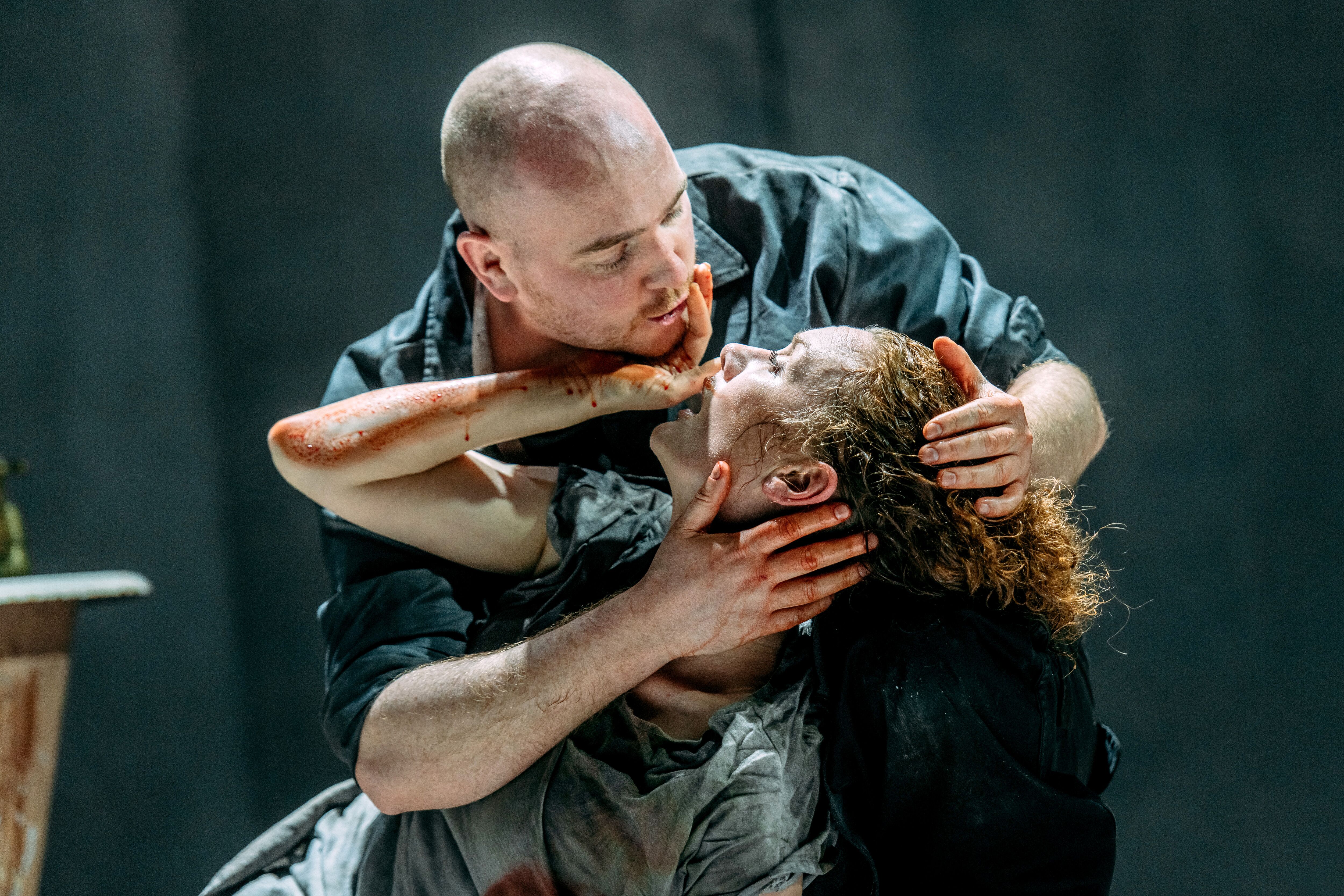
Adam Best as Bosola & Kirsty Stuart as the Duchess.
Photo: Mihaela Bodlovic

“A swingeing attack against inequality and injustice … with gouts of blood”

Editorial Rating:  4 Stars: Outstanding

Observe the bold italics: ‘The Duchess (of Malfi)’ after John Webster. Zinnie Harris’s compelling adaptation of the Jacobean tragedy has all its drive and grip, most of its heritage schlock, and some – but not much – of its superb, excoriating language. Never mind, Harris’s script is smart and disturbing in its own cause. Webster may turn in his grave but it would be a satisfied, pleasurable shift rather than a squirm of revulsion.  The great roles are there, just beneath the modern skin: the blameless Duchess; the depraved Cardinal; Bosola, the loyal creature  – all in the service of raging truths.


Yes, twin babies are gently rocked in their parents’ arms but the lullaby is ‘a slightly fucked-up version’ and love is defenceless. Back in Webster’s script of 1614 Bosola tells the Cardinal that

‘When thou kill’d’st thy sister,
Thou took’st from Justice her most equal balance,
And left her naught but her sword’.

Harris’ plot and Harris’ direction do the same, losing moderation, going on a swingeing attack against inequality and injustice. The bad comes first and it’s really bad. The Duchess, Giovanna, remarrries. Her two brothers, the Cardinal – utterly depraved – and Ferdinand – psychopath – find out and destroy her as ‘soiled goods’. Antonio, her husband, would avenge her but merciless killing is not for him. That’s more in Bosola’s line. However, watch the brooding Bosola, listen to him, for it’s a rewarding exercise and when the good comes out he’s your man. It is an extraordinary ‘turn’, beyond even Webster’s philosophical villain, and very well done by Adam Best.


If Bosola surprises, the Duchess inspires. She opens the play alone, centre stage, in front of a microphone and her audience. Her own story closes in around an excellent performance by Kirsty Stuart. Amused but all too aware of her brothers’ appalling misogyny, she is mischievous and loving with Antonio, craving and then burping  apricots during her pregnancy, and heroic – immortal – at her end. The two other female parts, Cariola (Fletcher Mathers), Julia (Leah Walker) suffer, fall – and rise – with her.


George Costigan as the Cardinal & Angus Miller as Ferdinand


The ghastly Cardinal is played by George Costigan, whose command of his lines is probably only matched by the respect he has for them. It would be a virtuoso performance except that to assign ‘virtue’ of any description to this demon would be too much. At least Angus Miller as the sick and puerile Ferdinand has howling lunacy on his side.


While she lives the Duchess has precious little freedom. If her brothers cannot control her, they can certainly contain her. Tom Piper’s set is a high undressed space, bleached stone white, with a gangway across its width. Sliding grillwork enforces the impression of prison and the basement bathroom provides a convenient torture chamber where standing mikes are used to address the prisoner. High voltage jolts frazzle the nerves throughout. Two songs offset the fear but still seemed out of place; worse, for me, was some foot stomping and an immediate association with the comic gospel strains of  ‘O Brother, Where Art Thou?’, which was unfortunate.


There are inevitable moments of jarring tone and effect, when modern idiom and thought collide with the Jacobean. “I’d kill the bastard who did this to you, the fiends” could be left unsaid but I’m all for the gouts of blood, the powerful re-writing, and the electric challenge of the closing caption.


outstanding

StarStarStarStar

Reviewer: Alan Brown (Seen 21 May)

Go to The Duchess (of Malfi) at the Lyceum

Read Edinburgh49 at The Lyceum archive.

NYOS: Chan, Osborne (Usher Hall: 12 April ’19)

Image result for National Youth Orchestra of Scotland 

“I have never heard Pictures played so well.  Ever.  By anyone.”

Editorial Rating: 3 Stars: Nae Bad


There is much talk in educational, local political and musical circles about youth and classical music today and where it is going.  I have a slightly different take to those who wish instrument teaching to be free for all, who I think miss the point.  Musical appreciation for all certainly at the infant and possibly early primary stages, but nothing is more likely to put someone off its joys than to learn something because they have to rather than because they want to.  Instrumental technique requires commitment, dedication and practice.  Money that is freely spent on other leisure pursuits can usually be redirected if wanted.


Serious youth music is channelled by the National Youth Orchestras of Scotland, which is not so much an orchestra as a movement, comprising three orchestras and two jazz combos, with illustrious patrons such Sir James MacMillan and Nicola Benedetti.


It is greatly to the RSNO’s credit that they devote such commitment to youth music, the more so because they integrated the orchestra’s 40th season into their own along with the creation of a new partnership.   The young people had the privilege on the night of being under the baton of the RSNO’s Principal Guest Conductor, Elim Chan, and of accompanying the uber talented Steven Osborne in Rach3.


As the players came on stage and warmed up full of brio I knew we were going to be in for a fun evening, even if fuelled on enthusiasm alone.  I was dismayed that the house was only half to three quarters full, but of course every conceivable parent, grandparent and sibling was there.  Often youth orchestras are capable of the very highest standard of delivery.  We would see.


Accompanying a soloist requires a different type of playing than when it is an entirely orchestral piece, the dynamics are more accentuated, you have to play quieter than you would wish a lot of the time.  The NYOS clearly understood this under the accessible and supportive conducting of Elim Chan, but perhaps they hadn’t reckoned with the bravura playing of Steven Osborne in Rachmaninov’s Piano Concerto No 3 In D minor, Op. 30To my utter astonishment, notwithstanding what I have said about Chan’s supportive style, she took the work really fast.  The tempo for the first movement is Allegro ma non tanto.  Clearly Chan forgot or chose to ignore the non tanto.  Boy!, it was fast, and Osborn played both fast and loud.  Very loud, it was an absolute virtuoso performance, but this meant the orchestra/soloist balance was often wrong with the orchestra playing too quietly apart from some confident solo instrumental passages.  As everybody settled in after the mammoth first movement the strings came into their own in the Intermezzo: Adagio with some exceptional pizzicato from the double basses (one of their proud parents was right in front of me and gladly pointed him out).  In the final movement Alla breve everyone had a good time as they brought this monumental, demanding work to a glorious conclusion.  Osborne rose from the piano stool, modestly took no bow alone and immediately referenced the orchestra.  He then treated us to something “quieter and slower”, one of Rachmaninov’s glorious preludes.


It transpired, after the interval, that this would be a “concert of two halves”, my slight reservations about some of the playing in Part One swept aside as the band was given their head in a full on performing, rather than accompanying role.  First up was Andrea Tarrodi’s (b. 1981) short orchestral piece Liguria, inspired by the composer’s 2011 visit to six of its small villages.  Dramatic from start to finish it showed off the orchestra’s credentials, enjoyable to listen to in the modern idiom, if somewhat derivative.  The waves depicting Onde reminded me of Debussy’s La Mer.


The final work in the programme was Ravel’s orchestration of Mussorgsky’s Pictures at an ExhibitionThis is a work guaranteed to bring the house down, and what impressed me was the joy, yet discipline and sheer musical accomplishment that the young orchestra brought to it.  Not a hint of vulgarity, clear, taut delivery, and the full gamut of strings, wind, brass (including two bass tubas), percussion (including tubular bells and two harps) giving us the full big orchestra experience.  I slept on this before finally convincing myself of the veracity of the happy note that I wrote before leaving the auditorium:  “I have never heard Pictures played so well.  Ever.  By anyone.”  Well done NYOS, you are a testimony for youth music.


nae bad_blue

Star (blue)Star (blue)Star (blue)

Reviewer: Charles Stokes (Seen 12 April)

Go to the National Youth Orchestras of Scotland

Visit Edinburgh49 at its Usher Hall archive.

SCO: Leleux (Queen’s Hall: 29 Mar.’19)

Image result for lelaux oboist

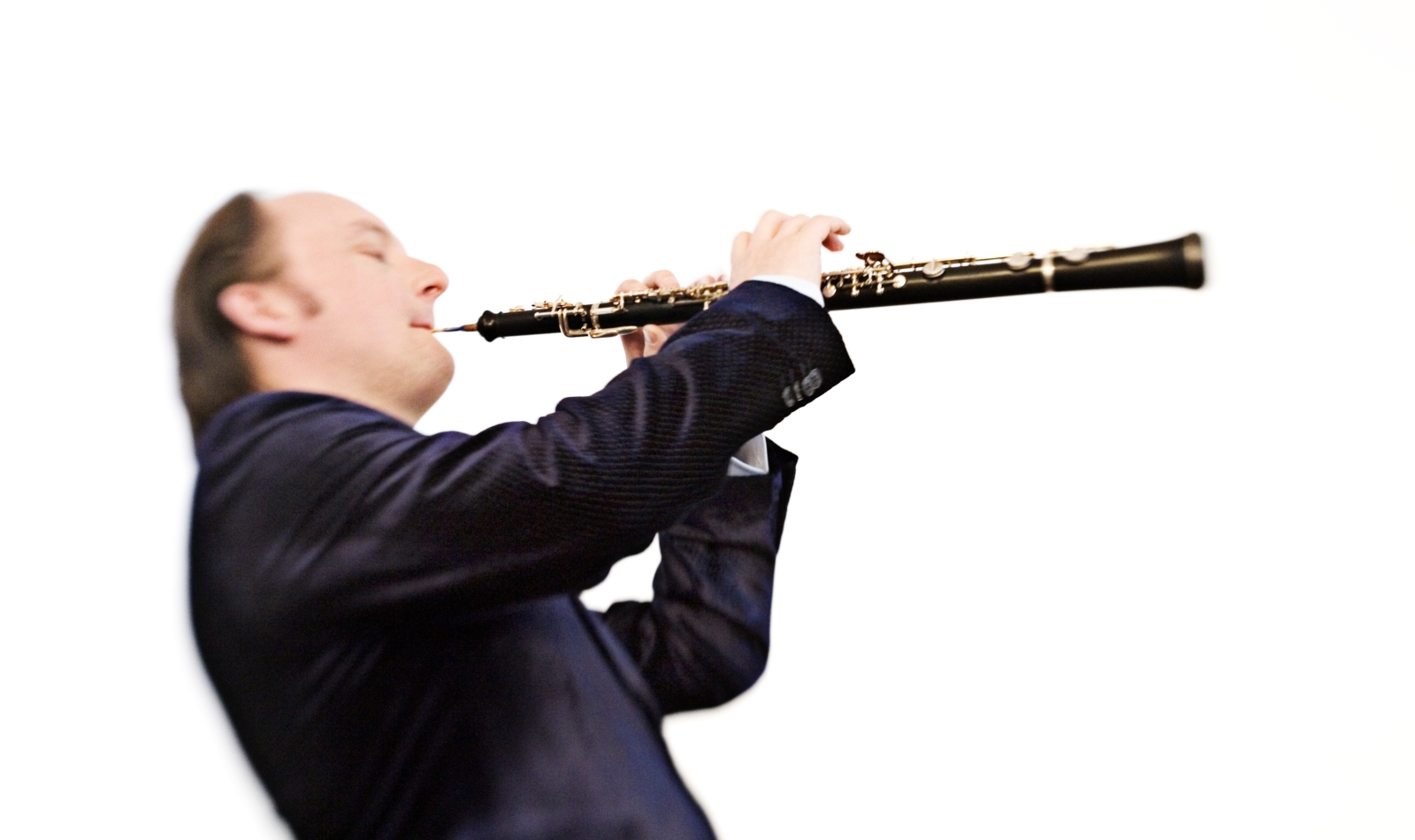
Francois Leleux – Oboist and Conductor

“Leleux….. has an engaging conducting style relating to, rather than directing, the orchestra.”


Editorial Rating: 4 Stars: Nae Bad

My mother spoke little of her life before her children were born, but it was clearly an interesting one.  The youngest of six children of a Northamptonshire shoe manufacturer and general bigwig, the first of her family to go to Oxford (and a woman to boot) and a wartime spent at Bletchley Park.  But what I remember most clearly, as we were both musical (at Oxford she sang in Ted Heath’s Bach Choir), was her telling me of her experience kissing an oboist whom she went out with for a while at University.  She told of his incredible muscular lips (by virtue of the necessary embouchure of blowing two reeds together) which made the embrace distinctly unusual.  As a result oboists – and the oboe (I love its clear, piercing tone, as did she) – have held a particular fascination for me, although I have never kissed one, reserving my affections quite by chance for the string section.


Consequently the SCO’s appointment of premier oboist Francois Leleux as an artist in residence for the 2018/19 season was a must-see.  I could not get to the first two gigs but enjoyed Thursday’s “Three Serenades” Concert enormously.


Generally, I have reservations about soloists who migrate into conductoring, even of the musical standard of Ashkenazy and Rostropovich, as it is a bit like film stars wanting to be directors: they rarely cut the mustard.  However, it has to be said that Leleux, either with baton or more restrained with instrument in mouth, has an engaging conducting style relating to, rather than directing, the orchestra.


Our first work was Hugo Wolf’s Italian Serenade, played in a splendidly happy rendition that clearly showed a bond between conductor and orchestra.  Good tempi, very together for so early on in the evening, a surprisingly enjoyable piece from this manic depressive composer written before the dark times took over his life.


Next up was Dvorak’s Serenade in D minor, Op.44. A wind ensemble of ten, including contrabassoon, accompanied by cello and bowed double bass, all standing save the latter two; this time with Leleux taking the oboe lead as well as directing.  Leleux’s tone was clear, fresh without being over bright, at times soaring over the rest of the ensemble.  In the third movement Andante con moto he engaged in charming interplay with the clarinettist opposite.  It was good to get our fix of the great man.


After the interval we heard by far the most substantive work of the evening, Brahms’s Serenade No 1 in D major, Op.11 with the full 40 strong orchestra on stage, quite an upgrade from its original conception as a nonet.  Albeit written earlier on in his career alongside the Piano Concerto No.1 this is a mature work with a great deal more roundedness and depth than the rustic Bohemian fare we received earlier.  In six varied movements ranging from close harmonies in the brass to full on orchestral romance, pretty little wind passages accompanied by the put-put of the bassoon and a mad rush to the finish, one was reminded of the near chaotic finish to the Academic Festival Overture.


Perhaps my only regret of the Leleux season was that he played only one concerto throughout, the Haydn.  One would have wished for the Mozart with its glorious third movement Rondo.  Never mind, it is always best to be left wanting more.


Star (blue)Star (blue)Star (blue)Star (blue)

Reviewer: Charles Stokes (Seen 28 March)

Go to the Scottish Chamber Orchestra

Visit Edinburgh49 at the Queen’s Hall archive.