+3 Review: A Streetcar Named Desire (Assembly Roxy, 5 Aug – 29 Aug : 13.55 : 1hr 30mins)

https://files.list.co.uk/images/festivals/2016/fringe/2016STREETC-9D-300.jpg

“Consistently raw, emotional and human”

Editorial Rating: 2 Stars Nae Bad

For many years, Tennessee Williams’ immortal “A Streetcar Named Desire” conjured up two shared memories: the off-yellow, stained tooth colour of chipboard desks; and the strange, (and in hindsight, quite sad) familiarity with which my divorced, middle-aged English teacher spoke about the dangers of hiding in fantasies.Now, thanks to the Tumanishvilli Film Actor’s Company and director Keti Dolidze, it’s far easier to think of quiet intricacy, and the heartfelt ebb of Georgian on a smoke-filled stage.

From the get-go, it clear this is a production which has been undertaken with care. The monotone stamp of poverty is imprinted surprisingly well on the set. Had it not been lit up on the Assembly Roxy stage, I would have had no trouble believing it had all just been sitting in the French Quarter. But what was most admirable about the set was its clever use of shadow. Translucent material and a little light transformed what in any other production would have simply been a rearward wall into a very entertaining transition tool: whilst set is moved around, the audience is treated to dancing shadows, or the silhouette of a saxophonist. And whilst occasionally these transitory segments went on a little too long, they were nevertheless welcome. Combined with excellent, well-timed soundscaping, it was clear the overall audiovisual design had received the care it deserved.

However, the background paled in comparison to the string of strong performances. It would be difficult to place the strongest actor in what is obviously a very seasoned cast. Even sans translation, this was a show which was consistently raw, emotional and human. Nineli Chankvetadze’s Blanche in particular showed almost uncanny emotional range, bringing depth to every smile and frightened sob even when the emotions in between were few. Kudos also to Imeda Arabuli as Stanley Kowalski, who lent an almost frightening hypermasculine, bestial quality to a character who is so easily made trite by a lesser actor.

With the aforementioned strengths, then, you could be forgiven for wondering why I’ve given this show a surprisingly low rating. And whilst, clearly, many of its component parts merit celebration, it is unfortunate then that this production was completely and utterly failed by its translation. Whilst subtitling a foreign language work is a fine idea, its execution onstage was risible.

From half a line being completely cut off (which happened often), to the subtitles stalling or – even more frustratingly, skipping back and forth in an obvious effort to re-find the dialogue – and the surprisingly low quality of what should have been a simple transcription of Williams’ original transcript (Prize contenders include the immortal phrase: “I’ll never forget the colour of his yes!”), the translation of this show was consistently frustrating. Even worse, the form and punctuation of character dialogue was not so much confused as nonexistent, leaving much of the second half reading as if Blanche was having the most spectacular breakdown ever seen on stage.

But even worse was the fact that, as an audience member, I often found myself between Scylla and Charybdis: either losing myself in the wonderful performances on show and having no idea what was being said, or half-understanding the dialogue whilst being unable to see the show itself as I craned my vision to the extreme top left of the stage. Had the subtitling quality been better this may have been less of a problem, but given the internal problem-solving required to make the subtitles coherent, it was like I had simply stepped outside for half the play. I shudder at the prospect of having seen this work without first being familiar with the plot beyond cultural osmosis, as a surprising number of people are. Given that the importance that the language plays in Streetcar, I was legitimately shocked at the poor quality of its execution.

In terms of its actual materiality, Keti Dolidze has crafted a fine show indeed. And, if you’re fluent enough to understand Georgian on the stage, I’m sure it would make for an afternoon to remember. Had it been simply billed as a foreign language play, even an English speaker would be able to understand, at least, the raw emotional content from performance alone. But, as it stands, the almost fantastically poor quality of translation packaged with this show made engaging with it a chore by the final half hour. With some simple tweaks, A Streetcar Named Desire could have quite handily added two more stars. But, as it stands, perhaps the kindness of strangers is less important than the kindness of transcribers.

 

nae bad_blue

Star (blue)Star (blue)

Reviewer: Jacob Close (Seen 5 August)

Visit the Assembly Roxy  archive.
THIS REVIEW HAS NOT BEEN SUBEDITED

+3 Review Moondogs (Edinburgh International Film Festival: 17 June ’16)

“Heartwarming and well written”

Editorial Rating: 3 Stars: Nae Bad

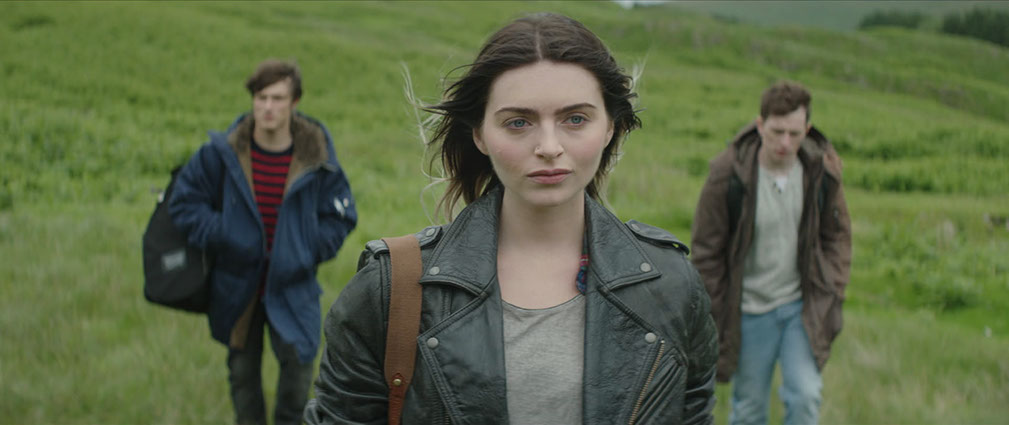
This year the 70th edition of the Edinburgh International Film Festival brought a wide range of films and documentaries home to Scotland. We took a look at the world premiere of Philip John’s Moon Dogs – a Scottish coming-of-age film – released on the 17th of June 2016.

Two step-brothers Michael (Jack Parry-Jones) and Thor (Christy O’Donnell) are thrown together through their parents’ marriage and the relationship between the two is far from perfect. Michael is a temperamental, slightly gullible young lad who having just finished high school is trying to figure out his future. Thor is the more quiet, reserved, artistic type who prefers to lock himself in his room to focus on his music and block out the rest of the world.

For their own individual reasons they decide to embark on a trip from their home on Shetland to Glasgow. With no money or any idea how they will get to there, they are lucky – or perhaps unlucky – to meet the wild, free-spirited yet slightly troubled young woman Caitlin (Tara Lee) who decides to accompany them on their journey.

The story focuses on the trio’s travels rather than their final destination. Throughout the film there are some beautiful shots of Scottish scenery and at times it almost feels like you are on a tour through Scotland’s landscapes and its society. With brutal honesty the film shows the best and the worst sides of Scotland. The three meet a variety of characters, from kind hearted locals to cruel criminals, whom anybody in their right mind would avoid.

The script, written by Derek Boyle and Raymond Friel, brings out a range of emotions with some charming and funny exchanges but also some darker, serious moments. Although this independent drama does at times appear a little awkward and staged this could be a reflection of how the characters themselves are feeling. At the beginning the boys, despite needing one another to make their journey to Glasgow possible, are both displeased at the idea of travelling together. As they begin to warm to each other the scenes and the interaction between the three appears to become more natural, resulting in some endearing moments for the audience and some sympathetic giggling.

The casting works. Michael and Thor are naive through their sheltered upbringing and young age and actors Parry-Jones and O’Donnell are very authentic in their roles. Tara Lee gives a captivating performance as Caitlin, although her questionable decision making and flirtatious nature make her a somewhat difficult character to comprehend. Personally I found this made her quite difficult to warm to, although perhaps the point of her role is more to provoke the boys and test their boundaries rather than to be a likeable character.

I would say Moon Dogs is a heartwarming, well written film that causes much amusement as the trio battle with the hardships of their journey and with growing up – as you do!


nae bad_blue

Star (blue)Star (blue)Star (blue)

Moondogs at the EIFF 2016 & at the British Films Directory

Reviewer: Iona Young (Seen 17 June)

Edinburgh Quartet: Mozart, MacMillan, Dvorak. (Queen’s Hall 25 May ’16)

Image result for edinburgh quartet pictures

“They played with zest, enthusiasm and perfect tonality”

Editorial Rating:  4 Stars:  Nae Bad

I think the overriding reason I enjoy the concerts of the Edinburgh Quartet over many others is their understanding of how to put together a performance, rather than just playing. A lot of thought clearly goes into this, from the overall theme, whether it be Storm and Stress or New Horizons to the programme mix on the night: this evening it was Mozart and MacMillan, followed by Dvorak, leaping boldly from the eighteenth to the twenty-first and then back to the nineteenth centuries – and then there’s considerate way they always do their final tuning before coming on stage so that they just smile at us and get on with it – it’s not about them, it’s about the music.

And smiling was very much in evidence on Wednesday; they were clearly enjoying themselves, and so were we. They put us at our ease.

We started with Mozart’s String Quartet No 19 in C, K465, the “Dissonance”. The first twenty bars or so really were the most incredible piece of creative genius of its time; we could easily have been listening to Schoenberg, but after that the piece reverts to classical, Haydnesque form, and a charming work it is, too. Assured, beautiful playing with the violins parrying the melody with the cello in contrapuntal support. An honourable mention must go to cellist Mark Bailey whose warm tone really brought it all out in the last movement.

Next up was James MacMIllan’s String Quartet No 3. The full gamut of techniques was used here, long silences, not so much sul ponticelli but playing on the other side of the bridge, tapping and knocking the bodies of the instruments, crazy pizzicatos, and the first violin playing right at the very top of the register on the E string. The work started eerily with unison octaves before breaking out into a thrilling full tilt series of prestissimo arpeggios thrown from instrument to instrument.  The players gave total commitment throughout to a highly unusual but engrossing work. I cannot pretend all the audience found it to their taste, but they were all remarking on it at the interval, and I for one was bowled over. It is clearly a demanding work extremely well played.

We were given an easier ride in part two, and gently led to the conclusion of the evening with Dvorak’s String Quartet No 12 in F Op 96, “The American”. From the confident and assured opening of Catherine Marwood’s viola to the many familiar melodies picked up individually and collectively by the band, they played with zest, enthusiasm and perfect tonality and were clearly enjoying themselves and we found their enthusiasm infective. Pure joy –  and a real treat to bring a thoroughly enjoyable evening to a close.

nae bad_blue

Star (blue)Star (blue)Star (blue)Star (blue)

Reviewer: Charles Stokes (Seen 25 May)

Go to the Edinburgh Quartet

Visit Edinburgh49‘s Queen’s Hall archive.

RSNO: Leticia Moreno; Thomas Sondergard: Usher Hall: 6 May ’16

“They really went for it full on, you got everything you wanted and hoped to hear, but it was never over the top…..terrific playing…..quite something!”

Editorial Rating:  4 Stars:  Nae Bad

The RSNO’s Friday night Edinburgh concerts really set you up for the weekend, and last Friday’s cornucopia of delights was eagerly awaited: Bartok and Stravinsky, an orgy of brass, dissonance and full on orchestral razzmatazz. We were not disappointed.

There was much in the plots that drove the ballet suite parts of the programme that was descriptive writing of the louche – if not actually sordid – kind, not to mention the fecund. Robbers setting up a young girl as bait, consent to coition in order to effect the death of the punter, and Spring as the enduring symbol not just of birth, but of fertility, and finally the sacrifice of a virgin to appease, one suspects, not only the Gods but also senile and jealous Elders. No wonder the performances as ballets caused such a stir in the early part of the twentieth century.

First off was Bartok’s Suite from the ballet The Miraculous Mandarin. As for the story, Google it for all the gory details, but suffice it to say the premiere in Cologne in 1926 (conducted by none less than the composer Erno Dohnanyi) caused catcalls, whistles, boos, stamping and a walk out by the clergy present, with the work being banned in a number of cities. Nothing could do more to promote the piece. As for the music, well, exciting is not a strong enough word, and what impressed me is how the band got into the groove of this really quite demanding work straight away: dissonant, chaotic, resemblant of street life, some pointers to Walton’s Belshazzar’s Feast. The lilting, seductive melodies supplanted by raucous, glorious trombones and brass in general, with the strings coming in at the end and taking us away like furies. Wow! A great start to the evening, twenty minutes of exquisite bombast.

There followed Stravinsky’s Violin Concerto played by Spanish violinist Leticia Moreno on a 1762 Gagliano. The Concerto as a musical form is often compared as either a contest or a love affair between soloist and orchestra, with early examples (e.g. Vivaldi) featuring the soloist as first among equals, and later composers taking the soloist more out front. This latter approach is inherently more difficult with instruments such as the violin and guitar that find it difficult through volume limitations to stand out as a piano or trumpet would, and this limitation is the more obvious in later, more heavily orchestrated works, of which the Stravinsky is certainly one. Only in the second and final movements did the soloist really come to the fore, with a lightly supported melody in the second, and a lively toccata in the fourth enabling her to do so. Elsewhere conductor Thomas Sondergard was doing what he could to restrain the orchestra without rendering them inaudible. This also resulted in too soft playing from the clarinet so unfortunately the performance as a whole of this underestimated, supposedly austere work never quite satisfied. The audience nonetheless delighted in it and sent the players off to the interval with enthusiastic applause ringing in their ears.

The last work of the evening was Stravinsky’s  The Rite of Spring, a brilliant choice of programming given the glorious Spring day that was now drawing to a close. The playing here was absolutely first class with spectacularly clear and well articulated woodwind – not at all outdone by the “heavier” brass – playing with real clean attack and verve; but by the time the work was over you knew that everyone in the 105 piece band had had their moment in the sun, from the ten timpani, three huge Wagner tubas, seven trumpets, eight horns, washboard, rattle, tam-tam etc. – get it? The strings soared gloriously and one was reminded that, as is so often the case, although this sounded like it was chaotic, it is in fact a highly structured, cleverly orchestrated work that raised the roof and actually caused a riot when it premiered in Paris in 1913. One hundred years on its excitement and sheer jaw-dropping daring nature does not pale and the RSNO gave the sort of performance a seasoned concertgoer loves. They really went for it full-on and you got everything you wanted and hoped to hear, but it was never over the top. Terrific playing with the structure and discipline that strong composition enables. Quite something!


nae bad_blue

Star (blue)Star (blue)Star (blue)Star (blue)

Reviewer: Charles Stokes (Seen 6 May)

Go to the RSNO here

Visit Edinburgh49‘s Usher Hall archive.

The Iliad (Lyceum: 20 April – 14 May ’16)

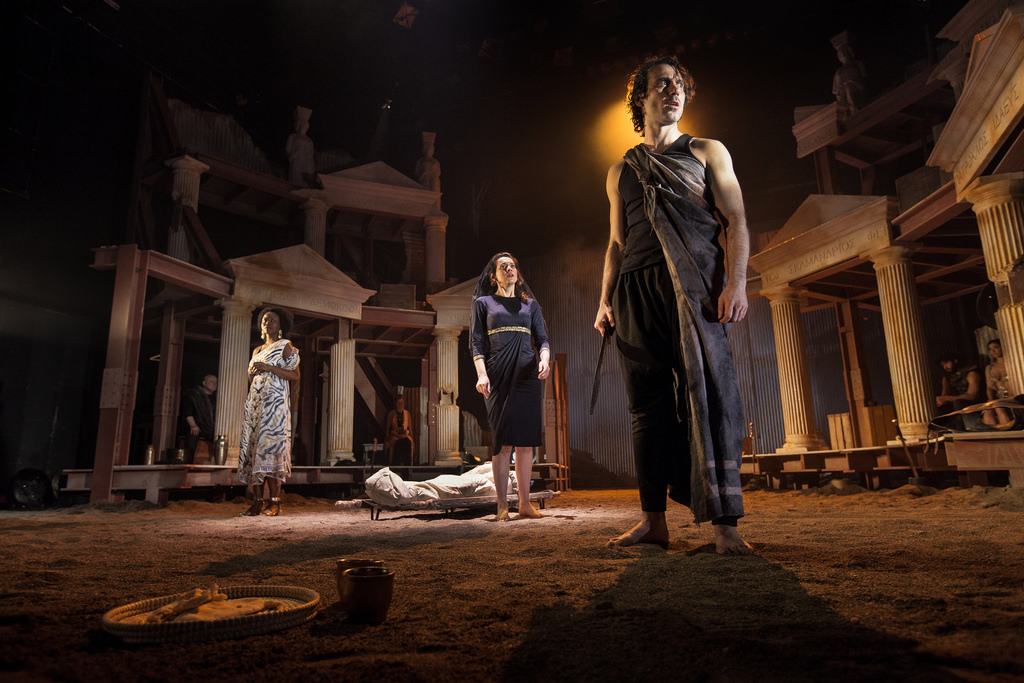
Ben Turner, downstage; Melody Grove, centre; & Emmanuella Cole, upstage.

Ben Turner, downstage; Melody Grove, centre; & Emmanuella Cole, upstage.

“This Iliad is forcefully staged and has the vehemence and colour of its core story.”

Editorial Rating:3 Stars Nae Bad

Mark Thomson’s last production as Artistic Director of the Lyceum for the past 13 years.

It is unsurprising that there’s plague about. There are no zips on the body bags on this beachhead and the Scamander River is full to overflowing with the dead. There’s Achilles’ refusal to dispose of Patroclus’s corpse until after he has killed Hector and then there’s the desecration of Hector’s body by lashing it to a chariot and dragging it through the dirt for twelve days, face down. No wonder – actually, yes, a lot of wonder is required – that Apollo took pity and ‘round him … wrapped the golden shield of storm so his skin would never rip’. Some say it was rose oil.

As epic tales go The Iliad is still the catchy, highly contagious one. It has tragic, raging action, love and sex, heroes and honour. There are no villains to speak of, just the ‘terrible beauty’ of Helen and the ‘smooth, full breasts’ of Aphrodite to sing of. Communicable? Certainly. Containable? Hardly.

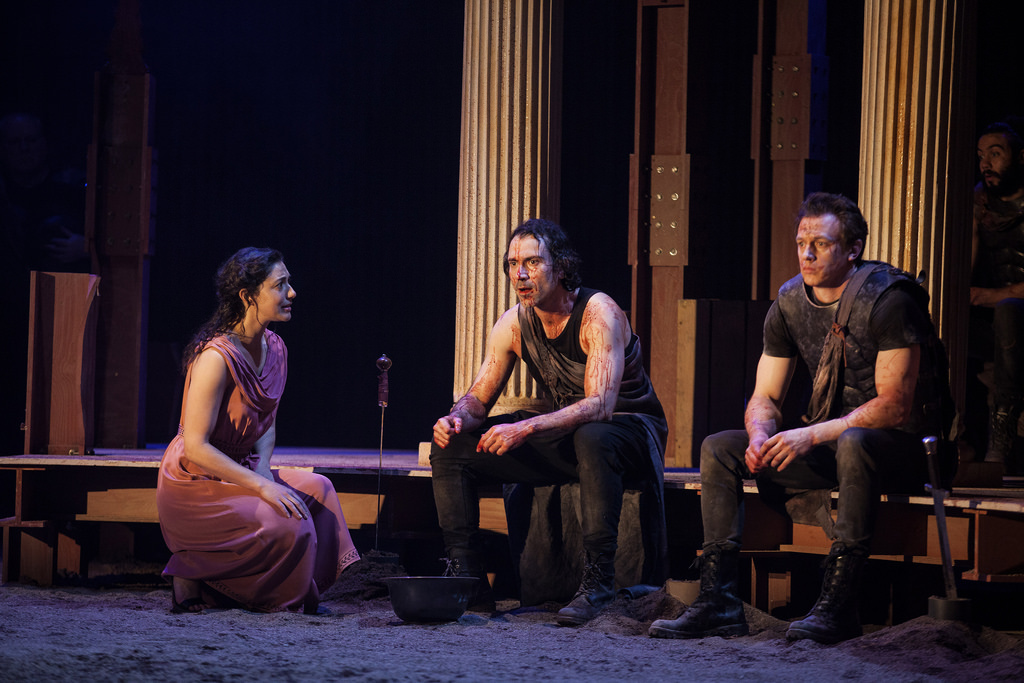
Emmanuella Cole, left; Ben Dilloway centre; & Rueben Johnson, right, as Diomede.

Emmanuella Cole, left; Ben Dilloway centre; & Rueben Johnson, right, as Diomede.

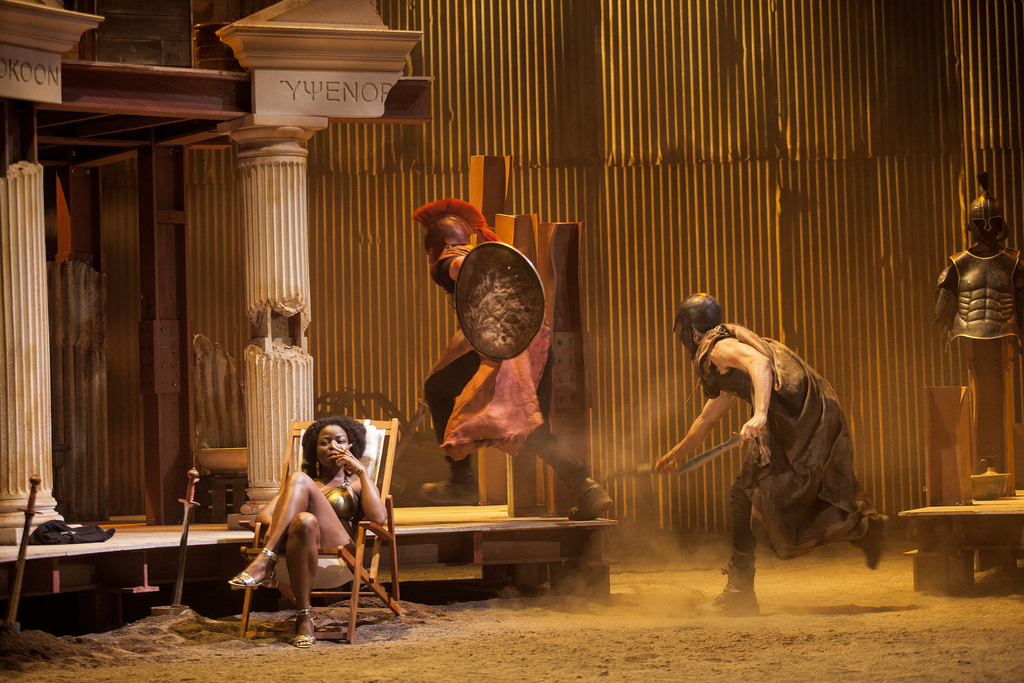
Fearless Mark Thomson takes writer Chris Hannan’s evocative script and directs an intrepid cast of twelve. Karen Tennent’s imposing set has broken columns and half pediments left and right with plenty of space and height for gods to take it easy in and for the Trojan women to look out anxiously over the ramparts. A massive wall of corrugated ‘bronze’ curves around them and the dust sometimes hangs in the air around a leather cuirass and plumed, hollow eyed helmet. The lighting design by Simon Wilkinson is as careful and as atmospheric as his work in Bondagers.

But there are 15,693 hexameter lines in Homer’s Iliad and probably as many ‘brazen spear points’ and slamming shields. What to do with them all? Thomson – to make an attractive prosaic point – starts his theatrical shebang with a baby’s cry and a cobbler hitting nails into a boot. (Think the traditional 3 knocks that alert a French audience to the start of a performance). More formally, several scenes begin and end as characters are dressed for their part, accompanied by near liturgical chant. No need though for Zeus (Richard Conlan) to dress up. His boxers and loose robe are as much Mustique as Olympus. Hephaestus (Daniel Poyser) has his iPad on the beach. ‘White-armed’ Hera (Emmanuella Cole) drifts in straight off Ebony magazine’s style pages and tells all. This is one all-mighty queen god who seems to owe her name to having had it up-to-here with her philandering husband (and brother BTW). We’re with you there, sister.

I worship Thetis,  because of passionate playing from Melody Grove, but otherwise these gods are the diverting side-show and narrative markers to the centre stage profiling of Achilles (Ben Turner). He stands, blood streaked, against all-comers, starting with ‘wine-mouth’ Agamemnon (Ron Donachie). There is pathos in the fine scene between the moping and vengeful Achilles and the shade of his beloved Patroclus (Mark Holgate) and the song at his companion’s funeral of his ‘head like a poppy drooping’ is an unlikely hit,  but it’s Thetis’s son vs. Hector (Benjamin Dilloway) that exercises fight director Raymond Short to his utmost. As well it might when he’s up against Brad Pitt and CGI – and a younger audience. Perhaps pounding Hector’s brains out is beyond even a screenplay.

Amiera Darwish, left, as Briseis; Ben Turner, centre; & Mark Holgate, right, as Patroclus.

Amiera Darwish, left, as Briseis; Ben Turner, centre; & Mark Holgate, right, as Patroclus.

This Iliad is forcefully staged and has the vehemence and colour of its core story. It is fiercely directed and there is a heart and soul to every performance, mortal or immortal, but it is so down to earth that it puts gods into deckchairs on a flyblown lido and so the topless towers of Ilium are levelled. I think it’s Hecuba (Jennifer Black) who says, ‘You clutch at emotions like clutching at straws’. That’s the problem when you go head-to-head with Homer.


nae bad_blue

Star (blue)Star (blue)Star (blue)

Reviewer: Alan Brown (Seen 26 April)

Go to The Iliad at the Lyceum.

Visit Edinburgh49‘s Lyceum archive.

Scottish Chamber Orchestra: Ain Anger & Olari Elts

https://i0.wp.com/angusarts.org/wp-content/uploads/2015/05/SCO2.jpg


“No musician could fail to admire, and secretly envy, the sheer bravura and chutzpah of this performance…

 Editorial Rating: 3 Stars Nae Bad

Thursday’s Scottish Chamber Orchestra concert at the Queen’s Hall was a fascinating melange of the contemporary, romantic and classical. As a result we experienced a variety of different musical experiences in an exciting evening’s musical entertainment.

I suspect the main draw must have been the evergreen Beethoven’s Fifth Symphony, but more of this later. The gig kicked off with Brett Dean’s “Testament”, a work some years in evolution that, to quote the composer “in some way related to Beethoven’s life and music”. I personally found it hard to trace this link back to the great man, notwithstanding the composer’s consultation with the string section of the Berlin Philharmonic and studying of the Heiligenstadt Testament. There were strong influences of Honegger, Adams and even Lutoslawski, as well as some clear 19th century style melodic lines in what was a mosaic of musical styles. It made for an entertaining and lively start to the evening and the orchestra dispatched it with enthusiasm and considerable skill.

By way of a contrast followed Mussorgsky’s Songs and Dances of Death. Mussorgsky had planned to set eight songs by the poet Arseny Golenishchev-Kutuzov, with whom he shared rooms. In the event he set only four of them and died before he got around to orchestrate them, which his eminent fans Rimsky-Korsakov and Shostakovich were happy to do, as has contemporary Australian composer James Ledger. This latter was the version chosen for us. Perhaps an unconventional choice in view of his illustrious forebears, the orchestration undoubtedly worked in an atmospheric and almost mysterious way, including an extraordinary clarinet glissando in the third song Trepak (described as “death dances with a drunk in the forest at night). Leading contemporary Wagnerian and Estonian born Bass Ain Anger gave a deep, clear and resonant account of this very Russian work in the folk idiom. The power of the magnificent, but I repeat pleasingly clear bass voice was enthusiastically supported, especially by the brass, as it drew to its sombre, striking conclusion.

And so on to the popular, oft played, recorded and interpreted Beethoven’s Fifth Symphony in C minor. One almost wonders what the point of performing this work is; how can one possibly bring anything new? Everyone, from Von Karajan, the wonderful Carlos Kleiber, and even the Bee Gees in Saturday Night Fever, has had a crack at this gloriously barmy work, and the only person who hasn’t heard it properly in the civilised world is probably Beethoven himself.

To their credit the SCO did pull a rabbit out of a hat. They went off at a cracking pace like the crews in the Boat Race, taut, together, on the money with every new passage and actually managed to convey the excitement of hearing the piece for the first time. A confident opening by the cellos in the Andante con moto made the most of the crescendo in the initial cadence and there were good dynamics and clarity even in the small supporting parts, in particular woodwind and pizzicato strings, and the more so of this latter in the subsequent Allegro. The final, fourth movement Allegro brought the work, and the evening, to a resounding conclusion.

So what to make of this interpretation of the well-known work? Full marks for enthusiasm as caution was thrown to the winds, not afraid of turning up the volume, raw, earthy, almost ‘street’, spirited and raucous. I am sure my school director of music would think that conductor Olari Elts was being a bit naughty with the work, and there were a number of bum notes and other flaws, particularly in the often exposed brass. However, no musician could fail to admire, and secretly envy, the sheer bravura and chutzpah of this performance. Roll over Beethoven!

nae bad_blue

Star (blue)Star (blue)Star (blue)

Reviewer: Charles Stokes (Seen 7 April)

Go to the Scottish Chamber Orchestra

Visit Edinburgh49‘s Queen’s Hall archive.

Uncanny Valley (Summerhall: 29 – 31 March) – part of Edinburgh International Science Festival

Photo:.Borderline Theatre

Photo:.Borderline Theatre

“Educational and entertaining, well-worth taking the kids to”

Editorial Rating: 3 Stars: Nae Bad

As a child I was never particularly into science. At school the lessons were boring and didn’t challenge me to think creatively or engage with it in real life situations. Uncanny Valley, however, does both, placing today’s children at the heart of a situation we may well find ourselves in 30 years’ time.

Essentially it’s a show about humans and robots, and the difference between the two. With the world becoming ever more robotic, the subject matter is engaging for audiences of all ages and I certainly learned a thing or two about artificial intelligence and the Turing Test during the performance. While I imagine 9-year-old me might have struggled with some of the concepts and sitting still through some of the longer “lesson” parts, many of the younger audience members seemed to grasp it fairly well and engage in the interactive elements.

As a children’s piece, one can forgive a certain amount of ridiculousness and be able to suspend disbelief to still be able to enjoy the action. Credit goes to the actors for keeping the performance engaging, with boundless energy creating big, bold characters that are instantly relatable. Kirsty Stuart in particular shines as the cut-throat Mayor who’ll stop at nothing to eliminate robots in her town.

I would have liked closer attention paid to the narrative to keep it seamless all the way through: there were quite a few unexplained jumps in time and location in the story, and I never quite believed Ada’s relationship with her adopted parents. In saying that, some of the theatrical elements are very well done: the Turing Test at the end of the show is funny and gripping; the open moral discussion about whether to swerve a car off road and kill a group of chickens to save yourself is very thought-provoking, and I was even able to feel emotional connection with the robot characters of OKAY and SARA, which adds a really nice dimension.

The beginning is a little confusing – I feel that Rob Drummond as facilitator perhaps tries too hard to convey a lot of factual information early on and doesn’t seem as comfortable in parts of audience interaction as I would expect from an experienced TIE professional. These are only small moments throughout the piece though, as on the whole it’s quite slick and professional.

Overall, Uncanny Valley is educational and entertaining, and well-worth taking the kids to, as long as you’re ready for a bit of thinking! Theatrically it is a bit rough around the edges but still full of heart.

nae bad_blue

Star (blue)Star (blue)Star (blue)

Reviewer: Steve Griffin (Seen 31 March)

Visit the Summerhall archive.

Legally Blonde: The Musical (King’s: 16 – 19 March, ’16)

“Catchy songs, big dance numbers and laughs a-plenty”

Editorial Rating: 4 Stars: Nae Bad

For those who know the film, the premise of the musical is almost exactly identical – blonde bombshell and fashionista Elle Woods from Malibu, California is determined to bag her man, so she buries her head in books and chases him to Harvard law school in the hope of impressing him. The accompanying score is very poppy and upbeat, and while not to my personal taste, even the sternest of faces can’t help but bop along with some of the numbers.

On the whole, local troupe the Bohemians Lyrics Opera Company handle this big production very well – with some impressive dance routines and real powerhouse vocals throughout. The mind boggles at some of the quick changes performed, especially those done on stage, so credit where credit’s due for the risk and professionalism to carry those off. At times, particularly in Whipped into Shape, the performance felt a little flat and a stretch too far for this amateur group – perhaps a bit of shakiness on opening night or not quite having the musical tempos nailed – but otherwise it’s very well rehearsed and full of personality.

Lydia Carrington gives it her all as leading legal lady Elle Woods, and shines with fantastic energy and likeability. Her spirit never falters throughout – impressive considering she is barely ever off stage – and she shows great range and versatility to reflect the changing mood in each scene. However, it’s Lyndsey McGhee as Paulette who raises the biggest cheer of the night with the very moving Ireland (watch out for that towards the end of Act 1). Her voice is deep, rich and she delivers a knockout performance. It’s a shame we don’t get to see more of her throughout the show.

While the leads very much hold their own throughout the performance, for me it is some of the cameo roles that make this production really enjoyable: Ross Stewart is eminently watchable as UPS guy Kyle, while Sam Eastop and Andrew Knox make a great comic pairing in Gay or European. And of course, there are dogs. Scene-stealing dogs. You have been warned…

Yes it’s cheesy, yes it’s American, and yes at times it’s a bit ridiculous, but it’s also a show full of catchy songs, big dance numbers and laughs a-plenty (my favourite line being “I see dead people” in relation to the rather bizarre inclusion of a Greek chorus). If you like the sound of all that then you’ll love this production.

nae bad_blue

Star (blue)Star (blue)Star (blue)Star (blue)

Reviewer: Steve Griffin (Seen 16 March)

Visit the King’s Theatre archive.

THIS REVIEW HAS NOT BEEN SUBEDITED

The Crucible (The Lyceum 18 Feb – 19 March ’16)

https://i.guim.co.uk/img/media/250f6b044fc785f891c930dbd8326ddbf5d7351e/125_403_5364_3222/master/5364.jpg?w=620&q=85&auto=format&sharp=10&s=83ea0e1bac8ee60cbbf8c5a0a8815ec7

“Just as bleak and brilliant as Miller’s tragedy demands”

Editorial Rating:  4 Stars Nae Bad

Nothing says “a good night” like unchecked hysteria, unopened hearts and unnecessary hangings. That’s why I’m always excited to see a production of Arthur Miller’s “The Crucible”, and even moreso in the beautiful Lyceum theatre. But does Mark Thomson’s staging of Miller’s work deserve a standing ovation or a slipknot? The star rating above may be a small clue as to which is true: this was a beautiful, if flawed, production of a well beloved American classic.

Set in the year 1692, ‘The Crucible’ follows the path of destruction wreaked by mass hysteria, lust and shame in the town of Salem, Massachusetts. As rumours of witchcraft fly and secret affairs are uncovered, what begins as a simple dance in the woods becomes a matter of law, life and death. Lighthearted stuff.

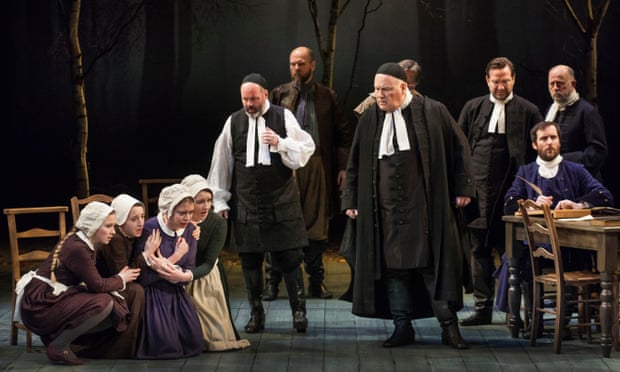
As you might imagine, Miller’s classic demands atmosphere. From the outset, it’s clear that Thomson has a knack for choosing set designers. It’s not often I open with talk about the furniture, but I was extremely impressed with the quiet ingenuity of Crucible’s set. From the authentic, rustic comfort of the Proctor house to the cold rigidity of the courthouse, each setting hit all the marks in terms of visuals. But even further, it wasn’t just pretty – the use of space was downright clever. Each little quadrant of the stage was self-contained enough to render smaller scenes intimate, and yet interconnected enough to make group sections seem cavernously intimidating. And the use of trees for scenery and blocking lent what felt like meters of depth to a finite stage. For set alone, this show ticked all the boxes.

But luckily, the set isn’t all I’ve got to write happily about. As can be expected from the Lyceum, the acting talent on display is considerable – my personal MVP goes to David Beames as the most entertaining and human interpretation of Giles Corey I’ve seen yet. If I could pay him to narrate my life, you’d bet he’d never go hungry.

But aside from pure entertainment value, I was most impressed by Richard Conlon as Reverend John Hale. When I first read The Crucible, I disliked Hale. I thought he was two-dimensional and boring – but none of these problems so much as touch Conlon. No other portrayal of the character has been as compelling or realistic as his, and I’ve similarly never felt for Hale as much as I did in this production. The emotional depth, the body language, the subtle vocal tics; they all come together almost flawlessly. Fan-bloody-tastic.

Similarly, Philip Cairns shines as John Proctor, applying a great amount of force and raw emotion to the character’s more intense scenes. He moves from tenderness to scepticism to fury as if it were easy as breathing – though this is no doubt benefited from acting opposite the likes of Irene Allan as Elizabeth Proctor. The part of Elizabeth is by no means easy: showing an audience the culmination of years of insecurity and indecision without overacting is like slacklining drunk; that’s what I was so pleased to see how powerful the character was in Allan’s hands. Her final scene and famous closing lines gave me chills.

That same strength runs through the rest of the cast. Meghan Tyler as Abigail Williams is wonderfully duplicitous, mixing sensuousness with devious brutality in the same breath. The Putnams (Douglas Russell and Isabella Jarrett) are as abrasive as the narrative demands, and Greg Powrie’s Reverend Parris is pathetic is the best way possible. Even the young company capture the panic and vulnerability of young girls in the hard frontier of the American East.

So, with such a talented cast and clever design crew, why isn’t this a five star show? Predictably, there are always a few flies in the soup.

As a general note, whilst the accent work at play generally good, it was prone to slippage. Often, the cadence showed more sense than the characters by fleeing from Massachusetts to upstate New York – and, on occasion, Cairns’ Bostonian drawl threatened to slide into a strange mix of Henry Kissinger and Arnold Schwarzenegger. Whilst it won’t bother the average Brit theatregoer, those more familiar with the voices of the new world may find it slightly grating.

Furthermore, I had a huge problem with the sound design. Whilst at times it was a dramatically advantageous decision, at others (especially in the courtroom scenes) it was, at best, a distraction and at worst it utterly broke the tension and dramatic pacing of the scene. I found myself consciously wondering why on earth a scene of screaming hysterics and implied cold-blooded murder for the sake of sex was accompanied by a pleasant violin trill in a major key. In any other show this might not be such a large issue, but in one which is so dependent on atmosphere and audience absorption, it gets amplified.

And it’s in the hysteria that we find my biggest complaint with the production. Whilst certain scenes were certainly not lacking in gravitas, the play’s overall arc of tension was patchy. Some sections jump from being devoid of dread to bursting with it – instead of a steadily escalating fever pitch, it jumps from extreme to extreme.

Unfortunately, this also wasn’t helped by the fact that it felt strangely static at points, as if all the fear had been sucked out of the room. There’s a difference between strained silence and dull quiet, and sometimes this production seemed to confuse them.

Do I think these flaws ruined The Crucible? Far from it. Mark Thomson’s formidable cast rides out the few choppy waves this show presented, and Miller’s famous talent for dialogue is hardly diminished. There are definitely more strengths to this production than weaknesses, and the audience chatter at both the interval and end attest to that fact.

If you get the chance, definitely give The Crucible a look. It’s a production that never fails to entertain whether you’re a Miller virgin or a die-hard fan. Though perhaps a little clunky in the seams, the overall fabric of the show is just as bleak and brilliant as it Miller’s tragedy demands. You might not see Sarah Good with the devil, but you’ll definitely see a strong production.

nae bad_blue

Star (blue)Star (blue)Star (blue)Star (blue)

Reviewer: Jacob Close (Seen 20 February)

Visit the The Lyceum archive.

THIS REVIEW HAS NOT BEEN SUBEDITED

Edinburgh Quartet (Queen’s Hall, 17th Feb. ’16)

Image result for edinburgh quartet pictures


“An interpretation of utter conviction, inspiration and stellar playing throughout”

Editorial Rating:  4 Stars: Nae Bad

The Edinburgh Quartet continued the second phase of their 2015/16 Season under the banner of “Storm and Stress”, derived from the loose translation of the German ‘Sturm und Drang’ movement of the eighteenth century. In this movement passionate expression was given free rein in literature, but also in music with works by Haydn and Mozart at the forefront. The Quartet performed a typical Sturm und Drang work by Haydn, Op 76 No 2 “The Fifths” alongside Bartók’s thrilling, dissonant but rewarding 3rd Quartet and Grieg”s surprisingly complex and at times  dark Quartet in G minor.

The Quartet got straight into their opening number with final tuning completed off stage. This, along with their precision and togetherness, immediately gave the audience confidence that they were in safe hands and in for a treat. So it proved.

The Haydn has (if you will forgive the pun) no hidin’ place (geddit?) in the transparency and openness of 18th century music, and chamber music in particular. The quartet were not found wanting. Clarity, accuracy, full on expression and commitment were the order of the day, and brought this 200-year-old work fully to life. At the end of the first movement I could not stop myself whispering “Wow” under my breath. By the third movement what impressed me most about this band was their sheer synergy. Disciplined, supportive pizzicato to Tristan Gurney’s lead violin, lightness of touch in the final movement with lead violin again doing most of the heavy lifting, as well as the dramatic opening fifths that told us this band meant business.

I have to say I had my heart in my mouth for the Bartok. A complex, austere work with brutal sul ponticello and col legno bowing, glissando fingering and a deep contrapuntal architecture, all grafted on to Hungarian folk song in a collage of different shades and expressions, at times highly dissonant, at others wistfully melodic. A hard act to pull off and a work after which the string quartet genre was never quite the same again. It has probably only been done justice by the Alban Berg Quartet, although the Takacs have given a creditable performance, and it was refreshing to hear the Edinburgh Quartet’s assured version of this piece that makes demands of players and audience alike.

I particularly enjoyed how the musicians let the music speak for itself – the various techniques demanded by the composer contributed to the overall musical experience rather than distracting through novelty or sensationalism. By this I mean the disconcerting col legno (basically bashing the bow up and down on the strings, even reversing the bow so the wood strikes them) was artistically justified!

We needed a breather after that and the interval proved welcome respite. We returned to the auditorium expecting some dreamy Grieg. Not so. This was more Peer Gynt than the Holberg Suite. A major, serious work full of contrasts, based on Spillemand, a Norwegian song from 1876, that gave us a strong, dramatic opening leading into a more lyrical style as it progressed. The quartet rewarded us with an interpretation of utter conviction, inspiration and stellar playing throughout. Special mention here has to be made to Cellist Mark Bailey laying down a melody of plaintive yearning, sensitively supported by ripieno violins and viola.

So, taken in the round, once again some really creative programming delivered with enthusiasm and élan. Putting Haydn and Bartok together before the interval took some courage, and it worked, albeit lacking just a touch of the transcendental magic shown in the Quartet’s previous outing. An engrossing, rewarding evening’s music. Bravo.


nae bad_blue

Star (blue)Star (blue)Star (blue)Star (blue)

Reviewer: Charles Stokes (Seen 17 February)

Visit the Queen’s Hall archive.

THIS REVIEW HAS NOT BEEN SUBEDITED