Jekyll & Hyde (Church Hill Theatre: 22 – 25 Nov ’16)

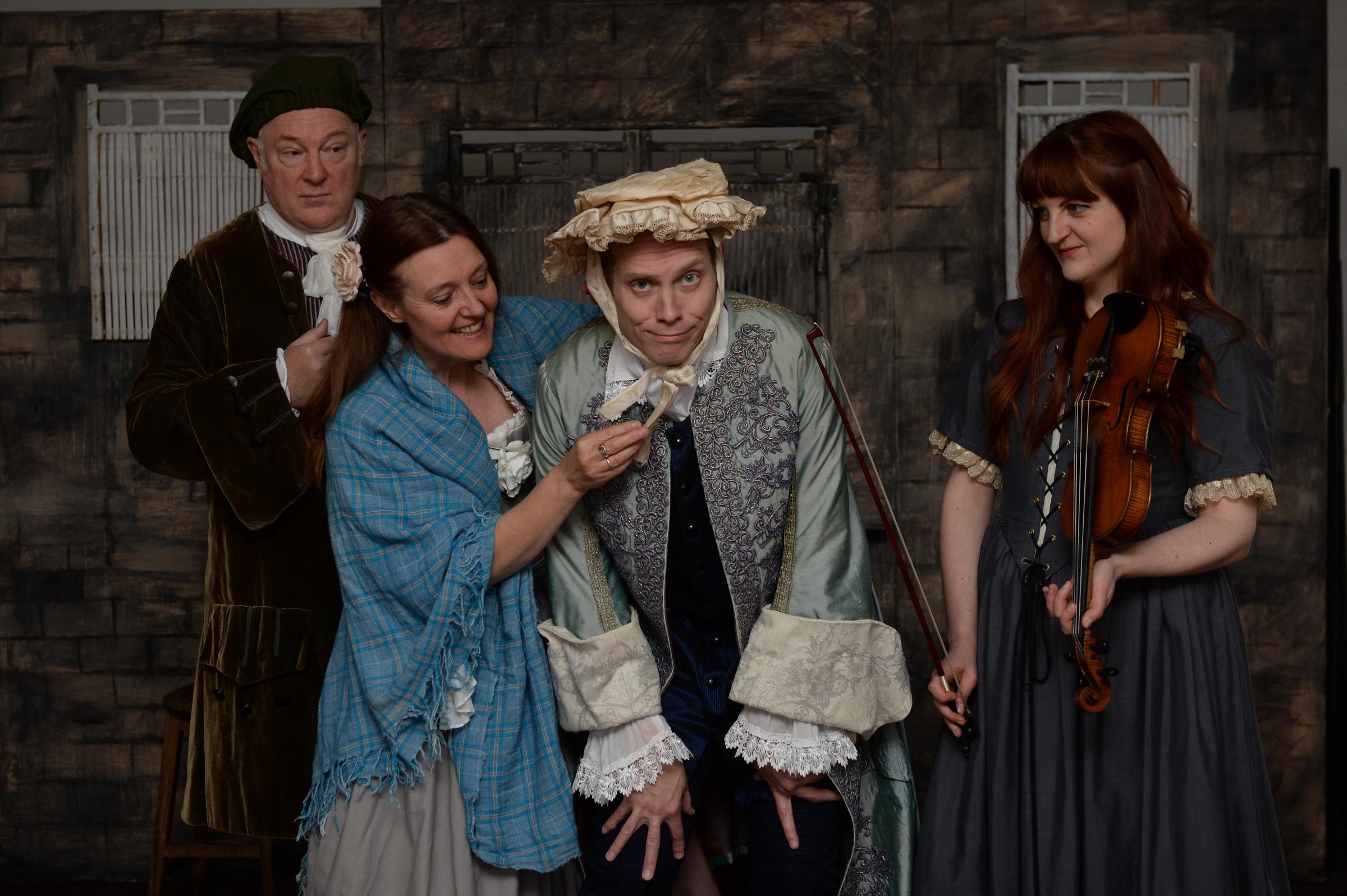
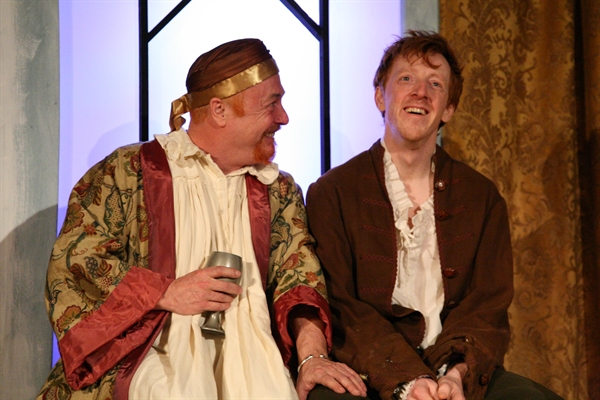
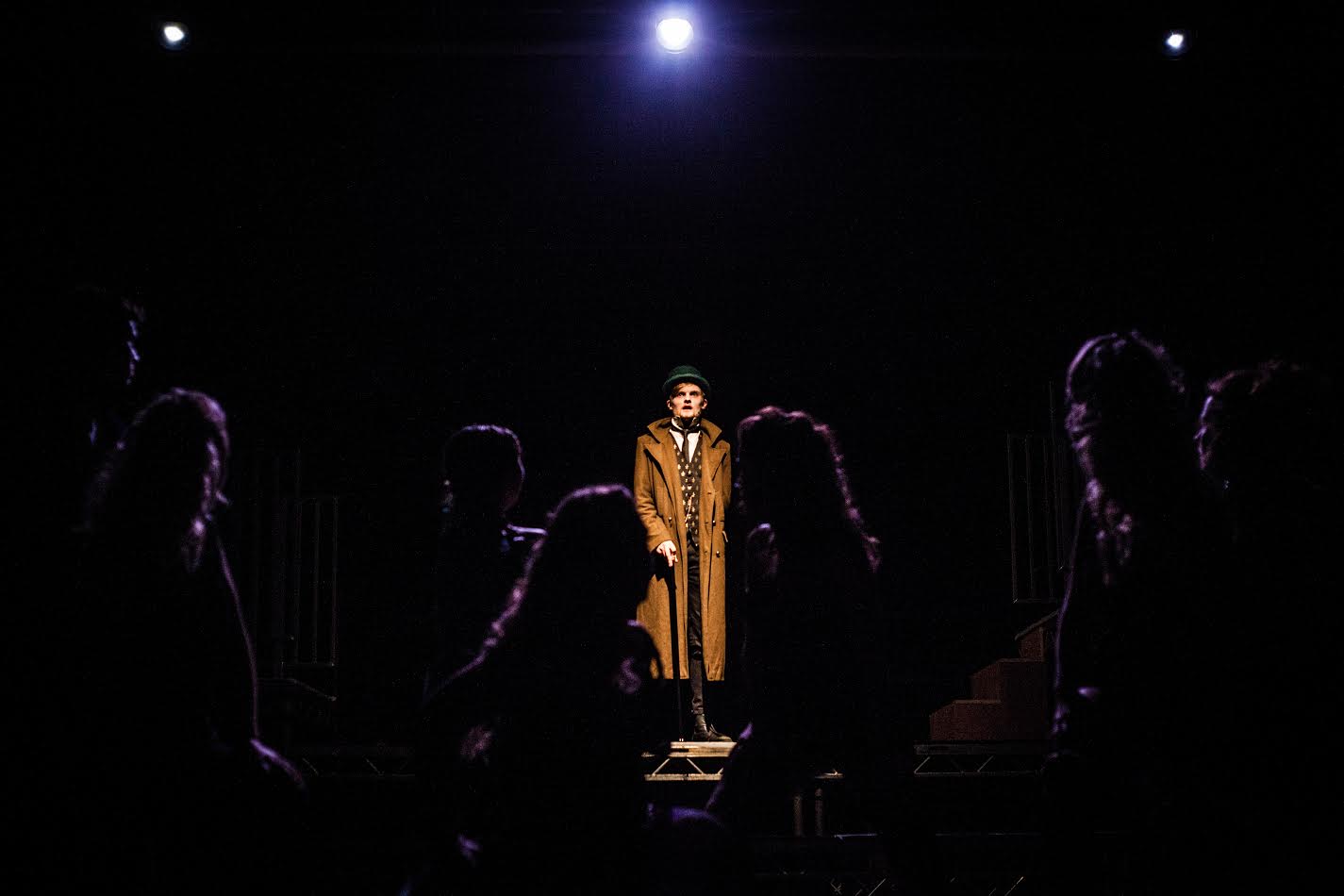
Stephen Quinn as Jekyll (& Hyde) Photos: Erica Belton

Stephen Quinn as Jekyll (& Hyde)
Photos: Erica Belton

“The talent neither stops at the singing, nor at the bounds of the principal cast.”

Editorial Rating: 3 Stars

I was part of an unfortunate, if very narrow, generation whose first encounter with Robert Louis Stephenson’s monstrous Mister Hyde was the opening of a terrible Hugh Jackman movie. As a result, questions of the duality of man, the nature of morality and the dangers of unrestrained passion didn’t really factor in for a while. It seems fitting therefore that EUSOG’s latest outing follows the pattern of contrast underscored by its source material: it’s a collection of both dizzying highs and curiously disappointing lows.

Jekyll & Hyde loosely follows Stephenson’s original work, with a few new emotional complications thrown in. It is a musical exploration of the ambition, suffering and fear associated not only with the fraught Henry Jekyll, but its effects on his friends, family and even the city of London itself. And to begin –  as usual – with the ability on display, it’s considerable. The singing talent in this show can’t be denied, ensemble included. Ellie Millar and Giselle Yonace in particular offer utterly breathtaking solos as Emma Carew and Lucy Harris, culminating in a duet that could shatter glass for precision.

And the talent neither stops at the singing, nor at the bounds of the principal cast. Special props go to Kirsten Millar as the world’s most entertainingly jovial prostitute; and to Jana Bernard, whose rare mix of graceful flexibility and natural showmanship lead to an array of angles that’d make an architect weep. Despite the occasional desync in a dance, the ensemble did their job with gusto and skill.

But any praise would be incomplete without hailing new face Stephen Quinn as the titular duo. Powerful voice aside, I found myself extremely taken with his portrayal of Henry Jekyll: he balances ambition, humanity and (perhaps most importantly) a genuine vulnerability during his two hour tenure as the good doctor, and it certainly stuck. Often, mild-mannered Jekyll is the more under-realised of the two, and it was refreshingly welcome to see such care put into his characterisation.

The question then, I suppose, is why this show only has three stars – and why have I personally left it unrated?

Despite the considerable strength of the cast, there are distinct elements of this show that detract from the overall fabric of the performance. Most glaringly, perhaps, is the way in which they handle Edward Hyde. At its core, there simply wasn’t enough contrast or intensity: often, the only difference between the two selves seemed to be his ragged choice of jacket, rather than any significant change in manner. The visceral glee, passionate brutality and utterly malevolent hedonism which typifies Hyde seems to get lost somewhere in the mix – and this is certainly not helped by fight choreography which is so floaty and strangely force-less that it occasionally comes off as comical rather than dramatic. Sitting next to the fantastic choreography of song numbers such as ‘Bring on the Men’, it seems worlds apart.

jekyllhyde3

And, most unfortunately, that fundamental element of violence and rage, which seems to be missing from much of the production, runs deeply through its other elements. Without that relish of cruelty, many scenes feel strangely bland for want of a contrast which just isn’t there. Combine that with mics which popped in and out more often than a first year halls cleaning lady and with variable volume levels, which would put Brexit indecision to shame, even when the show was at its strongest, then it was unsurprising that at times I could not hear a damned – or virtuous – thing.

That said, if you’re looking for a collection of entertaining and ear-pleasing song numbers, you’ll like what you get. However, if you’re wanting an exploration of human nature, brutality and debauchery, and a spot or two of vanquishing, then …. No. Upfront this is a strong production but it is let down by its emotional backdrop. For those who aren’t as pedantically focused on its content as I am, it’s certainly not going to sour your night – but walking home through the cold Edinburgh air I couldn’t help but think that Mister Hyde just didn’t show up.

Star (blue)Star (blue)Star (blue)

Reviewer: Jacob Close (Seen 22 November)

Go Edinburgh University Savoy Opera Group

Visit the Church Hill Theatre archive.

RSNO. Jensen. Lugansky: Usher Hall 4 Nov ’16.

nd

Image result for prokofiev

“The RSNO is maintaining an extraordinarily high standard of repertoire and performance”

Editorial Rating:  4 Stars

The RSNO’s 2016/17 season continues apace with intelligent programming and excellent playing. On Friday we also had significant added value inasmuch as we heard not one but two piano concertos, in a splendid celebration of Russian music from the first half of the 20th century.

The orchestra led off with The Enchanted Lake by Anatoli Liadov. Liadov was an enigma with a somewhat mystical approach to life as well as music, delighted to maintain that “Art is a figment, a fairy tale, a phantom. Give me a fairy tale, a dragon, a water sprite, a wood demon – give me something that is unreal, and I am happy.”  And sure enough, The Enchanted Lake follows no clear story and is an impressionistic portrait of a magical lake populated by all manner of water nymphs and wood sprites. It is a gentle piece that has evocations of Delius’s Walk to the Paradise Garden written some eight years earlier in 1901. The RSNO’s playing was suitably, lyrically, intoned as we settled comfortably in our seats.

We were rapidly shaken out of them by Nicolai Lugansky’s bravura rendition of Prokofiev’s Fifth Piano Concerto. “Nicolai has been coming to us for twenty years” one of the RSNO staffers enthusiastically told me, and it is commendable that this orchestra has such long-standing relationships with star players. Clearly this is reciprocated, because Lugansky learnt the work by heart in a week before the concert.

The work is of mixed quality and rather bitty. Five movements in twenty-five minutes, but only the last two are of any substance. There is far more “music” in the first concerto, a 15-minute work but less slender, which came after the interval. Nonetheless Lugansky took hold of it, easily disposing of its demanding notation, with the orchestra providing enthusiastic support. The fourth movement Larghetto was the most melodic, at least at the start until it built into a strong climax. The fifth, appropriately named Vivo, provided a lively conclusion.

After the interval the indomitable Lugansky appeared again for  Prokofiev’s First Piano Concerto, the more rounded one. This 15-minute tour de force is an object lesson in less means more, and much as I enjoy the other four concerti this one stirs me most. From its confident three chord brass opening in D flat major the piano and orchestra belted out the near frantic theme in unison until the orchestra took off on its own with the soloist following in a series of bravura passages, pausing only for a few minutes’ reflection in the second section of what is really a one-movement work. It was a joyride: taut, together, highly effective orchestral playing under the confident and relaxed baton of Eivind Gullberg Jensen, with soloist Lubansky clearly a master of his art. The theme sang out again when the pace returned in the third section and ended in a blaze of glory with the addition of glockenspiel.

The evening was brought to a close by Rachmaninov’s Third Symphony, premiered in 1936 by no less than Stokowski and the Philadelphia Orchestra, and by a short head the most recently composed piece of the evening. Rachmaninov was a master of the romantic genre and this work is close to film music, and none the worse for it. However, unlike the utterly romantic Second Symphony with its long melodic lines, this pleasing work is full of thematic variations that never really go anywhere, so you are subjected to a series of treats rather than an enveloping whole. The RSNO were completely at home with it, from the opening cello solo (the first movement is all down to the cellos), through the wistful horn and harp opening of the second, concluding with the zestful Allegro with the orchestra giving everything it had got. This is a more reflective, even introspective work than the second symphony, which nonetheless, and notwithstanding the stature of the second symphony, contains some of the most expressive and romantic classical music ever written.

The RSNO is maintaining an extraordinarily high standard of repertoire and performance, worthy of its pedigree and 125th Year Anniversary.

Star (blue)Star (blue)Star (blue)Star (blue)

Reviewer: Charles Stokes (Seen 4 November)

Go to the Royal Scottish National Orchestra

Visit Edinburgh49‘s Usher Hall archive.

Dr Johnson Goes to Scotland (Traverse: 1 – 5 Nov. ’16)

l to r. Lewis Howden, Gerda Stevenson, Simon Donaldson, and Morna Young. Photo: Kirsty Anderson

l to r. Lewis Howden, Gerda Stevenson, Simon Donaldson, and Morna Young.
Photo: Kirsty Anderson

“Comic effect knocks against an open coffin on Iona”

Editorial Rating: 3 Stars

Would Samuel Johnson, heroic dictionary maker, essayist, critic, and celebrity wit ever have appeared on ‘Strictly’? Perhaps. He was, after all, prone to nervous shakes and tics and he would have been mercilessly brilliant at discombobulating the judges. Anyhow, in the last of the current season of a Play, a Pie, and a Pint, the big man is in polished boots and plaid and he steps up to a jig and seems to enjoy it.

And verily this is the same Dr Johnson, who noticed that ‘the whole [of Edinburgh] bears some resemblance to the old part of Birmingham’. Writer James Runcie continues his rehabilitation of the arch English nationalist by rowing him thoughtfully and fondly over the sea to Skye (and to Mull and Raasay). A Word with Dr Johnson – at the Traverse in October last year – was about the man, his wife, and his English dictionary; this time (1773) he’s in the boondocks and the heather and the Gaelic. For the proto London-centric it’s an ear-bending peregrination in a land where ‘you have more words than people’, which could well have been its chief attraction.

Lewis Howden plays Johnson sympathetically, of splendid girth and with orotund voice, and with a baffled interest in all things Scottish. An exploration of Fingal’s Cave, lantern in hand, leaves him only dimly enlightened but his enthusiasm for Thomas Braidwood’s school for the deaf and dumb is obviously sincere.  His companion throughout is, of course, the amiable James Boswell (admirable by Simon Donaldson), who treats us to evocative latin from Dunbar’s ‘Lament for the Makars’, whilst guarding his distinguished author friend from the sublime and local peril of being called a bampot.

So then, a pleasing trot through good old Scottish ways ? Runcie even brings on ‘Macbeth’ and the Bonnie Prince, which is fine until their comic effect knocks against an open coffin on Iona and a poem of freedom in earnest pursuit of the Scottish nation. Supporting roles by Gerda Stevenson and Morna Young are amusing and/or tuneful but my distinct impression was of looking in at the tartan themed windows of discount booksellers, The Works, on Princes Street. The learned Dr.’s eye would take in a remaindered copy of his  ‘A Journey to the Western Islands’; he would harrumph, say “I’m deeply obliged”, and move on.

Star (blue)Star (blue)Star (blue)

Reviewer: Alan Brown (Seen 1 November)

Go to Dr Johnson Goes to Scotland at the Traverse

Visit Edinburgh49‘s Traverse archive.

Edinburgh Quartet and Guests: St Andrew’s and St. George’s West: 25 Oct ’16

Image result for edinburgh quartet

“the standard of playing remains remarkably high …all the more commendable in the main work that was technically very demanding in terms of phrasing, notation and timing.”

Editorial Rating:  3 Stars

The Edinburgh Quartet are skilful not only in their playing but in their approach to their constituency. Their 2016/17 series is a combination of daytime, rush hour and evening sets in order to reach new listeners and move away from the relative predictability and, for some, the difficulty of getting to evening gigs. Each season, or part of season, has a theme, and this season’s theme is vested in their Scottish roots. Tuesday’s concert programme contained works inspired by the island of Skye and the actual words of Robbie Burns. Informal in approach within the relaxing environs of St Andrew’s and St George’s West in Edinburgh, the occasion is probably more accurately described as an informal lecture recital rather than a concert, and none the worse for that.

Cleverly, the band started with a brief introductory piece, demanding in intonation and timing, which they played without music. Gordon Bragg then interviewed composer Alasdair Nicolson who spoke of the inspiration behind his String Quartet No 3, “Slanting Rain”, which was the centrepiece of the evening. After that Mairi Campbell, guest musician and one of two violists in the opening number, spoke of her love of the Scottish dance and folk music idiom and her approach to her music.

On to the main event. “Slanting Rain” is a six movement work full of chromatics, a wide variety of bowing techniques, harmonics and dissonance. It is a difficult play, and not an easy listen. I did think that the advanced technical construction of the work got in the way of its musicality. The introduction to the fourth movement, “Impossibly distant tree lined paths”, treated us to a melodic introduction by EQ Apprentice Competition winner Morag Robertson on viola, and the sixth movement, “Into an abyss made of time”, was a very clever melange of time signatures and orchestration that definitely worked.

The evening drew to a conclusion with a deeply moving rendition of a Robbie Burns poem sung and played by Mairi Campbell, followed by James MacMillan’s “Memento”.

Those familiar with the Edinburgh Quartet’s line up would have noticed some new faces, some planned, some drafted in at the last moment. Tristan Gurney has left and the first Violin chair is currently being recruited for. Tonight’s locum was taken ill on the morning of the concert, and Gordon Bragg nobly took on the first violin part, bringing in Rachel Spencer on second violin. Morag Robertson will take the viola desk for the first part of the season while Fiona Winning remains on maternity leave.  Mark Bailey remains at the cello desk.   All these changes notwithstanding, the standard of playing remains remarkably high and, astonishingly, the cohesion of the band appears completely unaffected, as if they had all being playing together for years, all the more commendable in the main work that was technically very demanding in terms of phrasing, notation and timing.

Star (blue)Star (blue)Star (blue)

Reviewer: Charles Stokes (Seen 25 October)

Go to Edinburgh Quartet‘s homepage

Visit Edinburgh49’s St Andrew’s and St George’s West archive.

Walking on Walls (Traverse: 18 – 22 October’16)

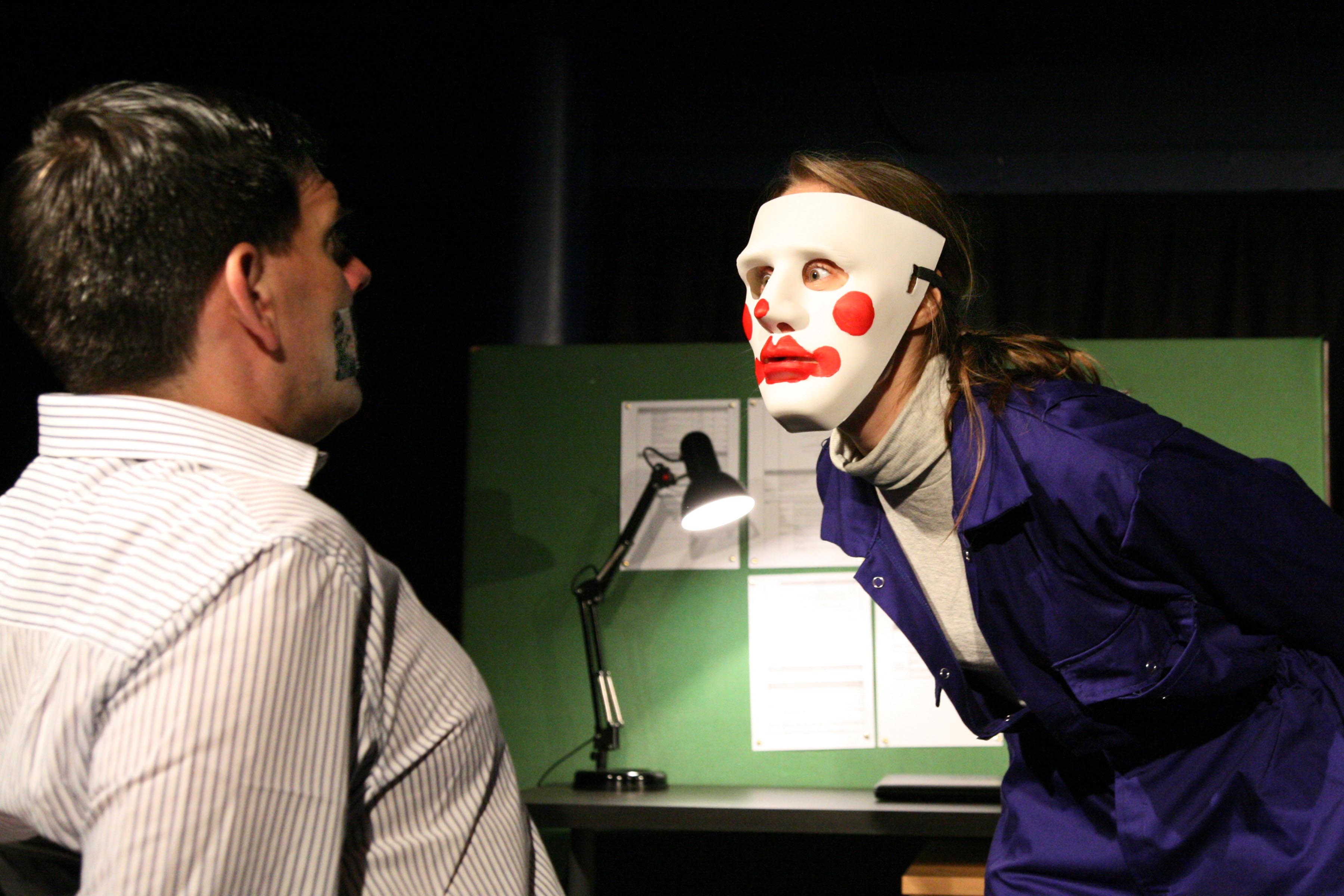
Image: Leslie Black

Image: Leslie Black

“Funny and searching by turns”

Editorial Rating: 4 Stars

You would not take Claire for a creepy clown. Have there been any sightings in Edinburgh yet? With Halloween around the corner there may well be a few popping up at the window or from behind a wall, which is where Claire comes into her own. She’s the ever so earnest social scientist who doubles as a Super Helpful Person, who just happens to wear a clown mask when she’s out at night looking after people. You could say she looks over them.

Nobody’s laughing at the sinister clown craze, least of all the police, and we shouldn’t laugh at Claire, who has just called them – again; but we do laugh at her, just as the police do, because Morna Pearson’s script makes it all too easy to. Poor Claire with her big round specs and love of chat-defying stats, who’ll never be down the pub after work. But this is the same Claire who notices that (normal) ‘people don’t board themselves up’ unless they’ve been hurt and are vulnerable.

You’ll hear a lot from Claire (Helen MacKay) as she explains herself and her wacky, neighbourly, exploits. She is admirably audible, even from behind the mask. You’ll hear less from Fraser (Andy Clark), not least because of the duct tape across his mouth, but he’s impressive at being incredulous, dumb, and helpless. Unsurprisingly he’s in WTF mode and tries to stay there until he too is affected by Claire’s story. Well, he might be affected, and that’s the point of Pearson’s stinging, interrogatory close.

It is a questioning piece, funny and searching by turns. Who’s the victim here, for one thing, and what’s their space like? Andy is literally bound in his and is pushed around by a young woman, which has to be a valuable experience for him. With Claire it is more complicated. Work is probably the featureless desk, stage left. Home seems to have shut behind her and seems inextricably part of a very unhappy time at school. She sees the empty Buckie bottles and used condoms in the street and it’s all pretty ugly.

There’s tension, of sorts. I saw and heard the opening out and folding up of Claire’s neighbourhood map – with its anti-social ‘hotspots’ – and thought, characteristically, ‘Metaphor-for-Anomie’, which is almost certainly to go too far. Walking on Walls is more interested in seeking kindness than anything else.

Walking on Walls is the third play in the Traverse’s current series of ‘A Play, a Pie, and a Pint’ from Oran Mor, Glasgow.

Star (blue)Star (blue)Star (blue)Star (blue)

Reviewer: Alan Brown (Seen 18 October)

Go to Walking on Walls at the Traverse

Visit Edinburgh49‘s Traverse archive.

The Suppliant Women (Lyceum: 1 -15 October ’16)

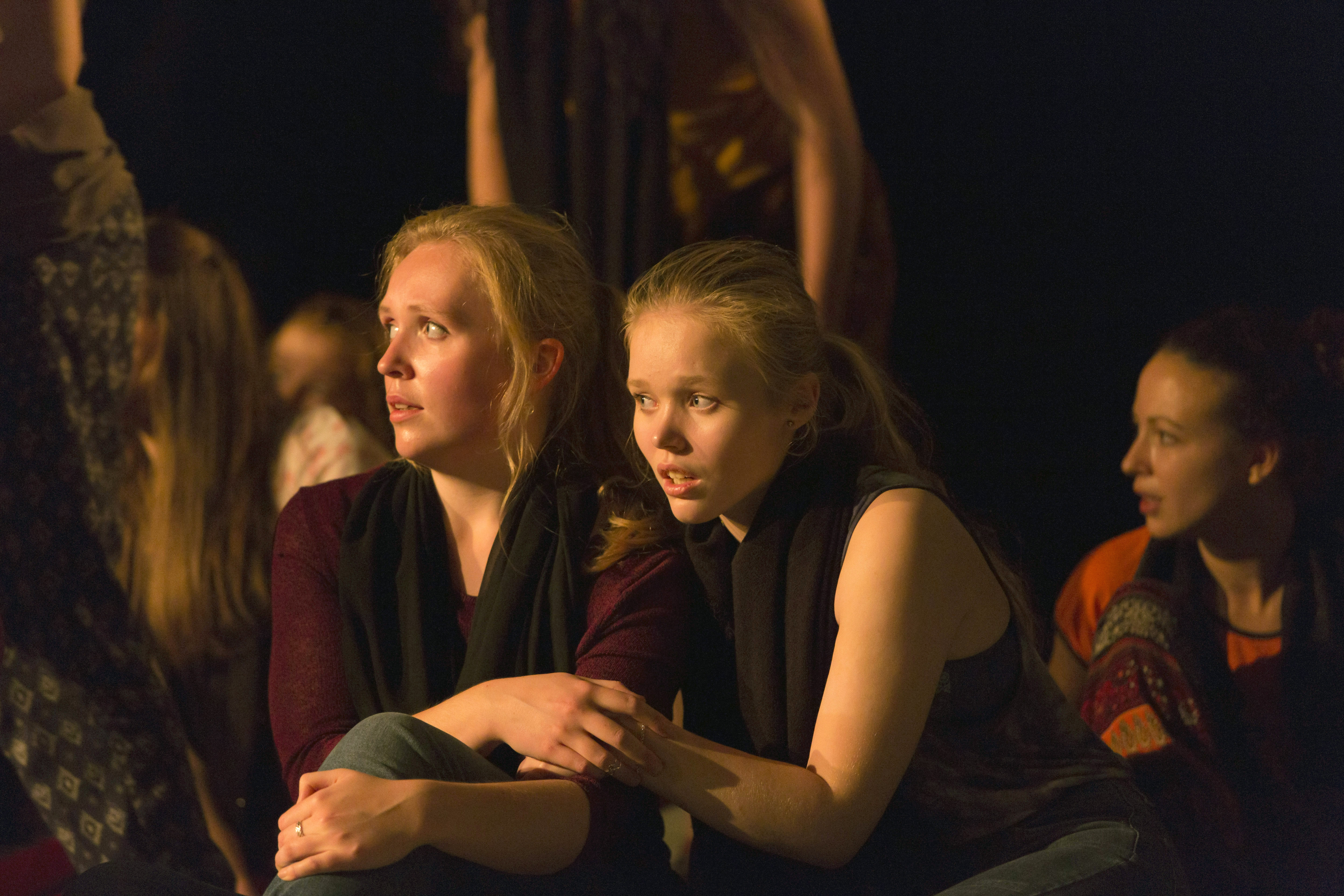
r. centre: Gemma May, Chorus Leader. Photos: Stephen Cummiskey.

r. centre: Gemma May, Chorus Leader.
Photos: Stephen Cummiskey.

“They do lovely huddled sounds of the night too, complete with sheep and Peloponnesian crickets.”

Editorial Rating: 4 Stars

Does it really come down to drink: a muscular Greek wine, £5.50 from Tesco say, against Egyptian small beer? Well, the libation was a full-bodied red and it went down a treat, all down the front of the stage in fact, and the bladdered sons of Aegyptos are repelled. The 50 refugee daughters of Danaus are safe in Argos – for now – protected by Zeus, the popular will, and by their father, whose clear head and savvy style suggests that he’s teetotal.

The Suppliant Women is heady, old theatre. Aeschylus wrote it for Athenians of his time (the demos of 500BC) and David Greig gives us his 90 minute version for our duty-free enfranchised time, when ‘border security’ matters and our leaders debate migrant quotas. Nevertheless and to its credit, as directed by Ramin Grey, this stays a civic piece, obliged to its community, retaining Aeschylus’ Chorus of (local) young women who seek asylum from forced marriage. It also – and very admirably – features original music by John Browne for percussion and aulos, single and double. What’s not to respect?

l.Imogen Rowe & Anna MacKennan, r.

l.Imogen Rowe & Anna MacKennan, r.

The Chorus is 36 determined volunteers from Edinburgh with a standout leader (Gemma May) and they have the angel’s share of the drama. The bare stage is all theirs, from top to bottom, side to side. It is sacred ground, a temple refuge supposedly, offering plenty of room for choreographed movement with some dance elements. Expert vocal direction from Stephen Deazley means that the devoted choral odes make sense and create their own rhythm and sway. They do lovely huddled sounds of the night too, complete with sheep and Peloponnesian crickets.

But still Father Danaus (Omar Ebrahim) presides. He is neat and conspicuous in black amongst the colourful mix of his daughters’ casual dress and his words are sage to the point, I thought, of being on a direct line to Zeus, which rather diminishes his daughters’ impressive praying. Pelasgos (Oscar Batterham), King of Argos, is the younger man and his sharp suit and tie speak ‘Lawmaker’. And, fair dues, he’s the one who has the job to do. How to convince his people to let these foreign women in? Sensitive. He pauses to consider the often terrible consequences of intervening in ‘another man’s war’ but, when in doubt and as quick as a Prime Minister in a jam, he decides: let the people vote … with some help from my silver tongue.

It is, actually, post-referenda, wildly familiar, if that’s not a paradox. The citizenry mistrusts authority, sees stitch-ups at its expense, and has faith only in the gods. Ah, but which god? And here’s where The Suppliant Women is mischievous and – in its modern semblance – a little muddled. For Aphrodite, she of lust and love, wants in on the act (and is in the cast photos of the suppliants, on p9 of the programme). If the women are saved from their Egyptian pursuers, why not – to honour the goddess – give themselves to their rescuers, the virile men of Argos? Father D, with an astonishing cherry metaphor, says “No, keep yourselves chaste”; whilst Zeus, ‘unknowable and unfathomable’, stays shtum. It is, at its stirring close, when the audience is face to face with Justice-For-Women, an appealing mash-up of the classic and the ballsy.

Star (blue)Star (blue)Star (blue)Star (blue)

Reviewer: Alan Brown(Seen 4 October)

Go to the Actors Touring Company  & The Suppliant Women

Visit Edinburgh49‘s The Lyceum archive.

+3 Review: Nuclear Family (Assembly Roxy: 3 – 29 Aug. 1715. 1h)

Image. Sunday's Child & Fever Dream Theatre.

Image. Sunday’s Child & Fever Dream Theatre.

” .. a drama of a hopeless, unstable, situation”

Editorial Rating:  2 Stars

Torness nuclear power station is 30kms from Edinburgh, strikingly visible from the A1 and from the main line. The MailOnline did a photo feature on it in January last year. A close-up on one of the panels in the Control Room shows the operating switches to Boilers A to D. Understandably, there’s ‘Start Up’, ‘Drain and Warm-Up’, and – critically – ‘Dump’; which is what Ellen, who’s a technician at a nuclear site, has just done to Phil. He takes it very, very badly.

This then is your chance to get up-close and personal with nuclear safety. You play your part in an examination of how Phil, the jilted boyfriend, and a couple of his drunk mates got into the Central Control Room of a nuclear power station and caused a disaster. It’s your job to review the evidence of how it was allowed to happen and to play ‘What Would You Do / What Should They Have Done?’ The results are to be included in the final ‘Prescott’ report. (There is no connection BTW with the former Deputy Prime Minister or indeed, I trust, with any incident at a nuclear installation). As a core idea, it has a lot going for it; but what of its processes?

The audience of eight to ten – it might stretch to 14 or so – sits in a semi-circle. In front of us two actors act out the CCTV footage of the Security desk from that terrible evening. Ellen (Eva O’Connor) is on duty with her brother Joe (Adam Devereux), who is on a verbal warning for telling site managers what they don’t want to hear. This sequence is interrupted on five occasions for  audience participants to look at further evidence: personnel records, transcripts, and the like. A facilitator officiates and calls Time when a decision has to be reached: for example, sound the alarm now or wait? There is a show of hands to determine what happens next.

The acting was by far and away the best part, creating tension even when the plot approached meltdown. However, for me, the ‘interactive’ theatre was a nightmare. I had my senior doubts from the start when the bumbling distribution of iPods did not convince me that this was an official inquiry and then the request for a rapporteur helper was immediately taken up by a man to my right festooned with venue participant lanyards. He started whispering broken instructions on how to open the nano which I tried to follow but I had to give up on the looped audio files. My neighbour to the left seemed to be ‘on task’ and having an engaged conversation but all this activity seemed completely superfluous. It didn’t help, of course, that I was outside the discussions that were taking place. I just wanted to hear more from Joe and Ellen, whose acting was reaching critical levels, rather than wait for the next predictable outcome. Even then it was pretty obvious that whatever decision was reached, at whichever improbable juncture, it would make no difference. When the votes were taken there was no time to really examine the decisions reached. As an immersive simulation it wasn’t working; as a drama of a hopeless, unstable, situation, I liked its fallout.

Star (blue)Star (blue)

Reviewer: Alan Brown (Seen 7 August)

Visit the Assembly Roxy  archive.

Scottish Chamber Orchestra and Chorus (Queen’s Hall: 28 April ’16)

“A very appealing and appropriate choice of works”

Editorial Rating:  3 Stars:

Thursday’s SCO concert at The Queen’s Hall was to celebrate the 25th anniversary of the SCO Choir, and like at all the best gigs, the star attraction came on after the interval, following an impressive warm up by the band themselves.

Indeed, “warm up” is a particularly apposite description. The gallery was unusually crowded owing to the need for the ground floor to accommodate both the orchestra and 60 strong chorus, as half the centre stalls had been taken out. Heat rises, and for some reason the upper half of the house was uncomfortably warm, the lower a little too refreshingly cool.   Deliberate attempt to boost interval bar sales? Of course not; worried staff were toying with the radiators all evening.

Hot stuff? (Groan). Yes, it was an interesting programme, very much in the classical vein.

First up was Bach’s Overture from Suite No 3. Conductor Richard Eggar engaged with us immediately, explaining that this piece was “the one before Air on a G string” which I guess made us feel at home. My concerns about the Master’s orchestration including three trumpets playing very much in the high register, reminiscent of Handel and in truth slightly jarring (absolutely no reflection on the playing) was confirmed by the view taken by musicologist Joshua Rifkin that the piece may originally have been conceived for strings alone. Nonetheless it made for a lively opening to the evening’s entertainment.

Next came Mendelssohn’s Fifth Symphony. Yes, Fifth. Most people think he wrote only four, and in fact this work was composed probably somewhere between the first and second, much delayed in the performance. Nothing like the “Italian” or “Scottish” symphonies, it is a highly classical work, fitting in well with the Bach, and includes in the scoring a part for that intriguing instrument of yore, the Serpent, that I would imagine sounds rather like a cardboard tube made of brass.

A short while through the first movement I thought I was listening to Wagner. How could this be? Well, both Mendelssohn in this work, and Wagner in Parsifal, use the chorale-like orchestration of Martin Luther’s setting of Psalm 46, Ein’ feste Burg (“A safe stronghold’). Later on there were reminders of Haydn’s ‘London’ Symphony (no 104) with the use of the Dresden ‘Amen”. This ‘Reformation” symphony was an orchestral link between concert hall and church, a prelude of what was to come after the interval.

Mendelssohn featured again after the interval with the choir performing his hymn-like Verleih uns Frieden’, or “Peace in our time”, later to have such resonant connotations.   It was a pleasure to hear choral singing with such soothing melodic lines in this brief, dignified work.

Finally, the piece de resistance, Bach’s Magnificat in D. Confident choral singing with a strong, reassuring opening ably supported by brass and wind. The “Et exultavit…” that followed suffered from a slight lack of volume from the solo soprano, but the work as a whole provided a compleat combination of chorus, soloists and orchestra.

So Happy Birthday, SCO Chorus and Band, a very appealing and appropriate choice of works to celebrate this joyful occasion!


Star (blue)Star (blue)Star (blue)

Reviewer: Charles Stokes (Seen 28 April)

Go to the SCO and the Queen’s Hall

Visit Edinburgh49‘s Queen’s Hall archive.

Right Now (Traverse: 19 April – 7 May ’16)

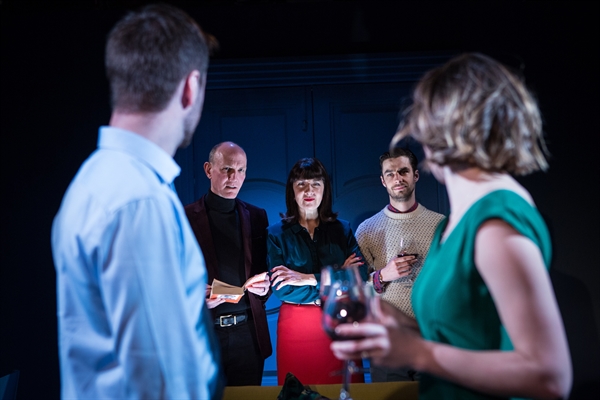
Photos: Helen Murray

Photos: Helen Murray

“Funny and clever, disturbing and salacious”

Editorial Rating: 4 Stars

A Traverse Theatre Company, Theatre Royal Bath Ustinov Studio and Bush Theatre co-production.

Ben is a junior doctor. He and Alice have been together for seven years and their work/life balance is screwed. As it happens, so far so familiar. Right now they’ve been in their new flat for six months, have just got the baby’s room to do, and things will get better. Only they don’t. Instead neighbours Juliette and Gilles and their son François come right on in from across the hall ….. Meet the Fockers from Quebec, everyone: with a ‘u’, inappropriate, out of order and way, way, out of bounds.

You watch your step in this pressing and uncomfortable comedy. You’re never too sure what’s underfoot or where it’s going. There’s a godawful squeaky toy behind the sofa and half a glass of red on the floor. ‘Beware’ should travel around the set like LED advertising at a sports ground. Beware Juliette with her penchant for flashing her knickers; beware Gilles’ prurient touch and tongue; beware François’s lacerating commentary. “They’re a bit odd” is Alice’s bang on estimate. “I like them” is Ben’s disastrous opinion. It’s funny and clever, disturbing and salacious, and very well performed.

Michael Boyd directs this production, which is a cracking compliment to French-Canadian writer Catherine-Anne Toupin. It looks clean, like a Farrow and Ball paint job by designer Madeleine Girling where the quality of the finish should never be in question. All the more effective, then, when a kind of moral distemper takes hold and it all gets corrupted, goes off-colour and becomes dubious. Guy Williams as Gilles is absolutely loathsome because his seduction of Alice is like a pet research project. He also, incidentally, proves that a black roll neck jumper and brown jacket are about as louche as it gets. Maureen Beattie, ever the mistress of the bewitching voice, is Juliette the mother temptress, against whom all resistance is futile. Just sticking a plaster on Dr. Ben’s hand makes him go weak at the knees. François – jittery and wacky by Dyfan Dwfor – may be appalled by his parents’ behaviour but is just as complicit.

Lindsey Campbell as Alice

Lindsey Campbell as Alice

If Toupin isolates a character, it’s Alice. The plot would push her under but she won’t go. Listen up in scene 5 for the psycho pairing of Ben (Sean Biggerstaff) and ‘Benny’ (that would be Biggerstaff too) but Alice stays there, screaming for help really. Lindsey Campbell has to do grieving and dirty dancing and horribly vulnerable all at once, which is why the sex is so desperate. It’s a class act and I think is what the show’s flier describes as traumatic, ‘teasing and thrilling’.

Right Now is as billed. It’s edgy, imminent, and contemporary, which makes it kind of Shakespearean: François as Feste maybe, Alice as the abused and distraught Ophelia; Juliette becomes Lady Macbeth, who has given suck, etc. Weird.

Star (blue)Star (blue)Star (blue)Star (blue)

Reviewer: Alan Brown (Seen 19 April)

See Right Now at the Traverse

Visit Edinburgh49‘s Traverse archive.

Neither God Nor Angel (Traverse 5 – 9 April ’16)

Jimmy Chisholm as James VI and Gavin Wright as William. Photo: Leslie Black

Jimmy Chisholm as James VI and Gavin Wright as William.
Photo: Leslie Black

“To an eloquent vocabulary!”

Editorial Rating: 4 Stars

4th in this Spring’s season of a Play, a Pie and a Pint.

Union (2014), Tim Barrow’s second play, was full of the joys of the Referendum campaign – vigorous, disputatious, even romantic. Neither God Nor Angel, his third, is not ‘Union the prequel’ (by a century), but more of a light amuse-bouche to that earlier rich and hearty fare. This is a waggish two-hander, chummier, a pawky chamber piece.

It is an entertaining fact that James VI, King of Scotland, must have spent some part of the night of April 4th 1603 in Holyrood wondering what it was going to be like to be James I of England (& Ireland) to boot. He was away to London the following morning. Did he blow hot and cold about the whole enterprise? The Incarnation probably sprang to the mind of this godly, seriously literate and absolute monarch who, in 1598 and blessedly free of irony, wrote of ‘the Reciprock and Mutuall Dutie betwixt a free King and his naturall Subiectes’. Let there then steal upon the scene, for the purposes of comic wrangling over glasses of good Rhenish wine, one such subject.

Levity, clearly, is heaven-sent. Enter gawky William (Gavin Wright) to cheek and cheer his King, who has been in peevish sorts. James (Jimmy Chisholm) welcomes – and would embrace in all innocence – the impertinent company of a serving man. Better William, any day, than those ‘devious bastards, the bankers, with their velvet draped bollocks’; and so the toast, raised by His Majesty, ‘To an eloquent vocabulary!’

William speaks Leith and James, crowned at thirteen months, speaks privilege with moments of dainty Morningside. “Would you ken where yon bottle is hid?” might well be an habitual question in Hermitage Gardens but the interesting parts, in amidst the humour, is the forgotten or unfamiliar history: Royal pal Esmé Stewart is pined for; recall of Gowrie and the Ruthven raid shakes the King; his wife, Anne of Denmark, is cherished; and William is sacked for spilling wine on John Ramsay’s silk doublet, which could have happened. I liked all this, almost as much as the use of quill on paper.

It’s a good title, Neither God Nor Angel, provided you can accept that the king’s a man for a’ that, which he ain’t really. Director Ryan Dewar and his two actors do very well with this pithy play of make-believe.

Star (blue)Star (blue)Star (blue)Star (blue)

Reviewer: Alan Brown  (Seen 5 April )

Go to Neither God Nor Angel at the Traverse

Visit Edinburgh49‘s Traverse archive.