Our Country’s Good (Bedlam: 26 February – 3 March)

BestPic2

“Bold and disciplined”

Editorial Rating: 4 Stars:  Outstanding

Lashings of intelligence here. That and the knowledge that ‘the shoulder blades are exposed at about 100 lashes’. There’s also sand on the stage floor, figuratively blood stained, but handy for gritty effect and for when you want to represent a play as ‘a diagram in the sand’, as proof of what could be and what might be changed for the better whatever the wretched circumstances.

And Lord knows that Australia has been there and done that. In literary terms it’s a swift line of descent: Robert Hughes’ ‘The Fatal Shore’ was published in 1986, Thomas Keneally’s ‘The Playmaker’ in 1987, and Timberlake Wertenbaker’s Our Country’s Good opened at the Royal Court, London, in September 1988. Historically it took eight months for the convict transports to get from Portsmouth to Botany Bay, arriving in January 1788. The action in Wertenbaker’s play – by now surely reckoned to be a modern ‘classic’ – is spread over five to six months. It is Edinburgh University’s official English Literature play of the year and this student production does it proud.

Of course, ‘Advance Australia Fair’ it ain’t. Major Robbie Ross (Amelia Watson) sees to that. He bitterly resents being in such an alien and depraved place, orders floggings for impertinence, and fears that any sign of weakness – ie. kindness – will result in revolt. Arguably it’s the toughest role because he is so singularly awful and Watson has the scowl and the whiplash voice to do it. He is opposed by Governor Arthur Phillip (Matthew Sedman) whose far-seeing humanity guides the play beyond the horror of its opening to its near jubilant close. Wertenbaker indicated that her play end with the ‘triumphant music of Beethoven’s 5th’ but perhaps that was felt to be too much for Bedlam on a freezing evening in February.

What Phillip does do is to require the production of George Farquhar’s Recruiting Officer (1706), directed by theatre loving 2nd Lieutenant Ralph Clark (Jacob Baird). The fact that Clark only has two copies of the play and that some of his cast cannot read and that Ross regards him as a sorry excuse for a Marine makes it a tall order to carry out. Baird is well cast as officer class decent but his character is frustrated almost to breaking point, emotionally and sexually. The relief provided by The Recruiting Officer is palpable and is far better for him than pining at his fly buttons for his beloved Betsey Alicia back home.

So, here’s the pre-text of late Restoration comedy within a docudrama, with its 22 strong cast list of gentlemen heroes (2), wise man (1) and villain (1), and the rest (several) as good-for-nothing, not! Robert Sideway (brilliant by Domi Ucar), pick-pocket to the gentry, and glorious ac-tor is a scuttling hoot, establishing her melancholy and rehearsing her bow. He is being flogged on deck when the play begins so it is a defining moment when during the second rehearsal scene he completely upstages a brutal Ross. No such joy for Midshipman Harry Brewer (Gordon Stackhouse) tormented by guilt and by his jealous love for his ‘Duckling’ girl (Anna Swinton). Their time together is raw and explicit and (for young actors) pretty impressive. Tiffany Garnham convinces that her Liz Morden, violent, in chains and born to be hanged, can still be redeemed. Jack McConnell is John Arnscott, transported for life, and so pleased that he can ‘be’ someone else. Erica Belton, speaks wonderfully as Ketch, apprentice hangman, who wants to be an actor because he remembers some players coming to his village in Ireland where they were loved ‘like the angels’. Anna Phillips’ shy Mary Brenham owns a precious and appealing dignity from the start. Anubhav Chowdhury’s Caesar is from Madagascar and you have to wonder at the bad luck that got him into a British penal colony but his French accent and daft woes do provide easy laughs. Hannah Robinson manages to be both upper class twit Campbell and illiterate Dabby, bless her, who never gives up on getting back to the soft rain of Devon.
IMG_4684

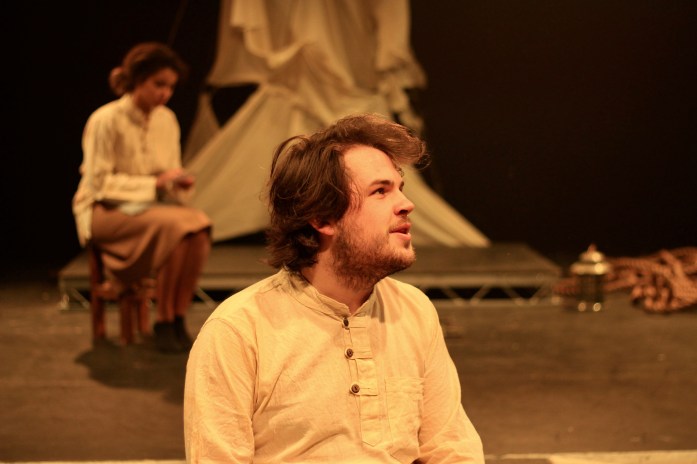
Matthew Sedman as Wisehammer and Anna Phillips as Mary, behind. Photo: Louis Caro.

Two characters remain: Wisehammer (Matthew Sedman again) and the Narrator, the Aboriginal Australian. Both command attention but Sedman is outstanding. In this production the Narrator (Sophie Boyle) plays a signature phrase on the violin and her few linked lines are a reminder of the tragic consequences for her people that followed this European ‘entertainment’. Wisehammer, as you can guess, is something else: almost a gentle philosopher, certainly a writer, and Sedman’s careful Northern delivery nail the words, especially his simple Prologue that gives the play its title and it is intoned twice for effect. The fact that Ralph Clark reckons it would give Major Ross apoplexy is a quality judgement.

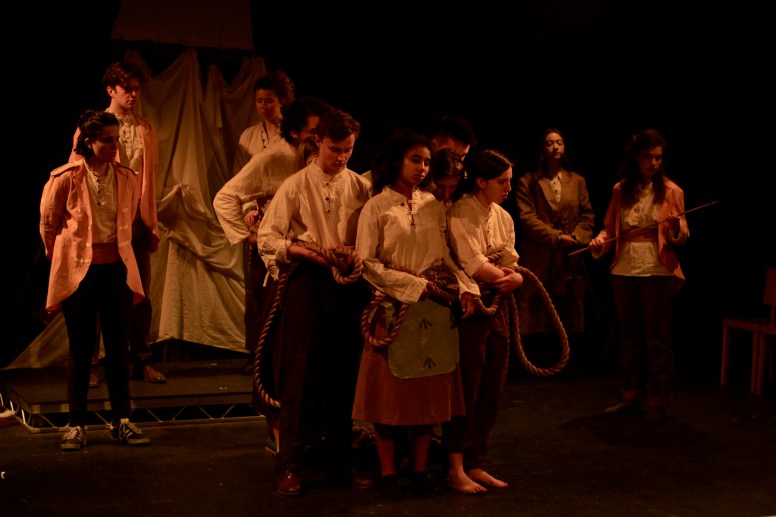
Our Country’s Good is serious drama and directors Luke Morley and Jane Prinsley take it seriously. This production is bold and disciplined, barely cut – if at all – and its actors work a demanding script with real attention. Yes, there’s some yelling – you would too if you’re being whipped – and it drowned Wisehammer’s astonishing, ghastly opening description of men and women ‘spewed from their country’. Naval uniform is in short supply and despite its appeal the thrust stage doesn’t work, but the actors being constantly visible, on or ‘off, does; and the onstage set design by Natasha Wood and Bryn Jones of a short mast, sail cloth and crossed spars is all that is needed.

I’m with Governor Phillip’s: ‘We will laugh, we may be moved, we may even think a little’. There’s a conviction worth upholding.

outstanding

StarStarStarStar

Reviewer: Alan Brown (Seen 26 February)

Go to Our Country’s Good at EUTC, Bedlam

Visit Edinburgh49  at the Bedlam  archive.

The Belle’s Stratagem (Lyceum: 15 Feb. to 10 March ’18)

Angela Hardie as Laetitia.
Photo. Mihaela Bodlovic.

“Jaunty, diverting and quick. A noteworthy woman playwright is not short-changed”

Editorial Rating:  3 Stars Nae Bad

There was gleeful mention of the ‘shit wagon’ and of the reeking ‘Nor Loch’ but these early New Town characters keep their stockings a blinding white and the hems of their fancy gowns spotless. It’s that kind of play: a slight comedy of appearances. Or should that be ‘sleight’?

The Belle’s Stratagem is a jaunty piece, giddy even. Its leading man is Doricourt (Angus Miller), although he’s led by the nose, and he has ‘l’air enjoué’ of a chap with too many Air Miles and too many hours in Club class. Well, he would have, except this is 1788 when Gold Cards and guineas were more likely gifted by pedigree than work. He’s back in Edinburgh after his ‘Grand Tour’ of assorted lounges, demoiselles and signorinas and finds himself betrothed to Letitia (Angela Hardie), known almost from birth and now two years out of boarding school, and he’s not impressed. She, Letitia, is pissed at this – vulgarity clearly crossed Princes Street – and is determined to have her man love her or lose her. Meanwhile, Sir George Touchwood (32 and of the Jacob Rees-Mogg brigade, benign branch) is back in town with his lovely, guileless, wife, Lady Frances. Beware! Cad about, Courtall by name (geddit?), who will have the lady.

Tony Cownie has adapted Mrs Cowley’s Belle’s Stratagem of 1780 and removed the whole play to Scotland, aka that ‘subjugated bunch of hills north of Berwick’. Deacon Brodie is stealing about; Doricourt and the honourable Saville (John Kielty)  are soft Jacobites; Laetitia’s father is Edinburgh’s Provost and Laetitia (in disguise) wins Doricourt’s heart and the audience’s with an aching ‘Will ye no come back again?’ The best joke of the evening is Courtall’s as he goes off to France for an assignation with the Revolution.

Theatre history is all over this piece, if you look for it. The big brother of Cowley’s original has to be George Farquhar’s Beaux Stratagem from 1707. Farquhar had arrived in London in 1697 from Dublin’s wonderfully evocative Theatre Royal at Smock Alley. Cowley’s play opened at the Theatre Royal Covent Garden. Nicola Roy’s Kitty, a prostitute with a proper sense of what’s decent, would fit well into those dodgy streets. She’s the key to foiling Courtall’s foul intrigue. The two widows, Racket (Pauline Knowles) and Ogle (Roy, again) give lechery a good name by repeatedly calling out the hypocrisies of male behaviour but enjoy eyeing the men themselves.

Helen Mackay as Lady Frances and Grant O’Rourke as Sir Edward.
Photo: Mihaela Bodlovic

Historians place The Belle’s Stratagem at the endpoint of a period when the Comedy of Manners went bourgeois. Marriage and compatibility within a marriage become a pair and so enter Sir Edward and Lady Frances, who (for me) are more interesting and entertaining than an infatuated Doricourt and the infantile Laetitia of the first half and the minx Laetitia of the second. Grant O’Rourke plays the country squire (ok, laird) as if to the manor born. He’s a kind fellow, whose daft helplessness (check O’Rourke’s real comic quality in the Venetian Twins) rallies to the call of defending his wife. He ends up an endearing character and – a near no-no in the Restoration comedy of times past – a deserving husband. And Lady Frances (admirably done by Helen Mackay) is bold enough to love him true once she has established her own rights, which again is rather refreshing. The New Town will be all the better for their rectitude during their three months residence in town! Laetitia’s father, the Provost, is more typecast as the lookout for a wealthy son-in-law but Steven McNicoll gives the part considerable warmth and humanity, not least in a party dress.

There’s pretty music, dancing, a masquerade, numpty grumpy footmen, and squeaky clean, impressively silent Heriot Row facades but all the same I longed for some ruggedness, more spit and bite. The gossip columnist, Flutter, is played by an impish John Ramage and that gets close, but finally it’s light and undemanding. The ‘modern’ script is frequently diverting and quick, actors help it on enormously, and a noteworthy woman playwright is not short-changed, but the intrigue unwinds too rapidly and I found much of the humour either forced or slack.

nae bad_blue

Star (blue)Star (blue)Star (blue)

Reviewer: Alan Brown (Seen 21 February)

Go to The Belle’s Stratagem at the Lyceum

Visit Edinburgh49 at The Lyceum  archive.

RSNO: Steffens. Ionita (Usher Hall: 9 Feb.’18)

Image result for karl steffens conductor

Karl-Heinz Steffens

“This was as close to perfection as live performance gets”

Editorial Rating: 4 Stars: Outstanding


With Valentine’s Day approaching the RSNO presented a programme on Friday of overtly romantic music: Schumann, Elgar, and, yes, Britten. They were under the baton of Karl-Heinz Steffens, a conductor of a rising reputation throughout his native Germany and also Scandinavia, who proved himself more than worthy of the occasion.

This was a concert of two halves, the first entirely adequate, the second quite exceptional.

In the first piece, Britten’s An American Overture, the band was let down by the relatively poor quality of the music. Not a criticism I would usually level at this composer, but Britten did himself deny all memory or knowledge of the piece when it was discovered in 1972 (it was composed in 1941 as a commission) and had to be shown the manuscript in his own handwriting to prove its provenance. It remained unperformed for a further 11 years. With shades of Copland and even Bernstein, there were flashes of interest in an otherwise fairly monochrome piece. The orchestra played it well, including some very exposed parts early on and while grateful for my knowledge of the repertoire being expanded through the experience, I have no particular wish to hear it again.

Next up the  – Oh, so romantic! –  Schumann Cello Concerto in A minor. RSNO Artist In Residence Jan Vogler was ill (Boy, has this been a season for withdrawals in Edinburgh!) and BBC New Generation Artist and 2015 International Tchaikovsky prizewinner Andre Ionita gamely took his place. The quality of the performance grew as the piece developed, one wondering if Ionita was playing con sordino as the sound coming forth initially lacked the necessary volume, and orchestra and soloist seemed a little out of synch, hardly surprising given the last minute replacement. Nonetheless in the second movement Langsam Ionita’s playing matched the music better, and in the final movement he brought out the necessary volume. His pizzicato encore left no one in any doubt as to his technique.

And now to the piece that everybody, I guess, had come to hear: Elgar’s Symphony No 1 in A flat major. If ever a case could be made for discipline in art, this was it. It would have been so easy to produce a piece of crowd pleasing schmaltz, but the words that come to my mind when analysing Steffens’s fine conducting and the orchestra’s magnificent playing are control, timing, tautness, controlled expression. Steffens showed himself to be a master of tempi, holding back and letting forth the players time and time again, including the final build-up in the brass where no one put a foot wrong. The flutes (I had seen Principal Flute Katharine Bryan chatting relaxedly in the hospitality suite only minutes earlier) kicked off the famous nobilmente with complete aplomb. I heard the cor anglais part clearly for the first time ever, and we were wafted away by the joyous playing of two harps in the final movement. This was as close to perfection as live performance gets. For that magical fifty minutes the RSNO were a world class orchestra. Bravo!


outstanding

StarStarStarStar

Reviewer: Charles Stokes (Seen 9 February)

Go to the RSNO, Scotland’s National orchestra

Visit Edinburgh49 at the Usher Hall archive.

Tom at the Farm (Bedlam: 7-10 Feb ’18)

“Intelligent and engaging”

Editorial Rating: 4 Stars: Outstanding

A dark, brooding affair, Tom at The Farm sees charming city-boy Tom visit his (secret) lover’s family farm in rural Ontario for his funeral, under the guise of having been purely his friend and co-worker. What unfolds is a tale of grief, secrets, identity and duty, akin to the works of Emile Zola, with the tensions between the characters evident upfront, and an intriguing journey ahead as to how each one will play out.

To that end, Michel Marc Bouchard’s script really is delicious serving up a twisting tale of deceit where Tom falls further and further into an elaborate web of lies in order to keep the family happy, though peppered with enough dark humour and sexual tension to make it enthralling on all levels. Asides and textual motifs are used cleverly to capture the sense of inevitability throughout, while the scene in French is simply a stroke of comic genius.

Director Joe Christie does a stellar job in capturing the overall mood of the piece, and attention to detail throughout each scene gives the production an intelligent and engaging quality – everything happens for a reason, and each contributing factor drives the narrative to its gritty resolution. The production team also deserve credit for transforming the Bedlam space into what could easily be believed as a rundown farmhouse, while the other visual and sound effects all contribute well to the psychologically intense nature of each moment.

With grief being such a strong central theme, it’s a tough ask for the student cast to delve into that level of emotional depth, but on the whole they handle it very well. Yann Davies as Tom is barely ever off stage, and steers the character from pillar to punch-bag with electrifying conviction, and Peter Morrison is every inch the guy you love to hate as Francis, oozing with masculinity and a genuinely frightening presence. Matilda Botsford brings a tender and controlled approach to Agatha, capably balanced out by Kathryn Salmond’s irreverent Sara.

For me the only real downfall in this production are the dips in emotional intensity and honesty that generally occur between scenes. Given the changes in dynamics and relationships throughout the play it sometimes takes the actors a little a while to really establish the tone of each new scene and bring us with them to where they are. The style of the production requires a lot from the audience to follow the journey, believe what happens in between each scene and then be present in each moment on-stage moment, and though it’s a tough ride, it is very well worth it in the end. I’d happily go again.


outstanding

StarStarStarStar

Reviewer: Steve Griffin (Seen 8 February)

Visit the Bedlam archive.

THIS REVIEW HAS NOT BEEN SUBEDITED

FAME! The Musical (Church Hill Theatre: 6-10 Feb ’18

“Plenty of individual noteworthy performances”

Editorial Rating: 3 Stars: Nae Bad

Fame! The Musical follows a group of performance arts students through their formative years at the “Fame” high school, and is full of vivid characters, energetic dance numbers, and show-stopping songs. Largely an ensemble piece, it’s the perfect choice and platform to allow Edinburgh University Footlights’ members to present their considerable talents as actors and singers, and there are plenty of individual noteworthy performances throughout.

Mimi Joffroy demonstrates all the ingredients of a stellar leading lady as Carmen, most evident in the goosebump-inducing In L.A.; Matt Galloway delivers a laugh a line as the charismatic Joe, and dance captain Connie McFarlane proves she’s a genuine triple threat in the gospel-tinged Mabel’s Prayer. Alice Hoult and Adam Makepeace show great chemistry as romantic leads Serena and Nick, and Mhairi Goodwin serves up a killer belt as Miss Sherman in These Are My Children. Liam Bradbury never quite convinces he’s actually a hip-hop dancer as Jack, though comes into his own during the character’s signature song Dancing on the Sidewalk.

Yet given all this obvious talent, what holds this production back is being able to effectively embrace the script’s very bitty nature, made up of lots of short scenes taking place over a number of years. EU Footlights’ simple set proves very constraining to this end, often dragging the action to the back of stage, while there’s precious little to link each part and show progression over time. There are pleasing teases of getting it right during Think of Meryl Streep, as action continues behind the singer, so it’s slightly frustrating not to see more creativity in the presentation of each scene throughout to make it feel like one cohesive piece.

Additionally, Fame! is a show that is chock-full of dancing, requiring much more from a cast and choreographer than your average production. The company certainly give it their all during this performance and there are some wonderful moments during the dances (especially some of the daring lifts!), but there’s also a scrappiness to the performance – particularly in the ballet sequences – which, although charming at times, more often detracts from a lot of the other great things happening on stage. Some extra time spent in brushing these up would go a long way to adding to the quality of this production.

Overall, Fame! is a feel-good show with plenty to enjoy, and EU Footlights should be very proud of the job they’ve done with it. Though one can’t help but feel that we ain’t see the best of them yet.


nae bad_blue

Star (blue)Star (blue)Star (blue)

Reviewer: Steve Griffin (Seen 7 February)

Visit the Church Hill Theatre archive.

THIS REVIEW HAS NOT BEEN SUBEDITED

Bedfest 2018: Scotland the Bollocks (Bedlam: 23rd Jan.’18)

Design: EUTC.

If all history lessons were like this, I would know and understand a lot more of my country’s story

Editorial Rating: 4 Stars

 
 To explore the EUTC’s Bedlam Festival 2018, ‘BedFest‘, we decided to go along to see Ross Baillie’s stand-up routine Scotland the Bollocks, an enthusiastic rendition of stories (in)famous in Scottish history. 

Straight from the word go Baillie is genuine and entertaining, if slightly unorganized at times. He is alone on stage, although he always has his stage manager Huw Jones at hand to help him via a screen in the backgroundWhen Baillie gets a little confused or forgets what he is talking about next, Jones is quick to provide funny pictures, anecdotes and explanations.  

The atmosphere remained relaxed throughout as Baillie told exciting stories of Mary Queen of Scots and ….. of the Bank of England. He engaged with an audience that seemed shocked yet highly amused by his hilariously sarcastic outbursts and at times slightly inappropriate sense of humourI was quite happy as I was not sitting in the front row.  

Baillie questions our national identity as he explores the mishaps and (if this is what we can call it) the ‘series’ of very unfortunate events which have fallen upon Scotland since the beginning of history as we know it. His show is almost a mock Horrible History lesson mixed in with some modern jokes about Trump and Brexit. One of my favourite moments was a make-believe Twitter argument between famous people from the 18th century.  

At times I was unsure if Baillie was genuinely confused or if his disorganisation was indeed part of the act –  either way, although his performance could have been a little more polished, the show worked really well. If all history lessons were like this, I would know and understand a lot more of my country’s story.

Star (blue)Star (blue)Star (blue)Star (blue)

Reviewer: Iona Young (Seen 24 January)

 Go to EUTC, the Ediinburgh University Theatre Company

Visit Edinburgh49 at the Bedlam archive.

Rabbie (Basement Theatre, Rose Street: 23-27 Jan ’18)

“It’s almost impossible not to find yourself engaged in every moment”

Editorial Rating: 4 Stars

For a musical about one of Scotland’s best-loved poets – many of whose works are also well-known songs – it’s hard to fathom why Rabbie hasn’t already been doing the rounds for years. Yet given Captivate Theatre’s impressive revision of it, I’m sure we’ll soon see this show becoming something of a tradition on stages around the country.

Loosely following Burns’ life and loves in chronological order, the action is also punctuated by toasts from a modern day Burns supper, which help give context and relevance to the action. Structurally it’s a fairly whistle-stop tour of the main turning points of the poet’s short life, and it’s a shame not to get more depth and drama from some of these, though the through-line about Burns’ love Jean Armour does go some way to adding that much-needed integrity to the piece.

The action often veers slightly too close to the edge of bawdy and crowd-pleasing for my tastes, but underneath the simple folksy style is a good musical – there’s a pleasantly surprising amount of harmonic complexity and variety in the numbers, and plenty of laughs to be had throughout. It all moves along at a rollicking pace so there’s never a chance for the energy to dip, and while I would have preferred more development in some of the scenes and characters to get to know them better, it’s almost impossible not to find yourself engaged in every moment.

The staging of this production is somewhat rough and ready, and director Sally Lyall’s decision to spread the action around the space perhaps isn’t the best given the setup of the Basement Theatre (if you’re sat in the front you’ll have to turn your ahead a lot!) but in a different space with more… space, and greater attention paid to the overall production values this could very easily be a show-stopping piece.

The cast are a talented bunch, and can’t be faulted when it comes to sheer gusto and conviction in their performance throughout. The nine-strong troupe play numerous characters between them and blend in and out of spotlight very well. A special mention to Charlie Munro who is hilarious as one of Burns’ publishers, Creech, while Meg Laird Drummond brings a wonderful sensitivity to Burns’ long-suffering wife Jean.

Like Burns’ own work, Rabbie may not be the finest example of writing ever to grace Edinburgh, but it’s certainly worth raising a glass to, in this, his celebratory week.


Star (blue)Star (blue)Star (blue)Star (blue)

Reviewer: Steve Griffin (Seen 24 January)

THIS REVIEW HAS NOT BEEN SUBEDITED

The Lover (Lyceum: 20 Jan-3 Feb ’18)

“Glimpses of brilliance”

Editorial Rating: 2 Stars

Margerite Duras’s sensational autobiographical novel about an affair between a 15-year-old girl from a poor family and a Chinese millionaire almost twice her age is certainly potent stuff for stage adaptation, and presenting this spoken word/dance interpretation on the backdrop of #MeToo and #ItsTime is a brave choice for co-collaborators The Royal Lyceum Theatre Edinburgh, Stellar Quines and Scottish Dance Theatre, which will be sure to attract interest. Unfortunately, given the finished product, it probably won’t be the level of interest hoped for.

The performance is narrated throughout by The Woman (Susan Vidler), who looks back on how her affair began, developed and ended. Jemima Levick’s and Fleur Darkin’s adaptation is somewhat lazy in its construction, with too many unnecessary accounts of (mimed!) dialogue and a plodding monotony which Vidler’s voice does little to enliven, leaving the other performers often stranded in the middle. Indeed, the confluence between text and movement seems at odds throughout, feeling not unlike a playground grapple for territory.


Darkin’s choreography at times gives glimpses of brilliance – from the awkward intimacy between the lovers to the playful fights between Paulo and Pierre – and the production’s moments of stillness (particularly towards the end) and subtle gestures often convey far more than the tedious narration. Yet, in saying that, the choreography also too often lapses into writhing around on the floor and clumsy movement of furniture which instantly breaks any of the mysticism and poetry previously built. It’s a genuine shame not to see lengthier dance sequences to tell the story at the sacrifice of some of the narration, while simplifying and minimising some of the on-stage antics would also ease comprehension.

In The Lover’s defence, Emma Jones’s lighting design and Torben Lars Sylvest’s soundtrack do pleasingly act as mediators throughout, dragging the other disparate elements into a clear time, place and mood. Yet the overriding impression this performance leaves – much like the subject matter of the show itself – is one of misfit: an attempt to bring together two different hearts for glorious joy, yet which ends up flat and, somehow, unfinished. What could have been.

In my book, this is a production that should have worked – it has enough of the right cards (including three great collaborating companies and a fantastic base text) to play a good hand – yet it dithers and dallies its way into such a mediocre result that my only constructive criticism would be to start again from scratch. A commendable concept, poorly executed.


Star (blue)Star (blue)

Reviewer: Steve Griffin (Seen 23 January)

Visit the The Lyceum archive.

THIS REVIEW HAS NOT BEEN SUBEDITED

A Bottle of Wine and Patsy Cline (Rose Theatre: 1-30 Dec ’17)

“Everything about this production oozes quality”

Editorial Rating: 5 Stars

For the uninitiated (like me), Patsy Cline was an American country music singer who found fame in the late 1950s/early 1960s, and went on to become one of the most influential, successful and acclaimed vocalists of the 20th century. Her life was tragically cut short at the age of 30, and this production represents a fresh (and fitting) celebration of the star and her work as part of Gilded Balloon’s winter programme at the newly revived Rose Theatre.

Created by the team that introduced Doris, Dolly & The Dressing Room Divas to the world at the Fringe in 2015, A Bottle of Wine and Patsy Cline is a hilarious new musical play featuring all the classic songs fans will love. Yet the only wine you’ll see is the free (mini) bottle you get as part of your entry to the show…

Written as a whistle-stop tour of Cline’s short life, Morag Fullerton’s script slickly presents the turning points in her career and personal life, squeezing in the hits, plenty of laughs and a few of the sadder moments along the way. I would have liked to see more detail in some moments and more creative risk taken with the structure of the piece – it’s safe, straightforward biographical narrative ticks along at a consistent pace – but otherwise everything about this production just oozes quality.

Giving Cline new life in this production is local gal Gail Watson: one of the most accomplished performers currently working in Scotland. Not only a supremely talented singer and impressionist in her own right, Watson commands the stage as the title character and delivers a knockout performance, demonstrating stamina and vocal control performers half her age dream of. Her standing ovation is well-deserved.

Watson is more than capably supported throughout the performance by Sandy Nelson and Hannah Jarrett-Scott, who not only play numerous roles between them, but also act as band and backing singers during the musical numbers. Given the teases of brilliance they demonstrate, it’s a shame we don’t get to see more of each and the wonderful cameo roles they play throughout the show.

Beware – some audience members like to sing along with every song. Those who prefer a silent audience may cringe and crush their plastic cups at the thought, but it’s the kind of show where some formalities can be overlooked. In short: you’d be Crazy to miss it!


Star (blue)Star (blue)Star (blue)Star (blue)Star (blue)

Reviewer: Steve Griffin (Seen 9 December)

THIS REVIEW HAS NOT BEEN SUBEDITED

How To Disappear (Traverse: 8 -23 Dec.’17)

Owen Whitelaw, Robert, with Kirsty Mackay as Isla.
Image: Beth Chalmers.

“Help yourself to creative energy …”

Editorial Rating: 4 Stars Nae Bad


You don’t associate Elgin with hoodies, or Percy Pigs come to that. Go see Morna Pearson’s How To Disappear, however, and you will. The broad Doric may be less surprising and – at this time of year – why not put Narnia, downsized and upstage, through a cupboard in a bungalow?

If this sounds funny, it is, but it is not light-hearted. Far out, maybe. Imagine finding a squashed pot of Angel Delight in your Christmas stocking and you’re some way there. Or, because this is a play of alternatives, you’ve been given 2 DVDs: ‘I, Daniel Blake’ and ‘Room’. Great films but nonstarters in the Ho Ho Ho! stakes.

That’s a deliberate choice of films, of course. Robert, 28, lives on benefits that the Department of Work and Pensions wants to relieve him of. He has not left his room for twelve years, near enough. He has not been outside since he was eight. In the absence of their parents his kid sister, Isla (14-ish) looks after him as best she can, so it helps when she is excluded from school. A benefits assessor, Jessica, has come to ask Robert some questions.

But that’s barely the half of it. There’s a glowing blue portal and a stage revolve to expose the full story. Exactly when it turns is, for the audience, quite exciting; for Robert it’s an obsessional, skin picking quest, but for his pet tarantula it’s an unfortunate accident; and for Jessica it’s spew and ‘Wow!’ all the way.

Help yourself to creative energy then. Certainly Robert does. Copies of ‘New Scientist’ are stacked up against the walls so there’s not much space for him to move around and check his various alarm clocks but this is one clever ‘mannie’ who – all innocent of the metaphor  – dumps his benefits assessment into his bedpan. Owen Whitelaw is excellent in what could be a raw and painful role but is actually agile and sympathetic. His sister, Isla, is more aware, more aggrieved and angrier with what – on the face of it – is a distressing existence. Kirsty Mackay has that awkward dual role as ‘adult’ carer and S4 pupil who is still getting mercilessly bullied at school. (Note for school Guidance staff – you get a mouthful). Jessica (Sally Reid) is a paper shuffling caricature to some extent but with Robert as her ‘client’ is happily saved.

There is redemption here, which is good for a Christmas production. It’s in the near constant humour for one thing and in the marvellous sense of release, of stepping out of the room that comes at the end. But it’s not an easy given and director Gareth Nicholls keeps the action pretty edgy, using plunging lighting effects (exemplary from Kai Fischer) and sound from Michael John McCarthy that begins, it seemed to me, with a nod to ‘Big Country’ and then funnels down to close in on Becky Minto’s box frame of a set.

We need plays with moral outreach and How To Disappear is definitely out there to bring us in. We’re with Robert because he wants to help his father be with his mother, which is where the plot line folds into the mystic portal and you wonder where you are. Just hang on to the fact that he shares his Milky Way with his sister. We’re with Isla because she won’t get lost and hangs onto her brother because she loves him. We’re even with Jessica because she too is a strung out case who does what she can to help people and, like Robert, she loves the ‘Hot Tub Time Machine’, which says it all really.

Star ratings get done over in the wash in this one: 3, 4, 3, 4 … ?

Isla         ‘D’you kain whit number the washin machine goes on at?

Robert  Nut.

By the end, it’s 4* from me for an original and entertaining play. Fabric conditioner for the soul!

nae bad_blue

Star (blue)Star (blue)Star (blue)Star (blue)

Reviewer: Alan Brown (Seen 8 December)

Go to How To Disappear at the Traverse

Visit Edinburgh49 at the Traverse archive.