Edinburgh Quartet and Guests: St Andrew’s and St. George’s West: 25 Oct ’16

Image result for edinburgh quartet

“the standard of playing remains remarkably high …all the more commendable in the main work that was technically very demanding in terms of phrasing, notation and timing.”

Editorial Rating:  3 Stars

The Edinburgh Quartet are skilful not only in their playing but in their approach to their constituency. Their 2016/17 series is a combination of daytime, rush hour and evening sets in order to reach new listeners and move away from the relative predictability and, for some, the difficulty of getting to evening gigs. Each season, or part of season, has a theme, and this season’s theme is vested in their Scottish roots. Tuesday’s concert programme contained works inspired by the island of Skye and the actual words of Robbie Burns. Informal in approach within the relaxing environs of St Andrew’s and St George’s West in Edinburgh, the occasion is probably more accurately described as an informal lecture recital rather than a concert, and none the worse for that.

Cleverly, the band started with a brief introductory piece, demanding in intonation and timing, which they played without music. Gordon Bragg then interviewed composer Alasdair Nicolson who spoke of the inspiration behind his String Quartet No 3, “Slanting Rain”, which was the centrepiece of the evening. After that Mairi Campbell, guest musician and one of two violists in the opening number, spoke of her love of the Scottish dance and folk music idiom and her approach to her music.

On to the main event. “Slanting Rain” is a six movement work full of chromatics, a wide variety of bowing techniques, harmonics and dissonance. It is a difficult play, and not an easy listen. I did think that the advanced technical construction of the work got in the way of its musicality. The introduction to the fourth movement, “Impossibly distant tree lined paths”, treated us to a melodic introduction by EQ Apprentice Competition winner Morag Robertson on viola, and the sixth movement, “Into an abyss made of time”, was a very clever melange of time signatures and orchestration that definitely worked.

The evening drew to a conclusion with a deeply moving rendition of a Robbie Burns poem sung and played by Mairi Campbell, followed by James MacMillan’s “Memento”.

Those familiar with the Edinburgh Quartet’s line up would have noticed some new faces, some planned, some drafted in at the last moment. Tristan Gurney has left and the first Violin chair is currently being recruited for. Tonight’s locum was taken ill on the morning of the concert, and Gordon Bragg nobly took on the first violin part, bringing in Rachel Spencer on second violin. Morag Robertson will take the viola desk for the first part of the season while Fiona Winning remains on maternity leave.  Mark Bailey remains at the cello desk.   All these changes notwithstanding, the standard of playing remains remarkably high and, astonishingly, the cohesion of the band appears completely unaffected, as if they had all being playing together for years, all the more commendable in the main work that was technically very demanding in terms of phrasing, notation and timing.

Star (blue)Star (blue)Star (blue)

Reviewer: Charles Stokes (Seen 25 October)

Go to Edinburgh Quartet‘s homepage

Visit Edinburgh49’s St Andrew’s and St George’s West archive.

RSNO: Sondergard, Jansen: Usher Hall 21 Oct 16

Image result for RSNO

“What struck me …. was the precision, accuracy and vitality of the playing, with rock steady tempi combined with real verve”

Editorial Rating: 5 Stars: Outstanding

Following on the RSNO’s opening gig a fortnight ago featuring the fabulous Nicola Benedetti and the Tchaikovsky Violin Concerto, Friday’s concert fielded another outstanding violinist in the persona of Janine Jansen playing the Sibelius. What is so special about live music is that you don’t know what you are going to get, in terms of interpretation and playing skill, until you hear it. You know it is (usually) going to be good, but how, and in what way? The RSNO, guest conductor Thomas Sondergard and Jansen, are all very fine artists approaching the top of their game, but who perhaps one would not yet categorise as world class. However, I defy anyone to name an artist or orchestra who could have performed better than they did on the night. I have never heard a rendition of the Sibelius Violin Concerto played with more clarity, dazzling technique and sheer artistic conviction, with orchestra and soloist joined at the hip through the sensitive yet controlled baton of Sondegard.

Intriguingly, the orchestra started the evening off with two short pieces by Mahler, Blumine, and What the Wild Flowers Tell Me, arranged by Benjamin Britten from the Third Symphony.

Blumine is a serious, complete piece. A quiet string introduction led to a short horn passage before the bleak solo trumpet established the theme, followed by lush strings that proved we were definitely in Mahler land. Plaintive oboe and mournful horn passages followed before the strings brought the work to an ethereal close.

What the Wild Flowers Tell Me made for a pleasant intermezzo. We were now musically well set up for the main event with our confidence in the orchestra and conductor fully endorsed.

Jean Sibelius was a violinist himself and knew the capabilities of his instrument, which he exploited to the full in his concerto. A violinist in the RSNO to whom I was chatting in the interval, described the first movement as “hard”, the second as “OK” and the third as “really very hard”. All I did was gasp at Janine Jansen’s ability to get concert hall audibility from pianissimo passages, and volume from high register playing and harmonics with little more than an inch or two of metal string to draw it from. The first movement conveyed an eerie dramatic tone that permeates much of Sibelius’s music, and suggested frozen wastes and Nordic mythology. The pianissimo opening with the interplay between the soloist and strings was brilliant and perfectly balanced, and as the movement progressed the theme was passed seamlessly from violin to woodwind and brass and then to a magnificent cadenza. To my satisfaction, the breath taken audience (I suspect a little more cognoscenti than on the opening night) refrained from applause.

In the second movement a rich woodwind opening gradually built up to a grand, panoramic finale. Come the third, the danse macabre, the soaring soloist and supportive orchestra brought the work to a deeply satisfying, enriching conclusion.

Our evening ended with Beethoven’s Seventh Symphony. What struck me about the performance of the work, which often comes across as a bit stodgy and clumsy, was the precision, accuracy and vitality of the playing, with rock steady tempi combined with real verve. A joyous, carefree end to an exceptional evening’s music.

outstanding

StarStarStarStarStar

Reviewer: Charles Stokes (Seen 21 October)

Visit Edinburgh49‘s Usher Hall archive.

Walking on Walls (Traverse: 18 – 22 October’16)

Image: Leslie Black

Image: Leslie Black

“Funny and searching by turns”

Editorial Rating: 4 Stars

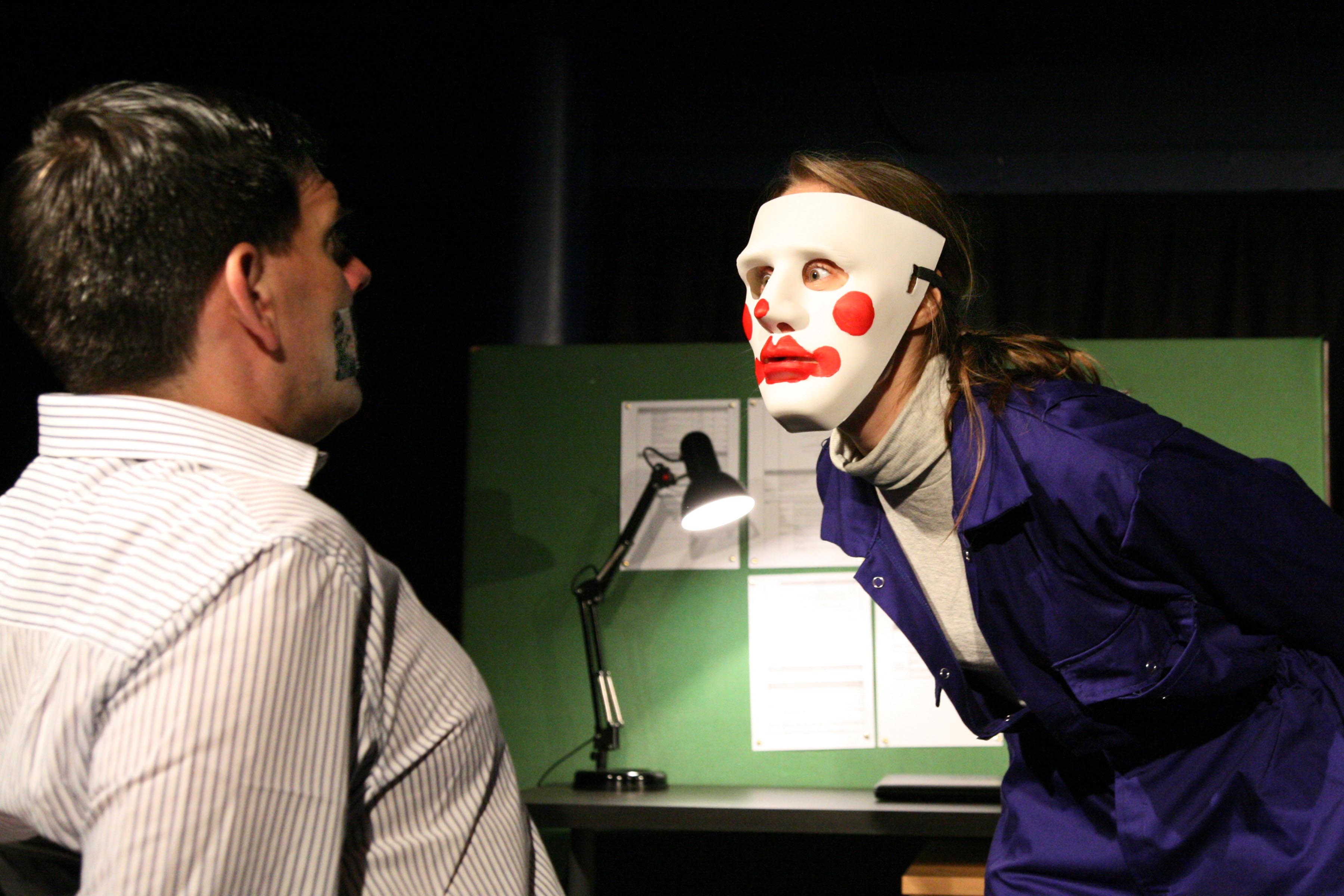
You would not take Claire for a creepy clown. Have there been any sightings in Edinburgh yet? With Halloween around the corner there may well be a few popping up at the window or from behind a wall, which is where Claire comes into her own. She’s the ever so earnest social scientist who doubles as a Super Helpful Person, who just happens to wear a clown mask when she’s out at night looking after people. You could say she looks over them.

Nobody’s laughing at the sinister clown craze, least of all the police, and we shouldn’t laugh at Claire, who has just called them – again; but we do laugh at her, just as the police do, because Morna Pearson’s script makes it all too easy to. Poor Claire with her big round specs and love of chat-defying stats, who’ll never be down the pub after work. But this is the same Claire who notices that (normal) ‘people don’t board themselves up’ unless they’ve been hurt and are vulnerable.

You’ll hear a lot from Claire (Helen MacKay) as she explains herself and her wacky, neighbourly, exploits. She is admirably audible, even from behind the mask. You’ll hear less from Fraser (Andy Clark), not least because of the duct tape across his mouth, but he’s impressive at being incredulous, dumb, and helpless. Unsurprisingly he’s in WTF mode and tries to stay there until he too is affected by Claire’s story. Well, he might be affected, and that’s the point of Pearson’s stinging, interrogatory close.

It is a questioning piece, funny and searching by turns. Who’s the victim here, for one thing, and what’s their space like? Andy is literally bound in his and is pushed around by a young woman, which has to be a valuable experience for him. With Claire it is more complicated. Work is probably the featureless desk, stage left. Home seems to have shut behind her and seems inextricably part of a very unhappy time at school. She sees the empty Buckie bottles and used condoms in the street and it’s all pretty ugly.

There’s tension, of sorts. I saw and heard the opening out and folding up of Claire’s neighbourhood map – with its anti-social ‘hotspots’ – and thought, characteristically, ‘Metaphor-for-Anomie’, which is almost certainly to go too far. Walking on Walls is more interested in seeking kindness than anything else.

Walking on Walls is the third play in the Traverse’s current series of ‘A Play, a Pie, and a Pint’ from Oran Mor, Glasgow.

Star (blue)Star (blue)Star (blue)Star (blue)

Reviewer: Alan Brown (Seen 18 October)

Go to Walking on Walls at the Traverse

Visit Edinburgh49‘s Traverse archive.

Frost / Nixon (Bedlam: 12 – 15 Oct.’16)

frost-nixon

David Frost (Callum Pope), left, interviews Richard Nixon (Paddy Echlin)

“The whole impression is one of a gathering and important moment.”

Editorial Rating:  4 Stars: Nae Bad

It’s a generational, media churned, thing. For Brits over 40 to call Peter Morgan’s Frost / Nixon (2006) the ‘real deal’, might be to ask ‘Collectable’ or ‘Antique’?; for Bedlam’s student audience this enthralling play on fact is simply ‘Legit’. Producer Patrick Beddow can be well pleased with its timeliness, coming as it does during the objectionable and tawdry business of the Hillary and Donald Show. Doubtless Frost / Nixon is relevant as U.S political history from 1977 but director Nathaniel Brimmer-Beller and cast make darned sure that it will still grab your attention as a piece of theatre.

David Frost died in 2013 and has the latest memorial stone in Poets’ Corner in Westminster Abbey, which says a lot about the influence of TV these days. Anyhow, he was 39 when he interviewed former President Richard Nixon, three years after Nixon was forced to resign following Watergate. Twenty-four hours plus of recorded material was edited into four ninety minute broadcasts. The first, on 5 May 1977, drew 45 million viewers, still the largest television audience for a political interview ever. Frost /Nixon is the story of how this big (and very real) deal happened, or kind of happened, and how it played out on all those screens. Frost was reckoned a lightweight, capable of only pitching softball questions, ‘puffballs’, that Nixon would just smash over the outfield fence and pocket $600,000. Well, he got his money – and a snazzy gift of Italian shoes – but not all the home runs.

Paddy Echlin is Nixon and Callum Pope is Frost and one on one, with a strong script, it’s a revealing double act. Frost, dapper and debonair, is still a shrewd operator. Nixon, is clever, practised, and self-assured almost to the last. Voice, gesture, timing are studied and effective. Off-camera – and there are cameras on stage – you get just enough of their personal lives to feel interested. Whether, you should sympathise with Richard Nixon is, of course, a contentious question but Echlin’s performance may well win you round. His chief of staff, Jack Brennan (Sasha Briggs), defends him against the liberal ‘side’, where Macleod Stephen as James Reston is particularly telling as player and commentator.

It’s 90 minutes straight through with no interval, which is a good call. Scenes proceed briskly and there are only a few chairs to move around and the whole impression is one of a gathering and important moment. The cameras provide some tight close-ups, and are a helpful reminder that this is a made-for-television ‘event’, but the flood lights do fade Nixon’s jowls to nothing. Otherwise, this is illuminating work.

nae bad_blue

Star (blue)Star (blue)Star (blue)Star (blue)

Reviewer: Alan Brown (Seen 12 October)

[Student? Want to review with us? Please email editor@edinburgh49.com]

Visit Bedlam Theatre

Visit Edinburgh49′s Bedlam archive.

Mischief (Traverse: 11-15 Oct ’16)

“Life-affirming and devastating in equal measure”

Editorial Rating: 3 Stars: Nae Bad

Ronnat and Brigid, mother and daughter, live alone on a small island, save for some cows that they tend to for a group of monks on a neighbouring island. But when the handsome young sailor Fari washes up on their beach, their little world is set to be changed forever. For his own good, Fari is sent off to live with the monks with the next dispatch of milk, but he soon becomes responsible for transporting the milk back and forward, meaning frequent visits to the women on the island, which have deeper effects on them all than any of them initially realise.

It’s a simple but intriguing set up, and Ellie Stewart’s writing creates a believable world and relationship web between the three characters that slowly unfurls as the play progresses. The plot is full of changes in direction and power between each one, keeping the tension alive throughout, and leading to a final scene and denouement that’s both life-affirming and devastating in equal measure.

While covering quite a “serious” overall topic, a fair amount of comedy is woven in, largely through quite overt sexualisation. Such moments are generally amusing, though do perhaps cheapen the play and divert attention away from the main drama, which is the piece’s real strength. Traditional singing and movement are also used throughout which in some ways add to the sense of history and ritual one would expect from such a setup, but in others seem a bit gratuitous in trying to cram in too many devices. Overall I think Mischief (a slightly misleading title) tries a bit too hard to do too much in such a short space of time.

What would make this play more effective would be a greater sense of stillness and time – there are quite a few scenes and scene changes as the story progresses at a pretty rollicking pace, but given the life-changing themes and choices presented, Gerda Stevenson’s slick direction never really gives enough opportunity for the situation or newly revealed facts to just hang and be absorbed. The young cast, in their earnestness, also seem very keen to over-emote and play up to stereotypical roles, when a subtler and more grounded approach would help make the play’s decisive moments stand out.

It’s a moving and captivating piece that’s cleverly written, but not realised to its full potential in this production.

nae bad_blue

Star (blue)Star (blue)Star (blue)

Reviewer: Steve Griffin (Seen 11 October)

Visit the Traverse archive.

THIS REVIEW HAS NOT BEEN SUBEDITED

Benedetti: Oundjian: RSNO (Usher Hall: 7 October ’16)

Image result for RSNO Benedetti

“Overall, an evening of first class playing and sheer joy.  The bar for the rest of the season has been set high”

Editorial Rating: 4 Stars:  Nae Bad

A steady swarm of eager concertgoers approached the Usher Hall and filled its bars, stairwells and ultimately seats on Friday night for the RSNO’s opening concert of their 2016/17 season. Effectively it was a full house, with almost all the choir stalls taken. Either way, the joint was heaving.

The star attraction was, of course, the superlative Nicola Benedetti with whom the city and Orchestra feel a strong affiliation, which she charmingly reciprocated in a short speech at the end of her bravura performance. This notwithstanding, the programme itself was a romantic blockbuster designed to pack them in, though the choice of starter was open to question.

Like a gourmet meal, there is a growing tendency in concerts to serve up an amuse bouche before the appetiser, and on this occasion the band put on Khachaturian’s Waltz from Masquerade as a four minute intro. Whilst undoubtedly Khachaturian stands comparison with Tchaikovsky and Rachmaninov as a Romantic composer and fellow Russian (albeit Georgian) this was by no means a romantic work, and frankly served the rest of the programme ill, getting us in the wrong frame of mind altogether. Charmingly rather galumphing and of the fairground genre, it needed more power from the strings and less from the brass and did little for us.

Then came Nicola in a performance of Tchaikovsky’s Violin Concerto , supported by the discipline and control of Peter Oundjian, and the excellent, well-balanced and complementary playing of the orchestra, that forced me to reappraise my entire attitude to this work several notches upwards. Never a grande oeuvre such as the Beethoven or Brahms, or as lush as the Bruch, the Tchaikovsky has always sat in my mind along the lighter end of the scale, like the Mendelssohn. Played as well as it was on the night, this concerto can take its place among the greats. Why? The limitations of the work remain -“a little showy” being a common criticism – but it was the playing that effected the transition. Benedetti’s long melodic lines, crystal clarity even playing in the highest of positions, and sheer ability to bring out the all the detail and nuances brought greater insight of the work than I have heard before. The orchestra gave a perfect, accurate and empathetic accompaniment, with excellent woodwind and brass in particular.

It was in Rachmaninov’s Symphony No2 that the strings really came into their own in a performance that was never self indulgent nor schmaltzy, but considered, well executed and disciplined so that unlike the Tchaikovsky the music spoke for itself. And what music! The first two movements are in fact quite complex as various themes develop, all of which were well handled, as the tension builds and is eventually rewarded with the fabulous, soaring third movement Adagio. A skilfully disciplined slow build-up under the iron grip of Oundjian held it all together brilliantly until the grand theme was unleashed, and here again not over done, but deeply moving with quite exceptional playing, feeling and discipline working hand in hand. Too often the final Allegro Vivace is frankly a bit of an anti climactic chore that one has to endure to round off the symphony, but  even at the end of a demanding night the RSNO really got into it and gave the movement a vivacity and brio I have rarely heard: glorious brass, hectic strings, all heading towards a spendidly exotic conclusion in the full romantic vein. Overall, an evening of first class playing and sheer joy. The bar for the rest of the season has been set high. Bring it on!

nae bad_blue

Star (blue)Star (blue)Star (blue)Star (blue)

Reviewer: Charles Stokes (Seen 7 October)

Go to the RSNO, Scotland’s National Orchestra.

Visit Edinburgh49‘s Usher Hall archive.

The Suppliant Women (Lyceum: 1 -15 October ’16)

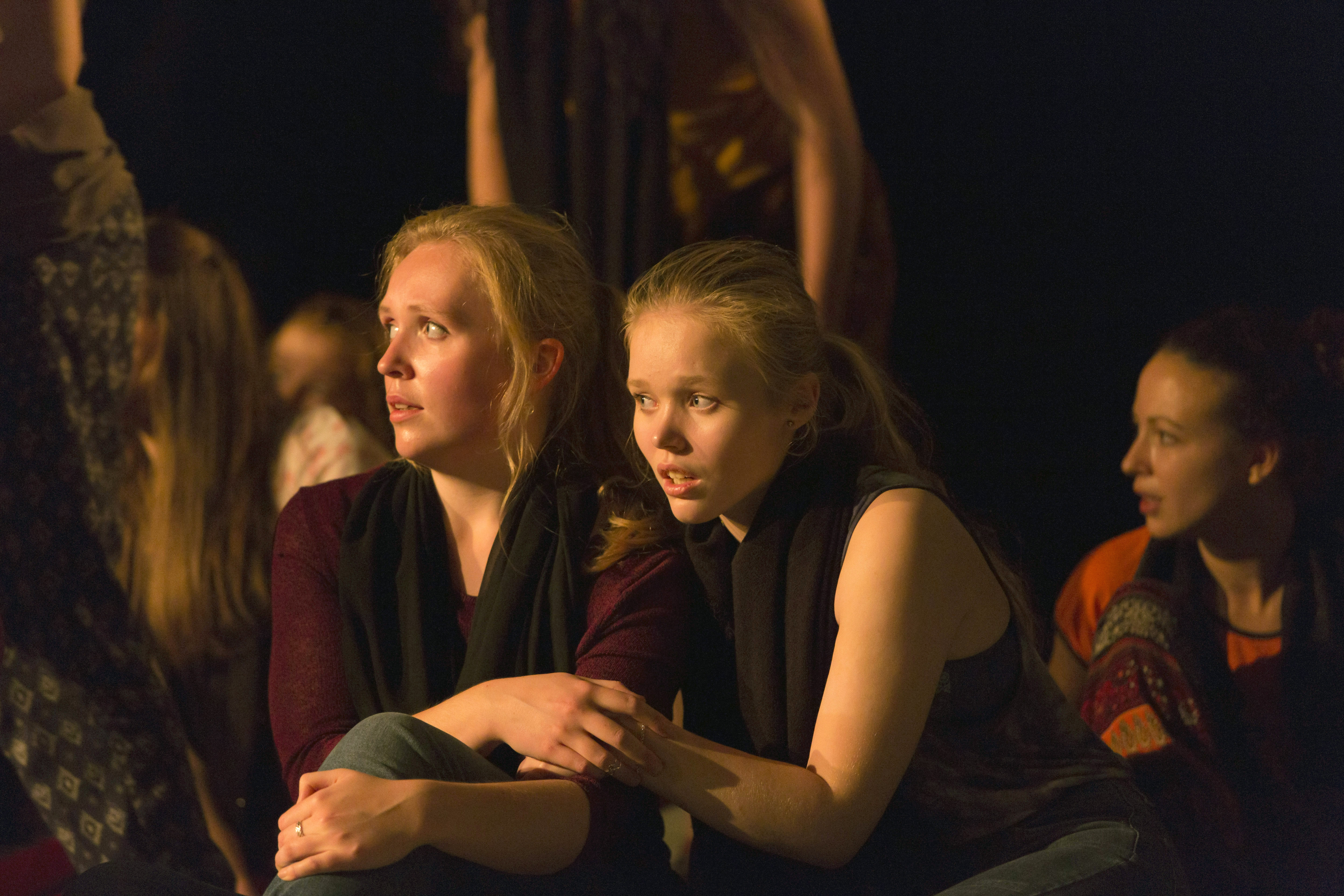
r. centre: Gemma May, Chorus Leader. Photos: Stephen Cummiskey.

r. centre: Gemma May, Chorus Leader.
Photos: Stephen Cummiskey.

“They do lovely huddled sounds of the night too, complete with sheep and Peloponnesian crickets.”

Editorial Rating: 4 Stars

Does it really come down to drink: a muscular Greek wine, £5.50 from Tesco say, against Egyptian small beer? Well, the libation was a full-bodied red and it went down a treat, all down the front of the stage in fact, and the bladdered sons of Aegyptos are repelled. The 50 refugee daughters of Danaus are safe in Argos – for now – protected by Zeus, the popular will, and by their father, whose clear head and savvy style suggests that he’s teetotal.

The Suppliant Women is heady, old theatre. Aeschylus wrote it for Athenians of his time (the demos of 500BC) and David Greig gives us his 90 minute version for our duty-free enfranchised time, when ‘border security’ matters and our leaders debate migrant quotas. Nevertheless and to its credit, as directed by Ramin Grey, this stays a civic piece, obliged to its community, retaining Aeschylus’ Chorus of (local) young women who seek asylum from forced marriage. It also – and very admirably – features original music by John Browne for percussion and aulos, single and double. What’s not to respect?

l.Imogen Rowe & Anna MacKennan, r.

l.Imogen Rowe & Anna MacKennan, r.

The Chorus is 36 determined volunteers from Edinburgh with a standout leader (Gemma May) and they have the angel’s share of the drama. The bare stage is all theirs, from top to bottom, side to side. It is sacred ground, a temple refuge supposedly, offering plenty of room for choreographed movement with some dance elements. Expert vocal direction from Stephen Deazley means that the devoted choral odes make sense and create their own rhythm and sway. They do lovely huddled sounds of the night too, complete with sheep and Peloponnesian crickets.

But still Father Danaus (Omar Ebrahim) presides. He is neat and conspicuous in black amongst the colourful mix of his daughters’ casual dress and his words are sage to the point, I thought, of being on a direct line to Zeus, which rather diminishes his daughters’ impressive praying. Pelasgos (Oscar Batterham), King of Argos, is the younger man and his sharp suit and tie speak ‘Lawmaker’. And, fair dues, he’s the one who has the job to do. How to convince his people to let these foreign women in? Sensitive. He pauses to consider the often terrible consequences of intervening in ‘another man’s war’ but, when in doubt and as quick as a Prime Minister in a jam, he decides: let the people vote … with some help from my silver tongue.

It is, actually, post-referenda, wildly familiar, if that’s not a paradox. The citizenry mistrusts authority, sees stitch-ups at its expense, and has faith only in the gods. Ah, but which god? And here’s where The Suppliant Women is mischievous and – in its modern semblance – a little muddled. For Aphrodite, she of lust and love, wants in on the act (and is in the cast photos of the suppliants, on p9 of the programme). If the women are saved from their Egyptian pursuers, why not – to honour the goddess – give themselves to their rescuers, the virile men of Argos? Father D, with an astonishing cherry metaphor, says “No, keep yourselves chaste”; whilst Zeus, ‘unknowable and unfathomable’, stays shtum. It is, at its stirring close, when the audience is face to face with Justice-For-Women, an appealing mash-up of the classic and the ballsy.

Star (blue)Star (blue)Star (blue)Star (blue)

Reviewer: Alan Brown(Seen 4 October)

Go to the Actors Touring Company  & The Suppliant Women

Visit Edinburgh49‘s The Lyceum archive.

Breaking the Ice (Traverse: 4-8 Oct ’16)

“[Why no] Danish pastries at a convention attended by the Danish?”

Editorial Rating: 3 Stars

The Arctic. Surrounded by seven of the world’s most prosperous and empire-building countries, and ripe for colonisation – if they can all agree on the best way to approach it. Breaking the Ice is set during The Arctic Council’s General Assembly 2016, where negotiations are to take place, and Frank, geologist and stand-in scientific advisor to the big dogs, is due to address the delegates upon the potential impacts of various courses of action. That’s if he manages to find his speech and get his suit dry-cleaned in time after spilling yogurt down it at breakfast.

From the opening few lines it’s clearly a comedy piece, with discussions into the lack of Danish pastries at a convention attended by the Danish and the merits of embossing on business cards, setting the tone somewhere between Dario Fo and Fawlty Towers. Steven McNicoll as Frank is a commanding and charismatic storyteller, and, dressed in a bath robe throughout (due to the yogurt debacle), can clearly be trusted to tell it as it is rather than giving any politico spin. He’s vulnerable, likeable, with a sense of being completely out of his depth but enjoying the ride anyway.

What’s disappointing though, is that as the play progresses (with kidnappings, arrests, and encounters with locals and lawyers), McNicoll’s tone and demeanour show very little variation or development, and by the time he finally gets to address the conference (late, and still in his bathrobe), he appears to be in no way affected by all that has gone before, approaching it as he would making a cup of tea. There is a distinct lack of build-up in tension towards the climax (which in itself fizzles into nothingness), meaning the whole thing feels a bit pointless.

That’s not to say the structure doesn’t facilitate a suspenseful build-up. Throughout his morning Frank encounters many different characters, all of whom have a different point of view on the conference and proposed developments, and all of whom try to persuade Frank to consider theirs when making his speech. It’s a great device to get these viewpoints across, but their rapidity, comic delivery and minimal effect on Frank make them seem like little more then neighbours passing comment about the Jones’s new car than individuals whose livelihoods are set to be deeply affected by the outcome of the conference. It doesn’t quite fit together.

McNicoll as Frank is certainly clear and engaging, if quite one-dimensional in his journey. Jimmy Chisholm is more impressive with his range of characters, creating strong contrasts to communicate the complexity of the situation, yet Nicola Roy’s more melodramatic style seems to be at odds with everything else on stage resulting in a bit of a mismatch in interpretation of the script and lack of consistency throughout.

While there are plentiful very witty lines, some of the dialogue seems quite forced in order to shoe-horn in the humour – in particular, a discussion into an environmental activist’s kidnapping prowess smacks of being thrown in for comic effect, given how little it adds to the overall piece. I spent much of this performance wishing they would just get on with it.

Ironically, Breaking the Ice does quite the opposite – merely skimming the surface of the debate into the economic and geological future of the Arctic, without ever prodding deep enough to build a strong connection with the issues to leave a lasting impression. Much like an iceberg, this production feels like there could be much more to it, but we’re not able to see it.

Star (blue)Star (blue)Star (blue)

Reviewer: Steve Griffin (Seen 4 October)

Visit the Traverse archive.

THIS REVIEW HAS NOT BEEN SUBEDITED

The Cheviot, the Stag and the Black, Black Oil (Lyceum: 14 – 24 Sept’16)

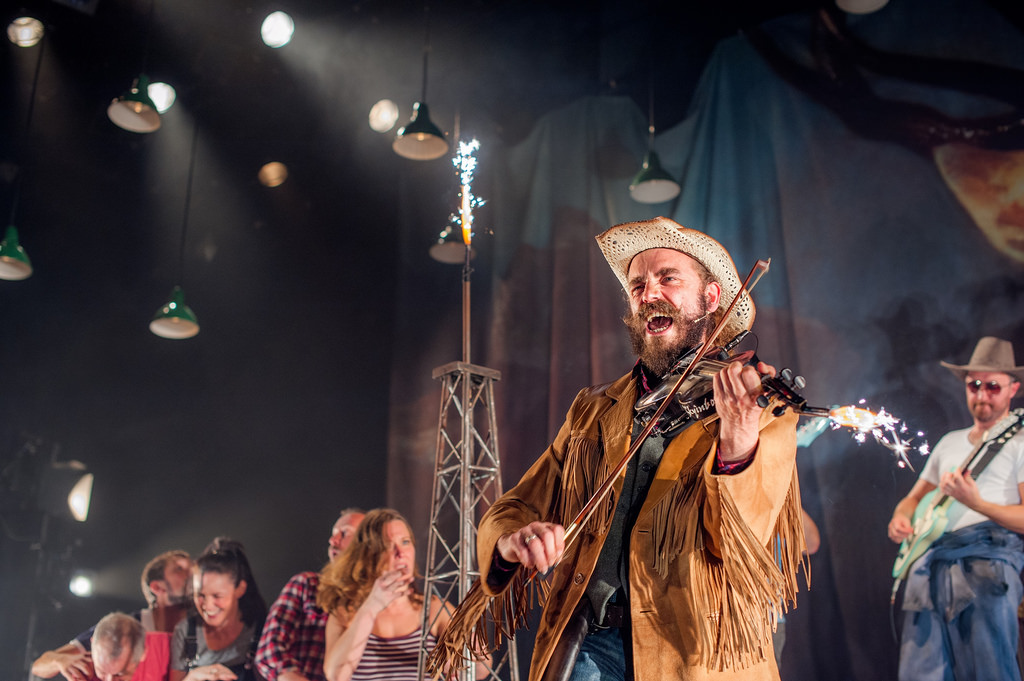
Alasdair Macrae, Musical Director, as Texas Jim . Photo:Tommy Ka-Gen Wan

Alasdair Macrae, Musical Director, as Texas Jim .
Photo:Tommy Ka-Gen Wan

“43 years of agitprop stardom”

Editorial Rating: 4 Stars: Outstanding

Popular entertainment is a broad church. It is entertaining (& mildly provocative) when the Union flag is raised above Craigmillar Castle, as it has been these past few days, and – to pursue a theme – there’s the BBC’s Scotland and the Battle for Britain to watch and absorb. And now, from 1973 but fresh from Dundee and fit as a fiddle, comes Tom McGrath’s fabled The Cheviot, the Stag, and the Black, Black Oil. From the off you’ll be singing These Are My Mountains and asking yersel, ‘And whose mountains are those, exactly?’

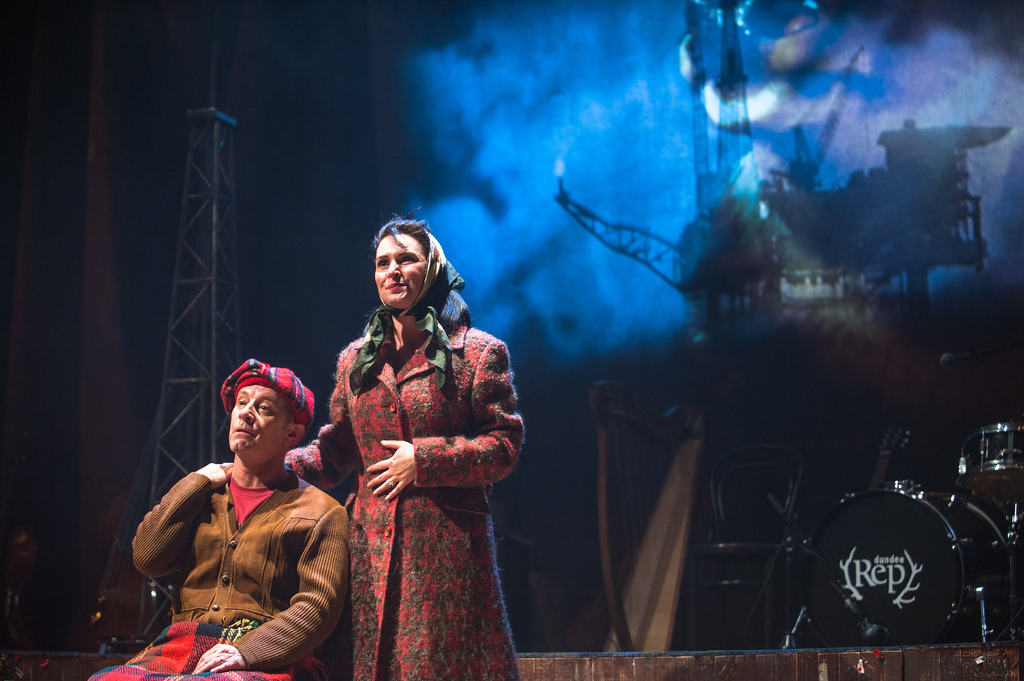
For this is about the land and of its people (& famously of the 7:84 theatre company that brought it across the land to the people). You don’t see the vans but you could just about pack up these actor musicians, their many costumes and their instruments, into two Ford Transits, with room to spare for model crofts, wee sheep, an oil derrick and some fancy digital kit. It’s all highly portable and hugely worth the telling – and the singing and the dancing. The staging, in the Lyceum space, does not lend itself to community theatre but this is still a barnstorming effort.

This is not Land Economy by ceilidh and clàrsach but it’s not far off, which is actually the point, because here’s the old story-on-stage, ingeniously played but plainly told, of the people of Sutherland and Ross-shire being expropriated and displaced by the forces of profit and loss. The sturdy Highlander cannot stand against the combined agency of absent landowner, factor, police and lots of sheep. In fact Porky Highlander (Stephen Bangs) doesn’t stand at all but takes prudent cover behind his women and shoogles off to Canada in a string vest. It’s much the same when it comes to the east coast and Aberdeen with oil, Texaco and Mobil, and company men; and now – to update our scene, as this production cleverly does – there’s the Trump International Golf Links and layoffs on the rigs. And what are the burghers of Edinburgh going to do about that? Hmm, sadly, probably not that much, but we can tap our feet to Texas Jim (Alasdair Macrae), laugh at Jo Freer’s turn as hideous property developer Andy McChuckemup, and wonder what on earth the ghillie (Calum MacDonald) is talking about, because his gaelic is way beyond our ken.

Barry Hunter & Jo Freer.

Barry Hunter & Jo Freer. Photo:Tommy Ka-Gen Wan

Director Joe Douglas plays the script for what it’s worth, which is still not devalued by 43 years of agitprop stardom. The humour is all there, from panto to banter, as is the braying English accent (Emily Winter, all tweed and Golly!) and ‘Land of Hope and Glory’ on kazoo. There is also the nastiness and the pity of it: evictions in the face of defiance and protest; loss and frailty; the dignity of labour forced down and out by ‘owners’ who monetise the works, from creel to North Sea platform. Irene Macdougall’s top hatted Loch is as villainous and intractable as her Announcer’s role is friendly and open.

It is a young Bill Paterson who, in the 1974 TV adaptation of The Cheviot, the Stag, and the Black, Black Oil, introduces the story of ‘What’s been happening here in the Highlands, a story that has a beginning, a middle, but as yet no end’. Well, conceivably, the Scottish Parliament and land reform might wrap it up, or the price of crude could do it, or – Whisht! – a second vote on independence, but for the time being Dundee Rep is bringing it on just fine.

(That Union Jack at Craigmillar Castle? Sony Pictures is filming Outlander there … )


outstanding

StarStarStarStar

Reviewer: Alan Brown (Seen 14 September)

Go to Dundee Rep and  the Lyceum

Visit Edinburgh49‘s The Lyceum  archive.

+3 Review: Ameé Smith – Relax, it’s not about you (Underbelly Med Quad: Aug 3 – 29: 15.00 : 1hr)

https://i0.wp.com/www.underbellyedinburgh.co.uk/images/uploads/15201-Ame_Smith_Relax_Its_Not_About_You.jpg

“Optimistic, off-the-wall and unapologetically human”

Editorial Rating: 4 Stars Outstanding

I try my best not to judge shows before they’re done. But, finding the queue as lonely as a tarantula’s birdcage, I confess to some trepidation as I waited for Ameé Smith’s “Relax, it’s not about you”. Shows with sub-dozen audiences can be tense at the best of times, and given the very personal nature of Smith’s themes, comedy’s need for reactivity and my own creeping paranoia about audience interaction, it seemed a bespoke recipe for awkwardness.

But, for once, it appears the mantra of the 2* performer rings true: the reviewer was dead wrong.

Who exactly “Relax, it’s not about you” is about could make for an excellent piece of theatre analysis – could be Smith’s ex’s, could be Smith herself; and, perhaps overarchingly, it could be about every person watching. Complete with examinations of toxic relationship types, explorations of what makes something TMI and confessions of Smith’s own foibles, “Relax, it’s not about you” is a frenetic, laugh-filled odyssey through the minefield that is interhuman relations.

Whilst it all might sound a bit metaphysical, it’s certainly entertaining. It’s somewhere between hearing stories from a drunk aunt and hanging out with an unlucky-in-love best friend: sometimes rambling ,sometimes short and sharp, and always cringingly self-aware. And whilst the occasional semantic meander leads to a dead-end, Smith seems to be an expert at winding back her own train of thought. And rest assured, despite the heavy premise, it’s a set with its fair share of laughs. You’ll never look at ceramic owls the same way again, and that’s a promise.

For such a blurry and ill-defined subject, it’s impressive how consistent the show feels for its duration. Smith’s nervy, almost fractious energy is a wonderful constant, even when presented with an audience of two. Never before have I seen a performer approach a nearly-empty house with such vigor. In truth, my greatest disappointment with this performance is that I never got to see how Smith would play off a full house. She is (fittingly and obviously) the greatest asset this show has, having cracked the comedian’s riddle of creating an obvious gulf of wit between her and the audience, whilst simultaneously closing it with an almost tactical show of real honesty and vulnerability.

This is perhaps the only time I’ve ever regretted that the jokey offer of a pint after the show was not capitalised upon, so enthralled I was with the sheer openness with which Smith presents herself. Even her dodgy guitar skills, though they open the show on a slightly jerky note, have their significance later. This is feel-good theatre, despite being based on one of the worst parts of romance.

This is a show which deserves far, far more than what I saw it receive. Ameé Smith has crafted a difficult and beautiful thing: a comedy show which thrives on universal truths, yet doesn’t claim to have any answers. And despite a few momentary stumbles, “Relax, it’s not about you” is exactly the kind of show that typifies the Edinburgh Fringe: optimistic, off-the-wall and unapologetically human. Ameé Smith isn’t making a show about you – but that doesn’t mean everyone shouldn’t see it.

outstanding

StarStarStarStar

Reviewer: Jacob Close (Seen 25 August)

Visit the Other archive.