The Belle’s Stratagem (Lyceum: 15 Feb. to 10 March ’18)

Angela Hardie as Laetitia.
Photo. Mihaela Bodlovic.

“Jaunty, diverting and quick. A noteworthy woman playwright is not short-changed”

Editorial Rating:  3 Stars Nae Bad

There was gleeful mention of the ‘shit wagon’ and of the reeking ‘Nor Loch’ but these early New Town characters keep their stockings a blinding white and the hems of their fancy gowns spotless. It’s that kind of play: a slight comedy of appearances. Or should that be ‘sleight’?

The Belle’s Stratagem is a jaunty piece, giddy even. Its leading man is Doricourt (Angus Miller), although he’s led by the nose, and he has ‘l’air enjoué’ of a chap with too many Air Miles and too many hours in Club class. Well, he would have, except this is 1788 when Gold Cards and guineas were more likely gifted by pedigree than work. He’s back in Edinburgh after his ‘Grand Tour’ of assorted lounges, demoiselles and signorinas and finds himself betrothed to Letitia (Angela Hardie), known almost from birth and now two years out of boarding school, and he’s not impressed. She, Letitia, is pissed at this – vulgarity clearly crossed Princes Street – and is determined to have her man love her or lose her. Meanwhile, Sir George Touchwood (32 and of the Jacob Rees-Mogg brigade, benign branch) is back in town with his lovely, guileless, wife, Lady Frances. Beware! Cad about, Courtall by name (geddit?), who will have the lady.

Tony Cownie has adapted Mrs Cowley’s Belle’s Stratagem of 1780 and removed the whole play to Scotland, aka that ‘subjugated bunch of hills north of Berwick’. Deacon Brodie is stealing about; Doricourt and the honourable Saville (John Kielty)  are soft Jacobites; Laetitia’s father is Edinburgh’s Provost and Laetitia (in disguise) wins Doricourt’s heart and the audience’s with an aching ‘Will ye no come back again?’ The best joke of the evening is Courtall’s as he goes off to France for an assignation with the Revolution.

Theatre history is all over this piece, if you look for it. The big brother of Cowley’s original has to be George Farquhar’s Beaux Stratagem from 1707. Farquhar had arrived in London in 1697 from Dublin’s wonderfully evocative Theatre Royal at Smock Alley. Cowley’s play opened at the Theatre Royal Covent Garden. Nicola Roy’s Kitty, a prostitute with a proper sense of what’s decent, would fit well into those dodgy streets. She’s the key to foiling Courtall’s foul intrigue. The two widows, Racket (Pauline Knowles) and Ogle (Roy, again) give lechery a good name by repeatedly calling out the hypocrisies of male behaviour but enjoy eyeing the men themselves.

Helen Mackay as Lady Frances and Grant O’Rourke as Sir Edward.
Photo: Mihaela Bodlovic

Historians place The Belle’s Stratagem at the endpoint of a period when the Comedy of Manners went bourgeois. Marriage and compatibility within a marriage become a pair and so enter Sir Edward and Lady Frances, who (for me) are more interesting and entertaining than an infatuated Doricourt and the infantile Laetitia of the first half and the minx Laetitia of the second. Grant O’Rourke plays the country squire (ok, laird) as if to the manor born. He’s a kind fellow, whose daft helplessness (check O’Rourke’s real comic quality in the Venetian Twins) rallies to the call of defending his wife. He ends up an endearing character and – a near no-no in the Restoration comedy of times past – a deserving husband. And Lady Frances (admirably done by Helen Mackay) is bold enough to love him true once she has established her own rights, which again is rather refreshing. The New Town will be all the better for their rectitude during their three months residence in town! Laetitia’s father, the Provost, is more typecast as the lookout for a wealthy son-in-law but Steven McNicoll gives the part considerable warmth and humanity, not least in a party dress.

There’s pretty music, dancing, a masquerade, numpty grumpy footmen, and squeaky clean, impressively silent Heriot Row facades but all the same I longed for some ruggedness, more spit and bite. The gossip columnist, Flutter, is played by an impish John Ramage and that gets close, but finally it’s light and undemanding. The ‘modern’ script is frequently diverting and quick, actors help it on enormously, and a noteworthy woman playwright is not short-changed, but the intrigue unwinds too rapidly and I found much of the humour either forced or slack.

nae bad_blue

Star (blue)Star (blue)Star (blue)

Reviewer: Alan Brown (Seen 21 February)

Go to The Belle’s Stratagem at the Lyceum

Visit Edinburgh49 at The Lyceum  archive.

RSNO: Steffens. Ionita (Usher Hall: 9 Feb.’18)

Image result for karl steffens conductor

Karl-Heinz Steffens

“This was as close to perfection as live performance gets”

Editorial Rating: 4 Stars: Outstanding


With Valentine’s Day approaching the RSNO presented a programme on Friday of overtly romantic music: Schumann, Elgar, and, yes, Britten. They were under the baton of Karl-Heinz Steffens, a conductor of a rising reputation throughout his native Germany and also Scandinavia, who proved himself more than worthy of the occasion.

This was a concert of two halves, the first entirely adequate, the second quite exceptional.

In the first piece, Britten’s An American Overture, the band was let down by the relatively poor quality of the music. Not a criticism I would usually level at this composer, but Britten did himself deny all memory or knowledge of the piece when it was discovered in 1972 (it was composed in 1941 as a commission) and had to be shown the manuscript in his own handwriting to prove its provenance. It remained unperformed for a further 11 years. With shades of Copland and even Bernstein, there were flashes of interest in an otherwise fairly monochrome piece. The orchestra played it well, including some very exposed parts early on and while grateful for my knowledge of the repertoire being expanded through the experience, I have no particular wish to hear it again.

Next up the  – Oh, so romantic! –  Schumann Cello Concerto in A minor. RSNO Artist In Residence Jan Vogler was ill (Boy, has this been a season for withdrawals in Edinburgh!) and BBC New Generation Artist and 2015 International Tchaikovsky prizewinner Andre Ionita gamely took his place. The quality of the performance grew as the piece developed, one wondering if Ionita was playing con sordino as the sound coming forth initially lacked the necessary volume, and orchestra and soloist seemed a little out of synch, hardly surprising given the last minute replacement. Nonetheless in the second movement Langsam Ionita’s playing matched the music better, and in the final movement he brought out the necessary volume. His pizzicato encore left no one in any doubt as to his technique.

And now to the piece that everybody, I guess, had come to hear: Elgar’s Symphony No 1 in A flat major. If ever a case could be made for discipline in art, this was it. It would have been so easy to produce a piece of crowd pleasing schmaltz, but the words that come to my mind when analysing Steffens’s fine conducting and the orchestra’s magnificent playing are control, timing, tautness, controlled expression. Steffens showed himself to be a master of tempi, holding back and letting forth the players time and time again, including the final build-up in the brass where no one put a foot wrong. The flutes (I had seen Principal Flute Katharine Bryan chatting relaxedly in the hospitality suite only minutes earlier) kicked off the famous nobilmente with complete aplomb. I heard the cor anglais part clearly for the first time ever, and we were wafted away by the joyous playing of two harps in the final movement. This was as close to perfection as live performance gets. For that magical fifty minutes the RSNO were a world class orchestra. Bravo!


outstanding

StarStarStarStar

Reviewer: Charles Stokes (Seen 9 February)

Go to the RSNO, Scotland’s National orchestra

Visit Edinburgh49 at the Usher Hall archive.

Bedfest 2018: Scotland the Bollocks (Bedlam: 23rd Jan.’18)

Design: EUTC.

If all history lessons were like this, I would know and understand a lot more of my country’s story

Editorial Rating: 4 Stars

 
 To explore the EUTC’s Bedlam Festival 2018, ‘BedFest‘, we decided to go along to see Ross Baillie’s stand-up routine Scotland the Bollocks, an enthusiastic rendition of stories (in)famous in Scottish history. 

Straight from the word go Baillie is genuine and entertaining, if slightly unorganized at times. He is alone on stage, although he always has his stage manager Huw Jones at hand to help him via a screen in the backgroundWhen Baillie gets a little confused or forgets what he is talking about next, Jones is quick to provide funny pictures, anecdotes and explanations.  

The atmosphere remained relaxed throughout as Baillie told exciting stories of Mary Queen of Scots and ….. of the Bank of England. He engaged with an audience that seemed shocked yet highly amused by his hilariously sarcastic outbursts and at times slightly inappropriate sense of humourI was quite happy as I was not sitting in the front row.  

Baillie questions our national identity as he explores the mishaps and (if this is what we can call it) the ‘series’ of very unfortunate events which have fallen upon Scotland since the beginning of history as we know it. His show is almost a mock Horrible History lesson mixed in with some modern jokes about Trump and Brexit. One of my favourite moments was a make-believe Twitter argument between famous people from the 18th century.  

At times I was unsure if Baillie was genuinely confused or if his disorganisation was indeed part of the act –  either way, although his performance could have been a little more polished, the show worked really well. If all history lessons were like this, I would know and understand a lot more of my country’s story.

Star (blue)Star (blue)Star (blue)Star (blue)

Reviewer: Iona Young (Seen 24 January)

 Go to EUTC, the Ediinburgh University Theatre Company

Visit Edinburgh49 at the Bedlam archive.

SCO: Ticciati. Atkins. Cargill. (Queen’s Hall: 11 January ’18)

Image result

Jean-Fery Rebel (1666-1747)

” A consummate synergy of soloist and orchestra.”

Editorial Rating: 4 Stars:  Nae Bad

Thursday’s 2018 Season opener by the Scottish Chamber Orchestra, “Chaos and Creation”, was one of the most creative, surprising and varied concert programmes that I have ever come across – with the exception of the Haydn. But more of that later.


Do you know Jean-Féry Rebel? No, he is not a rock star or DJ, but was a composer (1666-1747) at the French Court at the time of Louis XV and a favourite of Madame de Pompadour. He came of a dynasty of court musicians, lived a long and successful life and wrote Les Elemens at the age of 72. It is a most extraordinary piece, with a sort of full on slam-dunk opening that reminded me of Honegger, 250 years later. Special effects were very much the thing in European Baroque and we were treated to a bird warbler at the rear of the auditorium, a whoop whistle reminiscent of Oliver Postgate’s The Clangers, and a wonderful theorbo – basically an oversized lute – whose fretboard must have been at least four feet long. At times I thought I was listening to the soundtrack of The Magic Roundabout. Violin bodies were used as percussion, the conductor did a dance with the principal violist, and everyone had a good time. I never knew Baroque could be so much fun.


A darker form of intensity followed with principal violist Jane Atkins taking the solo spot in Martinu’s Rhapsody-Concerto for Viola and Orchestra (1951). She acquitted herself well, aided by her confident and lively persona. Although less celebrated now than his compatriot, Antonin Dvorak, Martinu was a successful composer and America took to him. The work is steeped in the Bohemian folksong style with a deep romanticism breaking away from his earlier neo-classical style. Atkins brought everything out of the work, producing rich melodic tones and light dance-like flashes that engaged us throughout. A consummate synergy of soloist and orchestra.


There was no let up in the treats Robin Ticciati and his band had in store for us after the interval. The Czech genre continued with Dvorak’s Biblical Songs. (1876). Scottish Mezzo Soprano Karen Cargill gave an assured and rewarding performance of the ten songs, commendably handling the Czech language without difficulty. Cargill has memorably sung Schoenberg’s Gurrelieder at the 2017 Proms with Sir Simon Rattle, and we were lucky to have her. I firmly believe this accomplished Mezzo, winner of the 2002 Kathleen Ferrier Award, to be on the verge of being one of the greatest Mezzos, and listening to her was a privilege.


The evening concluded with Haydn’s Symphony No. 96 (1791), wrongly called the Miracle Symphony for reasons we need not concern ourselves with here. Played with zest and not a hint of tiredness after a demanding programme, the orchestra acquitted itself well under Ticciati’s baton in this microcosm of Haydn’s symphonic genre, the first of his London Symphonies. But why it was included in the programme is open to question. It was  out of kilter with the other more esoteric works of the evening. Nonetheless it made an enjoyable finale.


nae bad_blue

Star (blue)Star (blue)Star (blue)Star (blue)

Reviewer: Charles Stokes (Seen 11 January)

Visit the SCO, the Scottish Chamber Orchestra

Go to Edinburgh49’s Queen’s Hall archive.

How To Disappear (Traverse: 8 -23 Dec.’17)

Owen Whitelaw, Robert, with Kirsty Mackay as Isla.
Image: Beth Chalmers.

“Help yourself to creative energy …”

Editorial Rating: 4 Stars Nae Bad


You don’t associate Elgin with hoodies, or Percy Pigs come to that. Go see Morna Pearson’s How To Disappear, however, and you will. The broad Doric may be less surprising and – at this time of year – why not put Narnia, downsized and upstage, through a cupboard in a bungalow?

If this sounds funny, it is, but it is not light-hearted. Far out, maybe. Imagine finding a squashed pot of Angel Delight in your Christmas stocking and you’re some way there. Or, because this is a play of alternatives, you’ve been given 2 DVDs: ‘I, Daniel Blake’ and ‘Room’. Great films but nonstarters in the Ho Ho Ho! stakes.

That’s a deliberate choice of films, of course. Robert, 28, lives on benefits that the Department of Work and Pensions wants to relieve him of. He has not left his room for twelve years, near enough. He has not been outside since he was eight. In the absence of their parents his kid sister, Isla (14-ish) looks after him as best she can, so it helps when she is excluded from school. A benefits assessor, Jessica, has come to ask Robert some questions.

But that’s barely the half of it. There’s a glowing blue portal and a stage revolve to expose the full story. Exactly when it turns is, for the audience, quite exciting; for Robert it’s an obsessional, skin picking quest, but for his pet tarantula it’s an unfortunate accident; and for Jessica it’s spew and ‘Wow!’ all the way.

Help yourself to creative energy then. Certainly Robert does. Copies of ‘New Scientist’ are stacked up against the walls so there’s not much space for him to move around and check his various alarm clocks but this is one clever ‘mannie’ who – all innocent of the metaphor  – dumps his benefits assessment into his bedpan. Owen Whitelaw is excellent in what could be a raw and painful role but is actually agile and sympathetic. His sister, Isla, is more aware, more aggrieved and angrier with what – on the face of it – is a distressing existence. Kirsty Mackay has that awkward dual role as ‘adult’ carer and S4 pupil who is still getting mercilessly bullied at school. (Note for school Guidance staff – you get a mouthful). Jessica (Sally Reid) is a paper shuffling caricature to some extent but with Robert as her ‘client’ is happily saved.

There is redemption here, which is good for a Christmas production. It’s in the near constant humour for one thing and in the marvellous sense of release, of stepping out of the room that comes at the end. But it’s not an easy given and director Gareth Nicholls keeps the action pretty edgy, using plunging lighting effects (exemplary from Kai Fischer) and sound from Michael John McCarthy that begins, it seemed to me, with a nod to ‘Big Country’ and then funnels down to close in on Becky Minto’s box frame of a set.

We need plays with moral outreach and How To Disappear is definitely out there to bring us in. We’re with Robert because he wants to help his father be with his mother, which is where the plot line folds into the mystic portal and you wonder where you are. Just hang on to the fact that he shares his Milky Way with his sister. We’re with Isla because she won’t get lost and hangs onto her brother because she loves him. We’re even with Jessica because she too is a strung out case who does what she can to help people and, like Robert, she loves the ‘Hot Tub Time Machine’, which says it all really.

Star ratings get done over in the wash in this one: 3, 4, 3, 4 … ?

Isla         ‘D’you kain whit number the washin machine goes on at?

Robert  Nut.

By the end, it’s 4* from me for an original and entertaining play. Fabric conditioner for the soul!

nae bad_blue

Star (blue)Star (blue)Star (blue)Star (blue)

Reviewer: Alan Brown (Seen 8 December)

Go to How To Disappear at the Traverse

Visit Edinburgh49 at the Traverse archive.

Oliver! (Pleasance Theatre: 28 Nov-2 Dec ’17)

1 press

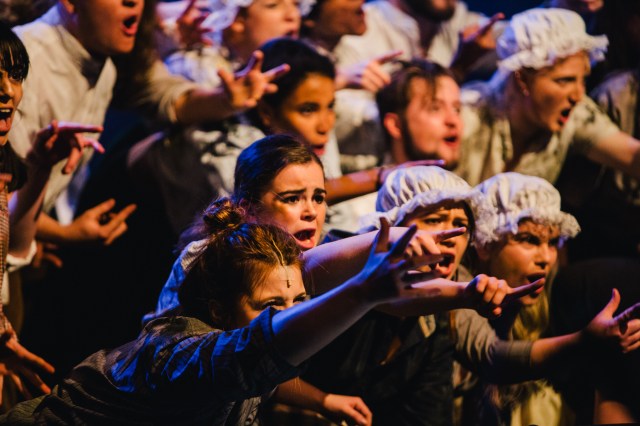
Cast of Oliver! Photo by Andrew Perry.

“FSELRES_382c628d-c6dd-48a3-859b-dfb8d567e430SELRES_d4a5f1dc-f027-48ef-8ada-6aca7f57b286SELRES_d0508c34-80ff-4d1c-9452-b9a4c366ffeaSELRES_007f217a-44d6-4932-8fa1-3d14d5861ee5FFull of EUSOG’s trademark heart and powerful vocalsSELRES_007f217a-44d6-4932-8fa1-3d14d5861ee5SELRES_d0508c34-80ff-4d1c-9452-b9a4c366ffeaSELRES_d4a5f1dc-f027-48ef-8ada-6aca7f57b286SELRES_382c628d-c6dd-48a3-859b-dfb8d567e430

Editorial Rating: 4 Stars: Nae Bad

Lionel Bart’s classic musical, Oliver! is an iconic story of cruelty, deceit and murder set in Victorian London, and features some of the best-known songs in musical theatre. Edinburgh University Savoy Opera Group (EUSOG) first performed this show in 1988, and almost 30 years on they’re back with a fresh, youthful take on the traditional tale.

While some of the company’s creative and casting choices in this revival absolutely do work in keeping the show relevant to today’s young people, unfortunately others are over-reached and not as well realised. Early on, the choreography and staging seem unnecessarily stompy and frantic, while some of the fight and chase scenes come across as a little under-rehearsed and clumsy.

But let’s start with the positives, of which there are many. In no particular order, Grace Dickson’s Nancy is a real highlight of the show, and her human, emotive rendition of As Long As He Needs Me deservedly gets the biggest cheer of the night. Rebecca Waites shines as Charlie with terrific energy throughout, and Ashleigh More is also excellent as the Artful Dodger, with a commanding stage presence and exquisite voice and physicality. In fact, the whole Consider Yourself scene More leads is the first where everything – choreography, vocals and direction – really falls into place to present the kind of show-stopping number that EUSOG are so good at.

What student productions – and EUSOG in particular – also tend to do very well is unearthing a script’s hidden comedy, especially with smaller characters. In this production, Kirsten Millar stands out as the Sowerberrys’ maid, Charlotte, bringing life and humour to each of her scenes, while Richard Blaquiere gives a hilarious geeky awkwardness to the role of Mr Bumble. Ewan Bruce as Mr Brownlow and Niamh Higgins as Mrs Bedwin also deserve a special mention for bringing a sense of calm maturity and experience to their older characters – a pleasant contrast from the energy of some of the other scenes.

In addition to casting females in some of the other main parts, EUSOG also opt for a female Fagin, which, unfortunately doesn’t prove as successful. Kathryn Salmond certainly gives it her all in this challenging role, though the songs (in particular You’ve Got To Pick A Pocket or Two) are very low in her register, meaning a lot this character’s authority is lost and at times it’s a struggle to follow the dialogue. I almost wish the company had gone one step further to make Fagin a female character to see what dynamic that would bring to proceedings. Yann Davies pleases in the title role with a purity and innocence to his voice, though something about the way this show is put together makes it seem like the character of Oliver is almost a bit part – his presence often gets lost in among everything else going on on stage.

Overall this show is full of EUSOG’s trademark heart and powerful vocals, with some wonderful individual performances, but lacks some polish and pace to be a truly spectacular production.

nae bad_blue

Star (blue)Star (blue)Star (blue)Star (blue)

Reviewer: Steve Griffin (Seen 29 November)

Visit the Pleasance, Potterrow & Teviot archive.

THIS REVIEW HAS NOT BEEN SUBEDITED


Pomona (Summerhall: 21 -25 November ’17)

Oliver Beaumont as Zeppo, Lauren Robinson as Ollie & (masked) Eilidh Northridge as Keaton
Photography by Andrew Perry.

“Provokes incredulity, fascination, and applause”

Editorial Rating:  4 Stars:  Nae Bad

It’s brownfield land with serious history in central Manchester. It’s a Metrolink tram stop. It’s also Alistair McDowall’s award winning play set in a ‘hole in the middle of the city’ – ‘hole’ as in a rank pit. Pomona (2014) provokes incredulity, fascination, and applause. Without the applause you’d have a WTF play, so it’s a risky business doing this one.

All credit, therefore, to Edinburgh University’s Theatre Paradok for taking Pomona on and finding the perfect venue in Summerhall’s Demonstration Room. The fairy lights on the approach are a fortuitous joke. Little could be less seasonal than the bare grey walls, tiered wooden seating, electrical trunking and peeling paint. As the play requires a ‘concrete island’ in amongst ‘cracked asphalt and weeds’ we’re all set. Not forgetting the open box of cold chicken nuggets and the octopus monster mask.

Ollie (Lauren Robinson) meets zany Zeppo (Oliver Beaumont at stunning top speed). They could be at the tram stop. You might consider a post-apocalyptic situation, with The Road re-surfaced as the M60 Ring, but, no, property is still owned – much of it by Zeppo – and there’s odd but respectful mention of the police. Still, Ollie does not want police help to find her sister. Directions to the likeliest neighbourhood will do. That’ll be to creepy Pomona Strand then.

Indirection more like. For the play twists and turns and the different characters come and go within a looping time frame. Rubik cubes befuddle and provide a handy metaphor for the mixed-up story. It is puzzling but it is doable. There’s Moe (Liam Bradbury) who has had it with people, mainly because he beats them up for a living. There’s Fay (Abi Ahmadzadeh), a sex worker, whose husband hurt her and their child. Moe and Fay share a rare tender moment. Then Fay steals a laptop and valuable data from overseer Gale (Megan Lambie), but it’s all to the good, despite the ‘Kill’ order on Fay’s head. One figure, Keaton (Eilidh Northridge), seems to have the presence to sort it all out but she could just as well be a character out of Charlie’s (Tom Hindle) role playing game box. Charlie really is a bit of a droll card, complete with wacky, sticky fantasy and roaring daftness as and when the dice roll. Zeppo’s back at the close, but this time as a vengeful seagull.

For all his interest in, and skill at, spiel and character McDowall does supply an explanation of what’s going on inside the security fence on the ‘island’ and it’s gross and melodramatic and sensibly left unexplored; no doubt contributing to Moe’s feeling that he’s ‘drowning in an ocean of piss’.

Pomona is fitful and outlandish with no comfortable ‘Home’ for Ollie to navigate to, which very probably explains its appeal to a student audience, who loved its waywardness. Tom Whiston, Director, and Madeleine Flint, Movement Director, work the play with a stylish and disciplined assurance that is easy to underestimate and the cast respond in kind. Personally, I’d rather have Springsteen’s Darkness on the Edge of Town as music to leave by but that was 1978 and students have moved onto more uncertain and contemporary ground. Go occupy.


nae bad_blue

Star (blue)Star (blue)Star (blue)Star (blue)

Reviewer: Alan Brown (Seen 22 November)

Go to Theatre Paradok on Facebook

Visit Edinburgh49 at the Summerhall  archive.

Edinburgh Quartet: Queen’s Hall (12 Nov.’17)

Image result for kamila stosslova

Janacek’s “Intimate Letters’  to Kamila Stosslova

“The Edinburgh Quartet go on tour to all four points of the compass, to build lasting relationships with communities in the North, South, East and West of Scotland”

Editorial Rating: 4 Stars


I have not reviewed the Edinburgh Quartet since March when they played a combination of Mozart, Beethoven and Shostakovich as part of their “Revolution” series. They have been busy since, including a fascinating mixed media “Dance” performance reviewed in June by my colleague Steve Griffin. The Quartet are not a conventional, formal concert giving band, and have a clear market and music focus: different themes for every season, and outreach to the local community, including incorporating artists, makars, dancers, and, tonight, student musicians. Sunday’s 3pm matinee was one of only a few conventional concert hall offerings this season. Otherwise there are rush hour concerts, lunchtime concerts, free concerts and concerts all over Scotland including as far afield as Lerwick. It is almost as if ‘Edinburgh’ is a misnomer. Their publicity rightly states that “the Edinburgh Quartet go on tour to all four points of the compass, to build lasting relationships with communities in the North, South, East and West of Scotland”.  They are a quartet for the nation.

With this creative and outward looking disrespect for inertia we also have had change in the line up almost to the point of it being a band of session musicians, Mark Bailey on cello apart. This does not trouble the band, and nor should it us. The vacant seats give an opportunity for up and coming musicians to try out their playing in a quartet as opposed to an orchestra or solo role, and it brings something new for each concert, where all the different line-ups I have reviewed deliver a surprising homogeneity.

Yet the move from homogeneity to synergy requires players in total empathy with one another and second guessing them, often for years, which is why great quartets are always better than star studded put-together ensembles.  Only the first violin seat remains to be filled, probably, I understand in the New Year. On balance, this is to be welcomed.

The programme took us from Haydn, through Tchaikovsky and Janacek to a new work by Scottish composer Tom Harrold.

Haydn’s String Quartet in F minor Op 20 No5 is part of his ‘Sun’ series, but this stupid name, based on a cover illustration, belies an austere work that is satisfying rather than uplifting. It was competently and confidently played.

The Janacek String Quartet No 2 “Intimate Letters’ was written 150 years later (1772, 1927 respectively) and in style probably quite demanding for the largely elderly Sunday afternoon audience. Written in the last year of Janacek’s life it reflects upon the woman for whom he fell head over heels, Kamila Stosslova, nearly 40 years his junior and to whom he wrote over 1000 letters, 300 in his last eighteen months*.   Certainly all manner of feeling was in this work, amounting to a conviction piece that, while not easy listening by any stretch, was as rewarding as it was demanding. That the relationship was reciprocated only platonically no doubt contributed to his and the music’s angst. The Quartet despatched its considerable demands with ease. So much so that when the work stopped in order for second violin Tom Hankey to return to the anteroom to pick up the rest of his music nobody minded, such is the quartet’s informal rapport with their audience.

Following the interval the quartet was joined with a “shadow” quartet of students from St Mary’s Music School: Briona Mannion and Marie-Sophie Baumgartner on violin, Rachel Spence and Finn Mannion on viola and cello respectively. They were playing the world premiere of Tom Harrold’s short piece “Elegy”. Harrold described the work as simple but the timings were very difficult (and which the shadow quartet managed very well) and there was a considerable amount of pizzicato to handle. Intensely quiet at the opening the piece developed into a pleasing, romantic work in the modern vein.

The evening ended with Tchaikovsky’s String Quartet No 2 in F, Op 22, a great, classical work relatively unknown outside of the musical world, for being within the chamber music genre, I suspect. Contrast it with the hugely popular Piano Concerto No 1 in B flat minor, Op 23. Both have the honour of being dismissed by Rubenstein: the Quartet “not really chamber music”, and the “Concerto “unplayable” It took considerable reserves of energy and musicality to deliver a work of this substance at the end of a long but engrossing Sunday afternoon. The elusive first violin seat was on this night guested by Nicolas Dupont from Belgium. He had most of the heavy lifting to do, ably supported by his colleagues. Whoever takes the first violin seat permanently has a lot to live up to.


***********

 * For those who want to know more about this extraordinary 11 year ‘non romance’ I recommend “Notes for a Hausfrau: Intimate Letters: Leos Janacek to Kamila Stosslova”, edited and translated by John Tyrell and published by Faber in 1994 at £25.  It may be out of print, so go to the excellent review in the Independent by Michael White that gives the gist of this extraordinary muse:  http://www.independent.co.uk/arts-entertainment/book-review-notes-fof-a-hausfrau-intimaye-letters-leos-janacek-to-kamila-stooslove-ed-trs-hohn-1410383.html


Star (blue)Star (blue)Star (blue)Star (blue)

Reviewer: Charles Stokes (Seen 12 November)

Go to the Edinburgh Quartet

Visit Edinburgh49 at the Queen’s Hall archive.

RSNO: Gomez, Sunwoo (Usher Hall:10 Nov.’17)

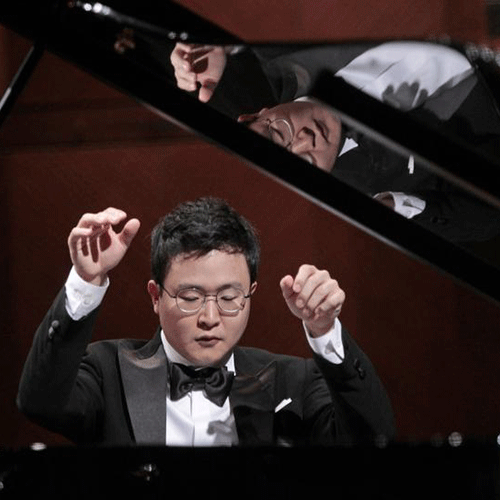
Yekwon Sunwoo
Photo: Philadelphia Chamber Music Society

“Sunwoo’s opening was utterly assured in its relaxed confidence, disposing of the keys with easy liquidity so that we were leaning forward in our seats to capture every nuance of interpretation”

Editorial Rating:  5 Stars Outstanding


I have written before of the RSNO’s skill in concert programming, often successfully juxtaposing contrasting yet somehow complementary works. Friday’s concert was to be a full blown Romantic affair in the Russian 20th century genre starting with the exquisite and rarely performed Vocalise, but, alas, illness, so common in the concert world at this time of the year, forced a programme and artist change. No Vocalise. Instead, we got Zulu, by British composer Daniel Kidane (b.1986). Quite a change.


Yet after the initial upset there was no room for disappointment. Jose Luis Gomez stood in for the indisposed Christian Macelaru at the last minute and arrived from America with a score of the symphony in his pocket. “Who doesn’t travel with Shostakovich 12?” His credentials were impressive, Assistant to Paavo Jarvi at the Frankfurt Radio Symphony Orchestra and in 2010 winner of First Prize in the Solti Conducting Competition. Currently he is Music Director of the Tucson Symphony Orchestra.


Prize winning credentials were also the order of the day for piano soloist Yekwon Sunwoo, prizewinner at the 2017 Van Cliburn International Piano Competition, and the programme change from Rach 2 to Rach 3 was in fact a welcome change from the much played second concerto to its slightly less well known, but in every other way equal sibling.


So on to the playing. Zulu was five minutes of noise. Enthusiastic brass playing, well orchestrated, good rhythm and momentum. Composer Daniel Kidane has studied at the Royal Northern, Royal College and privately at St Petersburg. The work was chosen from his participation in the RSNOs Composers’ Hub. It was a conceptual stretch to include it in the programme, but it made for a lively opening.


Next up was Rachmaninov’s Piano Concerto No 3 in D minor. I have seldom heard this work played so well, certainly not in the hands of a 21 year old. Sunwoo’s opening was utterly assured in its relaxed confidence, disposing of the keys with easy liquidity so that we were leaning forward in our seats to capture every nuance of interpretation. As the first movement Allegro ma non tanto developed so did Sunwoo’s attack, holding nothing back yet stopping way short of pastiche. You do not have to wear Rachmaninov on your sleeve to get the best out of of it. The RSNO accompanied him with playing that was glorious in its phrasing and intensity. The work has long solo and barely accompanied passages, not exactly cadenzas, but close. Time and again Sunwoo nursed and coaxed freshness of interpretation from this well known, much loved piece. Notwithstanding 45 minutes of bravura playing we were treated to an encore. The quiet and restful interpretation of Tchaikovsky’s Autumn Song from the Seasons lasted a full five minutes bringing the dramatic first half of the evening to a relaxing, introspective close. If you don’t know it, find it here on You Tube.


The second part of the evening was an assured, storming interpretation of Shostakovich’s 12th Symphony The Year 1917. Written in 1961 when Shostakovich was still not out of the political woods it is obviously a political work but without taking anything away from its inherent musicality. “Revolutionary Petrograd” started with typically haunting, bleak cellos and basses suggesting barren topographical (and political) landscapes full of desolation and foreboding before being joined by the upper strings in a more purposeful and positive timbre. Played continuously for 40 minutes the demanding work gave the whole orchestra, from expertly played woodwind soloists to stunning percussion, the opportunity to give the best possible account of themselves, which they did. The work built up though tableaux such as “Razliv” (Lenin’s revolutionary headquarters), “Aurora” (the battleship that fired the opening shots of the Bolshevik coup) and, finally the optimistically named “Dawn of Humanity” which was at least in musical terms a summation of all the themes that had gone before, and gave the orchestra the opportunity to demonstrate fluent, assured playing that whilst on occasions very loud, was never forced.


I have often said that one of the reasons live music is so exciting is the risk of failure. Here we had a last minute change of two out of the three pieces in the programme and a conductor no one had met or played under before the previous day. The result? Perhaps the most exciting and enjoyable concert I have been to this year. The RSNO continues to improve and impress


StarStarStarStarStar

Reviewer: Charles Stokes (Seen 10 November)

Go to the RSNO, Scotland’s National Orchestra

Visit Edinburgh49 at the Usher Hall archive.

RSNO: Oundijan; Vogler; Wang. Usher Hall. 3 Nov.’17

Related image

Jan Vogler

“Great if you like twelve-tone. Not so great if you don’t”

Editorial Rating:  4 Stars


Combined concerti for violin and cello are relatively rare, and on Friday at the Usher Hall we got two, separated in composition by 128 years. Such was the nature of the new work, however, that it was more like a comparison of the Viennese Salon of the 1890s and the 1930s’ Second Viennese School.


As is his custom, conductor and Director of Music Peter Oundjian gave us an introductory talk alongside cello soloist and this year’s Artist in Residence Jan Vogler. Not unreasonably, the majority of the talk was about the UK premiered work Duo Concerto by Wolfgang Rihm. Rihm was born in 1952 in Karlsruhe and is a professor of composition at the University of Music there. The work was commissioned by the Friends of Dresden Music Foundation to celebrate ten years since the reopening of the Frauenkirche and received its world premiere in Purchase, NY and in Europe in Dresden in 2015. It was written for performance by Vogler and tonight’s violin soloist, Mira Wang. Vogel’s association with the work, and his being the orchestra’s Artist In Residence, explains its choice on tonight’s programme in addition to its legitimacy as a composition.


The work lasts for 25 minutes in one movement. The soloists are in play almost the entire time, and the work has a heavy texture and is written in the twelve-tone technique. “Great if you like twelve-tone”, said Vogler. “Not so great if you don’t”. The work in fact had momentum, good orchestration, and a particularly demanding part for violin soloist Mira Wang. It was, perhaps, down to the limitations of twelve tone that it sounded remarkably similar to Schoenberg albeit composed seventy years later.


Our hardworking soloists carried straight on into the Brahms Double Concerto in A minor. Brahms is the master of melody, and we were into a glorious cello theme just four bars in. Whereas Wang did most of the heavy lifting in the Rihm, this work was Vogel’s and in fact a case could be made for writing out the violin part altogether, taking nothing away from Wang’s fine playing and   interplaying with Vogel beautifully when the score allowed it. The orchestra played with excellent phrasing and balance and were clearly very comfortable in their skin, supporting the soloists with all effortlessly harmonised under Oundjian’s baton.


After the interval we returned for Beethoven’s Symphony No 6 in F major, the ‘Pastoral’. What can a music writer add to the reams that have already been written about this glorious work? Well, you could feel the hall relax as we snuggled into this closing number, the orchestra were on top form, fully rehearsed and sure of foot, and familiarity did not disappoint. One notable difference in interpretation were the strings playing of the first subject in the final movement (Shepherd’s Song), Oundjian holding them back just a little so we could hear more of the supporting wind. He bought them back to the fore before the finale.


And did you know the Shepherd’s Song was used as music in the TV commercial for Lentheric’s Tweed fragrance in the 1960s? Now, you will find that degree of historical research only in Edinburgh49.


Star (blue)Star (blue)Star (blue)Star (blue)

Reviewd by Charles Stokes (Seen 3 November)

Go to the RSNO, Scotland’s National Orchestra

Visit Edinburgh49 at the Usher Hall archive.