RSNO: BENEDETTI & OUNDJIAN (Usher Hall: 18 March ’16

“Full on enthusiasm, lightness of touch and an abundance of joy”

Editorial Rating:  5 Stars Outstanding.

It was a bit like getting ready to hear Mahler’s Eighth Symphony, The Symphony of a Thousand. For there were musicians, and musical instruments, seemingly everywhere. Six timpani, two bass drums, two harps, five French horns, a bass tuba, and I reckoned a hundred young choristers, all dressed in black, sitting neatly at the back. Clearly we were in for quite a show.

And it was a show full of contrasts, spaced over almost 200 years of composition, yet all compellingly complementary. The beautiful austerity of James MacMillan; the lush, joyful optimism of Hector Berlioz; and the intense twentieth century romanticism of Karyl Szymanowski.

Sir Kenneth MacMillan’s Little Mass for children’s chorus was “little” only in the sense of limiting itself to the Kyrie, Sanctus and Agnus Dei and scoring it for young voices. It is a work of substance, first performed in Liverpool almost a year ago and premiered in Scotland with us. A piece of some drama: ghoulish, austere, dissonant and utterly beautiful. Undoubtedly a difficult work to perform, the RSNO Junior Chorus gave an excellent account of themselves in a composition many senior choirs would struggle with. Difficult intonations, tricky entries and fiercely challenging harmonies were sung with confidence and precision, with the cherry on top of the composer coming on to the platform to receive the applause and rightly point to the choir’s laudable achievement. Promising start.

A few minutes later on came Scotland’s musical sweetheart, Nicola Benedetti, resplendent in what looked like a Dolce and Gabbana figure-hugging long black dress with signature cascading curls hairstyle. It is a credit to her playing that one soon forgot such superficial accoutrements. Szymanowski and Benedetti have history, of the good kind. His first violin concerto was the piece that won her Young Musician of the Year in 2004 and her recording premiere for Deutsche Grammophon a year later. Tonight we heard her play the second concerto, a more complex work with a lot of writing in the higher register. Benedetti gave it everything and we got it all back. The young woman combines a phenomenal technique with extraordinary feeling; her 1717 ‘Gariel’ Stradivari more than responding to what she asked of it as it approaches its 300th birthday. Szymanowski’s intelligent and well-rounded orchestration gave the band ample opportunity to support and interplay with the solo part in this break-less twenty-five minute piece in the twentieth century romantic genre. Fine playing throughout. Kindly, this young woman who has absolutely no side, treated us to a Bach sarabande for an encore, considerately thanking us for our applause and announcing what she was going to play.

There is often a slight feeling of flatness as one dutifully returns to the auditorium for the second, usually symphonic part of the programme after the glamour and fireworks of the soloist and concerto have gone. Peter Oundjian and the RSNO were having none of this and brought Berlioz’s Symphonie Fantastique to light in a way that I have rarely heard it played, with full on enthusiasm, lightness of touch and an abundance of joy. More a symphonic poem than a symphony, there is a danger of the brass dominating, but Oudjian let everybody have their say: a beautiful intertwining of a very exposed but very well played cor anglais and timpani in the third movement; glorious, roaring brass in the fourth, and almost a fairground cacophony in the final fifth movement, the strings being given their head and the conductor, who one felt was liberating rather than directing the orchestra, ensuring balance, never vulgarity, and not once committing the cardinal sin of “looking encouragingly at the brass”. We left the auditorium chuckling.

StarStarStarStarStar

Reviewer: Charles Stokes (Seen 18 March)

Go to RSNO & Season 2016- 17

Visit Edinburgh49‘s Usher Hall archive.
Legally Blonde: The Musical (King’s: 16 – 19 March, ’16)

“Catchy songs, big dance numbers and laughs a-plenty”

Editorial Rating: 4 Stars: Nae Bad

For those who know the film, the premise of the musical is almost exactly identical – blonde bombshell and fashionista Elle Woods from Malibu, California is determined to bag her man, so she buries her head in books and chases him to Harvard law school in the hope of impressing him. The accompanying score is very poppy and upbeat, and while not to my personal taste, even the sternest of faces can’t help but bop along with some of the numbers.

On the whole, local troupe the Bohemians Lyrics Opera Company handle this big production very well – with some impressive dance routines and real powerhouse vocals throughout. The mind boggles at some of the quick changes performed, especially those done on stage, so credit where credit’s due for the risk and professionalism to carry those off. At times, particularly in Whipped into Shape, the performance felt a little flat and a stretch too far for this amateur group – perhaps a bit of shakiness on opening night or not quite having the musical tempos nailed – but otherwise it’s very well rehearsed and full of personality.

Lydia Carrington gives it her all as leading legal lady Elle Woods, and shines with fantastic energy and likeability. Her spirit never falters throughout – impressive considering she is barely ever off stage – and she shows great range and versatility to reflect the changing mood in each scene. However, it’s Lyndsey McGhee as Paulette who raises the biggest cheer of the night with the very moving Ireland (watch out for that towards the end of Act 1). Her voice is deep, rich and she delivers a knockout performance. It’s a shame we don’t get to see more of her throughout the show.

While the leads very much hold their own throughout the performance, for me it is some of the cameo roles that make this production really enjoyable: Ross Stewart is eminently watchable as UPS guy Kyle, while Sam Eastop and Andrew Knox make a great comic pairing in Gay or European. And of course, there are dogs. Scene-stealing dogs. You have been warned…

Yes it’s cheesy, yes it’s American, and yes at times it’s a bit ridiculous, but it’s also a show full of catchy songs, big dance numbers and laughs a-plenty (my favourite line being “I see dead people” in relation to the rather bizarre inclusion of a Greek chorus). If you like the sound of all that then you’ll love this production.

nae bad_blue

Star (blue)Star (blue)Star (blue)Star (blue)

Reviewer: Steve Griffin (Seen 16 March)

Visit the King’s Theatre archive.

THIS REVIEW HAS NOT BEEN SUBEDITED

SCO: IBRAGIMOVA & KRIVINE (Usher Hall 10 March ’16)

“I commend the SCO for their daring and committed performance tonight”

Editorial Rating: 3 stars


Thursday’s concert at the Usher Hall was designed to please, and did not fail. Mendelsohn’s Overture The Hebrides, Schumann’s Violin Concerto in D minor and Brahms’s Fourth Symphony span fifty years of the nineteenth century European Romantic genre and are all immensely satisfying upon the ear.

Yet when we talk of the Romantic genre we must not deceive ourselves with Batt-like portraits of composers gaining inspiration in the coffee house or at their desk by candlelight. These works are often borne out of insecurity and fear.

The Hebrides is really a tone poem in miniature, better known to us oldies as Fingal’s Cave, a short boat trip from Mull if you are interested. Mendelssohn struggled reconciling sonata form with tone painting, and wrote of the work as “the whole so-called development smells more of counterpoint than of blubber, gulls and salted cod”. In fact you would have to be an analytical cynic to agree with him, for it is a live, refreshing work and the SCO despatched it well.

Schumann’s Violin Concerto was also a cause of grief to its composer, who never heard it performed orchestrally. Swiftly composed in but thirteen days it was to languish for 125 years before its entry into the oeuvre after a series of family, political and technical issues. While fitting squarely into the romantic genre, and being a work of substance, it is nonetheless not without its problems. The first movement gives us soloist and orchestra working closely together more in the Baroque style, and this was exacerbated by imbalances between the two. Moreover, the positioning of instruments was curious, timpani within the main body, brass atop, basses to the left behind the first violins. Things came together better in the second slow movement when soloist Alina Ibragimova really came to the fore with confident bowing and tone. In the final movement it worked a treat and the band and soloist brought us romping home.

To me the ultimate version of the closing work, Brahms’s Fourth Symphony, has to be Carlos Kleiber’s extraordinary, almost eccentric 1981 recording for Deutsche Grammaphon with the Vienna Philharmonic, knocked off in a fraction less than 40 minutes. I have heard so many stodgy, proscenium arch type versions that I come to this oft performed work with some dread. I was delighted with the way the SCO tackled it. They took the opening movement very fast indeed – absolutely no trace of stodge here – and I would rather have a racy, resolute performance such as this with a few flaws (the trumpets a little too loud, some tricky moments in the horn section) than an immaculate, more pompous central European type interpretation. As we worked through the piece the playing became more assured, steady ensemble playing in the second movement after the hectic first, a slightly over keen entry to the third with the strings nailing it with their con attacas, a confident brass opening the final with the orchestra playing like the highly polished ensemble they can be.

All live music is a risk. I commend the SCO for their daring and committed performance tonight, and congratulate both them and Principal Guest Conductor Emmanuel Krivine drafted in at short notice to replace the indisposed Robin Ticciati. It was to his and the band’s credit that you never would have guessed.


Star (blue)Star (blue)Star (blue)

Reviewer: Charles Stokes (Seen 10 March)

Go to the Scottish Chamber Orchestra

Visit Edinburgh49‘s  Usher Hall archive

Angels in America (Bedlam: 8 – 12 March ’16)

Brooks Hudgins as Prior and Emily Deans as Harper Photos: EUTC

Brooks Hudgins as Prior and Emily Deans as Harper
Photos: EUTC

‘A Gay Fantasia on National Themes’

Editorial Rating: 4 Stars: Outstanding

If you think a log cabin Republican is the kind of guy who would fire off a Patriot missile at a low flying angel, that would be way, way off target. And what would be his (her?) Democrat equivalent? I dunno but it might involve tepees and he / she might major in lines like ‘Respect the delicate ecology of your emotions’. You get both sorts on the Bedlam stage this week. Yay!

This is Tony Kushner’s cultural blockbuster of a play from the early 90s: that’s actually two plays, Millenium Approaches and Perestroika, with a runtime – then – of around seven hours. See this EUTC production, ably directed by Liam Rees, and you’re done in just over three hours but you will probably want to know what has had to be cut. (There is the made-for-cable HBO miniseries that might help and you won’t have to suffer the Baltic temperatures of Bedlam, although the scenes in Antarctica might feel familiar.) In the original script there are 67 scenes for two characters and that’s more or less how it all proceeds, two-handers with stand-out monologues for the principals. It’s sharp, witty, political, and yet manages to shade from the domestic to the mythic. Its subtitle, ‘A Gay Fantasia on National Themes’ sets the scene.

To begin with it is 1985, Cats is going strong on Broadway and Ronald Reagan is President. In New York City Prior Walter – latest of the Walters who got off the Mayflower – is getting sick from AIDS and his partner of four years, Louis Ironson, is not coping. Lou works in the same building as Joe Pitt, a legal clerk, who is offered a big move to Washington DC by his powerful associate and friend, Roy Cohn. Joe does not know if he can take the job because his wife, Harper, is popping Valium like there’s no tomorrow. You are never entirely sure how many tomorrows Prior has left, not least when he’s visited by two ancestors in black capes who regard his pestilential condition as entirely befitting a sodomite.  Angel wings hang above the stage and at the close a tremendous thrumming heralds the arrival of the ‘Messenger’. In all likelihood the bearer of glad tidings has arrived but there have been angelic voices before and Prior, bless him, has no idea what they’re talking about.

The excellent cast does not leave the stage which works well to impress a sense of full-on, marginally dislocated action. Prior’s sick bed stays up centre throughout. Brooks Hudgins plays the stricken WASP with timing that stings and with biting bittersweet delivery. Abandoned by Louis, he muses on his desperate isolation: it’s a sad joke that his dermatologist is on a [long] vacation in Hawaii and his mother … well, his mother just stays away. Rob Younger as Louis has all the lines and tousled angst of a Woody Allen character. It’s a kind, thoughtful part, full of faltering starts, punctuated by ‘Okay ..’ and ‘Right ..’ as he tries to explain himself. At home, stranded in her Brooklyn apartment, Emily Deans is outstanding as Harper Pitt, managing her depressive state with what amounts to mischievous glee in pyjamas and spotted dressing gown. Andrew Hally as husband Joe has to behave decently against demanding odds and more insuperable than even his Mormon upbringing or his sexuality is the foul mouthed, monster ego of Roy Cohn. The fact that Al Pacino took this part gives you a measure of what Peter Morrison has to do and he does well, lurching from one ghastly judgement to the next upon what’s rotten in the land of the free. It is not at all difficult to realise that Cohn (1927-1986) was a real-life horror show.

Peter Morrison as Roy Cohn

Peter Morrison as Roy Cohn

Supporting roles by Meera Munoz Pandya (notably as Belize, onetime drag queen, Prior’s ex-boyfriend and best friend) and by Erica Belton are clearly defined and remarkably effective within the significantly reduced script. The inevitable problem in this half and half version of Angels in America is that the impact of the ‘blockbuster’ cannot be the same as it was when young Americans were all ‘Reagan’s children’. It even predates Friends for heaven’s sake! The angelic chorus gets muffled, as it certainly did up in the rafters of Bedlam. Exhortations to ‘Look up, look up’ did not just baffle Prior Walter. Nevertheless, when ‘Modern Studies’ in many a Scottish high school can still stop at JFK’s assassination and when HIV infection and AIDS simply register as component parts of the Health and Well Being curriculum, this EUTC production is important work.


outstanding

StarStarStarStar

Reviewer: Alan Brown (Seen 8 March)

Go to Angels in America at Bedlam Theatre

Visit Edinburgh49’s Bedlam archive.

King Lear (Pleasance: 1 – 5 March ’16)

MacLeod Stephen as Poor Tom (Edgar) & Will Fairhead as Lear. Photos: Louise Spence.

MacLeod Stephen as Poor Tom (Edgar) & Will Fairhead as Lear.
Photos: Louise Spence.

“Expressionist-noir”

Editorial Rating: 4 Stars

In this ‘Year of Lear’ the Edinburgh University Shakespeare Company is not afraid. It should be though, for the ‘True Chronicle Historie of the life and death of King Lear and his three daughters’ is a terrifying play. The voracious, great, Samuel Johnson could not stomach its last scenes and for near on 200 years it had to put up with the rewrite to end all rewrites. This is the tragedy that puts the brave into bravo.

And, first off, there were standing cheers at the curtain call. Will Fairhead’s performance as the foolhardy, maddening, mad, Lear deserved them. MacLeod Stephen acted out of his skin and nearly out of Poor Tom’s loincloth. Goneril (Caroline Elms) and Regan (Agnes Kenig) did that nasty, alluring thing with crystal diction on high heels and Cordelia (Marina Windsor) would break any father’s heart. Oliver Huband put the bad boy into whoreson, if that’s possible, and Tom Stuchfield made the worthy Earl of Kent positively exciting. Dual death by dagger thrust – Cornwall’s (Jordan Roberts-Laverty) and of the servant who dares protest at the blinding of Gloucester – is admirably dealt and nothing, nothing, disguises the naked brutality of the action that follows the ‘hideous rashness’ of Lear’s decision to dismember his kingdom. Cue the ‘What is Britain?’ line, topical then as now.

Still, forget history, or politics come to that, which is a professional undertaking. Henry Conklin directs a student production that bleaches affection and colour in favour of cold and dreadful suffering. The air drums relentlessly. Grey / blue, white and black predominate in a setting that may as well be called expressionist-noir. Only the all-licensed Fool is allowed to stand out but where, oh where, is the motley coat? A cheeky alpine hat is not enough support, even for the accomplished and confident Pedro Leandro. The wit and the timing worked well enough in the moment, prompting chuckles, but the effect was more often glib than penetrating. There was too much bleak distance between the king and his fool to reach across. Rid them of sympathy and these huge lines get the shakes:

Fool:    Thou shouldst not have been old till thou hadst been wise.
Lear:    O! Let me not be mad, not mad, sweet heaven;
Keep me in temper; I would not be mad!

Actually, of all things, it was near indistinguishable costume not age or aging that looked inescapable. No one stoops and Edgar, as poor bare Tom, is unmissable. Lear, mad, should appear ‘fantastically dressed with wild flowers’. You are more likely to notice his pronounced twitching and swinging arm than his headband. Presumably, in a man of eighty plus, this is a sign of Parkinson’s but then it makes sense to join the destruction of Lear’s reason to a modern interpretation that trembles upon Alzheimer’s.

Caroline Elms as Goneril & Oliver Huband as Edmund.

Caroline Elms as Goneril & Oliver Huband as Edmund.

Set aside the difficulties of keeping the verse safe – and some of it is gunned down – Lear can still be a bewildering nightmare of a play, if not downright disorientating, which might put an audience alongside the blind Gloucester (Ben Schofield) who thinks that he has just thrown himself off the white cliffs of Dover when he’s just taken a tumble in a field. Incriminating letters fall out of pockets and the foul Edmund proves irresistible to both Goneril and Regan, which provoked some inopportune laughter. For some reason, at the herald’s command, ‘Sound’ [trumpet] you hear a bell. Swords are fencing foils and you are treated to some impressive attacks and parries.

At heart, of course, this is a production where that throwaway “Love you” at the end of a 21st century phone call meets Lear’s last howling entry with Cordelia dead in his arms. Conklin and cast have done their very best to get you back to 1606 when it really hurts.


Star (blue)Star (blue)Star (blue)Star (blue)

Reviewer: Alan Brown (Seen 3 March)

Go to Edinburgh University Shakespeare Company

Visit Edinburgh49’s Pleasance archive.

The Crucible (The Lyceum 18 Feb – 19 March ’16)

https://i.guim.co.uk/img/media/250f6b044fc785f891c930dbd8326ddbf5d7351e/125_403_5364_3222/master/5364.jpg?w=620&q=85&auto=format&sharp=10&s=83ea0e1bac8ee60cbbf8c5a0a8815ec7

“Just as bleak and brilliant as Miller’s tragedy demands”

Editorial Rating:  4 Stars Nae Bad

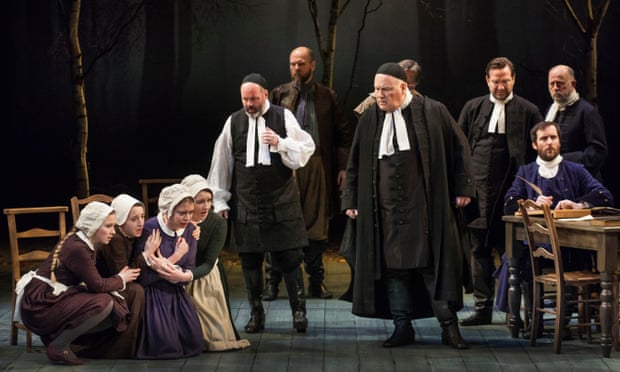
Nothing says “a good night” like unchecked hysteria, unopened hearts and unnecessary hangings. That’s why I’m always excited to see a production of Arthur Miller’s “The Crucible”, and even moreso in the beautiful Lyceum theatre. But does Mark Thomson’s staging of Miller’s work deserve a standing ovation or a slipknot? The star rating above may be a small clue as to which is true: this was a beautiful, if flawed, production of a well beloved American classic.

Set in the year 1692, ‘The Crucible’ follows the path of destruction wreaked by mass hysteria, lust and shame in the town of Salem, Massachusetts. As rumours of witchcraft fly and secret affairs are uncovered, what begins as a simple dance in the woods becomes a matter of law, life and death. Lighthearted stuff.

As you might imagine, Miller’s classic demands atmosphere. From the outset, it’s clear that Thomson has a knack for choosing set designers. It’s not often I open with talk about the furniture, but I was extremely impressed with the quiet ingenuity of Crucible’s set. From the authentic, rustic comfort of the Proctor house to the cold rigidity of the courthouse, each setting hit all the marks in terms of visuals. But even further, it wasn’t just pretty – the use of space was downright clever. Each little quadrant of the stage was self-contained enough to render smaller scenes intimate, and yet interconnected enough to make group sections seem cavernously intimidating. And the use of trees for scenery and blocking lent what felt like meters of depth to a finite stage. For set alone, this show ticked all the boxes.

But luckily, the set isn’t all I’ve got to write happily about. As can be expected from the Lyceum, the acting talent on display is considerable – my personal MVP goes to David Beames as the most entertaining and human interpretation of Giles Corey I’ve seen yet. If I could pay him to narrate my life, you’d bet he’d never go hungry.

But aside from pure entertainment value, I was most impressed by Richard Conlon as Reverend John Hale. When I first read The Crucible, I disliked Hale. I thought he was two-dimensional and boring – but none of these problems so much as touch Conlon. No other portrayal of the character has been as compelling or realistic as his, and I’ve similarly never felt for Hale as much as I did in this production. The emotional depth, the body language, the subtle vocal tics; they all come together almost flawlessly. Fan-bloody-tastic.

Similarly, Philip Cairns shines as John Proctor, applying a great amount of force and raw emotion to the character’s more intense scenes. He moves from tenderness to scepticism to fury as if it were easy as breathing – though this is no doubt benefited from acting opposite the likes of Irene Allan as Elizabeth Proctor. The part of Elizabeth is by no means easy: showing an audience the culmination of years of insecurity and indecision without overacting is like slacklining drunk; that’s what I was so pleased to see how powerful the character was in Allan’s hands. Her final scene and famous closing lines gave me chills.

That same strength runs through the rest of the cast. Meghan Tyler as Abigail Williams is wonderfully duplicitous, mixing sensuousness with devious brutality in the same breath. The Putnams (Douglas Russell and Isabella Jarrett) are as abrasive as the narrative demands, and Greg Powrie’s Reverend Parris is pathetic is the best way possible. Even the young company capture the panic and vulnerability of young girls in the hard frontier of the American East.

So, with such a talented cast and clever design crew, why isn’t this a five star show? Predictably, there are always a few flies in the soup.

As a general note, whilst the accent work at play generally good, it was prone to slippage. Often, the cadence showed more sense than the characters by fleeing from Massachusetts to upstate New York – and, on occasion, Cairns’ Bostonian drawl threatened to slide into a strange mix of Henry Kissinger and Arnold Schwarzenegger. Whilst it won’t bother the average Brit theatregoer, those more familiar with the voices of the new world may find it slightly grating.

Furthermore, I had a huge problem with the sound design. Whilst at times it was a dramatically advantageous decision, at others (especially in the courtroom scenes) it was, at best, a distraction and at worst it utterly broke the tension and dramatic pacing of the scene. I found myself consciously wondering why on earth a scene of screaming hysterics and implied cold-blooded murder for the sake of sex was accompanied by a pleasant violin trill in a major key. In any other show this might not be such a large issue, but in one which is so dependent on atmosphere and audience absorption, it gets amplified.

And it’s in the hysteria that we find my biggest complaint with the production. Whilst certain scenes were certainly not lacking in gravitas, the play’s overall arc of tension was patchy. Some sections jump from being devoid of dread to bursting with it – instead of a steadily escalating fever pitch, it jumps from extreme to extreme.

Unfortunately, this also wasn’t helped by the fact that it felt strangely static at points, as if all the fear had been sucked out of the room. There’s a difference between strained silence and dull quiet, and sometimes this production seemed to confuse them.

Do I think these flaws ruined The Crucible? Far from it. Mark Thomson’s formidable cast rides out the few choppy waves this show presented, and Miller’s famous talent for dialogue is hardly diminished. There are definitely more strengths to this production than weaknesses, and the audience chatter at both the interval and end attest to that fact.

If you get the chance, definitely give The Crucible a look. It’s a production that never fails to entertain whether you’re a Miller virgin or a die-hard fan. Though perhaps a little clunky in the seams, the overall fabric of the show is just as bleak and brilliant as it Miller’s tragedy demands. You might not see Sarah Good with the devil, but you’ll definitely see a strong production.

nae bad_blue

Star (blue)Star (blue)Star (blue)Star (blue)

Reviewer: Jacob Close (Seen 20 February)

Visit the The Lyceum archive.

THIS REVIEW HAS NOT BEEN SUBEDITED

Edinburgh Quartet (Queen’s Hall, 17th Feb. ’16)

Image result for edinburgh quartet pictures


“An interpretation of utter conviction, inspiration and stellar playing throughout”

Editorial Rating:  4 Stars: Nae Bad

The Edinburgh Quartet continued the second phase of their 2015/16 Season under the banner of “Storm and Stress”, derived from the loose translation of the German ‘Sturm und Drang’ movement of the eighteenth century. In this movement passionate expression was given free rein in literature, but also in music with works by Haydn and Mozart at the forefront. The Quartet performed a typical Sturm und Drang work by Haydn, Op 76 No 2 “The Fifths” alongside Bartók’s thrilling, dissonant but rewarding 3rd Quartet and Grieg”s surprisingly complex and at times  dark Quartet in G minor.

The Quartet got straight into their opening number with final tuning completed off stage. This, along with their precision and togetherness, immediately gave the audience confidence that they were in safe hands and in for a treat. So it proved.

The Haydn has (if you will forgive the pun) no hidin’ place (geddit?) in the transparency and openness of 18th century music, and chamber music in particular. The quartet were not found wanting. Clarity, accuracy, full on expression and commitment were the order of the day, and brought this 200-year-old work fully to life. At the end of the first movement I could not stop myself whispering “Wow” under my breath. By the third movement what impressed me most about this band was their sheer synergy. Disciplined, supportive pizzicato to Tristan Gurney’s lead violin, lightness of touch in the final movement with lead violin again doing most of the heavy lifting, as well as the dramatic opening fifths that told us this band meant business.

I have to say I had my heart in my mouth for the Bartok. A complex, austere work with brutal sul ponticello and col legno bowing, glissando fingering and a deep contrapuntal architecture, all grafted on to Hungarian folk song in a collage of different shades and expressions, at times highly dissonant, at others wistfully melodic. A hard act to pull off and a work after which the string quartet genre was never quite the same again. It has probably only been done justice by the Alban Berg Quartet, although the Takacs have given a creditable performance, and it was refreshing to hear the Edinburgh Quartet’s assured version of this piece that makes demands of players and audience alike.

I particularly enjoyed how the musicians let the music speak for itself – the various techniques demanded by the composer contributed to the overall musical experience rather than distracting through novelty or sensationalism. By this I mean the disconcerting col legno (basically bashing the bow up and down on the strings, even reversing the bow so the wood strikes them) was artistically justified!

We needed a breather after that and the interval proved welcome respite. We returned to the auditorium expecting some dreamy Grieg. Not so. This was more Peer Gynt than the Holberg Suite. A major, serious work full of contrasts, based on Spillemand, a Norwegian song from 1876, that gave us a strong, dramatic opening leading into a more lyrical style as it progressed. The quartet rewarded us with an interpretation of utter conviction, inspiration and stellar playing throughout. Special mention here has to be made to Cellist Mark Bailey laying down a melody of plaintive yearning, sensitively supported by ripieno violins and viola.

So, taken in the round, once again some really creative programming delivered with enthusiasm and élan. Putting Haydn and Bartok together before the interval took some courage, and it worked, albeit lacking just a touch of the transcendental magic shown in the Quartet’s previous outing. An engrossing, rewarding evening’s music. Bravo.


nae bad_blue

Star (blue)Star (blue)Star (blue)Star (blue)

Reviewer: Charles Stokes (Seen 17 February)

Visit the Queen’s Hall archive.

THIS REVIEW HAS NOT BEEN SUBEDITED

Guys & Dolls (Church Hill Theatre, 9-13 Feb. ’16)

Adam Makepeace as Nicely Nicely Johnson

Adam Makepeace as Nicely Nicely Johnson

“A feel-good romp of a show”

Editorial Rating: 4 Stars: Nae Bad

Guys & Dolls has a special place in my heart, as it was my first footlights show at university some ten years ago. I remember the hours I spent rehearsing the gruelling dance sequences and complex harmonies, so I was amazed at how well this cast of Edinburgh University students delivered on both counts. The scene in Havana was perhaps a bit ambitious choreographically and could have contained more progression and showpiece moments, but overall the chorus numbers were performed with great vim and pizazz.

The stars of show also delivered with aplomb. Ellie Millar as Sgt Sarah Brown had a voice that danced with the purity and clarity worthy of a leading lady, and her rendition of If I Were a Bell struck a fine balance between comedy and stunning vocal range. Oliver Barker oozed with masculinity and presence as Sky Masterson, while Tom Whiston brought a likeable naivety to Nathan Detroit. Mae Hearons was a delight as Miss Adelaide, and really came into her own in act two with a string of dazzling songs.

While the vocals across the board during the first half of the production were a little shaky (I’ll put it down to nerves in front of a packed house early in the run), the second half was littered with many a five-star moment, including Adelaide’s moving second lament, a Sinatra-esque Luck Be a Lady, and the precise and energetic Crapshooters Ballet. However, for me, the vocal performance of the night was by Adam Makepeace as Nicely Nicely Johnson, who delivered a rousing and extremely capable rendition of the tricky Sit Down You’re Rockin’ the Boat. A special mention also to Tilly Bartholomew as Arvide Abernathy, who was charming and note perfect in More I Cannot Wish You, and displayed great tenderness and well-placed comedy throughout the performance.

This show aimed to take the original musical back to its roots in the 1930s, and some nice touches in Grace Dickson’s choreography – particularly in Take Back Your Mink – felt very reminiscent of that golden era. Director Lucy Evans also cast some females in traditionally male roles as a nod to some of the period’s female gangsters, and, while a brave choice, I felt Evans could have gone one step further in allowing these characters to explore their femininity and interact with the male characters as women, rather than women pretending to be men. Still, Lila Pitcher was commanding as Chicago big-shot Big Jule in an interesting gender twist.

Yet for all the great work by the performers and band (who never faltered under Steven Segaud’s masterful musical direction), I was a little disappointed in the production values of the set and costumes. These elements were quite basic, and with a bit more attention could have added much more “wow factor” and style to be sympathetic to the show’s overall creative aims and chosen time period.

All-in-all, a feel-good romp of a show. Don’t gamble – buy a ticket.

nae bad_blue

Star (blue)Star (blue)Star (blue)Star (blue)

Reviewer: Steve Griffin (Seen 10 February)

Go to the Edinburgh University Footlights

Visit the Church Hill Theatre  archive.

The James Plays (Festival Theatre: 3 – 13 Feb.’16)

Steven Miller (James I) Photo Tommy Ga-Ken Wan

Steven Miller (James I) Photo Tommy Ga-Ken Wan

“‘On you go then, son. On you go. You can do it’.”

Editorial Rating: 4 Stars: Nae Bad

‘Poisoned dresses are something out of children’s stories … if you want to kill her. Put a knife in her’, which would explain, right enough, why there is a whopping great sword on the boards. Still, The James Plays do imply – with a nod and a wink and a catchy dance step – that the Scots are one wicked antidote to the English. They also, with stirring ease, bring on guid strong women. Admire (or not) the toxic fortitude and murderous determinations of James I, II, and III but applaud Queens Joan, Mary and Margaret and give thanks for Annabella, Meg and Phemy.

There is no shortage of bloodletting in Rona Munro’s gutsy trilogy of how to keep head and crown together – in fact the ginormous sword runs with the red stuff – but actually the property of the piece is the kist in the bedroom. That’s ‘proper furniture’ [that chest], with a hundred uses’. You can hide a boy king in it for a start – and ‘drop it out of the window and brain any bastard climbing up the castle’. Munro’s writing is like that: hands-on, unhesitating and constructive.

Best, if you can, to see the plays in order – that’s from 1420 to 1488; and although they’re too inventive and complete to be Horrible Histories they do, in their savage and entertaining scenes, come pretty close: in James I, for instance, when Walter Stewart nails horseshoes to the hands and feet of one of his tenants, old Ada, for scolding him; or in James II when the young king peeks out of his kist to see his mother about to have sex with her ‘protector’ John Stewart. Too many Stewarts? Well, there’s always a Douglas on the make and by the time of the bi-sexual James III, there’s his lover, architect Cochrane, and fine wine and madrigals before all else, especially trying to rule Scotland.

Laurie Sansom’s convinced direction and Jon Bausor’s set design, with drawbridge, allow a febrile exchange between private and public space. The royal four-poster is closely guarded and/or spied upon, take your pick, and the king swings his sword on its canopy. When Parliament assembles it is alongside an audience on stage. The throne is up there too, occasionally occupied, but the space also doubles as a tower room where Isabella Stewart is held captive and spins out her prophetic misery.

Blythe Duff (Isabella Stewart) in James I_& II Photo Tommy Ga-Ken Wan

Blythe Duff (Isabella Stewart) in James I & II Photo Tommy Ga-Ken Wan

That’s Blythe Duff as Isabella and as Annabella in James III and it is, again, a terrific performance. She reprises the roles from the original 2014 production with the same astringent glee and love. She’s there at the very end, dressing the new king with clothes and jewels and with an absolute definition of understatement: ‘On you go then, son. On you go. You can do it’.

And, yes, these dramatised chronicles do at times go on … and on. The squabbling lords might get to you, as they certainly did to James III, or it might just be that the set-piece addresses to the Three (male) Estates are too PC, too YES-NO referendum freighted for your taste, or that you find staged medieval football awkward, but then there’s the wheel of fortune to turn and it’s a mighty one to get going and even harder to brake. These are, after all, history plays and since when were they short and sweet?

Matthew Pidgeon (King James III) in James III_ Photo Tommy Ga-Ken Wan

Matthew Pidgeon (King James III) in James III
Photo Tommy Ga-Ken Wan

Go into the National Museum of Scotland, as I did in-between plays. You’ll find wolves on level 1, ‘Beginnings’, and they certainly belong in the nightmare sequences of James II, but search further and there ain’t too much in the Kingdom of the Scots: one small panel for each of ‘our’ Jamies and arrowheads from the walls of Threave Castle. More fun certainly, more knowledge possibly, is to be had watching Peter Forbes as gross, droll, Balvenie stacking up the Douglas lands; or see Dani Heron as Phemy, 15, assault a guard who’s presuming to search the queen’s rooms. Ballsy! And then there are the sovereign roles: Steven Miller as James I, the poet king, keyed up, commanding in the thick of it but who would have given everything to pen ‘Love, love me do’ in his time; rangy Andrew Rothney as James II, damaged and vulnerable, but who has that majesty thing ; and Matthew Pidgeon as James III, truth seeker, rascal man, outrageous king in black patent winklepickers , only matched by his virtuous Danish queen, Margaret, played by Swedish actress Malin Crepin, naturally.

I saw The James Plays in 2014, when I had been reviewing Fringe shows, and was disconcerted by the numbers on stage and by the sheer size of the venture. In review terms it was a stand-off. Now, second time around, I’d call it all audacious and vivid. Showstoppers with attitude.

nae bad_blue

Star (blue)Star (blue)Star (blue)Star (blue)

Reviewer: Alan Brown (Seen 6 February)

Go to The James Plays at the Festival Theatre and to the National Theatre of Scotland

Visit Edinburgh49’s Festival Theatre archive.

The Pillowman (Bedlam Theatre 2 – 6 Feb. ’16)

Scott Meenan as Katurian. Photo: Mollie Hodkinson

 “This show  will wring the life out of you, in the best way possible.”

Editorial Rating: 4 Stars Outstanding

Pillowman is to dark comedy what heroin is to vapor rub. Martin McDonagh’s tale of bloody flesh and fairytales is dark, dirty and sometimes barefacedly brutal – and in the hands of director Emily Aboud, often stingingly clever as well.

Set in a faceless concrete prison, ‘Pillowman’ tells the story of writer Katurian questioned about gory child murders strongly resembling the short stories he writes. Throw in a heaping helping of torture, a pinch of weirdly psychotic police banter and as much moral relativism as you can stomach, and you’ve got a play which (despite quite a few good laughs) stays tensely uncomfortable the entire way through. Make no mistakes: this show  will wring the life out of you, in the best way possible.

But a script without a director doesn’t get too far, and with Emily Aboud returning to the stage after her barnstorming production of Equus, there’s never any doubt it’s in safe hands. Apart from some strangely static blocking at the beginning, her overall vision for the production strikes gold: McDonagh’s work feels just as grittily surreal as it should.

And on the note of surreality, the set for this production is a gem- it’s not often I’ve seen twists dependent entirely on clever set design, let alone done so with such skill. There were some design choices, though, which seemed less prudent than others: a series of videos projected onto the stage wall would have had twice the impact if performed live. Whilst the presentation detracted nothing, it was slightly disappointing to think of its potential. And to sound designer Alex Greenwald, I’ll say only this: The low ambient drone? Fantastically slithery.

Luckily, the propitious problem of wasted potential is brilliantly absent from the cast. Theatre veteran Scott Meenan captures the quiet intensity of Katurian excellently. Subtle yet passionate is a hard duality to pull off, so it was a joy to see it done so well. And even more so when combined with Douglas Clark as Michal: the burden of the fool in black comedy is a heavy one, but Clark makes the part feel as natural as breathing.

Hot off the heels of EUSOG’s Addams Family, Esmee Cook expertly runs the emotional gamut as wonderfully sadistic second-in-command Ariel – but the indisputable star of the police parade is Paddy Echlin as Detective Tupolski. Sardonic and hilariously removed from normal logic, Echlin dominated the stage whenever his annoyingly wrong tie came flapping through the set doors.

The supporting cast were noticeably solid, especially in terms of physical theatre – Sian Davies in particular has a peculiar knack for playing tragically adorable kids.

With such energy and dynamism throughout, however, it was a disappointment to see the production fall into the trap of lengthy and jarring set changes. For a piece which, in every other aspect, set up a wonderfully naturalistic and believable surreality of tone, these seemed like a strange choice. They were luckily few and far between, but are still a bit like stopping a delicious meal to eat a couple of handfuls of packing peanuts.

Overall, I was impressed by Pillowman. It has creative and well-crafted direction and maintains the kind of thick atmosphere most other shows could only dream of (although, making the Bedlam Theatre feel like a freezing cell requires little help). Combine with stellar acting and a well-chosen crew, and you’ve got a production that’ll knock your socks off  –  and then probably strangle you with them, but still.


outstanding

StarStarStarStar

Reviewer: Jacob Close (Seen 3 February)

Go to Pillowman at Bedlam here.

Visit Edinburgh49’s Bedlam archive.