EdFringe Talk: Richard Stott: Afterparty

“My last shows were a look back Afterparty is a look at now.”

WHO: Richard Stott

WHAT: “Richard Stott returns to the Fringe with a brand-new show filled with trademark storytelling and joyously acerbic one liners. The runner-up in Dave’s Jokes of the Fringe 2019 talks about stripping down for a documentary, club nights that turned into afterparties and then into crime scenes, and finally starting to grow up and beginning to like the adult he’s become. All while living with a disability… perhaps. As seen on ITV2’s Stand Up Sketch Show.”

WHERE: Underbelly, Bristo Square – Dexter(Venue 302) 

WHEN: 16:15 (60 min)

MORE: Click Here!


Is this your first time to Edinburgh?

This is going to be my third fringe! I honestly tried to run before I could walk with my first one in 2017, I’d only been doing stand up for a matter of months but felt confident enough to bring a 45 min show called Wretched to it. It had it’s highs and lows but I reckon that first run did the ground work for everything else.

2019 was my real debut and I had a great time and surprised myself by nabbing runner up in Dave’s Jokes of the Fringe. Now I’m back with a second hour called Afterparty, a comedy about growing up, feeling your age etc. I’ve missed the fringe, for me it’s a special place that anyone can put on almost anything, you can be watching a TV star one hour then hopping across the road to see your friend you did open mics with. We have to make sure we keep it that way.

What are the big things you’ve learned since 2019 and have you absorbed any of the lessons yet?

Perhaps a lot of them are in the show itself so maybe I shouldn’t give them away. The years between 2019 and now just feel like a fever dream. Now this hasn’t got anything to do with the pandemic but the big thing I’m learning is how to write in the present. My last shows were a look back Afterparty is a look at now. It’s been a long process to get feeling comfortable forming the ideas. I’m pretty proud of where i’ve got to with it.

Tell us about your show.

Afterparty is written and performed by myself and directed by Kevin Shepherd. I also have the help of production team Andrew Roach Talent and Ingenious Fools who’ve been essential in getting the production off the ground.

It’s premiering at Edinburgh and afterwards I hope to develop it more and get some theatre bookings.

What should your audience see at the festivals after they’ve seen your show?

There’s so many people I could mention here but you can’t fail to have a good time at whatever Sooz Kempner is doing. Her show is called Playstation I believe, I don’t know what it’s about but it doesn’t matter, she don’t miss.


LIKE WHAT YOU JUST READ? FOLLOW US ON TWITTER! FIND US ON FACEBOOK! OR SIGN UP TO OUR MAILING LIST!

INTERESTED IN BEING INTERVIEWED TOO? CLICK HERE!

EdFringe Talk: Eli Matthewson: Daddy Short-Legs

“It’s ridiculous that anyone ever lets me do this…”

WHO: Tamsin Hurtado Clarke & Scarlett Plouviez: Performer & Director

WHAT: “Award-winning Eli Matthewson is taking you back through some huge life revelations that took place in some seriously shitty cars, from when he came out to his dad, to 10 years later when his dad came out to him.”

WHERE: Underbelly, George Square – The Wee Coo (Venue 300) 

WHEN: 20:50 (60 min)

MORE: Click Here!


Is this your first time to Edinburgh?

No this will be my third time performing as a solo stand-up performer – I’ve loved it every time and was all set to go in 2020 but decided not to for my own personal things, not because of anything you might have read about in the global news over the last few years.

What are the big things you’ve learned since 2019 and have you absorbed any of the lessons yet?

Honestly losing so much time, especially as a performer, was just a great reminder of what a privilege it is to have this job. It’s ridiculous that anyone ever lets me do this, and spending so much time not able to, and doing the dreaded Zoom gigs, really made me value getting to be on stage again.

Tell us about your show.

My show is called Daddy Short-Legs and it’s all about a huge revelation from my father that truly changed my family dynamic and put me through a bit of a spin. I made this stand-up hour for the New Zealand International Comedy Festival in 2021, where it won Best Show, and after the Fringe I’ll be taking it to a bunch of Arts Festivals in New Zealand.

What should your audience see at the festivals after they’ve seen your show?

Snort – it’s an improv show with a hot line up of New Zealand comedians including Rose Matafeo, Alice Snedden, Laura Daniel, Joseph Moore, Nic Sampson and yours truly. It’s the best way to finish a day at the Fringe.


LIKE WHAT YOU JUST READ? FOLLOW US ON TWITTER! FIND US ON FACEBOOK! OR SIGN UP TO OUR MAILING LIST!

INTERESTED IN BEING INTERVIEWED TOO? CLICK HERE!

EdFringe Talk: Done to Death, By Jove!

“We never want to retire. Our industry didn’t exist for 2 years. There’s so much to catch up on.”

WHO: Nicholas Collett & Gavin Robertson

WHAT: “The Great British Detective tradition! Holmes and Watson meet Poirot and Miss Marple (alongside the usual suspects) in a spoof homage – who murdered Lady Fanshawe!? Why have the sound cues got mixed up? Where’s the set? Made all the more tricky, given that four actors are stuck in the broken-down van, so theatrical knights, Sir Gavin of Robertson and Sir Nicholas of Collett attempt to deliver the play… what can go wrong!? Brand-new comedy, re-interpreting The Art of Coarse Acting with a farcical result. Time to discover whodunwhat and how… Warning: Contains hats!”

WHERE: theSpaceTriplex – Studio (Venue 117) 

WHEN: 17:05 (60 min)

MORE: Click Here!


Is this your first time to Edinburgh?

We first came to Edinburgh together in 2010 to perform “The Six-Sided Man” at Zoo. We returned in 2016 to perform the 30th anniversary version at Assembly Roxy. Prior to this Gavin was at Assembly with “Thunderbirds FAB!” in 1987, prior to the first of 6 West End runs. Since then he has appeared in many Fringe productions including “12 Angry Men” with Bill Bailey and a host of comics and “One Flew Over The Cuckoo’s Nest” with Christian Slater and Mackenzie Crook.

Nicholas’s first fringe was in 1980, performing new writing from the University of Birmingham Drama Dept with fellow students including a young man named Simon Le Bon. No idea what happened to him, he seemed quite interested in music. Since then he has twice appeared as Counsellor in “The Black and White Tea Room at Assembly (Special Performance Award at Seoul’s World Duo Festival) and “Your Bard” amongst many others.

We love doing Edinburgh – you have no idea who’s coming and the doors that may open as a result are exciting. Through Edinburgh we have both presented work internationally, including Hong Kong, Brazil, Korea, Japan, Adelaide, Kansas City and Florida.
It’s great meeting people from all over the world.

What are the big things you’ve learned since 2019 and have you absorbed any of the lessons yet?

We never want to retire. Our industry didn’t exist for 2 years. There’s so much to catch up on. We took the view that people would want to have a laugh after all this, so we’ve made a comedy. People seem to like it so we’ve learnt that works.

Tell us about your show.

Created, performed and produced by Gavin Robertson and Nicholas Collett. We met in 2007 through Tim Marriott on a production of Dante’s “Inferno”. We started making work together shortly after. This production has been touring since 2019 and will be touring the UK this Autumn, including a visit to Florida.

What should your audience see at the festivals after they’ve seen your show?

Tim Marriott in “Watson” at Assembly .
Yoshi Colwell in “Invisible Mending” at Summerhall .
“Prejudice and Pride” at Space Big, new country and bluegrass musical
“The Gods, The Gods. The Gods” Assembly Bijou
“SOE” Assembly Front Room
“The Wild Unfeeling World” Lion House Theatre Summerhall


LIKE WHAT YOU JUST READ? FOLLOW US ON TWITTER! FIND US ON FACEBOOK! OR SIGN UP TO OUR MAILING LIST!

INTERESTED IN BEING INTERVIEWED TOO? CLICK HERE!

EdFringe Talk: I Miss Amy Winehouse

“I Miss Amy has been selected for the 2022 VAULT Festival, Brixton House Theatre’s opening season Housemates and this year’s Boom Chicago Comedy Festival in Amsterdam. After all that, can it still premier when it goes to Edinburgh? I’m not sure I understand how that works…”

WHO: Suchandrika Chakrabarti: writer / performer

WHAT: “I Miss Amy Winehouse is the first solo hour from writer / comedian / journalist Suchandrika Chakrabarti (shortlisted for the inaugural VAULT FIVE scheme, regular writer on BBC Radio 4’s The News Quiz, Funny Women Stage Awards semi-finalist 2020, British Comedy Guide Pro Performance Awards finalist 2020). It’s 11 years since Amy Winehouse died. Suchandrika is a fan who partied the 2000s away in Camden, but never got to meet her musical hero. She’ll take you back in time to put that right. Brush up on your favourite Amy Winehouse trivia because there will be quizzes!”

WHERE: Paradise in The Vault – The Annexe (Venue 29) 

WHEN: 12:15 (60 min)

MORE: Click Here!


Is this your first time to Edinburgh?

This is the first time I’ve brought a show to Edinburgh, yes. I’ve been before as a punter, and just loved the energy, the incredible variety of shows to see and the way the timings work well with my natural tendency towards being nocturnal. I’ve even got sunburned sleeping off a hangover in Princes Street Gardens. Now I can’t wait to be on the other side of the Fringe!

What are the big things you’ve learned since 2019 and have you absorbed any of the lessons yet?

Wow, what a question! On the whole, I don’t think I know yet. We’re still in the pandemic, and so much has happened in the world in those years – I’m not sure I’ve got to grips with everything at all. There is one thing, though: what is now my one-hour comedy show started life as the first two chapters of a novel during lockdown – one I’d been trying to write for a long time – but, even with good feedback from an agent, my instincts told me that no, this manuscript will never be finished. The narrator has got too much of a ‘voice’… could it be a show? I trusted that little inner voice, and it was right.

Tell us about your show.

I wrote I Miss Amy Winehouse, which is my debut stand-up hour, so naturally I’m performing it as well. In the show, I promise to take the audience time-travelling back to Camden in the mid-2000s, when I was working and partying hard in Camden, like Amy Winehouse. Maybe this time I’ll get to meet my musical hero? The show is about the absurdity of grief, the strangeness of celebrity, the joy of sticky nights out in Noughties Camden – and what it means to truly miss someone. With the aid of slides, Google Maps and, of course, a hologram of the late Robert Kardashian, I set out to find the solution for longing… in 60 minutes. I’ve not worked with a producer or director on this show, but I have been very lucky to get onto Soho Theatre’s Edinburgh Labs course this summer, which has introduced me to people who have been great sounding-boards for my show and all the stuff around it, in the way that a producer or director can be. I Miss Amy has been selected for the 2022 VAULT Festival, Brixton House Theatre’s opening season Housemates and this year’s Boom Chicago Comedy Festival in Amsterdam. After all that, can it still premier when it goes to Edinburgh? I’m not sure I understand how that works… and, yes, I am taking to at least one festival afterwards, but I can’t announce that yet.

What should your audience see at the festivals after they’ve seen your show?

Well, of course you must see all the shows by my Edinburgh Labs classmates! Check out Posey Mehta’s I Am Not A Gorilla, Sid Singh’s Illegally Funny, Chelsea Birkby’s No More Mr Nice Chelsea, Phil Green’s 90s Boy – Blair, the Lovegun and Me, Michael Kunze’s Lil Saffron: Ragu to Riches… honestly, check them all out, they’re brilliant shows and Soho Theatre seems to like them!


LIKE WHAT YOU JUST READ? FOLLOW US ON TWITTER! FIND US ON FACEBOOK! OR SIGN UP TO OUR MAILING LIST!

INTERESTED IN BEING INTERVIEWED TOO? CLICK HERE!

“Charles Dickens was a big fan of coach travel. And as well as being a great storyteller he is the master at description. I’d love to mysteriously acquire a notebook he’d used to scribble down his thoughts as he hurtled northwards.” – Author Steve Silk talks about ‘The Great North Road’

“I was attracted to the road we now call the A1 because it had been such a big part of my life. As a youngster growing up in Southern England but studying at Newcastle University I was up and down it all the time. Later I worked as a newspaper reporter in Darlington and then a TV reporter in Peterborough. So whatever I did with my life, the Great North Road seemed to be close by.”

WHAT: “The Great North Road is Britain’s Route 66 – we’ve just forgotten how to sing its praises

In 1921, Britain’s most illustrious highway, the Great North Road, ceased to exist – on paper at least. Stretching from London to Edinburgh, the old road was largely replaced by the A1 as the era of the motor car took hold.

A hundred years later, journalist and cyclist Steve Silk embraces the anniversary as the perfect excuse to set off on an adventure across 11 days and 400 miles. Travelling by bike at a stately 14 miles per hour, he heads north, searching out milestones and memories, coaching inns and coffee shops.

Seen from a saddle rather than a car seat, the towns and the countryside of England and Scotland reveal traces of Britain’s remarkable past and glimpses of its future. Instead of the familiar service stations and tourist hotspots, Steve tracks down the forgotten treasures of this ancient highway between the two capitals”

WHO: “Steve Silk is a journalist working for BBC Look East in Norwich. His two previous books – The Wherryman’s Way and Hidden Riverside Norwich – saw him take to a canoe to explore the Norfolk Broads. He’s now more comfortable on an old-fashioned touring bike with a pannier full of obsolete maps and flapjack.”

MORE? Here!


Why ‘The Great North Road’?

Well, before you even know what it is and where it goes, isn’t it a great name? Can any true traveller resist the thought of exploring such a highway? Slightly more prosaically, I was attracted to the road we now call the A1 because it had been such a big part of my life. As a youngster growing up in Southern England but studying at Newcastle University I was up and down it all the time. Later I worked as a newspaper reporter in Darlington and then a TV reporter in Peterborough. So whatever I did with my life, the Great North Road seemed to be close by.  Finally, as a cyclist seeking a new challenge, I felt the 400-mile length between London and Edinburgh offered just the right amount of jeopardy and adventure.

You are following in the tyre tracks of the Victorian cycling writer, Charles Harper. 100 years from now, what are the things about the landscape you cycled through that you expect will have changed the most?

That’s a tough one. I’m going to start off with what won’t change. We will always need places to eat and places to stay. So there will be cafes and inns – even if we call them something different. In fact, my friends with electric cars tell me they are currently spending more time in service station type places – because charging takes longer than filling up.

Moving on to changes, I guess the quality of road will improve. We’ve already seen huge upgrades in recent decades, yet north of Alnwick in Northumberland, the road does largely revert to a single carriageway in each direction. The obvious next step is dualling all the way to Edinburgh. With my history hat on, I have mixed feelings about this. Certainly, we need to make the most of those wild and woolly stretches while we can.

You write that of all the Coaching Inns still extant on the route, it’s the Bell in Barnby Moor that would be most familiar to Harper – even to the extent that he might have to take a moment to realise the time difference. What spot on the route would you like to change the least in the century to come?

I have a soft spot for Newcastle. I have a seriously soft spot for the moment you cross the Tyne gorge across the Tyne Bridge. That whole vista has improved immeasurably over the last 20 years. The Quayside looks the business, Gateshead has been transformed, they’ve got rid of the dodgy floating nightclub and the Millennium Bridge looks a million dollars. Now just leave it alone!

If you could go back in time and travel part of the route during the golden age of stagecoaches, which would it be and would you be sitting inside or outside?

I like the fact that the A1 gets noticeably wilder once you cross the border. So, I would summon up some bravery and be one of the “outsides” on that stretch where the road runs close to the North Sea between Lamberton and Burnmouth.

Here, you don’t need much of an imagination to summon up the ghosts of mail coaches past. It is still a truly exhilarating road made more dramatic by the proximity of the coastline. (Incidentally, this is one of many sections of the road where it would be suicidal – if not illegal – to travel by bike. I had to find quieter lanes further inland instead.)

What’s the one relic or artefact from the golden age of coaching (that you could fit on your writing desk) that you would want to acquire money and rarity presenting no problems?

Charles Dickens was a big fan of coach travel. And as well as being a great storyteller he is the master at description. I’d love to mysteriously acquire a notebook he’d used to scribble down his thoughts as he hurtled northwards. I feel I could certainly learn a few tricks from seeing the world through his sharp, all-seeing eyes.

What’s the best place to stand and see/sense the Great North Road as it would have been before the arrival of automobiles?

Stilton in Cambridgeshire. The Bell at Stilton is one of my favourite GNR pubs – it still looks like a coaching inn after all these years. But what sets Stilton apart is the breadth of its high street and the fact that it’s been so thoroughly bypassed that nothing had to change. Yes, you can hear the modern A1 in the background, but look more closely and I swear you can summon up at least the mirage of a four-in-hand, the horses snorting and the guard blowing his bugle.

You pack a lot of historic factoids into the narrative. What’s the best one that didn’t make the final edit?

There’s a museum directly under the A1(M) in Hertfordshire and it doesn’t even get a mention! Disgraceful I know, but I just had too much history at that point in my journey to weave in the archaeology around some Roman Baths. That is one of the challenges of a book like mine. To keep readers reading, you need a good mix of description, action and personality. The road provides my narrative thread, but I can’t always control the pace of the facts. There was just too much going on here. Many apologies to the museums department of Welwyn Hatfield council.

If you could share a convivial meal at an inn with any one of the great and the good personalities mentioned by you and Harper who would it be?

Well, first of all I would want Harper along too. I suspect we would argue quite a bit, but while several people have written about the Great North Road over the decades, we all accept that he’s the Boss. 

As for the personality, I’d go for John Palmer. He was a Bristol man, rather than a GNR sort of chap, but he is single-handedly responsible for the introduction of the mail coach system. Before he came along the post was taken from place to place by slightly dozy blokes on horses. They were often beholden to – or in league with – the local highwaymen. Palmer travelled regularly from Bristol to Bath by stagecoach and grew fed up with their lack of get-up-and-go.

He was the one who came up with the idea of specialist mail coaches, protected by a guard armed with pistols and a blunderbuss. He also suggested that the turnpike barriers should be specially opened to increase their speed and reliability. Because the railways came along so soon afterwards, we forget how phenomenal a logistical achievement that was.

The Three Tuns at Beamish sounds like an epically brilliant concept. What are your top tips (sans bedbugs) that you would insist on for the sake of authenticity?

So, just to explain, Beamish Museum wants to build a replica coaching inn at its huge outdoor site in County Durham. Since Covid it’s actually gone a bit quiet but I’m sure they will get it sorted at some point. The original Three Tuns was at Scotch Corner – the place where Scotland-bound travellers had to decide whether to continue up the east coast to Edinburgh or cross the Pennines en route to Glasgow.

The museum wants to give people the chance to stay overnight at a “genuine” coaching inn. It’s a fantastic idea. I know there’s rightly a lot of emphasis on the food and the beer and the ambience. But I’d want horses – lots of them. They were what made coaching inns, coaching inns. I would want horses in stables, complete with an ostler shouting at stable hands and the “coachy” walking round like he owned the place. The sights and the sounds of a forgotten world.

What are you currently working on?

I have another road in my sights. You might have imagined that having done the A1, I would have chosen one of other biggies – the A2,3,4,5 or 6 in England or 7,8 and 9 in Scotland.  In fact I’m going for the relatively unheralded A40. I’ve chosen it simply because I fancy the route. It goes over the Chilterns to Oxford and then includes the Cotswolds, the Wye Valley and the Brecon Beacons, finishing at Fishguard on the Welsh coast. It should be stunning.

I’m currently at the research stage. I am very much a part-time author, but I happen to have a week off at the moment, so Saturday saw me at Burford in Oxfordshire where there was an annual ceremony remembering three Levellers who were shot on Cromwell’s orders during the English Civil War. It’s rather complicated to explain here, but it’s just the kind of historical nugget that I enjoy digging out. On Sunday I did a 30-mile bike round around Oxford including Shotover Hill – once a haunt of highwaymen and more recently made famous by a Supergrass song. And on Monday I was exploring old chair factories around High Wycombe. When – or even if – this all morphs into an intelligible book is anyone’s guess.

LIKE WHAT YOU JUST READ? FOLLOW US ON TWITTER! OR SIGN UP TO OUR MAILING LIST!

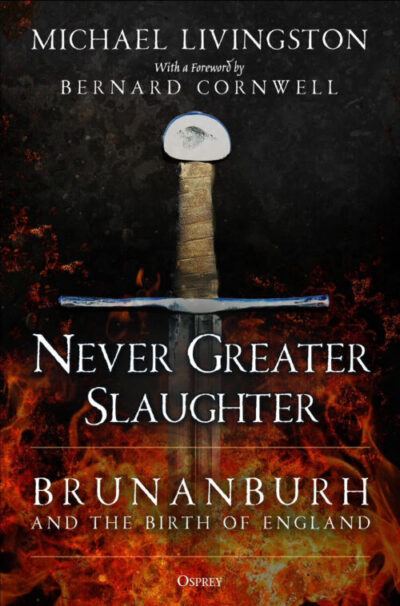
“Boots planted firm, shield shoulder strong, weapon hand unflinching … and prayers already said.” – Author Michael Livingston talks about ‘Never Greater Slaughter: Brunanburh and the Birth of England’

“Not only does Old English Brunanburh become Modern English Bromborough, the landscape, social, and political situations of the Wirral are a perfect match for everything we know about the battle.”

WHAT: Late in AD 937, four armies met in a place called Brunanburh. On one side stood the shield-wall of the expanding kingdom of the Anglo-Saxons. On the other side stood a remarkable alliance of rival kings – at least two from across the sea – who’d come together to destroy them once and for all. The stakes were no less than the survival of the dream that would become England. The armies were massive. The violence, when it began, was enough to shock a violent age. Brunanburh may not today have the fame of Hastings, Crécy or Agincourt, but those later battles, fought for England, would not exist were it not for the blood spilled this day. Generations later it was still called, quite simply, the ‘great battle’. But for centuries, its location has been lost.

Today, an extraordinary effort, uniting enthusiasts, historians, archaeologists, linguists, and other researchers – amateurs and professionals, experienced and inexperienced alike – may well have found the site of the long-lost battle of Brunanburh, over a thousand years after its bloodied fields witnessed history. This groundbreaking new book tells the story of this remarkable discovery and delves into why and how the battle happened. Most importantly, though, it is about the men who fought and died at Brunanburh, and how much this forgotten struggle can tell us about who we are and how we relate to our past.”

WHO: “Michael Livingston is a two-time winner of the Distinguished Book Prize from the International Society for Military History (2017, 2020), an author of best-selling fiction, an award-winning full professor at The Citadel, and a frequent public lecturer, and occasionally even a person on TV. At present, he serves as the Secretary-General for the United States Commission on Military History and sits on the Board of the South Carolina Academy of Authors.”

MORE? Here!


Why Brunanburh?

In 937, a massive alliance of Scots, Vikings, and Britons came together to try to eradicate England at a place called Brunanburh. From the first time I heard about the battle as a student, I found it fascinating. It sits at this enormously tantalizing crossroads of being an event of enormous importance in the history of the British Isles … yet it’s also an event about which very little is known. I’ve always liked puzzles, and as historical events go, this is a terrific one!

Other than the location, what are the things we don’t know about the battle and its context that you wish we did?

The absolute number one thing we’re missing, without question, is how the alliance came together. All three of the kings who banded together – Constantine of the Scots, Anlaf of the Dublin Vikings, and Owain of the Strathclyde Britons – had reason to hate each other, and yet they set these differences aside to try to take on King Athelstan of the English. The negotiations must have been fascinating, but we don’t know what they were. We don’t even know for sure whose idea it was at the start!

What’s your elevator pitch for Brunanburh’s having taken place on the Wirral?

Not only does Old English Brunanburh become Modern English Bromborough, the landscape, social, and political situations of the Wirral are a perfect match for everything we know about the battle.

How did Brunanburh live in the memory of ordinary folk in the immediate generations after the battle?

They called it simply the “Great Battle,” which speaks volumes about how horrific it must have been. As I say in the book, the violence shocked a violent age. How did they remember it over time? Well, poetry has long been a vital way of preserving the past, and Brunanburh was certainly no exception to this. The most famous “artifact” of the battle today is a powerful poem in the Anglo-Saxon Chronicle – the sole information that it records for the year 937. Likely there were many such things told in the years after the bloodshed, and we’re fortunate that this one survived.

If you could possess one item mentioned in your narrative, what would it be and why?

According to one chronicler, a Frankish duke sent King Athelstan a long list of treasures, including “the sword of Constantine the Great, inscribed with the ancient owner’s name in golden letters, with one of the iron spikes used to crucify our Lord affixed to the scabbard with golden fastenings.” I feel like that would be a nice addition to the office, right?

If it was possible for you to own a from life photograph portrait of any one of the characters chronicled in the story, who would you want to see and what would you be looking for?

I’d want to see Athelstan, immediately after the battle. Thousands had fought and died for him. How much did the bloodshed impact him? How much did the trauma haunt him? He no doubt wore a public face, but I’d want to see the look in his eyes when he thought no one was watching.

What’s the best way to stand in a shield wall and live to tell the tale?

Boots planted firm, shield shoulder strong, weapon hand unflinching … and prayers already said. It was unbelievably brutal combat.

Bernard Cornwell wrote the preface to the book. What’s the best thing about his “Last Kingdom” series of novels and are there any parts you aren’t so keen on?

I love Cornwell’s novels – and not just the Last Kingdom ones! Wouldn’t change a thing about them, honestly. What I love best about them is the ways in which he manages to respect the hard work of historians while also pulling off that a bit. I mean, what are the odds that his Uhtred of Bebbanburg, being born in the 850s, would still be effectively swinging a sword at Brunanburh in 937? Not high, but damn if it doesn’t make for an awesome story!

You’ve got one year living as an observer in the 930s. What’s on your bucket list of sights to see?

Can I witness Brunanburh – and all the arrangements that made it happen – without participating in it? I’d do that if I could, just to satisfy my final curiosities. And what downtime I had I’d spend riding the roads from Hastings to Winchester to London and then up to York. Figure I’d knock out some other questions along the way!

What are you currently working on?

In June I’ve got another historical investigation in the same vein of Never Greater Slaughter coming out: Crécy: Battle of Five Kings. I’m really excited for people to get their hands on it. Right now I’m working on its sequel, which is an investigation and reconstruction of the Battle of Agincourt.

LIKE WHAT YOU JUST READ? FOLLOW US ON TWITTER! OR SIGN UP TO OUR MAILING LIST!

“I think Napoleon planned his offensive against the Papacy like a military campaign. Manoeuvring, invasion, battle, victory, and capitulation were the set pattern of his triumphs.” – Author Ambrogio A. Caiani talks about ‘To Kidnap a Pope’

“I’d love to ask Pius VII what kept him going during his imprisonment/exile? It would be fascinating to know if his faith that he would be delivered from and survive his incarceration ever wavered.”

WHAT: The story of The Story, of Christianity as it appears in the historical record, is a constant tussle between those empowered solely by their spiritual faith and those holding supreme temporal power. For the Catholic Church, the established church of Western Europe, the multidimensional Venn diagram of overlapping spiritual and temporal interests has been a fractal labyrinth through which very few have successfully navigated. There is scarcely a polity – not an Earldom, Dukedom, Kingdom, or Empire – in which Church and state have ever coexisted in perfect balance without the unfolding, all consuming drama of a Beckett or a Borgia, a Henry or an Honorius. Since the fall of Rome, the history of Europe has always been, in one sense or another, the history of Church and state.

Amid the aftershocks of the political and intellectual earthquake known to us as the French Revolution, Napoleon Bonaparte (1769-1821) and Pope Pius VII (1742 -1823) attempted to reconcile the latter’s old church with the former’s new state. The early signs were promising. Together in 1801 they formalized an agreement, but relations between them rapidly deteriorated. In 1809, to the horror of the faithful across the continent, Napoleon ordered the Pope’s arrest. Pius’ imprisonment, which would vary in severity and isolation, lasted until Napoleon’s fall in 1814.

In his pioneering account of the tempestuous relationship between the Emperor and his most unyielding opponent Ambrogio Caiani draws on original findings in the Vatican and other European archives. He uncovers the nature of Catholic resistance to Napoleon’s aggression; charts Napoleon’s approach to Papal power; and reveals how the Emperor attempted to subjugate the church to his particular vision of modernity.

“In gripping, vivid prose, Caiani brings to life the struggle for power that would shape modern Europe. It all makes for a historical read which is both original and enjoyable.” – Antonia Fraser, author of ‘Marie Antoinette’.

WHO: Ambrogio A. Caiani is senior lecturer in modern European history at the University of Kent. He is the author of ‘Louis XVI and the French Revolution 1789-1792‘.

MORE? Here!


Why ‘To Kidnap a Pope’?

Well, the title is meant to provide the reader with the basic storyline of the book: in 1809 Napoleon ordered that Pius VII be removed from Rome against his will. He would remain the French Emperor’s prisoner for nearly five years. I have always been fascinated by the politics of religion. The more I researched this topic in the Vatican Archives, and National Archives in Paris, the more I became convinced that its legacy cast a long shadow over the Catholic Church. Indeed, the age of revolutions catalysed the decline in church and state relations that had its roots in the long eighteenth century. The experience of persecution under the French Revolution and Napoleon ensured that the Papacy would view modern states with unconcealed distrust.

Biographers are often asked if they came to like and / or respect their subjects. How do you feel about these two personalities now compared to when you started out? Would you want to share a small and remote holiday cottage with either for an indeterminate period?

Ultimately, I learned to respect both my protagonists as men of principle. Regrettably for them their most deeply held convictions set them on a collision course that was to have disastrous consequences for Europe and the Church. If I had to spend a wet weekend with them…. that’s easy …. Napoleon would definitely be better company than the taciturn and contemplative, former monk, Barnaba Chiaramonti, who was elected Pope in March 1800. I imagine that it would have been tricky to pry even the smallest of conversations out of Pius. He was a deeply religious man, and I am not sure he was that keen on human company. His companions tended to be theologians and confessors. He only really spoke freely to a tiny circle of friends and family.

Whereas Napoleon adored conversation and, when he was not in one of his dark moods, he was, apparently, very good company and a scintillating conversationalist (you just have to read the memorial de Sainte-Hélène to realise that this was the case). Having said this, I suspect that a hyperactive guest, who barely slept four hours a night, like the French Emperor would have tried the endurance skills and energy levels of even the most consummate host. Despite this snag, I think I would be willing to risk it.

How does Napoleon’s struggle with the Papacy of Pius VII stack up against his more famous military campaigns in terms of planning, execution, and adaption to shifting circumstances? Did he have a particular idea of what ultimate victory might look like?

That’s a great question, I think Napoleon planned his offensive against the Papacy like a military campaign. Manoeuvring, invasion, battle, victory, and capitulation were the set pattern of his triumphs. He, probably, expected that he could follow a similar grand design, and ultimately subordinate the Catholic Church to his will. Yet, like in Spain and Calabria, he met a determined group of ecclesiastical resisters, especially the Pope, who simply refused to concede defeat and yield. Simply put, Chiaramonti, unlike a Habsburg or Hohenzollern sovereign, was unresponsive to bullying and military intimidation. Pius’ weapons and provisions were spiritual. He organised a mass campaign of passive resistance that made French rule in the papal states next to impossible. Such tactics prove much more effective in resisting Napoleon than brute force.

Neither Napoleon or Pius were especially modern political thinkers. Neither believed that political legitimacy rests exclusively on the consent of the governed. Keynes described Newton as the last magician rather than the first scientist. Did you ever find yourself wondering if you were chronicling a late medieval struggle rather than an early modern chapter of European history?

Well you say that … but I do wonder if anything, at the end of the day, is really that modern. Napoleon often drew parallels between himself and the medieval investitures crisis of the eleventh century. For example, the struggle that pitted Gregory VII against the Emperor Henry IV, or that which saw Philip IV, possibly, murder Boniface VIII bear remarkable analogies to the events of my book. Yet, by the same logic, the investiture crisis that set Communist China against the Holy See, in the early twenty first century, bears some, loose, though striking parallels to the Napoleonic Empire’s relationship with the Catholic Church. Governments, whether ancient or modern, have and will continue to put pressure on the Church to yield to the power of the state. A harmonious relationship between church and state remains an elusive objective even to this day.

What lessons from this period could the Papacy have absorbed and applied when it came to dealing with 20th century dictators such as Mussolini and Hitler?

Let me start by saying that in general concordats have a good track record in the long history of the Catholic Church. When both contracting parties have upheld the bargain, then, these treaties often created harmonious periods in church and state relations. This was particularly the case in nineteenth century Latin America. Such agreements cemented the Church’s position, rather than undermining it, in South America. A major problem emerges when one party is ‘not playing by the rules.’ The soft power of the church unsupported by hard power of the state could only go so far. The church negotiated these agreements in good faith, but it did not possess the means to force secular states to adhere to the terms of the concordats it signed. The dictators of the twentieth century proved unscrupulous and manipulative in their selective reading of the concordats they had ratified. Like Napoleon, they showed little respect for the Church’s prerogatives and position.

Unlike the French Emperor, they did not kidnap a Pope and exile him (although apparently at one point Hitler did consider kidnapping Pius XII according to one author). Ultimately, there is no easy lesson for the Papacy to draw from the Napoleonic period. Perhaps focusing on its pastoral mission, and avoiding politics where possible, could only be to the church’s advantage.

You express an admiration for Marie Louise, Napoleon’s second wife and the mother of his son. Why has she been so overlooked? Why does she deserve a greater share of the limelight?

I think we tend to be dismissive of arranged marriages in our society as they lack the romance and passion of courtship. In consequence, I guess, the public dismisses the marriage of Napoleon to Marie Louise as mere politics. This eclipses the fact that Marie Louise and Napoleon formed a notable political partnership. Unlike Josephine, she served as regent of France in 1813-1814 while the Emperor was on campaign. This was certainly a token of the trust and esteem Napoleon placed on her. Indeed, as Michael Broers has stated, she attended the council of state and was given a good education. After Napoleon’s fall, she became Duchess of Parma where she is remembered as an enlightened ruler. Under her beneficent guidance, Parma achieved some of the highest literacy rates in Italy, and she was a renowned patron of the arts, especially Italian opera. It has even been suggested that the quality controls and production standards for Parma ham were inspired by her. I also quite like that Napoleon was only husband number one (out of three), so she clearly was a strong woman who put her stamp on an age ruled by men. I do wish somebody would write a political biography of this formidable princess.

If you could directly ask one question of each of your protagonists what would you ask them and what answers would you expect?

I’d love to ask Pius VII what kept him going during his imprisonment/exile? It would be fascinating to know if his faith that he would be delivered from and survive his incarceration ever wavered. I suspect I would not be likely to get an honest answer. Once freed, the Pope claimed his emancipation was a clear manifestation of divine providence. We have no real source with which access to Pius VII’s inner most thoughts which is frustrating for a historian.

To Napoleon I would ask why he wavered (which was out of character) on what to do with his prisoner? Why he wrote to Fouche, his minister of police, claiming that taking the Pope into custody had never been his intention (a manifest lie)? Perhaps I would also ask if deep down he had some lingering belief in the Catholic God… I suspect we’ll never know.

If you could possess one artefact mentioned in your narrative, what would it be and why?

Oh dear, I am not very good when it comes to the ‘material turn’ in history or the current obsession some historians have with knick-knacks. But I would love to possess some of the notes and fragments of paper that Pius smuggled out of Savona, in the seams of his cassock, to communicate with the outside world. It would be fun to spend hours trying to decipher and reassemble his messages to loyal Catholics across Europe.

Was Pius VII an effective Pope? Does he have any wider claim to fame other than having reigned and suffered in interesting times?

Oh, definitely! He was, to an extent, the architect of the Catholic revival of the nineteenth century. The re-establishment of the Jesuit order in 1814, the rediscovery of baroque/popular piety and the drive towards Marianism, can all be attributed to his post-Napoleonic reign. He was determined to not only ensure the church survived the Napoleonic episode, but prospered after one of its darkest hours. He showed an iron determination that the Papacy should retain its central Italian principality. This turned out to be a lost cause and left something of a burdensome legacy. He created a church that was spiritually vibrant. Indeed, numbers of vocations and worshippers increased in rural Europe in the decades following his pontificate. Yet, at the same time, he left much unfinished business with the modern secular state. He would not be the last Pope forced to leave Rome and lose his principality.

What are you currently working on?

I am working on a political history of Global Catholicism during the age of revolutions 1700-1903. It is a great challenge but must say I am loving every minute of it!

LIKE WHAT YOU JUST READ? FOLLOW US ON TWITTER! OR SIGN UP TO OUR MAILING LIST!

‘Bonny and Clyde’ (Town and Gown, 3-6 November)

“Edge does authenticity like Sir Francis Chichester did knots. He’s intricate, solid, reliable – as perfect a pairing with Tapako-Brown as when gin met tonic.”

Editorial Rating: 4 Stars (Nae Bad)

Go big or go home. Karl Steele’s gone big. Two tons big. Two tons of building sand delivered to central Cambridge and then wheelbarrowed, personalmente di persona, by The Town and Gown’s in-house director up, up, and up to the black box in which he has framed Adam Peck’s #notthemusical portraits of Bonnie Elizabeth Parker (b. 1 October, 1910 – d. 23 May, 1934) and Clyde Chestnut Barrow (b. 24 March, 1909 – d. 23 May, 1934).

Bonnie and Clyde are so famous that you know who they are even if you know nothing about them. You won’t have learned very much more as you exit this show. Peck’s script is thinner than what they fed to Oliver Twist while he was still at the orphanage. Least said soonest mended. So in brief, Bonnie and her beau are (presumably) in their hideout, (presumably) recovering from a recentish gun battle, (definitely) a bit nuts, (definitely) squabbling like only people in love can.

We enter to find Steele’s sand as the stage on which the drama will play out. It brings a depth and physicality to the piece that must be seen to be believed. Actors Sharni Tapako-Brown and James Edge are toe-deep in the stuff. Brooding. Bickering. Bullshitting. Tapako-Brown brings a Black Annis, banshee-ite energy that is ferocious, frightening, and full on. She walks softly while never letting go of the big crazy stick. Tapako-Brown glides across the sand more elegant than Audrey Hepburn juggling bottles of Chanel °5. Yet she’ll turn on a sixpence, 0 to 60 faster than a Bugatti Chiron. It’s a hell hath no fury performance that’s not to be missed by anyone who’s ever wondered what it might be like to watch a Hollywood star of the old school live on stage.

At the crease, batman James Edge must play over after over with (seemingly) no idea of what kind of ball will be bowled at him next. Bouncers, inswingers, yorkers, and then the deadly slower paced deliveries that really show off Tapako-Brown’s range and skill. Edge might have played defensively, given up the sandy ground to let his colleague strut her stuff. Instead he gives as good as he gets modulating his performance from sleepy lion to buzzed-up fox. Edge does authenticity like Sir Francis Chichester did knots. He’s intricate, solid, reliable – as perfect a pairing with Tapako-Brown as when gin met tonic.

Get your coats on. Come for the set. Stay for the performances. Despite the script, you won’t be disappointed.


Reviewer: Dan Lentell

ALL our Town & Gown coverage? Click here!

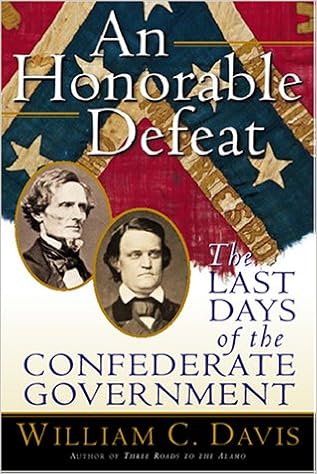
“I don’t think the CSA would have won independence had Breckinridge bene president. No one was going to make that happen given the determination of Lincoln and his people.” – Author William C. Davis talks about ‘An Honorable Defeat: The Last Days of the Confederate Government’

“I do suspect that by the time of the flight from Richmond, Davis had become intermittently delusional, as he could not see, what all around him saw.”

WHAT: “A dramatic retelling of four months in 1865…; A true story full of political treachery and physical adventure; Author is arguably the foremost authority on the American Civil War; In February, 1865, the end was clearly in sight for the Confederacy. Lee was defeated at Gettysburg, Grant’s victory at Memphis had cut the South in two, and Sherman’s brutal march through Georgia had destroyed what was left of the Southern economy. With the land shattered, people starving, and no hope left, the reality for the secessionist government was grim. An Honorable Defeat is the story of four months in 1865, during which the South surrendered, the North triumphed, and President Lincoln was assassinated, told with style and with absolute historical accuracy.”

WHO: “William Charles “Jack” Davis (born 1946) is an American historian who was a professor of history at Virginia Tech and the former director of programs at that school’s Virginia Center for Civil War Studies. Specializing in the American Civil War, Davis has written more than 40 books on the American Civil War and other aspects of early southern U.S. history such as the Texas Revolution.[1] He is the only three-time winner of the Jefferson Davis Prize for Confederate history and was awarded the Jules and Frances Landry Award for Southern history.”

MORE? Here!


Why ‘An Honorable Defeat’?

I have always found the story of the last days of the CSA government and the flight of Davis and the cabinet to be fascinating. Inevitable, tragic, at times comic, and at others suspenseful.

Did the CSA ever have a viable path to victory via an exclusively military route?

In a word, No. That is to say, I see no way the CSA was going to win independence on the battlefield so long as Lincoln and the people of the Union were willing to keep fighting, which they showed they were from the outset. Only massive foreign intervention might have turned the tables, and no European power regarded having an independent CSA as worth the potential cost of being at war with the Union’s huge army and modern navy.

Was Jefferson Davis too quick on the draw in 1861? Should he (could he) have exhausted
any of the other options – such as attempting to establish the legal right of states to exit the Union in the courts – before firing on Fort Sumter?

I think so. In fact, in February-March 19861, I think the CSA’s best chance was in the Supreme Court, which had a pro-Southern majority on the bench. Instead of seizing arsenals and other clearly warlike acts, they could have filed suits through the federal district court in Richmond or elsewhere, which they surely would have won, and then Washington would have appealed it to the supreme court. Of course, like Andrew Jackson before him, Lincoln could simply have ignored a court ruling.

Could Davis have made a worse job of leading his government into exile? Does this chapter typify his wartime presidency, or did everything in his public life become him EXCEPT the leaving of it? Were you ever tempted into thinking he was trying to be captured and put on trial?

I do suspect that by the time of the flight from Richmond, Davis had become intermittently delusional, as he could not see, what all around him saw. He was simply too invested in the CSA mentally and emotionally to admit it was dead. Consequently, I think it possible that he even hoped to be killed during the flight rather than outlive it. Failing that, he very definitely wanted a trial so he could make the case that secession was lawful, and there he and the seceding states were not traitors. Fear of such a court ruling was a bit part of why Washington chose not to prosecute him.

Who was John C. Breckinridge? You seem to suggest that had he been at the helm the CSA
might have stood a better chance of winning its independence. Why’s that?

I don’t think the CSA would have won independence had Breckinridge bene president. No one was going to make that happen given the determination of Lincoln and his people. However, I think it probable that had he been president in 1865, he would have negotiated a peaceful surrender and gotten some concessions in return that might have made the transition to reconstruction easier on the South.

“He had so large a hand in making Southern character, as it existed before the war, that he is in great measure responsible for the war.” Was Mark Twain right about Walter Scott?

Twain, as often, was being glib and hyperbolic.

In Europe we live our daily lives amid the physical reminders of our past political follies and once trendy cultural foibles. Do you think Americans could ever learn to live with their past rather than in it?

Perhaps not. We—or our leaders—are too fond of making political and social capital out of misstating the past to further contemporary aims.

If you could personally possess one physical item described in your narrative, what would it
be and why?

I’d like to have the pocket compass Breckinridge carried. I believe it is at the American Civil War Museum in Richmond, though not on exhibit.

If you could interview just one character from your drama (without changing the course of
history), who would they be, what would you ask them, and what would you tell them?

Breckinridge of course. I have studied him for more than fifty years, and still find him interesting. I would ask him his innermost feelings about slavery and secession. He was opposed to both personally, but regarded them as lawful and therefore beyond interference. I wonder if he let ambition cloud his judgment when he went over to the CSA.

What are you currently working on?

No books. I am restoring a 1928 Pierce-Arrow convertible coupe to running order. Don’t really know what I’m doing, but I am enjoying it!

LIKE WHAT YOU JUST READ? FOLLOW US ON TWITTER! OR SIGN UP TO OUR MAILING LIST!

+3 Interview: Flanker Origami

“This first hybrid edition of the Fringe festival is juggling with lot of challenges and opportunities, and it is great that it opened to online performances as there is so much experimentation going on.”

WHO: Bianca Mastrominico: Performer, co-creator

WHAT: “An artistic couple expose their daily rituals and lockdown coping routines, digitally unleashing two eccentric performance personas bent on transforming their Edinburgh home into a glittery alternative reality. Through dressing up, dancing, disembodied animations, forced karaoke and improbable ASMR storytelling, they are on a quest to enhance their own wellbeing and yours! Stranded on Zoom, their relationship reveals a tender and funny, if slightly disturbing, world of online intimacy on the edge of misunderstanding and manipulation. Award-winning Organic Theatre returns to the Fringe for a digital world premiere.”

WHERE: Fringe Online – Zoom (Venue 362) 

WHEN: VARIES (60 min)

MORE: Click Here!


Is this your first time to Edinburgh?

We have presented work at the EdFringe before and we are an Edinburgh-based company so even when we haven’t performed we have been lucky to have it on our doorstep – it’s addictive!

This first hybrid edition of the Fringe festival is juggling with lot of challenges and opportunities, and it is great that it opened to online performances as there is so much experimentation going on. This is very exciting and enriching, and also fair for artists who cannot afford to travel right now. It feels like the Fringe is returning to its origins, with theatre-makers taking the lead over the needs of venue programming, and we are thrilled to be part of this new iteration. Besides, we’re working from home so it’s cost-effective…

What are the big things you’ve learned since 2019 and have you absorbed any of the lessons yet?

Like many other theatre makers, we found ourselves confronting the need to be creative, learning new ways of working and making the most of the constraints of being ‘at home’. With Flanker Origami we are affirming the power of creative action over habits forced upon us by the health crisis and our home has now been transformed into a (rather messy) digital stage… We couldn’t have imagined an emergency that would have forced us to reconsider how we make, perform and meet our audiences, as well as how we live our lives, and Flanker Origami is our joyous, slightly dark but liberating response to the time that was lost to fear and shock.

Tell us about your show.

Flanker Origami is a ‘home-specific’ performance, so John Dean and I are inviting our audiences to gaze, imagine, and be voyeurs of our personal spaces in our real house. There isn’t a narrative, but a roller-coaster of dynamics between our two eccentric alter egos Flanker and Origami, out of which emerges a darkly comedic and – at times – grotesque journey into the collective psychological drama of the lockdowns. Flanker (and) Origami are seen stranded on Zoom in their own house, with no other escape than playing out preposterous online wellbeing routines, under the illusion of healing themselves and others.

The performance is a world premiere produced by Organic Theatre, it has been devised for digital audiences on Zoom and will be live-streamed daily during the last week of the festival. The process started with adapting our studio work during the pandemic and once we understood that this year’s Fringe was including a digital programme, we decided it was a good fit.

We’re not alone in the show, as we have animated replicas of ourselves in 2d rotoscope animations by artist and animator Cristiana Messina, and a fantastic technical collaborator Chiara Menozzi. It’s a weird experience that we live in the same city and we only ever see each other online…

Organic Theatre started in 2002 as an intercultural performance lab, devising and touring performances and workshops in the UK and internationally – we have performed in theatres, art galleries, museums, streets, barns, village halls and festivals. Our processes are collaborative, interdisciplinary and based on extended periods of research and development. In Flanker Origami we dance, our performances are physical, but there is also a strong emphasis on using text which is improvised and becomes scripted as part of our final performance. We like to create on our feet, through improvisation and repetition of the bits that made sense to us, so the resulting work feels somehow in-between art and life.

What should your audience see at the festivals after they’ve seen your show?

Supporting online work is crucial as many artists are experimenting with the digital medium and what came out of necessity has become a new way of engaging with audiences, producers and press, possibly beyond the Fringe. We particularly recommend the curated programme at Summerhall, which gives a lot of food for thought in terms of creative hybrid exploration. Both these shows play imaginatively and topically with online forms:

> >  iMelania – Summerhall online – Gather.Town
> >  Knot: The Trilogy, Summerhall online – Darkfield App


LIKE WHAT YOU JUST READ? FOLLOW US ON TWITTER! FIND US ON FACEBOOK! OR SIGN UP TO OUR MAILING LIST!

INTERESTED IN BEING INTERVIEWED TOO? CLICK HERE!