Splash Test Dummies (Underbelly Circus Hub on the Meadows : Aug 3-11, 13-18, 20-24: 13:00 : 1hr)

“You won’t see a funnier, more joyous, more riotous, or more uplifting show this Fringe.”

Editorial Rating: 5 Stars: Outstanding

Reams of mum-blogs (dad-blogs too, but the mums are winning in terms of overwhelming numbers) will give chapter and verse on how parenthood changes you. Parenthood has certainly changed how I approach the Fringe. In the old days, I actively looked forward to the 5am finishes in clubs. Now I mostly worry whether or not the fireworks will wake the kids.

It also changes how you consume the Fringe. Gone, largely, are the late night comics. The earnest, right-on types making other earnest, right-on types laugh are a thing of the past (no great shame). The late night smut merchants are done too. I don’t care what anyone says: if you don’t laugh at rude songs you are doing life wrong.

But whilst some of the Festival no longer is for you, a whole new side opens up. So I took my nephew (9) and my eldest daughter (5) along to the Splash Test Dummies. I will confess that we did so because my daughter liked their poster.

What a choice. I may start getting her to pick my shows purely on this basis. Splash Test Dummies was quite brilliant. It was everything a good Festival show should be. It had a bit of everything: acrobatics, unicycles, Cirque du Soleil-style gymnastics, running gags, good ol’ fashioned clowning, magic, puppetry, and slapstick galore. I laughed until I was hoarse. My nephew at numerous points said he was ”dying with laughter”. I may as well have not bothered getting my daughter a seat as she spent much of it standing in front of it clapping or laughing with glee.

The actors don’t so much breach the fourth wall but obliterate it. At one point, in a hilarious moment based around the Baywatch theme song, one of the three actors climbed through the crowd, stood on my daughter’s chair and bounced up and down. Later a man nearby had a (very sweaty) Dummy on his lap being hugged.

The ‘Rubber Duckie’ song was glorious as was the sketch with ping pong balls. A relatively simple magic trick taken to a whole new level. It may have been puerile but that’s the whole dang point. I laughed like a drain, as did my young duo.

There are water pistols, noodles, skeleton fights, skipping on unicycles and bubbles pumping out over you. The Dummies fire ping pong balls at you. It is an assault on your senses from before you even enter the tent.

All of this sounds easy but being this funny, this physical under lights for an hour is hard yakka in anyone’s money. More than that it isn’t easy. It is hard and the three Dummies clearly had bucketloads of talent and skill.

The three actors may look like they are clowning around but they do some seriously difficult stuff. Synchronised swimming on unicycles took the breath away as did some work with large metal rings. To make it all look so effortless is quite a skill. To do it and infuse it with comedy… well, it deserves the applause it got.

Apparently in reviews you should always give something critical lest readers think you are some professional fluffer or on the payroll. My one minor quibble – and this is true of almost every kid’s show – is that anything marketed for 5+ probably would be super if it were 45 minutes/50 minutes rather than an hour. I’m not sure what could be cut down or cut out but a few kids did start getting a little restless. Mine didn’t but I did notice a few around me beginning to turn. That though is universal and shouldn’t be held against the three magnificent Dummies: as I looked around at the end, the audience was grinning. The sort of grinning we don’t have enough of in life.

The Dummies have thought hard about how to entertain us and, importantly, our children. Even more than that, they delivered relentlessly. You won’t see a funnier, more joyous, more riotous, or more uplifting show this Fringe. My daughter spent the rest of the day pretending to be a Splash Test Dummy. If you’ve got kids, go. If you haven’t, borrow one from a friend. If you can’t do that, go along yourself. You’ll have a ball. I did as did my youngsters.

outstanding

StarStarStarStarStar

Reviewer: Rob Marrs (Seen 3 August)

ALL our +3 (festivals) coverage? Click here!


Ray Badran: Everybody loves Ray, Man (The Cellar, Pleasance : Aug 5-11, 13-25 : 21:45 : 1hr)

“His highest heights are high indeed.”

Editorial Rating:  4 Stars : Nae Bad 

I had spent the day watching the world’s superlative sporting battle. No, not Nathan’s Coney Island Hot Dog Eating Contest – compulsive though it is – but England versus Australia for the latest installment in the immortal tussle for the Ashes. Nails bitten to the quick, beers had been drunk, nerves were shredded. It would be fair to say that my disposition towards our friends from the Antipodes was not imbued with the spirit of friendship which usually binds the Commonwealth.

Of course that old tart, Fate, likes to throw down the odd googly every once in a while to keep us on our tippy toes. So when I booked a last minute show at the Pleasance, I was brought face to face with the old enemy. The thought, however, of Ray Badran secreting sandpaper about his person was unthinkable. Indeed, seeing as at various points he took all of his clothes off I was visibly reassured he was on the level.

But what of his show?

The show was intimate  – maybe 50 people watching – which is probably to Badran’s strength. His self-deprecating humour lends itself to a tight venue, as does his crowd interaction.

It was a curate’s egg of a show. His ‘emergency joke’ was not a show saver as he joked but a showstopper. If it wasn’t so outrageous it would be a contender for gag of the Fringe. I just can’t see the Metro publishing bestiality. More is the pity.

His highest heights are high indeed. A hilarious tale about pretending to be disabled to fool his brother with inevitable results; a good riff on why so few things are measured in inches (I’ll never look at a Subway sandwich the same way again); using a YouTube clip to try and get an NI card; and a misplaced Deliveroo order were all genuinely funny. If he could have kept up that quality throughout we’d have a serious star on our hands and, perhaps, one day we will.

Other moments, though, weren’t quite there. His group work wasn’t as good as it might be. I suspect that he would be much stronger on home turf where he has the cultural references, the jokes about the town are obvious, the links clearer. After all, Australians can struggle in an English summer – or at least, here’s hoping.

Ultimately there’s little point asking where someone in the front row is from if you can’t spin it into a few gags. Given the young lady he picked on was from Aberdeen it wasn’t as though he was short of potential material but the section petered out. There were other moments when a joke didn’t work and he ended up joking about the failure. This is a good save so far as it goes but something you can really only do once per show. More than that and it serves a reminder to the audience that there is trouble at mill. A few of the longer stories fell flat. It really was a bag of revels.

That said, he’s clearly dedicated to the craft and confident enough to tell you what he is doing, telling the audience the stagecraft, and still get the laughs. Whilst the show lacked  a theme, being more a series of riffs, Badran’s final gag brought the show together – and drew both laughter and astonished applause.

It takes a lot in an Ashes summer to get a full-blooded Englishman willing an Ozzie on.  But I did. I liked him enormously and I think the rest of the crowd agreed
In cricketing terms, an Usman Khawaja rather than a Steve Smith. Moments of genuine brilliance amid some baffling choices which make you shake your head. You want to see more of him, you know how good he can be, and you look past the faults simply because you remember the perfect moment earlier on. Certainly – I’m very thankful to say – not a David Warner.

nae bad_blue

Star (blue)Star (blue)Star (blue)Star (blue)

Reviewer: Rob Marrs  (Seen 3 August)

ALL our +3 (festivals) coverage? Click here!

 

Princess Party (Gilded Balloon, Aug 3-11, 13-18, 20-26 : 22:30 : 1hr)

“Required watching for anyone who wants to be in a comedy duo”

Editorial Rating: 4 Stars: Outstanding

It’s 4pm on a Saturday. The sun is beating down through the window and drowning my laptop screen, but it doesn’t matter. After a half hour, I’ve got nothing to show for all my squinting and sighing except for unanswered questions: how do you talk about the incredible comedic restraint in a show that starts out with everybody being flashed? What kind of production simultaneously respects and ridicules its audience? How do you even begin to describe Princess Party?

The synopsis is simple enough: it’s a duo comedy presented by comedians Lauren Howard Hayes and Hannah Pilkes, about a rich kid’s birthday party that goes horribly wrong. The audience are the children, and sometimes the parents. You get to hold a cool flashlight. Telling you any more than that would be revealing far too much, and give Hayes and Pilkes too little credit.

Princess Party is a lot of things. It’s the best party you’ve ever been to, wrapped in the worst party you’ve ever been to. It’s like going to Disneyland, if Disneyland let in people who’d been drunk for three days. But most importantly, Princess Party is a masterclass in how to properly implement artistic restraint and make hard comedy look easy.

From the outset, the basic mechanics of the piece are excellent. With an impressive pile of acting, writing and comedy credits between them, Hayes and Pilkes are very visibly comfortable in their craft. Punchlines are crisp and well execution; physical clowning elements have complete follow-through; and everything is presented with a confidence and polish that can only come from collaborators who know how to fit into their genre like water in a glass.

And make no mistake, Hannah Pilkes and Lauren Howard Hayes are the show. It’s hard to nail down exactly what each brings to the table, but only because they jump from role to defined role like it’s child’s play. Pilkes plays the perfect dope, but her sense of comedic timing and verbal dynamics would make a razor weep. Hayes, who so effortlessly channels a living cartoon from the moment she’s on stage, can go acid queen in a single wig change. But what’s so truly excellent about this show, oddly enough, is invisible. To define it, we’ve gotta talk about nudity.

I have a lot of thoughts on comedic nudity. It’s not hard to pull off (you’re welcome), but damn hard to actually do well. Audiences have a level of shock fatigue, and if it’s not incorporated enough or relied on too heavily, it can come off as crass and lazy. Even worse, it can pull an audience out of the flow entirely. But in Princess Party, it’s funny as hell – It’s not played for too long, or too hard, and is so at home in its setting that you can only think “well of course this is happening”. Beyond the visible, it’s an incredibly impressive display of artists who know the relationship between shock and restraint.

So why is that important? Because it applies to every other joke and theme in the show. Controversial jokes and setups only stick around insofar as they’re funny, and never push themselves into bad taste. Do they toe the line? Pilkes and Hayes have basically built a big mansion on the line. But God knows they never cross it. It’s a testament to how tight and well crafted their material is, and a joy to watch.

The same goes for the multimedia portions of the performance. Despite a few visible command boxes, it’s seamless and ultimately serves its purpose without ever sticking out or dragging. As a cover for costume changes, its brevity only becomes more impressive.

Does everything in the show work? No. Because of the creative talent on display in other portions of the performance, certain skits (particularly the balloon artist sketch) seemed sluggish by comparison. Although these pockets of slowdown seldom lasted long, and were usually ended with some crackling improv, they were nevertheless noticeable in amongst the otherwise flawless wallpaper.

Princess Party is, if nothing else, a wonderfully crafted piece of entertainment. When I one day ascend to power and rule with neither pity nor mercy, it will be required watching for anyone who wants to be in a comedy duo, and/or anyone who thinks lavish parties for children are a good idea. Hannah Pilkes and Lauren Howard Hayes are damn funny people, and this show is a love letter to the hard work it takes to make that talent into something worthwhile. If you’re in need of laughter, this is the next best thing to nitrous oxide.

outstanding

StarStarStarStar

Reviewer: Jacob Close (Seen 2 August)

Visit the  Potterrow & Teviot archive.


+3 Interview: The Empathy Experiment

“The subject matter resonates strongly with people, and has sparked some animated and urgent discussion about how we use our phones and how we connect with each other.”

WHO: Rose Condo: Writer / Performer

WHAT: “Is empathy facing extinction? Are smartphones to blame? Multiple slam-winning Canadian poet Rose Condo returns with her latest spoken word show. Embarking on a day of no mobile phones, Rose delves into tech addiction and compassion using herself as the test subject… think Dr Jekyll meets Dr Seuss. Join Rose in the final hour of her experiment as she madly tries to capture data, record findings, navigate withdrawal and prove her theory that empathy can be saved. Runner-up for Best UK Spoken Word Show at Saboteur Awards 2017. ‘Emotionally charged performance’ (BroadwayBaby.com). **** (Winnipeg Free Press).”

WHERE: PBH’s Free Fringe @ Banshee Labyrinth – Banquet Hall (Venue 156) 

WHEN: 11:40 (60 min)

MORE: Click Here!


Is this your first time to Edinburgh?

I spent two glorious years (2003-2005) living in Edinburgh, and loved it. My first time at the Edinburgh Fringe was in 2004, working for the University of Edinburgh Fringe Office. The following summer I worked for the main Festival Fringe Box Office on the Royal Mile. They were both bonkers but beautiful experiences. I saw some brilliant work and made amazing friends. But I also remember thinking that actually getting to perform in the festival was some crazy pipe dream.

Now, fifteen (15!?) years later, I have acted in two productions (DESERT BLOOM and NOISELESS & PATIENT) and performed two spoken word shows (THE GEOGRAPHY OF ME and HOW TO STARVE AN ARTIST). This year I am bringing my third solo spoken word show to the Edinburgh Fringe. I am over the moon excited to be performing THE EMPATHY EXPERIMENT at the Banshee Labyrinth venue all month. I’ve seen some awesome spoken word there in past.

Big shout out to the PBH Free Fringe team, who work super duper hard to make performing in the Edinburgh Fringe financially available to artists.

What’s the biggest thing to have happened to you since Festivals ’18?

Big huge news for me was getting an Arts Council England grant to develop THE EMPATHY EXPERIMENT. It took me three times applying to be successful. The grant meant I had the resources to collaborate with some truly fabulous artists, such as Dominic Berry (who is doing two brilliant shows in Edinburgh this year), Kristen Luckins (who is the Apples & Snakes North Producer), Charles Leek (who did my very cool photos, video and promo artwork) and Kate Morton (whose keen theatre design eye helped me create a minimalist set that I can cart around in a flight case on wheels). I also worked with a composer for the first time. Eleonora Rosca created and recorded the cello and piano music that plays during the show. Her composing came from improvising alongside my poetry, which was a really cool creative experience.

Tell us about your show.

THE EMPATHY EXPERIMENT explores whether addictions to mobile devices are having an impact on how we feel and demonstrate empathy. I weave spoken word poetry through this hour-long show. The premise is that I’ve given up all my devices for 24 hours to see if I can measure increases in my empathy, and the show is the ‘final hour’ of the experiment where I frantically try to prove to the audience that my theory has worked.

I developed the show earlier this year, with R&D support at Harrogate Theatre, the Lawrence Batley Theatre (LBT), Square Chapel Arts Centre, and the Brewery Arts Centre. I had a sold-out premiere at the LBT in March and have performed it in Kendal, Harrogate and the Cotswolds. Feedback has been incredibly positive. The subject matter resonates strongly with people, and has sparked some animated and urgent discussion about how we use our phones and how we connect with each other. I’ll be performing the show at the Greater Manchester Fringe in July, before heading up to Scotland.

A new experience in this process was having live captioning at one of my performances. I connected with a woman called Margaret Hansard who provided captions for the show at Harrogate Theatre. I was featured in Limping Chicken (the world’s most popular deaf blog) about the reasons behind my decision to do this. As a result of the blog, I was contacted by Claire Hill and will have a captioned performance of THE EMPATHY EXPERIENT in Edinburgh on Tuesday 13 August. Claire is a seasoned captioner, and this will be her first time captioning a PBH Free Fringe show … we are so excited to make it happen!

What should your audience see at the festivals after they’ve seen your show?

Dominic Berry (who helped develop my show) is performing When Trolls Try to Eat Your Goldfish (fab kids show), as well as his wonderfully energetic show, I Can Make You Fail Slightly Less. Bróccán Tyzack-Carlin’s show Don’t Bother is superb (it won Best Spoken Word Show at the 2019 Saboteur Awards). I’ve been following Leanne Moden’s development of Skip Skip Skip on Instagram and am really excited to see it. Ros Ballinger’s Better Than Dying Alone was aces at last year’s Camden Fringe. Poet Henry Raby’s Apps & Austerity promises to be powerful, and Sez Thomasin’s Equality and Perversity will pull no poetic punches. Also excited for Mark Grist’s Mark Can’t Rap and Pete the Temp’s Homer to Hip Hop … SO MUCH TO SEE!!!

Plus, I’ve been invited to be a guest performer at some fabulous shows: That’s What She Said, Loud Poets: Best of Fringe, and She Grrrowls. All three shows feature different (and amazing!) artists each night, so are definitely worth checking out!


LIKE WHAT YOU JUST READ? FOLLOW US ON TWITTER! FIND US ON FACEBOOK! OR SIGN UP TO OUR MAILING LIST!

INTERESTED IN BEING INTERVIEWED TOO? CLICK HERE!

+3 Interview: Gabe Mollica: The Whole Thing

“The show went from being a distant idea to a thing I was performing and working on all year.”

WHO: Gabe Mollica, Comedian/Writer/Performer

WHAT: “Gabe Mollica started doing stand-up in Edinburgh after he got dumped for his best friend. Five years later, this New York comedian returns with a debut show about embarrassment, what it means ‘to comedy’ and rice cakes. Gabe’s stories have appeared on the Moth Radio Hour Podcast (NPR), he’s written jokes for the New York Video Game Awards and Hard Drive (TheHardTimes.net). He runs a popular show in New York City called The Funniest People I Met This Month. He does not have a podcast.”

WHERE: Just the Tonic at The Mash House – Just the Snifter Room (Venue 288) 

WHEN: 23:150 (60 min)

MORE: Click Here!


Is this your first time to Edinburgh?

This is my first fringe show, but I lived in Edinburgh in 2014 after graduating uni in the states. I had a rough year, you could say. My best friend and my ex-girlfriend got together and my life sort of spiraled… so just like everybody else I became a comedian.

Now, five years later, I’m very excited to return to Edinburgh and reclaim the city where I felt at my worst!

It’s been basically my only goal in comedy to create a show for Edinburgh and let’s just say I’m very excited to share.

What’s the biggest thing to have happened to you since Festivals ’18?

The show went from being a distant idea to a thing I was performing and working on all year.

Since 2014, I knew I wanted to have a show that was essentially a long story but to go about actually putting together has been challenging and rewarding. (I had my first panic attack, did my first preview to a sold-out room of 70, and stayed up all night writing down very silly ideas that went nowhere.)

Tell us about your show.

Like all the stand-ups at the Fringe, I wrote the show myself, with of course help along the way from my friends and fellow comics. I’d love to keep going with this story, perform it a bunch when I return to America, and one day maybe record it as a special or an album or something like that.

What should your audience see at the festivals after they’ve seen your show?

There are so many talented American comedians coming over. I’m most familiar with them, so I’ll say Kevin James Doyle has been a hilarious and helpful person while working on my Edinburgh Show. Check out his show “Loud, Blonde, Bald Kid.” Kevin has a way about talking about puberty and childhood that will make you laugh and blush and feel grateful to be an adult.

Emmy Blotnik is one of my favorite jokewriters in new york. She’s smart and silly. Cat Cohen makes me laugh in a way I didn’t think was possible. She feels like the future of comedy in a lot of ways. Dan Soder is an incredible comic, perhaps one of the best in America. He’s done my show in New York and I’ve continually been blown away by his material. Caitlin Cooke is an extremely talented comedian, musician and podcaster. I can’t recommend her show enough: It’s funny and sweet. (She’s also like, the nicest person. Sean Patton is one of the great American comics, his material is unique and interesting. I can’t wait to see his show a few times.

There’s also some great folks in the UK I’m excited to see like Christopher KC and Stephen Carlin. I met both of them while doing comedy in the UK in 2014 and they were both super nice, smart, and funny. It will be so exciting to see their shows and how much they’ve changed in 5 years

Anyone trying to get the most out of their Edinburgh experience should start with those comedians!!


LIKE WHAT YOU JUST READ? FOLLOW US ON TWITTER! FIND US ON FACEBOOK! OR SIGN UP TO OUR MAILING LIST!

INTERESTED IN BEING INTERVIEWED TOO? CLICK HERE!

EIFF: “Unstoppable”

“Excellent performances.”

Editorial Rating: 2 Stars

Don Lee is a big man. With very big fists. It would be easy for a man like Don Lee to have scripts written entirely around how hard his fists can punch his opponents, and leave it at that, ‘acting’ be damned. But to his immense credit, Lee (sometimes known as Dong-seok Ma, but more often as Don Lee as his profile rises with Western audiences) is also a magnetic and gifted screen performer. With his recent lauded performances in films like Train To Busan and The Gangster, The Cop, The Devil, Lee is sure to soon enter the pantheon of massive, big-fisted men who can not only wow a crowd with their figure, but actually act to boot. In Kim Min-Ho’s Unstoppable, Lee is certainly strong, both as man and performer; if only the rest of the film was not so weakly executed in comparison. 

This film, written and directed by Min-Ho, has leaned into a reputation as ‘the Korean Taken.’ Sure enough, mild-mannered Dong-Chui (Lee) becomes the wrong man to have messed with when sadistic gangsters led by the colorfully deranged Ki-Tae (Seong-oh Kim) kidnap his wife for purely diabolical reasons. The film takes its time setting up the confrontation, however, including a lengthy McGuffin surrounding the importation of king crab, a product that may or may not spell riches for Dong-Chui’s starved financial situation as a fishmonger. But his earnest attempts to provide for his wife Ji-Soo (Ji-Hyo Song) quickly become irrelevant as Ki-Tae arbitrarily decides to abduct Ji-Soo because he finds her pretty, and add her to his harrowing harem of captive women. Cue the righteous punch-crusade.

The film becomes considerably boring for a stretch, even after Ji-Soo is kidnapped, because like other refrigerator-sized heroes in film history, this Herculean powerhouse has been earnestly trying to ditch his violent capabilities, and resolve his matters without resorting to fistfights. This is clearly a deliberate plot move to get the audience’s mouths watering for Dong-Chui to drop the niceties and get on with the annihilating combat — and rest assured, he does. Perhaps the highlight of the film for me came when a nasty, small-time crook who owes Dong-Chui money, but has been callously taking advantage of his mild manner and ignoring him, refuses to repay Dong-Chui once and for all. Ignoring his pleas and explanation that he needs the money to try and find his wife, the crook orders his languid goons to make Dong-Chui leave his sweaty little office. In a scene cleverly constructed to build suspense, the goons move towards Dong-Chui, insisting he leave, poking and prodding him. After a few too many pushes, Lee turns his massive head towards the offending goon, with his signature you-asked-for-it stare, and with a flick of his wrist, bats him into a metal door, which immediately crunches and buckles from the power of the punch. The camera even lingers on the goon’s crumpled body and the obliterated door, reflecting the aghast faces of the other henchmen who just realized what they’re up against. Yes, Don Lee is kicking ass again. 

The rest of the film really just follows that last sentence to a T. A few of Dong-Chui’s friends and associates assist his quest to find and free his wife along the way, to reasonably amusing comic effect, but the bulk of the action really belongs to Lee and his fists, which becomes rather repetitive. That being said, the eye-popping extravagance and mania of Ki-Tae is played with clear relish in a standout performance by Kim, and comes close to rivaling Lee’s unforgettable screen presence from time to time. Min-Ho commendably executes one of the cardinal rules of action filmmaking: a good hero must have a good villain. Ki-Tae does not disappoint, though his revolting villainy may make some blanche, and one might claim he borrows one too many traits from a maniacal sadist number one, The Joker. 

Lee and Kim’s excellent performances aside, the rest of this is quite conspicuously lacking much soul or weight. The dialogue is trite, and the camerawork has no real personality or discernible style. The plot itself takes one too many cues from Taken, a film I personally found very disappointing, in that it is paper-thin and charmlessly crass. Even when the film lets Ji-Soo  have some kickass moments, these come off conspicuously as attempts to give the woman some agency, but without letting her actually achieve anything. It rings quite hollow when she seems determined to be her own character, yet the script never follows through.

Don Lee is a star, and he deserves to be — he certainly has more charm in Unstoppable than Neeson ever did in all three Taken‘s — but Min-Ho’s film does not harness any of his talent in particularly memorable ways. Apart from that obliterated door. That will stay with me. 


Star (blue)Star (blue)

Reviewer: Nathaniel Brimmer-Beller


The Duchess (of Malfi) (Lyceum: 17 May -18 June ’19)

Adam Best as Bosola & Kirsty Stuart as the Duchess.
Photo: Mihaela Bodlovic

“A swingeing attack against inequality and injustice … with gouts of blood”

Editorial Rating:  4 Stars: Outstanding

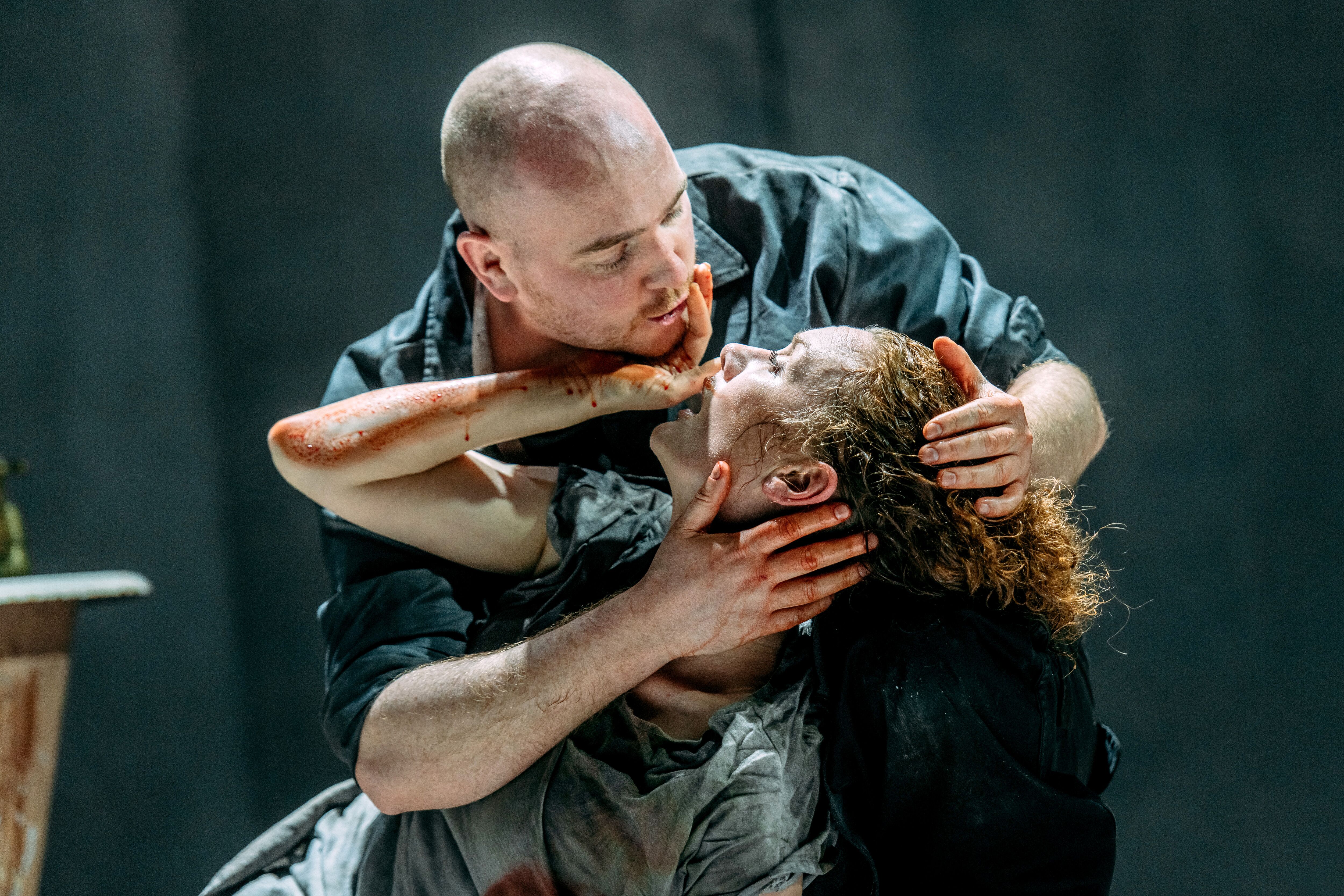
Observe the bold italics: ‘The Duchess (of Malfi)’ after John Webster. Zinnie Harris’s compelling adaptation of the Jacobean tragedy has all its drive and grip, most of its heritage schlock, and some – but not much – of its superb, excoriating language. Never mind, Harris’s script is smart and disturbing in its own cause. Webster may turn in his grave but it would be a satisfied, pleasurable shift rather than a squirm of revulsion.  The great roles are there, just beneath the modern skin: the blameless Duchess; the depraved Cardinal; Bosola, the loyal creature  – all in the service of raging truths.


Yes, twin babies are gently rocked in their parents’ arms but the lullaby is ‘a slightly fucked-up version’ and love is defenceless. Back in Webster’s script of 1614 Bosola tells the Cardinal that

‘When thou kill’d’st thy sister,
Thou took’st from Justice her most equal balance,
And left her naught but her sword’.

Harris’ plot and Harris’ direction do the same, losing moderation, going on a swingeing attack against inequality and injustice. The bad comes first and it’s really bad. The Duchess, Giovanna, remarrries. Her two brothers, the Cardinal – utterly depraved – and Ferdinand – psychopath – find out and destroy her as ‘soiled goods’. Antonio, her husband, would avenge her but merciless killing is not for him. That’s more in Bosola’s line. However, watch the brooding Bosola, listen to him, for it’s a rewarding exercise and when the good comes out he’s your man. It is an extraordinary ‘turn’, beyond even Webster’s philosophical villain, and very well done by Adam Best.


If Bosola surprises, the Duchess inspires. She opens the play alone, centre stage, in front of a microphone and her audience. Her own story closes in around an excellent performance by Kirsty Stuart. Amused but all too aware of her brothers’ appalling misogyny, she is mischievous and loving with Antonio, craving and then burping  apricots during her pregnancy, and heroic – immortal – at her end. The two other female parts, Cariola (Fletcher Mathers), Julia (Leah Walker) suffer, fall – and rise – with her.


George Costigan as the Cardinal & Angus Miller as Ferdinand


The ghastly Cardinal is played by George Costigan, whose command of his lines is probably only matched by the respect he has for them. It would be a virtuoso performance except that to assign ‘virtue’ of any description to this demon would be too much. At least Angus Miller as the sick and puerile Ferdinand has howling lunacy on his side.


While she lives the Duchess has precious little freedom. If her brothers cannot control her, they can certainly contain her. Tom Piper’s set is a high undressed space, bleached stone white, with a gangway across its width. Sliding grillwork enforces the impression of prison and the basement bathroom provides a convenient torture chamber where standing mikes are used to address the prisoner. High voltage jolts frazzle the nerves throughout. Two songs offset the fear but still seemed out of place; worse, for me, was some foot stomping and an immediate association with the comic gospel strains of  ‘O Brother, Where Art Thou?’, which was unfortunate.


There are inevitable moments of jarring tone and effect, when modern idiom and thought collide with the Jacobean. “I’d kill the bastard who did this to you, the fiends” could be left unsaid but I’m all for the gouts of blood, the powerful re-writing, and the electric challenge of the closing caption.


outstanding

StarStarStarStar

Reviewer: Alan Brown (Seen 21 May)

Go to The Duchess (of Malfi) at the Lyceum

Read Edinburgh49 at The Lyceum archive.

Interview: Shine (Traverse 16 – 18 May ’19)

“The show has been like therapy to me…”

WHAT: “Kema’s 3 years old when his family move from Zambia to Newcastle.

It’s a story of new surroundings, about making a new life and then watching that life fall apart. A story about self-belief, trusting your head, your heart and always chasing your dreams.

Actor, rapper, singer, rising star and Live Theatre Associate Artist Kema Sikazwe (I, Daniel Blake), also known as Kema Kay, makes his powerful stage debut mixing a bittersweet coming-of-age story with an electrifying live soundtrack and heartfelt words.”

WHO: Kema Sikazwe, writer & performer

MORE? Here!


Why ‘Shine’?

The title of the show, Shine, is named after my name which means ‘one who shines’ in one of the Zambian languages. I hope people join me on this journey of finding out who we are, accepting who we are, and come away inspired to go find their shine! It’s never too late.

This is your life story. How have the people in your life and audiences reacted to its telling?

There are definitely find some parts in the show they can relate but you can never really judge how an audience will respond. There are a lot of questions that are left unanswered and I know people will want to know. The show has been like therapy to me and I just want the audience to keep fighting the good fight of life and find their shine!

What’s the one thing about Zambia that everyone should know?

It’s a beautiful country!

The Newcastle and Gateshead skylines are famous for their bridges. Which is your favourite?

The Millennium Bridge. I love when it lights up!

What’s the one thing you wish you’d known at the start of rehearsals?

I underestimated how emotional it would be. It’s been a real mixture of emotions. In rehearsals, I broke down a few times as I realised how much bottled emotion I’ve had in over the years. Also, I wrongly judged theatre in the beginning, but once I got a taste of it, I was hooked from then onwards. I’ve been a sponge since starting but I’ve learnt so much in a short space of time.

LIKE WHAT YOU JUST READ? FOLLOW US ON TWITTER! FIND US ON FACEBOOK! OR SIGN UP TO OUR MAILING LIST!

Interview: The Lark (Bellfield, Portobello 4 – 8 June ’19)

“Latterly, I’ve become interested in the story of the woman who takes on the establishment and for a little while, is hailed as a hero. Until it no longer suits them and they decide to get rid of her.”

WHAT: “Joan of Arc. Saint, saviour or someone who heard voices?

Against the backdrop of one of the world’s longest wars, a 17-year-old peasant girl led an army of men into battle and carved a victory that defined France. She claimed God told her to do it; the church says she’s a witch and should be burnt alive.

Jean Anouilh’s classic play tells the tale of how Joan convinced the church, the state – and her dad – to let her tackle an apparently impossible feat. And then plays witness at her trial: a nineteen-year-old uneducated woman held to account for her successes by the world’s most educated men.”

WHO: Claire Wood, Director

MORE? Here!


Why ‘The Lark’?

I’ve always loved the story of Joan of Arc. I was brought up Catholic so feel as if I’ve always known the story. I didn’t realise how much of a cult comes with her story. Look up Joan of Arc tattoos on Pinterest – it’s incredible. I discovered the plays as an adult. At first I was interested in the story of a young peasant woman who claimed God was talking to her – much to the outrage of all the educated men in the church who assumed that only they had a direct line to the Lord’s intentions. Latterly, I’ve become interested in the story of the woman who takes on the establishment and for a little while, is hailed as a hero. Until it no longer suits them and they decide to get rid of her.

One of the characters in the play, Bishop Cauchon, who has his own darkly sinister agenda, says “when a man can keep his dignity and purpose in that loneliness, in that silence of a vanished God, that is when he is truly great.” Joan’s story is relevant to activists and political prisoners, religious or not, across the world.

The real Joan lived 600 years ago but looking at people like Greta Thunberg, Malala Yousafzai, the story also feels incredibly current. They’re both about the same age as Joan was, both doing incredible things in their field. This is a slice of history that has all sorts of messages about the courage and determination needed to hold your ground in the face of fierce opposition.

Do you see Joan as a revolutionary prime mover, fighting for the timeless cause; or was she simply a pawn on the familiar medieval chessboard promoting the self-interest of the real players?

She was both. Isn’t Greta Thunberg? Joan was fighting to get France out of the control of the English. Getting the rightful king crowned was a significant step towards that. At the same time – to my modern day mind! – she was fighting for the right, as a woman, to do the things she wanted to do. To wear what she wanted to – which wasn’t a skirt. To be listened to. To be taken seriously. To make a difference. Rather than festering away in skirts in her sleepy little French village.

Anouilh (and translator Gill Taylor ) do a brilliant job of condensing the history but if you look at what actually happened, it looks as if Joan’s confidence did finally outstrip her ambition. She started losing battles, her soldiers started abandoning her. She first attempted to march on Paris to drive the English out of France’s capital city – without the king’s permission. And then it all started going wrong. The history doesn’t all fit in the play necessarily – or we’d be there for hours!

But back to your question, at the same time as she was trying to achieve all these things, the establishment were busy there using her for their own ends. And this comes through really neatly in the script. The king’s mother-in-law, Yolande, trying to persuade the king to see Joan as she might help give him some much-needed celebrity sparkle. The Church’s various representatives greeting her with suspicion and then conspiring to squash her when their godly status has been affirmed. The army taking pains to point out that she’s nothing but a puppet soldier – albeit a puppet who achieved more than they had in fifty years of fighting. Few of the characters in Anouilh’s play have any interest in her as a person and are interested only in what Joan can achieve for them.

What makes Gill Taylor’s new translation of the original special?

It’s easy to tell this story in a way that’s very black and white. She was certainly hearing god talking to her. The church thought she was lying and burnt her. It’s my bugbear with the Shaw version of the story. I love Anouilh’s script for acknowledging the convenience of this girl turning up at a time when the country was in a political mess and had lost its sense of self. Joan gave them an opportunity to rediscover that. Where Christopher Fry’s translation from the 1950’s feels very much like a script from the fifties, Gill Taylor’s script does a brilliant job of highlighting how current the story is. Joan’s dad swaggers about cursing his daughter for the shame she’ll bring on the family with her claims of hearing voices – then calls her a slut for sneaking about in the fields meeting someone he’s certain is an illicit boyfriend rather than the holy St Michael. Gill’s use of the sort of language we use now to diminish women – particularly topical now as gender equality is so high on the public agenda – make the story that happened six hundred years ago feel really current.

What will a band and choir add to the mix?

At one level, we’re performing the show in a church – so it seemed rude not to have a choir. The shape of what’s now the performing space was perfectly suited to locating the choir in the balcony above what used to be the altar, acting as real live angels on high!

Looking purely at the words in the script, and getting your head around all the protagonists in the story and their respective agendas, it’s easy to lose sight of contemporary resonances. The pop music we’ve woven into the story is there as a reminder that these are all issues we’re still tussling with today.

What’s the one thing you wish you’d known at the start of rehearsals?

What a big story this is! Unusually for that time in history, we’ve inherited an enormously thorough record of her story as the transcripts from her trial still survive. The trial lasted for over 80 days, Joan was on her feet for 12 hours a day being quizzed by a conveyor belt of clerics trying to catch her out, and throughout her interrogation, her story remained remarkably, impressively consistent. The one thing she refused to tell the court was what her angels looked like. She said that was between her and god.

I would love to have known at the start of rehearsals whether Joan was really hearing God talking to her. Really hearing some sort of voice in her head. Or capitalising on prophecies that had been doing the rounds for several centuries – which she would have heard from travellers visiting their house as she grew up – about a virgin girl who would come from the countryside to save France.

There’s a fabulous podcast by an Italian professor called Daniele Bolleli (‘History on Fire‘) that sees him reviewing all of the evidence and concluding that we can’t possibly tell whether she was mad, whether she’s was God’s spokesperson on earth or whether her talent was putting herself in the right place at the right time – and consequently, having a ball doing all the things that women weren’t allowed to do at the time. I’ve been boring the poor cast with the history – as most of the cast are based on known historical figures – since we started rehearsals.

So I wish I’d known the answer before we set off. But I suspect that the reason Joan’s story continues to fascinate us – is precisely because we don’t know that answer. And that’s what makes it such a brilliantly intriguing tale.

LIKE WHAT YOU JUST READ? FOLLOW US ON TWITTER! FIND US ON FACEBOOK! OR SIGN UP TO OUR MAILING LIST!

White (St Cecilia’s Hall: 23 – 25 Mar.’19)

Image may contain: 2 people, people standing

“An incredibly important production”

Editorial Rating: 3 Stars Outstanding

Ah, racial politics. Anxiety-studded star of a few hundred conversations in coffee shops and pubs. It’s not that the constant deluge of injustice and anger in the world is depressing, it’s that it’s utterly depressing. Talking about it at all, let alone making comedy out of it, is like trying to tapdance your way through a minefield. One false slip and you’re either offending, rehashing or – perhaps worst of all – inadvertently punching down. And even if the comedy’s coming from a true, honest voice, the risk of creating “zeitgeist-y” work with little staying power looms ever present. Needless to say, the prospect of reviewing James Ijames’ “White” filled me with tentative hope and cautious apprehension: what I got in return was a wonderfully slanted commentary on modern sociopolitics, and enough comedy to keep me from realizing I was learning until it was far too late to stop.

Based on a true series of events surrounding the 2014 Whitney Biennial Exhibition of Contemporary Art, White tells the story of white artist Gus (Levi Mattey), who hires African American actress Vanessa (Anna Phillips) to present his work as her own, thus defaming an exhibition he was unable to qualify for. From this fairly simple starting point comes a flurry of emotionally charged and often absurd vignettes, examining the morality of racial curation and the various chasms which still exist at the intersections of ethnicity, sexuality, gender and identity.

First and foremost is the skill and timeliness of Ijames’ writing. White, in many ways, is a clever sleight of hand: the charged subject of race never leaves the stage, and yet seems to disappear beneath illusory hand waves of wit and stinging turnaround. Before you know it, you’re considering your own place in the debate, unconsciously picking apart what is satire and what isn’t. It’s the kind of theatre that is sorely needed in a climate that often seems paralysed in the face of despair.

That illusory quality is helped vastly by the show’s comedic direction: energy is the word of the day, and Nathaniel Brimmer-Beller has packed it like gunpowder in an old rifle. Despite the open elliptical shape of  St Cecilia’s Hall, this production turned into bouts of verbal tennis, firing jokes so quickly across the room that distance seemed almost to help it. Of course, with a base of clear talent, it’s easily done: Mattey does an extremely laudable job at portraying a character who seems to flip between main antagonist and protagonist with every sentence, and yet still seem jaw-clenchingly consistent. In a similar vein, Phillips’ pulls triple-duty in a trio of roles (one a role within a role), rolling them out chameleon like: same silhouette, but vastly different vibes and patterns.

Supporting, we have Bradley Butler as Gus’ boyfriend Tanner, and Jess Butcher as museum curator Jane – though to relegate them to ensemble would do them injustice. The production would not be half as good without Butler’s caring, vibrant foil to Gus’ ironclad self-interest; and to say too much about Butcher’s portrayal of Jane would ruin some of the best scenes going – I can say only that themes of duality and hypocrisy are shiningly represented.

So, in such a shiny show, what didn’t go so smoothly? Unfortunately, a few stylistic kinks along the way are enough to turn what could be a smooth ride into something bumpier. Though the comedy seldom suffers from the almost breathless pace of the dialogue, there are times when certain lines, actions or even reactions could have done with more time to breathe. Especially in the third act, when things get heavier than ever, I found myself wanting to wait a little more in the questions before being whisked off to more one-liners.

And it’s that same breakneck paceyness which turns some of the show’s more surreal moments into missed opportunities. Without spoiling too much, part of the joy of this show is how left-field the ending is. But buoyed on its own wild momentum and without enough time to properly clock what was happening, genuinely interesting satire ended up feeling more muddled than biting. Without room for contrast, the energy seems to dip without ever getting lower, like getting used to the temperature of shower water.

And while scenes of sexual intimacy are intimate and very well done, the same cannot be said of the show’s flirtation with day-to-day romance. A very certain scene makes it abundantly clear that Mattey and Butler can play off each other wonderfully, but there seems to be an odd sterility to their interactions in the wider world of the play. The words are right but it lacks passion and force.

So what does this all add up to? And, maybe more importantly, how does this all play into a rating? Put shortly, this is an incredibly important production, marred by a few key flaws. Even if there are elements that could be improved on, White is a show that I wildly encourage everyone to see whilst it’s here – and to endeavour to seek out when it’s not.

The best theatre is the kind that leaves you fundamentally, and almost unwillingly, questioning yourself. By that metric, White certainly doesn’t disappoint.

outstanding

StarStarStar

Reviewer: Jacob Close (Seen 23 March)

Visit Edinburgh49 at Other venues.